The history of this kingdom, the smallest in the Heptarchy, is still more imperfect than that of Essex. Ælla, the founder of the monarchy, left the crown to his son Cissa, who is chiefly remarkable for his long reign of seventy-six years. During his time, the South Saxons fell almost into a total dependence on the kingdom of Wessex; and we scarcely know the names of the princes who were possessed of this titular sovereignty. Adelwalch, the last of them, was subdued in battle by Ceadwalla, king of Wessex, and was slain in the action; leaving two infant sons, who, falling into the hand of the conqueror, were murdered by him. The abbot of Bedford opposed the order for this execution; but could only prevail on Ceadwalla to suspend it till they should be baptized. Bercthun and Audhum, two noblemen of character, resisted some time the violence of the West Saxons; but their opposition served only to prolong the miseries of their country; and the subduing of this kingdom was the first step which the West Saxons made towards acquiring the sole monarchy of England.[*]
The kingdom of Wessex, which finally swallowed up all the other Saxon states, met with great resistance on its first establishment; and the Britons, who were now inured to arms, yielded not tamely their possessions to those invaders. Cerdic, the founder of the monarchy, and his son Kenric, fought many successful, and some unsuccessful battles, against the natives; and the martial spirit, common to all the Saxons, was, by means of these hostilities, carried to the greatest height among this tribe. Ceaulin, who was the son and successor of Kenric, and who began his reign in 560, was still, more ambitious and enterprising than his predecessors; and by waging continual war against the Britons, he added a great part of the counties of Devon and Somerset to his other dominions. Carried along by the tide of success, he invaded the other Saxon states in his neighborhood, and becoming terrible to all, he provoked a general confederacy against him. This alliance proved successful under the conduct of Ethelbert, king of Kent; and Ceaulin, who had lost the affections of his own subjects by his violent disposition, and had now fallen into contempt from his misfortunes, was expelled the throne,[**]and died in exile and misery. Cuichelme, and Cuthwin, his sons, governed jointly the kingdom, till the expulsion of the latter in 591, and the death of the former in 593, made way for Cealric, to whom succeeded Ceobaîd in 593, by whose death, which happened in 611, Kynegils inherited the crown.
This prince embraced Christianity,[*] through the persuasion of Oswald, king of Northumberland, who had married his daughter, and who had Attained a great ascendant in the Heptarchy. Kenwalch next succeeded to the monarchy, and dying in 672, left the succession so much disputed, that Sexburga, his widow, a woman of spirit,[**] kept possession of the government till her death, which happened two years after. Escwin then peaceably acquired the crown; and, after a short reign of two years, made way for Kentwin, who governed nine years. Ceodwalla, his successor, mounted not the throne without opposition; but proved a great prince, according to the ideas of those times; that is, he was enterprising, warlike, and successful. He entirely subdued the kingdom of Sussex, and annexed it to his own dominions He made inroads into Kent; but met with resistance from Widred, the king, who proved successful against Mollo, brother to Ceodwalla, and slew him in a skirmish. Ceodwalla at last, tired with wars and bloodshed, was seized with a fit of devotion; bestowed several endowments on the church; and made a pilgrimage to Rome, where he received baptism, and died in 689. Ina, his successor, inherited the military virtues of Ceodwalla, and added to them the more valuable ones of justice, policy, and prudence. He made war upon the Britons in Somerset; and, having finally subdued that province, he treated the vanquished with a humanity hitherto unknown to the Saxon conquerors. He allowed the proprietors to retain possession of their lands, encouraged marriages and alliances between them and his ancient subjects, and gave them the privilege of being governed by the same laws. These laws he augmented and ascertained; and though he was disturbed by some insurrections at home, his long reign of thirty-seven years may be regarded as one of the most glorious and most prosperous of the Heptarchy. In the decline of his age he made a pilgrimage to Rome; and after his return, shut himself up in a cloister, where he died.
Though the kings of Wessex had always been princes of the blood, descended from Cerdic, the founder of the monarchy, the order of succession had been far from exact; and a more remote prince had often found means to mount the throne, in preference to one descended from a nearer branch of the royal family. Ina, therefore, having no children of his own and lying much under the influence of Ethelburga, his queen, left by will the succession to Adelard, her brother, who was his remote kinsman; but this destination did not take place without some difficulty. Oswald, a prince more nearly allied to the crown, took arms against Adelard; but he being suppressed, and dying soon after, the title of Adelard was not any further disputed; and in the year 741, he was succeeded by his cousin Cudred. The reign of this prince was distinguished by a great victory, which he obtained by means of Edelhun, his general, over Ethelbald, king of Mercia. His death made way for Sigebert, his kinsman, who governed so ill, that his people rose in an insurrection, and dethroned him, crowning Cenulph in his stead. The exiled prince found a refuge with Duke Cumbran, governor of Hampshire; who, that he might add new obligations to Sigebert, gave him many salutary counsels for his future conduct, accompanied with some reprehensions for the past. But these were so much resented by the ungrateful prince, that he conspired against the life of his protector, and treacherously murdered him. After this infamous action, he was forsaken by all the world; and skulking about in the wilds and forests, was at last discovered by a servant of Cumbran's, who instantly took revenge upon him for the murder of his master.[*]
Cenulph, who had obtained the crown on the expulsion of Sigebert, was fortunate in many expeditions against the Britons of Cornwall; but afterwards lost some reputation by his ill success against Offa, king of Mercia.[**] Kynehard also, brother to the deposed Sigebert, gave him disturbance; and though expelled the kingdom, he hovered on the frontiers, and watched an opportunity for attacking his rival. The king had an intrigue with a young woman, who lived at Merton, in Surrey, whither having secretly retired, he was on a sudden environed, in the night time, by Kynehard and his followers, and after making a vigorous resistance, was murdered, with all his attendants. The nobility and people of the neighborhood, rising next day in arms, took revenge on Kynehard for the slaughter of their king, and put every one to the sword who had been engaged in that criminal enterprise. This event happened in 784.
Brthric next obtained possession of the government, though remotely descended from the royal family; but he enjoyed not that dignity without inquietude. Eoppa, nephew to King Ina, by his brother Ingild, who died before that prince, had begot Eata, father to Alchmond, from whom sprung Egbert,[*] a young man of the most promising hopes, who gave great jealousy to Brithric, the reigning prince, both because he seemed by his birth better entitled to the crown, and because he had acquired, to an eminent degree, the affections of the people. Egbert, sensible of his danger from the suspicions of Brithric, secretly withdrew into France;[**] where he was well received by Charlemagne. By living in the court, and serving in the armies of that prince, the most able and most generous that had appeared in Europe during several ages, he acquired those accomplishments which afterwards enabled him to make such a shining figure on the throne. And familiarizing himself to the manners of the French, who, as Malmsbury observes,[***] were eminent both for valor and civility above all the western nations, he learned to polish the rudeness and barbarity of the Saxon character: his early misfortunes thus proved of singular advantage to him.
It was not long ere Egbert had opportunities of displaying his natural and acquired talents. Brithric, king of Wessex, had married Eadburga, natural daughter of Offa, king of Mercia, a profligate woman, equally infamous for cruelty and for incontinence. Having great influence over her husband, she often instigated him to destroy such of the nobility as were obnoxious to her; and where this expedient failed, she scrupled not being herself active in traitorous attempts against them. She had mixed a cup of poison for a young nobleman, who had acquired her husband's friendship, and had on that account become the object of her jealousy; but unfortunately the king drank of the fatal cup along with his favorite, and soon after expired.[****] This tragical incident, joined to her other crimes, rendered Eadburga so odious, that she was obliged to fly into France; whence Egbert was at the same time recalled by the nobility, in order to ascend the throne of his ancestors.[*****] He attained that dignity in the last year of the eighth century.
In the kingdoms of the Heptarchy, an exact rule of succession was either unknown or not strictly observed; and thence the reigning prince was continually agitated with jealousy against all the princes of the blood, whom he still considered as rivals, and whose death alone could give him entire security in his possession of the throne. From this fatal cause, together with the admiration of the monastic life, and the opinion of merit attending the preservation of chastity even in a married state, the royal families had been entirely extinguished in all the kingdoms except that of Wessex; and the emulations, suspicions, and conspiracies, which had formerly been confined to the princes of the blood alone, were now diffused among all the nobility in the several Saxon states. Egbert was the sole descendant of those first conquerors who subdued Britain, and who enhanced their authority by claiming a pedigree from Woden, the supreme divinity of their ancestors. But that prince, though invited by this favorable circumstance to make attempts on the neighboring Saxons, gave them for some time no disturbance, and rather chose to turn his arms against the Britons in Cornwall, whom he defeated in several battles.[*] He was recalled from the conquest of that country by an invasion made upon his dominions by Bernulf, king of Mercia.
The Mercians, before the accession of Egbert, had very nearly attained the absolute sovereignty in the Heptarchy: they had reduced the East Angles under subjection, and established tributary princes in the kingdoms of Kent and Essex. Northumberland was involved in anarchy; and no state of any consequence remained but that of Wessex, which, much inferior in extent to Mercia, was supported solely by the great qualities of its sovereign. Egbert led his army against the invaders; and encountering them at Ellandun, in Wiltshire, obtained a complete victory, and by the great slaughter which he made of them in their flight, gave a mortal blow to the power of the Mercians. Whilst he himself, In prosecution of his victory, entered their country on the side of Oxfordshire, and threatened the heart of their dominions, he sent an army into Kent, commanded by Ethelwolph, his eldest son,[**] and, expelling Baldred. The tributary king, soon made himself master of that county.
The kingdom of Essex was conquered with equal facility; and the East Angles, from their hatred to the Mercian gov ernment, which had been established over them by treachery and violence, and probably exercised with tyranny, immediately rose in arms, and craved the protection of Egbert.[*] Bernulf, the Mercian king, who marched against them, was feated and siain; and two years after, Ludican, his successor, met with the same fate. These insurrections and calamities facilitated the enterprises of Egbert, who advanced into the centre of the Mercian territories, and made easy conquests over a dispirited and divided people. In order to engage them more easily to submission, he allowed Wiglef, their countryman, to retain the title of king, whilst he himself exercised the real powers of sovereignty.[**] The anarchy which prevailed in Northumberland tempted him to carry still farther his victorious arms; and the inhabitants, unable to resist his power, and desirous of possessing some established form of government, were forward, on his first appearance, to send deputies, who submitted to his authority, and swore allegiance to him as their sovereign. Egbert, however, still allowed to Northumberland, as he had done to Mercia, and East Anglia, the power of electing a king, who paid him tribute, and was dependent on him.
Thus were united all the kingdoms of the Heptarchy in one great state, near four hundred years after the first arrival of the Saxons in Britain; and the fortunate arms and prudent policy of Egbert at last effected what had been so often attempted in vain by so many princes.[***] Kent, Northumberland, and Mercia, which had successively aspired to general dominion, were now incorporated in his empire; and the other subordinate kingdoms seemed willingly to share the same fate. His territories were nearly of the same extent with what is now properly called England; and a favorable prospect was afforded to the Anglo-Saxons of establishing a civilized monarchy, possessed of tranquillity within itself, and secure against foreign invasion. This great event happened in the year 827.[****]
The Saxons, though they had been so long settled in the island, seem not as yet to have been much improved beyond their German ancestors, either hi arts, civility, knowledge, humanity, justice, or obedience to the laws. Even Christianity, though it opened the way to connections between their and the more polished states of Europe, had not hitherto been very effectual in banishing their ignorance, or softening their barbarous manners. As they received that doctrine through the corrupted channels of Rome, it carried along with it a great mixture of credulity and superstition, equally destructive to the understanding and to morals. The reverence towards saints and relics seems to have almost supplanted the idoration of the Supreme Being; monastic observances were esteemed more meritorious than the active virtues; the knowledge of natural causes was neglected, from the universal belief of miraculous interpositions and judgments; bounty to the church atoned for every violence against society; and the remorses for cruelty, murder, treachery, assassination, and the more robust vices, were appeased, not by amendment of life, but by penances, servility to the monks, and an abject and illiberal devotion.[*] The reverence for the clergy had been carried to such a height, that, wherever a person appeared in a sacerdotal habit, though on the highway, the people flocked around him, and, showing him all marks of profound respect, received every word he uttered as the most sacred oracle.[**] Even the military virtues, so inherent in all the Saxon tribes, began to be neglected; and the nobility, preferring the security and sloth of the cloister to the tumults and glory of war, valued themselves chiefly on endowing monasteries, of which they assumed the government.[***] The several kings too, being extremely impoverished by continual benefactions to the church, to which the states of their kingdoms had weakly assented, could bestow no rewards on valor or military services, and retained not even sufficient influence to support their government.[****]
Another inconvenience which attended this corrupt species of Christianity, was the superstitious attachment to Rome, and the gradual subjection of the kingdom to a foreign jurisdiction. The Britons, having never acknowledged any subordination to the Roman pontiff, had conducted all ecclesiastical government by their domestic synods and councils;[*] but the Saxons, receiving their religion from Roman monks, were taught at the same time a profound reverence for that see, and were naturally led to regard it as the capital of their religion. Pilgrimages to Rome were represented as the most meritorious acts of devotion. Not only noblemen and ladies of rank undertook this tedious journey,[**] but kings themselves, abdicating their crowns, sought for a secure passport to heaven at the feet of the Roman pontiff. New relics, perpetually sent from that endless mint of superstition, and magnified by lying miracles, invented in convents, operated on the astonished minds of the multitude. And every prince has attained the eulogies of the monks, the only historians of those ages, not in proportion to his civil and military virtues, but to his devoted attachment towards their order, and his superstitious reverence for Rome.
The sovereign pontiff, encouraged by this blindness and submissive disposition of the people, advanced every day in his encroachments on the independence of the English churches. Wilfrid, bishop of Lindisferne, the sole prelate of the Northumbrian kingdom, increased this subjection in the eighth century, by his making an appeal to Rome against the decisions of an English synod, which had abridged his diocese by the erection of some new bishoprics.[***] Agatho, the pope, readily embraced this precedent of an appeal to his court; and Wilfrid, though the haughtiest and most luxurious prelate of his age,[****] having obtained with the people the character of sanctity, was thus able to lay the foundation of this papal pretension.
The great topic by which Wilfrid confounded the imaginations of men, was, that St. Peter, to whos custody the keys of heaven were intrusted, would certainly refuse admittance to every one who should be wanting in respect to his successor, This conceit, well suited to vulgar conceptions, made great impression on the people during several ages, and has act even at present lost all influence in the Catholic countries. Had this abject superstition produced general peace and tranquillity, it had made some atonement for the ills attending it; but besides the usual avidity of men for power and riches, frivolous controversies in theology were engendered by it, which were so much the more fatal, as they admitted not, like the others, of any final determination from established possession. The disputes, excited in Britain, were of the most ridiculous kind, and entirely worthy of those ignorant and barbarous ages. There were some intricacies, observed by all the Christian churches, in adjusting the day of keeping Easter; which depended on a complicated consideration of the course of the sun and moon; and it happened that the missionaries, who had converted the Scots and Britons, had followed a different calendar from that which was observed at Rome, in the age when Augustine converted the Saxons. The priests also of all the Christian churches were accustomed to shave part of their head; but the form given to this tonsure was different in the former from what was practised in the latter. The Scots and Britons pleaded the antiquity of their usages; the Romans and their disciples, the Saxons, insisted on the universality of theirs. That Easter must necessarily be kept by a rule, which comprehended both the day of the year and age of the moon, was agreed by all; that the tonsure of a priest could not be omitted without the utmost impiety, was a point undisputed; but the Romans and Saxons called their antagonists schismatics, because they celebrated Easter on the very day of the full moon in March, if that day fell on a Sunday, instead of waiting till the Sunday following; and because they shaved the fore part of their head from ear to ear, instead of making that tonsure on the crown of the head, and in a circular form. In order to render their antagonists odious, they affirmed that, once in seven years, they concurred with the Jews in the time of celebrating that festival;[*] and that they might recommend their own form of tonsure, they maintained, that it imitated symbolically the crown of thorns worn by Christ in his passion; whereas the other form was invented by Simon Magus, without any regard to that representation.[**]
These controversies had, from the beginning, excited such animosity between the British and Romish priests that, instead of concurring in their endeavors to convert the idolatrous Saxons, they refused all communion together, and each regarded his opponent as no better than a pagan.[*] The dispute lasted more than a century; and was at last finished, not by men's discovering the folly of it, which would have been too great an effort for human reason to accomplish, but by the entire prevalence of the Romish ritual over the Scotch and British.[**] Wilfrid, bishop of Lindisferne, acquired great merit, both with the court of Rome and with all the southern Saxons, by expelling the quartodeciman schism, as it was called, from the Northumbrian kingdom, into which the neighborhood of the Scots had formerly introduced it.[***]
Theodore, archbishop of Canterbury, called, in the year 680, a synod at Hatfield, consisting of all the bishops in Britain,[****] where was accepted and ratified the decree of the Lateran council, summoned by Martin, against the heresy of the Monothelites. The council and synod maintained, in opposition to these heretics, that, though the divine and human nature in Christ made but one person, yet had they different inclinations, wills, acts, and sentiments, and that the unity of the person implied not any unity in the consciousness.[*****] This opinion it seems somewhat difficult to comprehend; and no one, unacquainted with the ecclesiastical history of those ages, could imagine the height of zeal and violence with which it was then inculcated. The decree of the Lateran council calls the Monothelites impious, execrable, wicked, abominable, and even diabolical; and curses and anathematizes them to all eternity.[******]
The Saxons, from the first introduction of Christianity among them, had admitted the use of images; and perhaps that religion, without some of those exterior ornaments, had lot made so quick a progress with these idolaters; but they had not paid any species of worship or address to images; and this abuse never prevailed among Christians, till it received the sanction of the second council of Nice.
827.
The kingdoms of the Heptarchy, though united by a recent conquest, seemed to be firmly cemented into one state under Egbert; and the inhabitants of the several provinces had lost all desire of revolting from that monarch, or of restoring their former independent governments. Their language was every where nearly the same, their customs, laws, institutions, civil and religious; and as the race of the ancient kings was totally extinct in all the subjected states, the people readily transferred their allegiance to a prince who seemed to merit it by the splendor of his victories, the vigor of hia administration, and the superior nobility of his birth. A union also in government opened to them the agreeable prospect of future tranquillity; and it appeared more probable that they would thenceforth become formidable to their neighbors, than be exposed to their inroads and devastations. But these flattering views were soon overcast by the appearance of the Danes, who, during some centuries, kept the Anglo-Saxons in perpetual inquietude, committed the most barbarous ravages upon them, and at last reduced them to grievous servitude.
The emperor Charlemagne, though naturally generous and humane, had been induced by bigotry to exercise great severities upon the pagan Saxons in Germany, whom he subdued; and besides often ravaging their country with fire and sword, he had, in cool blood, decimated all the inhabitants for their revolts, and had obliged them, by the most rigorous edicts, to make a seeming compliance with the Christian doctrine. That religion, which had easily made its way among the British Saxons by insinuation and address, appeared shocking to their German brethren, when imposed on them by the violence of Charlemagne; and the more generous and warlike of these pagans had fled northward into Jutland, in order to escape the fury of his persecutions. Meeting there with a people of similar manners, they were readily received among them; and they soon stimulated the natives to concur in enterprises which both promised revenge on the haughty conqueror, and afforded subsistence to those numerous inhabitants with which the northern countries were now overburdened.[*] They invaded the provinces of France, which were exposed by the degeneracy and dissensions of Charlemagne's posterity; and being there known under the general name of Normans, which they received from their northern situation, they became the terror of all the maritime and even of the inland countries. They were also tempted to visit England in their frequent excursions; and being able, by sudden inroads, to make great progress over a people who were not defended by any naval force, who had relaxed their military institutions, and who were sunk into a superstition which had become odious to the Danes and ancient Saxons, they made no distinction in their hostilities between the French and English kingdoms. Their first appearance in this island was in the year 787,[**] when Brithric reigned in Wessex. A small body of them landed in that kingdom, with a view of learning the state of the country; and when the magistrate of the place questioned them concerning their enterprise, and summoned them to appear before the king, and account for their intentions, they killed him, and, flying to, their ships, escaped into their own country. The next alarm was given to Northumberland in the year 794,[***] when a body of these pirates pillaged a monastery; but their ships being much damaged by a storm, and their leader slain in a skirmish, they were at last defeated by the inhabitants, and the remainder of them put to the sword. [Sidenote: 832] Five years after Egbert had established his monarchy over England, the Danes landed in the Isle of Shepey, and having pillaged it, escaped with impunity.[****] They were not so fortunate in their next year's enterprise, when they disembarked from thirty-five ships, and were encountered by Egbert, at Charmouth, in Dorsetshire. The battle was bloody; but though the Danes lost great numbers, they maintained the post which they had taken, and thence made good their retreat to their ships.[*****]
Having learned, by experience, that they must expect a vigorous resistance from this warlike prince, they entered into an alliance with the Britons of Cornwall; and, landing two years after in that country, made an inroad with their confederates into the county of Devon, but were met at Hengesdown by Egbert, and totally defeated.[*] While England remained in this state of anxiety, and defended itself more by temporary expedients than by any regular plan of administration, Egbert, who alone was able to provide effectually against this new evil, unfortunately died, and left the government to his son Ethelwolf.
This prince had neither the abilities nor the vigor of his father, and was better qualified for governing a convent than a kingdom.[*] He began his reign with making a partition of his dominions, and delivering over to his eldest son, Athelstan, the new-conquered provinces of Essex, Kent, and Sussex. But no inconveniences seem to have arisen from this partition as the continual terror of the Danish invasions prevented all domestic dissension. A fleet of these ravagers, consisting of thirty-three sail, appeared at Southampton, but were repulsed with loss by Wolfhere, governor of the neighboring country.[**] The same year, Æthelhelm, governor of Dorsetshire, routed another band, which had disembarked at Portsmouth; but he obtained the victory after a furious engagement, and he bought it with the loss of his life.[***]
Next year, the Danes made several inroads into England, and fought battles, or rather skirmishes, in East Anglia and Lindesey and Kent; where, though they were sometimes repulsed and defeated, they always obtained their end, of committing spoil upon the country, and carrying off their booty. They avoided coming to a general engagement, which was not suited to their plan of operations. Their vessels were small, and ran easily up the creeks and rivers, where they drew them ashore, and, having formed an intrenchment round them, which they guarded with part of their number, the remainder scattered themselves every where, and carrying off the inhabitants, and cattle, and goods, they hastened to their ships, and quickly disappeared. If the military force of the county were assembled, (for there was no time for troops to march from a distance,) the Danes either were able to repulse them, and to continue their ravages with impunity, or they betook themselves to their vessels, and, setting sail, suddenly invaded some distant quarter, which was not prepared for their reception.
Every part of England was held in continual alarm; and the inhabitants of one county durst not give assistance to those of another, lest their own families and property should in the mean time be exposed by their absence to the fury of these barbarous ravagers.[*]
[* Alured. Beverl. p. 108.]
All orders of men were involved in this calamity; and the priests and monks, who had been commonly spared in the domestic quarrels of the Heptarchy, were the chief objects on which the Danish idolaters exercised their rage and animosity. Every season of the year was dangerous, and the absence of the enemy was no reason why any man could esteem himself a moment in safety.
These incursions had now become almost annual; when the Danes, encouraged by their successes against France as well as England, (for both kingdoms were alike exposed to this dreadful calamity,) invaded the last in so numerous a body as seemed to threaten it with universal subjection. But the English, more military than the Britons, whom a few centuries before they had treated with like violence, roused themselves with a vigor proportioned to the exigency. Ceorle, governor of Devonshire, fought a battle with one body of the Danes at Wiganburgh,[*] and put them to rout with great slaughter.
King Athelstan attacked another at sea, near Sandwich, sunk nine of their ships, and put the rest to flight.[*]
A body of them, however, ventured, for the first time, to take up winter quarters in England; and receiving in the spring a strong reënforcement of their countrymen, in three hundred and fifty vessels, they advanced from the Isle of Thanet, where they had stationed themselves, burnt the cities of London and Canterbury, and having put to flight Brichtric, who now governed Mercia under the title of king, they marched into the heart of Surrey, and laid every place waste around them. Ethelwolf, impelled by the urgency of the danger, marched against them at the head of the West Saxons; and, carrying with him his second son, Ethelbald, gave them battle at Okely, and gained a bloody victory over them. This advantage procured but a short respite to the English. The Danes still maintained their settlement in the Isle of Thanet; and, being attacked by Ealher and Huda, governors of Kent and Surrey, though defeated in the beginning of the action, they finally repulsed the assailants, and killed both the governors, removed thence to the Isle of Shepey, where they took up their winter quarters, that they might farther extend their devastation and ravages.
This unsettled state of England hindered not Ethelwolf from making a pilgrimage to Rome, whither he carried his fourth and favorite son, Alfred, then only six years of age.[*] He passed there a twelvemonth in exercises of devotion; and failed not in that most essential part of devotion, liberality to the church of Rome. Besides giving presents to the more distinguished ecclesiastics, he made a perpetual grant of three hundred mancuses[**] a year to that see; one third to support the lamps of St. Peter's, another those of St. Paul's, a third to the pope himself.[***] In his return home, he married Judith, daughter of the emperor Charles the Bald; but, on his landing in England, he met with an opposition which he little looked for.
His eldest son, Athelstan, being dead, Ethelbald, his second, who had assumed the government, formed, in concert with many of the nobles, the project of excluding his father from a throne which his weakness and superstition seem to have rendered him so ill qualified to fill. The people were divided between the two princes, and a bloody civil war, joined to all the other calamities under which the English labored, appeared inevitable, when Ethelwolf had the facility to yield to the greater part of his son's pretensions. He made with him a partition of the kingdom; and, taking to himself the eastern part, which was always, at that time, esteemed the least considerable, as well as the most exposed,[****] he delivered over to Ethelbald the sovereignty of the western. Immediately after, he summoned the states of the whole kingdom, and with the same facility conferred a perpetual and important donation on the church.
The ecclesiastics, in those days of ignorance, made rapid advances in the acquisition of power and grandeur; and, inculcating the most absurd and most interested doctrines, though they sometimes met, from the contrary interests of the laity, with an opposition which it required time and address to overcome, they found no obstacle in their reason or understanding. Not content with the donations of land made them by the Saxon princes and nobles, and with temporary oblations from the devotion of the people, they had cast a wishful eye on a vast revenue, which they claimed as belonging to them by a sacred and indefeasible title. However little versed in the Scriptures, they had been able to discover that, under the Jewish law, a tenth of all the produce of land was conferred on the priesthood; and, forgetting what they themselves taught, that the moral part only of that law was obligatory on Christians, they insisted that this donation conveyed a perpetual property, inherent by divine right in those who officiated at the altar. During some centuries, the whole scope of sermons and homilies was directed to this purpose; and one would have imagined, from the general tenor of these discourses, that all the practical parts of Christianity were comprised in the exact and faithful payment of tithes to the clergy.[*] Encouraged by their success in inculcating these doctrines, they ventured farther than they were warranted even by the Levitical law, and pretended to draw the tenth of all industry, merchandise, wages of laborers, and pay of soldiers;[**] nay, some canonists went so far as to affirm that the clergy were entitled to the tithe of the profits made by courtesans in the exercise of their profession.[***] Though parishes had been instituted in England by Honorius, archbishop of Canterbury, near two centuries before,[****] the ecclesiastics had never yet been able to get possession of the tithes; they therefore seized the present favorable opportunity of making that acquisition; when a weak, superstitious prince filled the throne, and when the people, discouraged by their losses from the Danes, and terrified with the fear of future invasions, were susceptible of any impression which bore the appearance of religion.[*****] So meritorious was this concession deemed by the English, that, trusting entirely to supernatural assistance, they neglected the ordinary means of safety; and agreed, even in the present desperate extremity, that the revenues of the church should be exempted from all burdens, though imposed for national defence and security.[******]
Ethelwolf lived only two years after making this grant; and by his will he shared England between his two eldest sons, Ethelbald and Ethelbert; the west being assigned to the former, the east to the latter. Ethelbald was a profligate prince; and marrying Judith, his mother-in-law, gave great offence to the people; but moved by the remonstrances of Swithun, bishop of Winchester, he was at last prevailed on to divorce her. His reign was short; and Ethelbert, his brother, succeeding to the government, behaved himself, during a reign of five years, in a manner more worthy of his birth and station. The kingdom, however, was still infested by the Danes, who made an inroad and sacked Winchester, but were there defeated. A body also of these pirates, who were quartered in the Isle of Thanet, having deceived the English by a treaty, unexpectedly broke into Kent, and committed great outrages.
Ethelbert was succeeded by his brother Ethered, who, though he defended himself with bravery, enjoyed, during his whole reign, no tranquillity from those Danish irruptions. His younger brother, Alfred, seconded him in all his enterprises, and generously sacrificed to the public good all resentment, which he might entertain on account of his being excluded by Ethered from a large patrimony which had been left him by his father.
The first landing of the Danes, in the reign of Ethered, was among the East Angles, who, more anxious for their present safety than for the common interest, entered into a separate treaty with the enemy, and furnished them with horses, which enabled them to make an irruption by land into the kingdom of Northumberland. They there seized the city of York, and defended it against Osbricht and Ælia, two Northumbrian princes, who perished in the assault.[*] Encouraged by these successes, and by the superiority which they had acquired in arms, they now ventured, under the command of Hinguar and Hubba, to leave the sea-coast, and penetrating into Mercia, they took up their winter quarters at Nottingham, where they threatened the kingdom with a final subjection.
The Mercians, in this extremity, applied to Ethered for succor; and that prince, with his brother Alfred, conducting a great army to Nottingham, obliged the enemy to dislodge, and to retreat into Northumberland.
870.
Their restless disposition, and their avidity for plunder, allowed them not to remain long in those quarters; they broke into East Anglia, defeated and took prisoner Edmund, the king of that country, whom they afterwards murdered in cool blood; and, committing the most barbarous ravages on the people, particularly on the monasteries, they gave the East Angles cause to regret the temporary relief which they had obtained, by assisting the common enemy.
The next station of the Danes was at Reading; whence they infested the neighboring country by their incursions. The Mercians, desirous of shaking off their dependence on Ethered, refused to join him with their forces; and that prince, attended by Alfred, was obliged to march against the enemy with the West Saxons alone, his hereditary subjects. The Danes, being defeated in an action, shut themselves up in their garrison; but quickly making thence an irruption, they routed the West Saxons, and obliged them to raise the siege. An action soon after ensued at Aston, in Berkshire, where the English, in the beginning of the day, were in danger of a total defeat. Alfred, advancing with one division of the army, was surrounded by the enemy in disadvantageous ground; and Ethered, who was at that time hearing mass, refused to march to his assistance till prayers should be finished;[*] but, as he afterwards obtained the victory, this success, not the danger of Alfred, was ascribed by the monks to the piety of that monarch.
This battle of Aston did not terminate the war; another battle was a little after fought at Basing, where the Danes were more successful; and being reënforced by a new army from their own country, they became every day more terrible to the English. Amidst these confusions, Ethered died of a wound which he had received in an action with the Danes; and left the inheritance of his cares and misfortunes, rather than of his grandeur, to his brother Alfred, who was now twenty-two years of age.
This prince gave very early marks of those great virtues and shining talents, by which, during the most difficult times, he saved his country from utter ruin and subversion. Ethelwolf, his father, the year after his return with Alfred from Rome, had again sent the young prince thither with a numerous retinue; and a report being spread of the king's death, the Pope, Leo III., gave Alfred the royal unction;[*] whether prognosticating his future greatness from the appearances of his pregnant genius, or willing to pretend, even in that age, to the right of conferring kingdoms. Alfred, on his return home, became every day more the object of his father's affections; but being indulged in all youthful pleasures, he was much neglected in his education; and he had already reached his twelfth year, when he was yet totally ignorant of the lowest elements of literature. His genius was first roused by the recital of Saxon poems, in which the queen took delight; and this species of erudition, which is sometimes able to make a considerable progress even among barbarians, expanded those noble and elevated sentiments which he had received from nature.[**] Encouraged by the queen, and stimulated by his own ardent inclination, he soon learned to read those compositions; and proceeded thence to acquire the knowledge of the Latin tongue, in which he met with authors that better prompted his heroic spirit, and directed his generous views. Absorbed in these elegant pursuits, he regarded his accession to royalty rather as an object of regret than of triumph;[***] but being called to the throne, in preference to his brother's children, as well by the will of his father,—a circumstance which had great authority with the Anglo-Saxons[****]—as by the vows of the whole nation, and the urgency of public affairs, he shook off his literary indolence, and exerted himself in the defence of his people. He had scarcely buried his brother, when he was obliged to take the field, in order to oppose the Danes, who had seized Wilton, and were exercising their usual ravages on the countries around.
He marched against them with the few troops which he could assemble on a sudden, and, giving them battle, gained at first an advantage; but, by his pursuing the victory too far, the superiority of the enemy's numbers prevailed, and recovered them the day. Their loss, however, in the action, was so considerable, that, fearing Alfred would receive daily reënforcements from his subjects, they were content to stipulate for a safe retreat, and promised to depart the kingdom. For that purpose, they were conducted to London, and allowed to take up winter quarters there; but, careless of their engagements, they immediately set themselves to the committing of spoil on the neighboring country. Burrhed, king of Mercia, in whose territories London was situated, made a new stipulation with them, and engaged them, by presents of money, to remove to Lindesey, in Lincolnshire, a country which they had already reduced to ruin and desolation. Finding, therefore, no object in that place, either for their rapine or violence, they suddenly turned back upon Mercia, in a quarter where they expected to find it without defence; and fixing their station at Repton, in Derbyshire, they laid the whole country desolate with fire and sword. Burrhed, despairing of success against an enemy whom no force could resist, and no treaties bind, abandoned his kingdom, and, flying to Rome, took shelter in a cloister.[*] He was brother-in-law to Alfred, and the last who bore the title of king in Mercia.
The West Saxons were now the only remaining power in England; and though supported by the vigor and abilities of Alfred, they were unable to sustain the efforts of those ravagers, who from all quarters invaded them. A new swarm of Danes came over this year under three princes, Guthrum, Oscitel, and Amund; and having first joined their countrymen at Repton, they soon found the necessity of separating, in order to provide for their subsistence. Part of them, under the command of Haldene, their chieftain,[**] marched into Northumberland, where they fixed their residence; part of them took quarters at Cambridge, whence they dislodged in the ensuing summer and seized Wereham, in the county of Dorset, the very centre of Alfred's dominions. That prince so straitened them in these quarters, that they were content to come to a treaty with him, and stipulated to depart his country. Alfred, well acquainted with their usual perfidy, obliged them to swear upon the holy relics to the observance of the treaty;[***] not that he expected they would pay any veneration to the relics; but he hoped that, if they now violated this oath, their impiety would infallibly draw down upon them the vengeance of Heaven.
But the Danes, little apprehensive of the danger suddenly, without seeking any pretence, fell upon Alfred's army; and having put it to rout, marched westward, and took possession of Exeter. The prince collected new forces, and exerted such vigor, that he fought in one year eight battles with the enemy,[*] and reduced them to the utmost extremity. He hearkened, however, to new proposals of peace, and was satisfied to stipulate with them, that they would settle somewhere in England,[**] and would not permit the entrance of more ravagers into the kingdom. But while he was expecting the execution of this treaty, which it seemed the interest of the Danes themselves to fulfil, he heard that another body had landed, and, having collected all the scattered troops of their country men, had surprised Chippenham, then a considerable town, and were exercising their usual ravages all around them.
This last incident quite broke the spirit of the Saxons, and reduced them to despair. Finding that, after all the miserable havoc which they had undergone in their persons and in their property, after all the vigorous actions which they had exerted in their own defence, a new band, equally greedy of spoil and slaughter, had disembarked among them, they believed themselves abandoned by Heaven to destruction, and delivered over to those swarms of robbers which the fertile north thus incessantly poured forth against them. Some left their country and retired into Wales, or fled beyond sea; others submitted to the conquerors, in hopes of appeasing their fury by a servile obedience.[***] And every man's attention being now engrossed in concern for his own preservation, no one would hearken to the exhortations of the king, who summoned them to make, under his conduct, one effort more in defence of their prince, their country, and their liberties. Alfred himself was obliged to relinquish the ensigns of his dignity, to dismiss his servants, and to seek shelter in the meanest disguises from the pursuit and fury of his enemies. He concealed himself under a peasant's habit, and lived some time in the house of a neat-herd, who had been intrusted with the care of some of his cows.[****]
There passed here an incident, which has been recorded by all the historians, and was long preserved by popular tradition, though it contains nothing memorable in itself, except so far as every circumstance is interesting which attends so much virtue and dignity reduced to such distress. The wife of the neat-herd was ignorant of the condition of her royal guest; and observing him one day busy, by the fireside, in trimming his bow and arrows, she desired him to take care of some cakes which were toasting, while she was employed elsewhere in other domestic affairs. But Alfred, whose thoughts were otherwise engaged, neglected this injunction; and the good woman, on her return, finding her cakes all burnt, rated the king very severely, and upbraided him, that he always seemed very well pleased to eat her warm cakes though he was thus negligent in toasting them.[*]
By degrees, Alfred, as he found the search of the enemy become more remiss, collected some of his retainers, and retired into the centre of a bog, formed by the stagnating waters of the Thone and Parret, in Somersetshire. He here found two acres of firm ground; and building a habitation on them, rendered himself secure by its fortifications, and still more by the unknown and inaccessible roads which led to it, and by the forests and morasses with which it was every way environed. This place he called Æthelingay, or the Isle of Nobles;[**] and it now bears the name of Athelney. He thence made frequent and unexpected sallies upon the Danes, who often felt the vigor of his arm, but knew not from what quarter the blow came. He subsisted himself and his followers by the plunder which he acquired; he procured them consolation by revenge; and from small successes, he opened their minds to hope that, notwithstanding his present low condition, more important victories might at length attend his valor.
Alfred lay here concealed, but not inactive, during a twelvemonth; when the news of a prosperous event reached his ears, and called him to the field. Hubba the Dane, having spread devastation, fire, and slaughter over Wales, had landed in Devonshire from twenty-three vessels, and laid siege to the castle of Kinwith, a place situated near the mouth of the small river Tau. Oddune, earl of Devonshire, with his followers, had taken shelter there; and being ill supplied with provisions, and even with water, he determined, by some vigorous blow, to prevent the necessity of submitting to the barbarous enemy. He made a sudden sally on the Danes before sun-rising; and taking them unprepared, he put them to rout, pursued them with great slaughter, killed Hubba himself, and got possession of the famous Reafen, or enchanted standard, in which the Danes put great confidence.[*] It contained the figure of a raven, which had been inwoven by the three sisters of Hinguar and Hubba, with many magical incantations, and which, by its different movements, prognosticated, as the Danes believed, the good or bad success of any enterprise.[**]
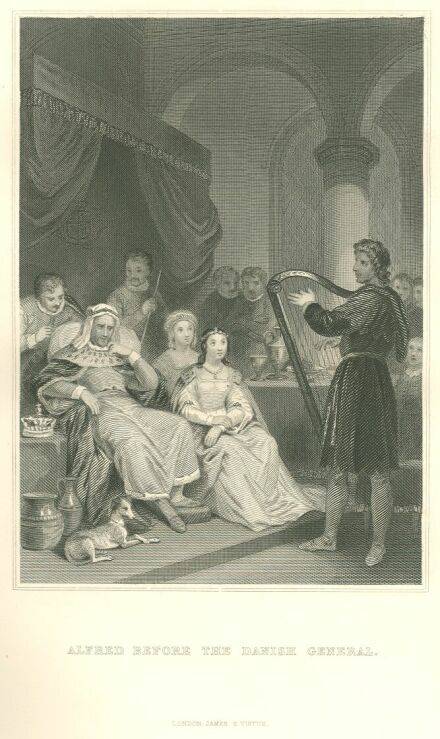
When Alfred observed this symptom of successful resistance in his subjects, he left his retreat; but before he would assemble them in arms, or urge them to any attempt, which, if unfortunate, might, in their present despondency, prove fatal, he resolved to inspect himself the situation of the enemy, and to judge of the probability of success. For this purpose he entered their camp under the disguise of a harper, and passed unsuspected through every quarter. He so entertained them with his music and facetious humors, that he met with a welcome reception, and was even introduced to the tent of Guthrum, their prince, where he remained some days.[***] He remarked the supine security of the Danes, their contempt of the English, their negligence in foraging and plundering, and their dissolute wasting of what they gained by rapine and violence. Encouraged by these favorable appearances, he secretly sent emissaries to the most considerable of his subjects, and summoned them to a rendezvous, attended by their warlike followers, at Brixton, on the borders of Selwood Forest.[****] The English, who had hoped to put an end to their calamities by servile submission, now found the insolence and rapine of the conqueror more intolerable than all past fatigues and dangers; and at the appointed day, they joyfully resorted to their prince. On his appearance, they received him with shouts of applause,[*****] and could not satiate their eyes with the sight of this beloved monarch, whom they had long regarded as dead, and who now, with voice and looks expressing his confidence of success, called them to liberty and to vengeance.
He instantly conducted them to Eddington, where the Danes were encamped; and taking advantage of his previous knowledge of the place, he directed his attack against the most unguarded quarter of the enemy. The Danes, surprised to see an army of English, whom they considered as totally subdued, and still more astonished to hear that Alfred was at their head, made but a faint resistance, notwithstanding their superiority of number, and were soon put to flight with great slaughter. The remainder of the routed army, with their prince, was besieged by Alfred in a fortified camp to which they fled; but being reduced to extremity by want and hunger, they had recourse to the clemency of the victor, and offered to submit on any conditions. The king, no less generous than brave, gave them their lives, and even formed a scheme for converting them from mortal enemies into faithful subjects and confederates. He knew that the kingdoms of East Anglia and Northumberland were totally desolated by the frequent inroads of the Danes, and he now proposed to repeople them, by settling there Guthrum and his followers. He hoped that the new planters would at last betake themselves to industry, when, by reason of his resistance, and the exhausted condition of the country, they could no longer subsist by plunder; and that they might serve him as a rampart against any future incursions of their countrymen. But before he ratified these mild conditions with the Danes, he required that they should give him one pledge of their submission, and of their inclination to incorporate with the English, by declaring their conversion to Christianity.[*] Guthrum and his army had no aversion to the proposal; and, without much instruction, or argument, or conference, they were all admitted to baptism. The king answered for Guthrum at the font, gave him the name of Athelstan, and received him as his adopted son.[**]
The success of this expedient seemed to correspond to Alfred's hopes: the greater part of the Danes settled peaceably in their new quarters: some smaller bodies of the same nation, which were dispersed in Mercia, were distributed into the five cities of Derby, Leicester, Stamford, Lincoln, and Nottingham, and were thence called the Fif or Five-burgers. The more turbulent and unquiet made an expedition into France, under the command of Hastings;[*] and except by a short incursion of Danes, who sailed up the Thames, and landed at Fulham, but suddenly retreated to their ships, on finding the country in a posture of defence, Alfred was not for some years infested by the inroads of those barbarians.[**]
The king employed this interval of tranquillity in restoring order to the state, which had been shaken by so many violent convulsions; in establishing civil and military institutions; in composing the minds of men to industry and justice; and in providing against the return of like calamities. He was, more properly than his grandfather Egbert, the sole monarch of the English, (for so the Saxons were now universally called,) because the kingdom of Mercia was at last incorporated in his state, and was governed by Ethelbert, his brother-in-law, who bore the title of earl; and though the Danes, who peopled East Anglia and Northumberland, were for some time ruled immediately by their own princes, they all acknowledged a subordination to Alfred, and submitted to his superior authority. As equality among subjects is the great source of concord, Alfred gave the same laws to the Danes and English, and put them entirely on a like footing in the administration both of civil and criminal justice. The fine for the murder of a Dane was the same with that for the murder of an Englishman; the great symbol of equality in those ages.
The king, after rebuilding the ruined cities, particularly London,[*] which had been destroyed by the Danes in the reign of Ethelwolf, established a regular militia for the defence of the kingdom. He ordained that all his people should be armed and registered; he assigned them a regular rotation of duty; he distributed part into the castles and fortresses, which he built at proper places;[**] he required another part to take the field on any alarm, and to assemble at stated places of rendezvous; and he left a sufficient number at home, who were employed in the cultivation of the land, and who afterwards took their turn in military service.[***]
The whole kingdom was like one great garrison; and the Danes could no sooner appear in one place, than a sufficient number was assembled to oppose them, without leaving the other quarters defenceless or disarmed.[*]
But Alfred, sensible that the proper method of opposing an enemy who made incursions by sea, was to meet them on their own element, took care to provide himself with a naval force,[*] which, though the most natural defence of an island, had hitherto been totally neglected by the English. He increased the shipping of his kingdom both in number and strength, and trained his subjects in the practice as well of sailing as of naval action. He distributed his armed vessels in proper stations around the island, and was sure to meet the Danish ships, either before or after they had landed their troops, and to pursue them in all their incursions. Though the Danes might suddenly, by surprise, disembark on the coast, which was generally become desolate by their frequent ravages, they were encountered by the English fleet in their retreat; and escaped not, as formerly, by abandoning their booty, but paid, by their total destruction, the penalty of the disorders which they had committed.
In this manner Alfred repelled several inroads of these piratical Danes, and maintained his kingdom, during some years, in safety and tranquillity. A fleet of a hundred and twenty ships of war was stationed upon the coast; and being provided with warlike engines, as well as with expert seamen, both Frisians and English, (for Alfred supplied the defects of his own subjects by engaging able foreigners in his service,) maintained a superiority over those smaller bands, with which England had so often been infested.[*]
But at last Hastings, the famous Danish chief, having ravaged all the provinces of France, both along the sea-coast and the Loire and Seine, and being obliged to quit that country, more by the desolation which he himself had occasioned, than by the resistance of the inhabitants, appeared off the coast of Kent with a fleet of three hundred and thirty sail. The greater part of the enemy disembarked in the Rother and seized the fort of Apuldore. Hastings himself, commanding a fleet of eighty sail, entered the Thames, and fortifying Milton, in Kent, began to spread his forces over the country, and to commit the most destructive ravages. But Alfred, on the first alarm of this descent, flew to the defence of his people, at the head of a select band of soldiers, whom he always kept about his person,[*] and, gathering to him the armed militia from all quarters, appeared in the field with a force superior to the enemy. All straggling parties, whom necessity, or love of plunder, had drawn to a distance from their chief encampment, were cut off by the English;[**] and these pirates, instead of increasing their spoil, found themselves cooped up in their fortifications, and obliged to subsist by the plunder which they had brought from France. Tired of this situation, which must in the end prove ruinous to them, the Danes at Apuldore rose suddenly from their encampment, with an intention of marching towards the Thames, and passing over into Essex: but they escaped not the vigilance of Alfred, who encountered them at Farnham, put them to rout,[***] seized all their horses and baggage, and chased the runaways on board their ships, which carried them up the Colne to Mersey, in Essex, where they intrenched themselves. Hastings, at the same time, and probably by concert, made a like movement; and deserting Milton, took possession of Bamflete, near the Isle of Canvey, in the same county,[****] where he hastily threw up fortifications for his defence against the power of Alfred.
Unfortunately for the English, Guthrum, prince of the East Anglian Danes, was now dead; as was also Guthred, whom the king had appointed governor of the Northumbrians; and those restless tribes, being no longer restrained by the authority of their princes, and being encouraged by the appearance of so great a body of their countrymen, broke into rebellion, shook off the authority of Alfred, and yielding to their inveterate habits of war and depredation,[*] embarked on board two hundred and forty vessels, and appeared before Exeter, in the west of England. Alfred lost not a moment in opposing this new enemy. Having left some forces at London to make head against Hastings and the other Danes, he marched suddenly to the west,[**] and, falling on the rebels before they were aware, pursued them to their ships with great slaughter.
These ravagers, sailing next to Sussex, began to plunder the country near Chichester; but the order which Alfred had everywhere established, sufficed here, without his presence, for the defence of the place, and the rebels, meeting with a new repulse, in which many of them were killed, and some of their ships taken,[*] were obliged to put again to sea, and were discouraged from attempting any other enterprise.
Meanwhile the Danish invaders in Essex, having united their force under the command of Hastings, advanced into the inland country, and made spoil of all around them; but soon had reason to repent of their temerity. The English army left in London, assisted by a body of the citizens, attacked the enemy's intrenchments at Bamflete, overpowered the garrison, and having done great execution upon them, carried off the wife and two sons of Hastings.[*] Alfred generously spared these captives, and even restored them to Hastings,[**] on condition that he should depart the kingdom.
But though the king had thus honorably rid himself of this dangerous enemy, he had not entirely subdued or expelled the invaders. The piratical Danes willingly followed in an excursion any prosperous leader who gave them hopes of booty, but were not so easily induced to relinquish their enterprise, or submit to return, baffled and without plunder, into their native country. Great numbers of them, after the departure of Hastings, seized and fortified Shobury, at the mouth of the Thames; and having left a garrison there, they marched along the river, till they came to Boddington, in the county of Glocester; where, being reënforced by some Welsh, they threw up intrenchments, and prepared for their defence. The king here surrounded them with the whole force of his dominions; [*] and as he had now a certain prospect of victory, he resolved to trust nothing to chance, but rather to master his enemies by famine than assault. They were reduced to such extremities, that having eaten their own horses, and having many of them perished with hunger,[**] they made a desperate sally upon the English; and though the greater number fell in the action, a considerable body made their escape.[***]
These roved about for some time in England, still pursued by the vigilance of Alfred; they attacked Leicester with success, defended themselves in Hartford, and then fled to Quatford, where they were finally broken and subdued. The small remains of them either dispersed themselves among their countrymen in Northumberland and East Anglia,[*] or had recourse again to the sea, where they exercised piracy, under the command of Sigefert, a Northumbrian.
This freebooter, well acquainted with Alfred's naval preparations, had framed vessels of a new construction, higher, and longer, and swifter than those of the English; but the king soon discovered his superior skill, by building vessels still higher, and longer, and swifter than those of the Northumbrians; and falling upon them, while they were exercising their ravages in the west, he took twenty of their ships; and having tried all the prisoners at Winchester, he hanged them as pirates, the common enemies of mankind.
The well-timed severity of this execution, together with the excellent posture of defence established every where, restored full tranquillity in England, and provided for the future security of the government. The East Anglian and Northumbrian Danes, on the first appearance of Alfred upon their frontiers, made anew the most humble submissions to him; and he thought it prudent to take them under his immediate government, without establishing over them a viceroy of their own nation.[*] The Welsh also acknowledged his authority; and this great prince had now, by prudence, and justice, and valor, established his sovereignty over all the southern parts of the island, from the English Channel to the frontiers of Scotland; when he died,
901.
in the vigor of his age and the full strength of his faculties, after a glorious reign of twenty-nine years and a half,[**] in which he deservedly attained the appellation of Alfred the Great, and the title of founder of the English monarchy.
The merit of this prince, both in private and public life, may with advantage be set in opposition to that of any monarch, or citizen, which the annals of any age, or any nation, can present to us. He seems, indeed, to be the model of that perfect character, which, under the denomination of a sage or wise man, philosophers have been fond of delineating, rather as a fiction of their imagination, than in hopes of ever seeing it really existing; so happily were all his virtues tempered together, so justly were they blended, and so powerfully did each prevent the other from exceeding its proper boundaries. He knew how to reconcile the most enterprising spirit with the coolest moderation; the most obstinate perseverance with the easiest flexibility: the most severe justice with the gentlest lenity; the greatest vigor in commanding with the most perfect affability of deportment;[*] the highest capacity and inclination for science with the most shining talents for action.
His civil and his military virtues are almost equally the objects of our admiration; excepting only that the former, being more rare among princes, as well as more useful, seem chiefly to challenge our applause. Nature, also, as if desirous that so bright a production of her skill should be set in the fairest light, had bestowed on him every bodily accomplishment—vigor of limbs, dignity of shape and air, with a pleasing, engaging, and open countenance. Fortune alone, by throwing him into that barbarous age, deprived him of historians worthy to transmit his fame to posterity; and we wish to see him delineated in more lively colors, and with more particular strokes, that we may at least perceive some of those small specks and blemishes, from which, as a man, it is impossible he could be entirely exempted.
But we should give but an imperfect idea of Alfred's merit, were we to confine our narration to his military exploits, and were not more particular in our account of his institutions for the execution of justice, and of his zeal for the encouragement of arts and sciences.
After Alfred had subdued, and had settled or expelled the Danes, he found the kingdom in the most wretched condition; desolated by the ravages of those barbarians, and thrown into disorders which were calculated to perpetuate its misery. Though the great armies of the Danes were broken, the country was full of straggling troops of that nation, who, being accustomed to live by plunder, were become incapable of industry; and who, from the natural ferocity of their manners, indulged themselves in committing violence, even beyond what was requisite to supply their necessities. The English themselves, reduced to the most extreme indigence by those continued depredations, had shaken off all bands of government; and those who had been plundered to-day, betook themselves next day to a like disorderly life, and, from despair, joined the robbers in pillaging and ruining their fellow-citizens. These were the evils for which it was necessary that the vigilance and activity of Alfred should provide a remedy.
That he might render the execution of justice strict and regular, he divided all England into counties: these counties he subdivided into hundreds, and the hundreds into tithings. Every householder was answerable for the behavior of his family and slaves, and even of his guests, if they lived above three days in his house. Ten neighboring householders were formed into one corporation, who, under the name of a tithing, decennary, or fribourg, were answerable for each other's conduct, and over whom, one person, called a tithing-man, headbourg, or borsholder, was appointed to preside. Every man was punished as an outlaw who did not register himself in some tithing. And no man could change his habitation without a warrant or certificate from the borsholder of the tithing to which he formerly belonged.
When any person, in any tithing or decennary, was guilty of a crime, the borsholder was summoned to answer for him; and if he were not willing to be surety for his appearance, and his clearing himself, the criminal was committed to prison, and there detained till his trial. If he fled, either before or after finding sureties, the borsholder and decennary became liable to inquiry, and were exposed to the penalties of law. Thirty-one days were allowed them for producing the criminal; and if that time elapsed without their being able to find him, the borsholder, with two other members of the decennary, was obliged to appear, and, together with three chief members of the three neighboring decennaries, (making twelve in all,) to swear that his decennary was free from all privity, both of the crime committed, and of the escape of the criminal. If the borsholder could not find such a number to answer for their innocence, the decennary was compelled by fine to make satisfaction to the king, according to the degree of the offence.[*]
By this institution, every man was obliged, from his own interest, to keep a watchful eye over the conduct of his neighbors; and was in a manner surety for the behavior of those who were placed under the division to which he belonged; whence these decennaries received the name of frank-pledges.
Such a regular distribution of the people, with such a strict confinement in their habitation, may not be necessary in times when men are more inured to obedience and justice; and it might, perhaps, be regarded as destructive of liberty and commerce in a polished state; but it was well calculated to reduce that fierce and licentious people under the salutary restraint of law and government. But Alfred took care to temper these rigors by other institutions favorable to the freedom of the citizens; and nothing could be more popular and liberal than his plan for the administration of justice. The borsholder summoned together his whole decennary to assist him in deciding any lesser differences which occurred among the members of this small community. In affairs of greater moment, in appeals from the decennary, or in controversies arising between members of different decennaries, the cause was brought before the hundred, which consisted of ten decennaries, or a hundred families of freemen, and which was regularly assembled once in four weeks, for the deciding of causes.[*] Their method of decision deserves to be noted, as being the origin of juries; an institution admirable in itself, and the best calculated for the preservation of liberty and the administration of justice that ever was devised by the wit of man. Twelve freeholders were chosen, who, having sworn, together with the hundreder, or presiding magistrate of that division, to administer impartial justice,[**] proceeded to the examination of that cause which was submitted to their jurisdiction. And beside these monthly meetings of the hundred, there was an annual meeting, appointed for a more general inspection of the police of the district; for the inquiry into crimes, the correction of abuses in magistrates, and the obliging of every person to show the decennary in which he was registered. The people, in imitation of their ancestors, the ancient Germans, assembled there in arms; whence a hundred was sometimes called a wapentake, and its courts served both for the support of military discipline and for the administration of civil justice.[***]
The next superior court to that of the hundred was the county court, which met twice a year, after Michaelmas and Easter, and consisted of the freeholders of the county, who possessed an equal vote in the decision of causes. The bishop presided in this court, together with the alderman; and the proper object of the court was, the receiving of appeals from the hundreds and decennaries, and the deciding of such controversies as arose between men of different hundreds. Formerly, the alderman possessed both the civil and military authority; but Alfred, sensible that this conjunction of powers rendered the nobility dangerous and independent, appointed also a sheriff in each county, who enjoyed a coördinate authority with the former in the judicial function.[*] His office also impowered him to guard the rights of the crown in the county, and to levy the fines imposed, which in that age formed no contemptible part of the public revenue.
There lay an appeal, in default of justice, from all these courts, to the king himself in council; and as the people, sensible of the equity and great talents of Alfred, placed their chief confidence in him, he was soon overwhelmed with appeals from all parts of England. He was indefatigable in the despatch of these causes;[*] but finding that his time must be entirely engrossed by this branch of duty, he resolved to obviate the inconvenience, by correcting the ignorance or corruption of the inferior magistrates, from which it arose.[**] He took care to have his nobility instructed in letters and the laws; [***] he chose the earls and sheriffs from among the men most celebrated for probity and knowledge; he punished severely all malversation in office;[****] and he removed all the earls whom he found unequal to the trust;[*****] allowing only some of the more elderly to serve by a deputy, till their death should make room for more worthy successors.
The better to guide the magistrates in the administration of justice, Alfred framed a body of laws, which, though now lost, served long as the basis of English jurisprudence, and is generally deemed the origin of what is denominated the COMMON LAW. He appointed regular meetings of the states of England twice a year, in London,[*] a city which he himself had repaired and beautified, and which he thus rendered the capital of the kingdom.
The similarity of these institutions to the customs of the ancient Germans, to the practice of the other northern conquerors, and to the Saxon laws during the Heptarchy, prevents us from regarding Alfred as the sole author of this plan of government, and leads us rather to think, that, like a wise-man, he contented himself with reforming, extending, and executing the institutions which he found previously established. But, on the whole, such success attended his legislation, that everything bore suddenly a new face in England. Robberies and iniquities of all kinds were repressed by the punishment or reformation of the criminals;[*] and so exact was the general police, that Alfred, it is said, hung up, by way of bravado, golden bracelets near the highways, and no man dared to touch them.[**] Yet, amidst these rigors of justice, this great prince preserved the most sacred regard to the liberty of his people; and it is a memorable sentiment preserved in his will, that it was just the English should forever remain as free as their own thoughts.[***]
As good morals and knowledge are almost inseparable, in every age, though not in every individual, the care of Alfred for the encouragement of learning among his subjects was another useful branch of his legislation, and tended to reclaim the English from their former dissolute and ferocious manners; but the king was guided, in this pursuit, less by political views than by his natural bent and propensity towards letters. When he came to the throne, he found the nation sunk into the grossest ignorance and barbarism, proceeding from the continued disorders in the government, and from the ravages of the Danes. The monasteries were destroyed, the monks butchered or dispersed, their libraries burnt; and thus the only seats of erudition in those ages were totally subverted. Alfred himself complains, that on his accession he knew not one person, south of the Thames, who could so much as interpret the Latin service, and very few in the northern parts who had reached even that pitch of erudition. But this prince invited over the most celebrated scholars from all parts of Europe; he established schools every where for the instruction of his people; he founded, at least repaired, the University of Oxford, and endowed it with many privileges revenues, and immunities; he enjoined by law all freeholders possessed of two hides[*] of land, or more, to send their children to school, for their instruction; he gave preferment both in church and state to such only as had made some proficiency in knowledge; and by all these expedients he had the satisfaction, before his death, to see a great change in the face of affairs; and in a work of his, which is still extant, he congratulates himself on the progress which learning, under his patronage, had already made in England.
But the most effectual expedient, employed by Alfred for the encouragement of learning, was his own example, and the constant assiduity with which, notwithstanding the multiplicity and urgency of his affairs, he employed himself in the pursuits of knowledge. He usually divided his time into three equal portions: one was employed in sleep, and the refection of his body by diet and exercise; another, in the despatch of business; a third, in study and devotion; and that he might more exactly measure the hours, he made use of burning tapers of equal length, which he fixed in lanterns,[*] an expedient suited to that rude age, when the geometry of dialling, and the mechanism of clocks and watches, were totally unknown. And by such a regular distribution of his time though he often labored under great bodily infirmities,[**] this martial hero, who fought in person fifty-six battles by sea and land,[***] was able, during a life of no extraordinary length, to acquire more knowledge, and even to compose more books, than most studious men, though blessed with the greatest leisure and application, have, in more fortunate ages, made the object of their uninterrupted industry.
Sensible that the people, at all times, especially when their understandings are obstructed by ignorance and bad education, are not much susceptible of speculative instruction, Alfred endeavored to convey his morality by apologues, parables, stories, apothegms, couched in poetry; and besides propagating among his subjects former compositions of that kind, which he found in the Saxon tongue,[*] he exercised his genius in inventing works of a like nature,[**] as well as in translating from the Greek the elegant Fables of Æsop. He also gave Saxon translations of Orosius's and Bede's histories; and of Boethius concerning the consolation of philosophy.[***] And he deemed it nowise derogatory from his other great characters of sovereign, legislator, warrior, and politician, thus to lead the way to his people in the pursuits of literature.
Meanwhile, this prince was not negligent in encouraging the vulgar and mechanical arts, which have a more sensible, though not a closer connection with the interests of society. He invited, from all quarters, industrious foreigners to re-people his country, which had been desolated by the ravages of the Danes.[*] He introduced and encouraged manufactures of all kinds, and no inventor or improver of any ingenious art did he suffer to go unrewarded.[**] He prompted men of activity to betake themselves to navigation, to push commerce into the most remote countries, and to acquire riches by propagating industry among their fellow-citizens. He set apart a seventh portion of his own revenue for maintaining a number of workmen, whom he constantly employed in rebuilding the ruined cities, castles, palaces, and monasteries.[***] Even the elegances of life were brought to him from the Mediterranean and the Indies;[****] and his subjects, by seeing those productions of the peaceful arts, were taught to respect the virtues of justice and industry, from which alone they could arise. Both living and dead, Alfred was regarded by foreigners, no less than by his own subjects, as the greatest prince, after Charlemagne, that had appeared in Europe during several ages, and as one of the wisest and best that had ever adorned the annals of any nation.
Alfred had, by his wife Ethelswitha, daughter of a Mercian earl, three sons and three daughters. The eldest son, Edmund, died without issue, in his father's lifetime. The third, Ethelward, inherited his father's passion for letters, and lived a private life. The second, Edward, succeeded to his power, and passes by the appellation of Edward the Elder, being the first of that name who sat on the English throne.
This prince, who equalled his father in military talents, though inferior to him in knowledge and erudition,[*] found immediately on his accession, a specimen of that turbulent life to which all princes, and even all individuals, were exposed, in an age when men, less restrained by law or justice, and less occupied by industry, had no aliment for their inquietude out wars, insurrections, convulsions, rapine, and depredation.
Ethelwald, his cousin-german, son of King Ethelbert, the elder brother of Alfred, insisted on his preferable title;[*] and arming his partisans, took possession of Winburne, where he seemed determined to defend himself to the last extremity, and to await the issue of his pretensions.[**] But when the king approached the town with a great army, Ethelwald, having the prospect of certain destruction, made his escape, and fled first into Normandy, thence into Northumberland, where he hoped that the people, who had been recently subdued by Alfred, and who were impatient of peace, would, on the intelligence of that great prince's death, seize the first pretence or opportunity of rebellion. The event did not disappoint his expectations: the Northumbrians declared for him,[***] and Ethelwald, having thus connected his interests with the Danish tribes, went beyond sea, and collecting a body of these freebooters, he excited the hopes of all those who had been accustomed to subsist by rapine and violence.[****]
The East Anglian Danes joined his party; the Five-burgers, who were seated in the heart of Mercia, began to put themselves in motion; and the English found that they were again menaced with those convulsions from which the valor and policy of Alfred had so lately rescued them. The rebels, headed by Ethelwald, made an incursion into the counties of Glocester, Oxford, and Wilts; and having exercised their ravages in these places, they retired with their booty, before the king, who had assembled an army, was able to approach them. Edward, however, who was determined that his preparations should not be fruitless, conducted his forces into East Anglia, and retaliated the injuries which the inhabitants had committed, by spreading the like devastation among them. Satiated with revenge, and loaded with booty, he gave orders to retire; but the authority of those ancient kings, which was feeble in peace, was not much better established in the field; and the Kentish men, greedy of more spoil, ventured, contrary to repeated orders, to stay behind him, and to take up their quarters in Bury. This disobedience proved, in the issue, fortunate to Edward. The Danes assaulted the Kentish men, but met with so vigorous a resistance, that, though they gained the field of battle, they bought that advantage by the loss of their bravest leaders, and, among the rest, by that of Ethelwald, who perished in the action.[*] The king, freed from the fear of so dangerous a competitor, made peace on advantageous terms with the East Angles.[**]
In order to restore England to such a state of tranquillity as it was then capable of attaining, nought was wanting but the subjection of the Northumbrians, who, assisted by the scattered Danes in Mercia, continually infested the bowels of the kingdom. Edward, in order to divert the force of these enemies, prepared a fleet to attack them by sea, hoping that when his ships appeared on their coast, they must at least remain at home, and provide for their defence. But the Northumbrians were less anxious to secure their own property, than greedy to commit spoil on their enemy; and, concluding that the chief strength of the English was embarked on board the fleet, they thought the opportunity favorable, and entered Edward's territories with all their forces. The king, who was prepared against this event, attacked them, on their return, at Tetenhall in the county of Stafford, put them to rout, recovered all the booty, and pursued them with great slaughter into their own country.
All the rest of Edward's reign was a scene of continued and successful action against the Northumbrians, the East Angles, the Five-burgers, and the foreign Danes, who invaded him from Normandy and Brittany. Nor was he less provident in putting his kingdom in a posture of defence, than vigorous in assaulting the enemy. He fortified the towns of Chester, Eddesbury, Warwick, Cherbury, Buckingham, Towcester, Maldon, Huntingdon, and Colchester. He fought two signal battles at Temsford and Maldon.[*]
He vanquished Thurketill, a great Danish chief, and obliged him to retire with his followers into France, in quest of spoil and adventures. He subdued the East Angles, and forced them to swear allegiance to him: he expelled the two rival princes of Northumberland, Reginald and Sidroc, and acquired, for the present, the dominion of that province: several tribes of the Britons were subjected by him; and even the Scots, who, during the reign of Egbert, had, under the conduct of Kenneth, their king, increased their power by the final subjection of the Picts, were nevertheless obliged to give him marks of submission.[*] In all these fortunate achievements, he was assisted by the activity and prudence of his sister Ethelfleda, who was widow of Ethelbert, earl of Mercia, and who after her husband's death, retained the government of that province. This princess, who had been reduced to extremity in childbed, refused afterwards all commerce with her husband; not from any weak superstition, as was common in that age, but because she deemed all domestic occupations unworthy of her masculine and ambitious spirit.[**] She died before her brother; and Edward, during the remainder of his reign, took upon himself the immediate government of Mercia, which before had been intrusted to the authority of a governor.[***] The Saxon Chronicle fixes the death of this prince in 925 his kingdom devolved to Athelstan, his natural son.
925.
The stain in this prince's birth was not, in those times, deemed so considerable as to exclude him from the throne; and Athelstan, being of an age, as well as of a capacity, fitted for government, obtained the preference to Edward's younger children, who, though legitimate, were of too tender years to rule a nation so much exposed both to foreign invasion and to domestic convulsions. Some discontents, however, prevailed on his accession; and Alfred, a nobleman of considerable power, was thence encouraged to enter into a conspiracy against him. This incident is related by historians, with circumstances which the reader, according to the degree of credit he is disposed to give them, may impute either to the invention of monks, who forged them, or to their artifice, who found means of making them real. Alfred, it is said, being seized upon strong suspicions, but without any certain proof, firmly denied the conspiracy imputed to him; and, in order to justify himself, he offered to swear to his innocence before the pope, whose person, it was supposed, contained such superior sanctity, that no one could presume to give a false oath in his presence, and yet hope to escape the immediate vengeance of Heaven. The king accepted of the condition, and Alfred was conducted to Rome, where, either conscious of his innocence, or neglecting the superstition to which he appealed, he ventured to make the oath required of him, before John, who then filled the papal chair; but no sooner had he pronounced the fatal words, than he fell into convulsions, of which, three days after, he expired. The king, as if the guilt, of the conspirator were now fully ascertained, confiscated his estate, and made a present of it to the monastery of Malmesbury,[*] secure that no doubts would ever thenceforth be entertained concerning the justice of his proceedings.
The dominion of Athelstan was no sooner established over his English subjects, than he endeavored to give security to the government, by providing against the insurrections of the Danes, which had created so much disturbance to his predecessors. He marched into Northumberland; and, finding that the inhabitants bore with impatience the English yoke, he thought it prudent to confer on Sithric, a Danish nobleman, the title of king, and to attach him to his interests by giving him his sister Editha in marriage. But this policy proved by accident the source of dangerous consequences. Sithric died in a twelvemonth after; and his two sons by a former marriage, Anlaf and Godfrid, founding pretensions on their father's elevation, assumed the sovereignty, without waiting for Athelstan's consent. They were soon expelled by the power of that monarch; and the former took shelter in Ireland, as the latter did in Scotland, where he received, during some time, protection from Constantine, who then enjoyed the crown of that kingdom. The Scottish prince, however, continually solicited, and even menaced by Athelstan, at last promised to deliver up his guest; but secretly detesting this treachery, he gave Godfrid warning to make his escape;[*] and that fugitive, after subsisting by piracy for some years, freed the king, by his death, from any further anxiety. Athelstan, resenting Constantine's behavior, entered Scotland with an army, and ravaging the country with impunity,[**] he reduced the Scots to such distress, that their king was content to preserve his crown by making submissions to the enemy. The English historians assert,[***] that Constantine did homage to Athelstan for his kingdom; and they add, that the latter prince, being urged by his courtiers to push the present favorable opportunity, and entirely subdue Scotland, replied, that it was more glorious to confer than conquer kingdoms.[****]
But those annals, so uncertain and imperfect in themselves, lose all credit when national prepossessions and animosities have place; and, on that account, the Scotch historians, who, without having any more knowledge of the matter, strenuously deny the fact, seem more worthy of belief.
Constantine, whether he owed the retaining of his crown to the moderation of Athelstan, who was unwilling to employ all his advantages against him, or to the policy of that prince who esteemed the humiliation of an enemy a greater acquisition than the subjection of a discontented and mutinous people thought the behavior of the English monarch more an object of resentment than of gratitude. He entered into a confederacy with Anlaf, who had collected a great body of Danish pirates, whom he found hovering in the Irish seas, and with some Welsh princes, who were terrified at the growing power of Athelstan; and all these allies made by concert an irruption with a great army into England. Athelstan, collecting his forces, met the enemy hear Brunsbury, in Northumberland, and defeated them in a general engagement. This victory was chiefly ascribed to the valor of Turketul, the English chancellor; for, in those turbulent ages, no one was so much occupied in civil employments as wholly to lay aside the military character.[*]
There is a circumstance, not unworthy of notice, which historians relate, with regard to the transactions of this war. Anlaf, on the approach of the English army, thought that he could not venture too much to insure a fortunate event, and employing the artifice formerly practised by Alfred against the Danes, he entered the enemy's camp, in the habit of a minstrel. The stratagem was, for the present, attended with like success. He gave such satisfaction to the soldiers, who flocked about him, that they introduced him to the king's tent; and Anlaf, having played before that prince and his nobles during their repast, was dismissed with a handsome reward. His prudence kept him from refusing the present; Dut his pride determined him, on his departure, to bury it while he fancied that he was unespied by all the world. But a soldier in Athelstan's camp, who had formerly served under Anlaf, had been struck with some suspicion on the first appearance of the minstrel, and was engaged by curiosity to observe all his motions. He regarded this last action as a full proof of Anlaf's disguise; and he immediately carried the intelligence to Athelstan, who blamed him for not sooner giving him information, that he might have seized his enemy. But the soldier told him, that, as he had formerly sworn fealty to Anlaf, he could never have pardoned himself the treachery of betraying and ruining his ancient master; and that Athelstan himself, after such an instance of his criminal conduct, would have had equal reason to distrust his allegiance. Athelstan, having praised the generosity of the soldier's principles, reflected on the incident, which he foresaw might be attended with important consequences. He removed his station in the camp; and as a bishop arrived that evening with a reënforcement of troops, (for the ecclesiastics were then no less warlike than the civil magistrates,) he occupied with his train that very place which had been left vacant by the king's removal. The precaution of Athelstan was found prudent; for no sooner had darkness fallen, than Anlaf broke into the camp, and hastening directly to the place where he had left the king's tent, put the bishop to death, before he had time to prepare for his defence.[*]
There fell several Danish and Welsh princes in the action of Brunsbury;[**] and Constantine and Anlaf made their escape with difficulty, leaving the greater part of their army on the field of battle. After this success, Athelstan enjoyed his crown in tranquillity; and he is regarded as one of the ablest and most active of those ancient princes. He passed a remarkable law, which was calculated for the encouragement of commerce, and which it required some liberality of mind in that age to have devised—that a merchant, who had made three long sea voyages on his own account, should be admitted to the rank of a thane or gentleman. This prince died at Glocester, in the year 94l,[***] after a reign of sixteen years, and was succeeded by Edmund, his legitimate brother.
941.
Edmund, on his accession, met with disturbance from the restless Northumbrians, who lay in wait for every opportunity of breaking into rebellion. But marching suddenly with his forces into their country, he so overawed the rebels that they endeavored to appease him by the most humble submissions.[*]
In order to give him the surer pledge of their obedience, they offered to embrace Christianity; a religion which the English Danes had frequently professed, when reduced to difficulties, but which, for that very reason, they regarded as a badge of servitude, and shook off as soon as a favorable opportunity offered. Edmund, trusting little to their sincerity in this forced submission, used the precaution of removing the Five-burgers from the towns of Mercia, in which they had been allowed to settle; because it was always found that they took advantage of every commotion, and introduced the rebellious or foreign Danes into the heart of the kingdom. He also conquered Cumberland from the Britons; and conferred that territory on Malcolm, king of Scotland, on condition that he should do him homage for it, and protect the north from all future incursions of the Danes.
Edmund was young when he came to the crown; yet was his reign short, as his death was violent. One day, as he was solemnizing a festival in the county of Glocester, he remarked that Leolf, a notorious robber, whom he had sentenced to banishment, had yet the boldness to enter the hall where he himself dined, and to sit at table with his attendants. Enraged at this insolence, he ordered him to leave the room; but on his refusing to obey, the king, whose temper, naturally choleric, was inflamed by this additional insult, leaped on him himself, and seized him by the hair; but the ruffian, pushed to extremity, drew his dagger, and gave Edmund a wound of which he immediately expired. This event happened in the year 946, and in the sixth year of the king's reign. Edmund left male issue, but so young, that they were incapable of governing the kingdom; and his brother, Edred, was promoted to the throne.
946.
The reign of this prince, as those of his predecessors, was disturbed by the rebellions and incursions of the Northumbrian Danes, who, though frequently quelled, were never entirely subdued, nor had ever paid a sincere allegiance to the crown of England. The accession of a new king seemed to them a favorable opportunity for shaking off the yoke; but on Edred's appearance with an army, they made him their wonted submissions; and the king, having wasted the country with fire and sword, as a punishment of their rebellion, obliged them to renew their oaths of allegiance; and he straight retired with his forces. The obedience of the Danes lasted no longer than the present terror. Provoked at the devastations of Edred, and even reduced by necessity to subsist on plunder, they broke into a new rebellion, and were again subdued; but the king, now instructed by experience, took greater precautions against their future revolt. He fixed English garrisons in their most considerable towns, and placed over them an English governor, who might watch all their motions, and suppress any insurrection on its first appearance. He obliged also Malcolm, king of Scotland, to renew his homage for the lands which he held in England.
Edred, though not unwarlike, nor unfit for active life, lay under the influence of the lowest superstition, and had blindly delivered over his conscience to the guidance of Dunstan commonly called St. Dunstan, abbot of Glastonbury, whom he advanced to the highest offices, and who covered, under the appearance of sanctity, the most violent and most insolent ambition. Taking advantage of the implicit confidence reposed in him by the king, this churchman imported into England a new order of monks, who much changed the state of ecclesiastical affairs, and excited, on their first establishment, the most violent commotions.
From the introduction of Christianity among the Saxons, there had been monasteries in England; and these establishments had extremely multiplied by the donations of the princes and nobles, whose superstition, derived from their ignorance and precarious life, and increased by remorses for the crimes into which they were so frequently betrayed, knew no other expedient for appeasing the Deity, than a profuse liberality towards the ecclesiastics. But the monks had hitherto been a species of secular priests, who lived after the manner of the present canons or prebendaries, and were both intermingled, in some degree, with the world, and endeavored to render themselves useful to it. They were employed in the education of youth;[*] they had the disposal of their own time and industry; they were not subjected to the rigid rules of an order; they had made no vows of implicit to their superiors;[*] and they still retained the choice, without quitting the convent, either of a married or a single life.[**]
But a mistaken piety had produced in Italy a new species of monks, called Benedictines; who, carrying farther the plan sible principles of mortification, secluded themselves entirely from the world, renounced all claim to liberty, and made a merit of the most inviolable chastity. These practices and principles, which superstition at first engendered, were greedily embraced and promoted by the policy of the court of Rome. The Roman pontiff, who was making every day great advances towards an absolute sovereignty over the ecclesiastics, perceived that the celibacy of the clergy alone could break off entirely their connection with the civil power, and, depriving them of every other object of ambition, engage them to promote, with unceasing industry, the grandeur of their own order. He was sensible that so long as the monks were indulged in marriage, and were permitted to rear families, they never could be subjected to strict discipline, or reduced to that slavery, under their superiors, which was requisite to procure to the mandates, issued from Rome, a ready and zealous obedience. Celibacy, therefore, began to be extolled as the indispensable duty of priests; and the pope undertook to make all the clergy, throughout the western world, renounce at once the privilege of marriage; a fortunate policy, but at the same time an undertaking the most difficult of any, since he had the strongest propensities of human nature to encounter, and found that the same connections with the female sex, which generally encourage devotion, were here unfavorable to the success of his project. It is no wonder, therefore, that this master-stroke of art should have met with violent contradiction, and that the interests of the hierarchy, and the inclinations of the priests, being now placed in this singular opposition, should, notwithstanding the continued efforts of Rome have retarded the execution of that bold scheme during the course of near three centuries.
Dunstan was born of noble parents in the west of England; and being educated under his uncle Aldhelm, then archbishop of Canterbury, had betaken himself to the ecclesiastical life, and had acquired some character in the court of Edmund. He was, however, represented to that prince as a man of licentious manners;[*] and finding his fortune blasted by these suspicions, his ardent ambition prompted him to repair his indiscretions, by running into an opposite extreme. He secluded himself entirely from the world; he framed a cell so small, that he could neither stand erect in it, nor stretch out his limbs during his repose; and he here employed himself perpetually either in devotion or in manual labor.[**] It is probable that his brain became gradually crazed by these solitary occupations, and that his head was filled with chimeras, which, being believed by himself and his stupid votaries, procured him the general character of sanctity among the people. He fancied that the devil, among the frequent visits which he paid him, was one day more earnest than usual in his temptations, till Dunstan, provoked at his importunity, seized him by the nose with a pair of red-hot pincers, as he put his head into the cell; and he held him there till that malignant spirit made the whole neighborhood resound with his bellowings. This notable exploit was seriously credited and extolled by the public; it is transmitted to posterity by one, who, considering the age in which he lived, may pass for a writer of some elegance;[***] and it insured to Dunstan a reputation which no real piety, much less virtue, could, even in the most enlightened period, have ever procured him with the people.
Supported by the character obtained in his retreat, Dunstan appeared again in the world; and gained such an ascendent over Edred who had succeeded to the crown, as made him not only the director of that prince's conscience, but his counsellor in the most momentous affairs of government. He was placed at the head of the treasury,[*] and being thus possessed both of power at court, and of credit with the populace, he was enabled to attempt with success the most arduous enterprises. Finding that his advancement had been owing to the opinion of his austerity, he professed himself a partisan of the rigid monastic rules; and after introducing that reformation into the convents of Glastonbury and Abingdon, he endeavored to render it universal in the kingdom.
The minds of men were already well prepared for this innovation. The praises of an inviolable chastity had been carried to the highest extravagance by some of the first preachers of Christianity among the Saxons: the pleasures of love had been represented as incompatible with Christian perfection; and a total abstinence from all commerce with the sex was deemed such a meritorious penance, as was sufficient to atone for the greatest enormities. The consequence seemed natural, that those, at least, who officiated at the altar, should be clear of this pollution; and when the doctrine of transubstantiation, which was now creeping in,[**] was once fully established, the reverence to the real body of Christ in the eucharist bestowed on this argument an additional force and influence.
The monks knew how to avail themselves of all these popular topics, and to set off their own character to the best advantage. They affected the greatest austerity of life and manners; they indulged themselves in the highest strains of devotion; they inveighed bitterly against the vices and pretended luxury of the age; they were particularly vehement against the dissolute lives of the secular clergy, their rivals; every instance of libertinism in any individual of that order was represented as a general corruption; and where other topics of defamation were wanting, their marriage became a sure subject of invective, and their wives received the name of concubine, or other more opprobrious appellation. The secular clergy, on the other hand, who were numerous and rich, and possessed of the ecclesiastical dignities, defended themselves with vigor and endeavored to retaliate upon their adversaries. The people were thrown into agitation; and few instances occur of more violent dissensions, excited by the most material differences in religion; or rather by the most frivolous; since it is a just remark, that the more affinity there is between theological parties, the greater commonly is their animosity.
The progress of the monks, which was become considerable, was somewhat retarded by the death of Edred, their partisan, who expired after a reign of nine years. He left children; but as they were infants, his nephew Edwy, son of Edmund, was placed on the throne.
955.
Edwy, at the time of his accession, was not above sixteen or seventeen years of age, was possessed of the most amiable figure, and was even endowed, according to authentic accounts, with the most promising virtues.[*] He would have been the favorite of his people, had he not unhappily, at the commencement of his reign, been engaged in a controversy with the monks, whose rage neither the graces of the body nor virtues of the mind could mitigate, and who have pursued his memory with the same unrelenting vengeance, which they exercised against his person and dignity during his short and unfortunate reign. There was a beautiful princess of the royal blood, called Elgiva, who had made impression on the tender heart of Edwy; and as he was of an age when the force of the passions first begins to be felt, he had ventured, contrary to the advice of his gravest counsellors, and the remonstrances of the more dignified ecclesiastics,[**] to espouse her; though she was within the degrees of affinity prohibited by the canon law.[***]
As the austerity affected by the monks made them particularly violent on this occasion, Edwy entertained a strong prepossession against them; and seemed, on that account, determined not to second their project of expelling the seculars from all the convents, and of possessing themselves of those rich establishments. War was therefore declared between the king and the monks; and the former soon found reason to repent his provoking such dangerous enemies. On the day of his coronation, his nobility were assembled in a great hall, and were indulging themselves in that riot and disorder, which, from the example of their German ancestors, had become habitual to the English;[*] when Edwy, attracted by softer pleasures, retired into the queen's apartment, and in that privacy gave reins to his fondness towards his wife, which was only moderately checked by the presence of her mother. Dunstan conjectured the reason of the king's retreat; and, carrying along with him Odo, archbishop of Canterbury, over whom he had gained an absolute ascendant, he burst into the apartment, upbraided Edwy with his lasciviousness, probably bestowed on the queen the most opprobrious epithet that can be applied to her sex, and tearing him from her arms, pushed him back, in a disgraceful manner, into the banquet of the nobles.[**] Edwy, though young, and opposed by the prejudices of the people, found an opportunity of taking revenge for this public insult. He questioned Dunstan concerning the administration of the treasury during the reign of his predecessor;[***] and when that minister refused to give any account of money expended, as he affirmed, by orders of the late king, he accused him of malversation in his office, and banished him the kingdom. But Dunstan's cabal was not inactive during his absence: they filled the public with high panegyrics on his sanctity: they exclaimed against the impiety of the king and queen; and having poisoned the minds of the people by these declamations, they proceeded to still more outrageous acts of violence against the royal authority. Archbishop Odo sent into the palace a party of soldiers, who seized the queen; and having burned her face with a rod-hot iron, in order to destroy that fatal beauty which had seduced Edwy, they carried her by force into Ireland, there to remain in perpetual exile.[****] Edwy, finding it in vain to resist, was obliged to consent to his divorce, which was pronounced by Odo;[*****] and a catastrophe still more dismal awaited the unhappy Elgiva. That amiable princess being cured of her wounds, and having even obliterated the scars with which Odo had hoped to deface her beauty, returned into England, and was flying to the embraces of the king, whom she still regarded as her husband; when she fell into the hands of a party whom the primate had sent to intercept her. Nothing but her death could now give security to Odo and the monks, and the most cruel death was requisite to satiate their vengeance. She was hamstringed; and expired a few days after at Glocester in the most acute torments.[******]
The English, blinded with superstition, instead of being shocked with this inhumanity, exclaimed that the misfortunes of Edwy and his consort were a just judgment for their dissolute contempt of the ecclesiastical statutes. They even proceeded to rebellion against their sovereign; and having placed Edgar at their head, the younger brother of Edwy, a boy of thirteen years of age, they soon put him in possession of Mercia, Northumberland, East Anglia, and chased Edwy into the southern counties. That it might not be doubtful at whose instigation this revolt was undertaken, Dunstan returned into England, and took upon him the government of Edgar and his party. He was first installed in the see of Worcester, then in that of London,[**] and, on Odo's death, and the violent expulsion of Brithelm, his successor, in that of Canterbury;[***] of all which he long kept possession. Odo is transmitted to us by the monks under the character of a man of piety: Dunstan was even canonized; and is one of those numerous saints of the same stamp, who disgrace the Romish calendar. Meanwhile the unhappy Edwy was excommunicated,[****] and pursued with unrelenting vengeance; but his death, which happened soon after, freed his enemies from all further inquietude, and gave Edgar peaceable possession of the government.[*****] 2
959.
This prince, who mounted the throne in such early youth, soon discovered an excellent capacity in the administration of affairs, and his reign is one of the most fortunate that we meet with in the ancient English history. He showed no aversion to war; he made the wisest preparations against invaders; and, by this vigor and foresight, he was enabled without any danger of suffering insults, to indulge his inclination towards peace, and to employ himself in supporting and improving the internal government of his kingdom. He maintained a body of disciplined troops; which he quartered in the north, in order to keep the mutinous Northumbrians in subjection, and to repel the inroads of the Scots. He built an supported a powerful navy;[*] and that he might retain the seamen in the practice of their duty, and always present a formidable armament to his enemies, he stationed three squadrons off the coast, and ordered them to make, from time to time, the circuit of his dominions.[**] 3 The foreign Danes dared not to approach a country which appeared in such a posture of defence: the domestic Danes saw inevitable destruction to be the consequence of their tumults and insurrections: the neighboring sovereigns, the king of Scotland, the princes of Wales, of the Isle of Man, of the Orkneys, and even of Ireland,[***] were reduced to pay submission to so formidable a monarch. He carried his superiority to a great height, and might have excited a universal combination against him, had not his power been so well established, as to deprive his enemies of hopes of shaking it It is said, that residing once at Chester, and having purposed to go by water to the abbey of St. John the Baptist, he obliged eight of his tributary princes to row him in a barge upon the Dee.[****] The English historians are fond of mentioning the name of Kenneth III., king of Scots, among the number: the Scottish historians either deny the fact, or assert that their king, if ever he acknowledged himself a vassal to Edgar, did him homage, not for his crown, but for the dominions which he held in England.
But the chief means by which Edgar maintained his authority, and preserved public peace, was the paying of court to Dunstan and the monks, who had at first placed him on the throne, and who, by their pretensions to superior sanctity and purity of manners, had acquired an ascendant over the people. He favored their scheme for dispossessing the secular canons of all the monasteries;[*****] he bestowed preferment on none but their partisans; he allowed Dunstan to resign the see of Worcester into the hands of Oswald, one of his creatures; [******] and to place Ethelwold, another of them, in that of Winchester;[*******] he consulted these prelates in the administration of all ecclesiastical and even in that of many civil affairs; and though the vigor of his own genius prevented him from being implicitly guided by them, the king and the bishops found such advantages in their mutual agreement, that they always acted in concert, and united their influence in preserving the peace and tranquillity of the kingdom.
In order to complete the great work of placing the new order of monks in all the convents, Edgar summoned a general council of the prelates, and the heads of the religious orders. He here inveighed against the dissolute lives of the secular clergy; the smallness of their tonsure, which, it is probable, maintained no longer any resemblance to the crown of thorns; their negligence in attending the exercise of their function; their mixing with the laity in the pleasures of gaming, hunting, dancing, and singing; and their openly living with concubines, by which it is commonly supposed he meant their wives. He then turned himself to Dunstan, the primate; and in the name of King Edred, whom he supposed to look down from heaven with indignation against all those enormities, he thus addressed him: "It is you, Dunstan, by whose advice I founded monasteries, built churches, and expended my treasure in the support of religion and religious houses. You were my counsellor and assistant in all my schemes: you were the director of my conscience: to you I was obedient in all things. When did you call for supplies, which I refused you? Was my assistance ever wanting to the poor? Did I deny support and establishments to the clergy and the convents? Did I not hearken to your instructions, who told me that these charities were, of all others, the most grateful to my Maker, and fixed a perpetual fund for the support of religion? And are all our pious endeavors now frustrated by the dissolute lives of the priests? Not that I throw any blame on you: you have reasoned, besought, inculcated, inveighed; but it now behoves you to use sharper and more vigorous remedies; and conjoining your spiritual authority with the civil power, to purge effectually the temple of God from thieves and intruders."[*]
It is easy to imagine that this harangue had the desired effect; and that, when the king and prelates thus concurred with popular prejudices, it was not long before the monks prevailed, and established their new discipline in almost all the convents.
We may remark, that the declamations against the secular clergy are, both here and in all the historians, conveyed in general terms; and as that order of men are commonly restrained by the decency of their character, it is difficult to believe that the complaints against their dissolute manners could be so universally just as is pretended. It is more probable that the monks paid court to the populace by an affected austerity of life; and representing the most innocent liberties taken by the other clergy as great and unpardonable enormities, thereby prepared the way for the increase of their own power and influence. Edgar, however, like a true politician, concurred with the prevailing party; and he even indulged them in pretensions, which, though they might, when complied with, engage the monks to support royal authority during his own reign, proved afterwards dangerous to his successors, and gave disturbance to the whole civil power. He seconded the policy of the court of Rome, in granting to some monasteries an exemption from episcopal jurisdiction; he allowed the convents, even those of royal foundation, to usurp the election of their own abbot; and he admitted their forgeries of ancient charters, by which, from the pretended grant of former kings, they assumed many privileges and immunities.[*]
These merits of Edgar have procured him the highest panegyrics from the monks; and he is transmitted to us, not only under the character of a consummate statesman and an active prince,—praises to which beseems to have been justly entitled,—but under that of a great saint and a man of virtue. But nothing could more betray both his hypocrisy in inveighing against the licentiousness of the secular clergy, and the interested spirit of his partisans in bestowing such eulogies on his piety, than the usual tenor of his conduct, which was licentious to the highest degree, and violated every law, human and divine. Yet those very monks, who, as we are told by Ingulf, a very ancient historian, had no idea of any moral or religious merit, except chastity and obedience, not only connived at his enormities, but loaded him with the greatest praises. History, however, has preserved some instances of his amours, from which, as from a specimen, we may form a conjecture of the rest.
Edgar broke into a convent, carried off Editha, a nun, by force, and even committed violence on her person.[**]
For this act of sacrilege he was reprimanded by Dunstan; and that he might reconcile himself to the church, he was obliged, not to separate from his mistress, but to abstain from wearing his crown during seven years, and to deprive himself so long of that vain ornament;[*] a punishment very unequal to that which had been inflicted on the unfortunate Edwy, who, for a marriage, which in the strictest sense could only deserve the name of irregular, was expelled his kingdom, saw his queen treated with singular barbarity, was loaded with calumnies, and has been represented to us under the most odious colors. Such is the ascendant which may be attained, by hypocrisy and cabal, over mankind.
There was another mistress of Edgar's, with whom he first formed a connection by a kind of accident. Passing one day by Andover, he lodged in the house of a nobleman, whose daughter, being endowed with all the graces of person and behavior, inflamed him at first sight with the highest desire; and he resolved by any expedient to gratify it. As he had not leisure to employ courtship or address for attaining his purpose, he went directly to her mother, declared the violence of his passion, and desired that the young lady might be allowed to pass that very night with him. The mother was a woman of virtue, and determined not to dishonor her daughter and her family by compliance; but being well acquainted with the impetuosity of the king's temper, she thought it would be easier, as well as safer, to deceive than refuse him. She feigned therefore a submission to his will; but secretly ordered a waiting maid, of no disagreeable figure, to steal into the king's bed, after all the company should be retired to rest. In the morning, before daybreak, the damsel, agreeably to the injunctions of her mistress, offered to retire; but Edgar, who had no reserve in his pleasures, and whose love to his bed-fallow was rather inflamed by enjoyment, refused his consent, and employed force and entreaties to detain her. Elfleda (for that was the name of the maid) trusting to her own charms, and to the love with which, she hoped, she had now inspired the king, made probably but a faint resistance; and the return of light discovered the deceit to Edgar. He had passed a night so much to his satisfaction, that he expressed no displeasure with the old lady on account of her fraud; his love was transferred to Elfleda; she became his favorite mistress, and maintained her ascendant over him, till his marriage with Elfrida.[*]
The circumstances of his marriage with this lady were more singular and more criminal. Elfrida was daughter and heir of Olgar, earl of Devonshire; and though she had been educated in the country, and had never appeared at court, she had filled all England with the reputation of her beauty. Edgar himself, who was indifferent to no accounts of this nature, found his curiosity excited by the frequent panegyrics which he heard of Elfrida; and reflecting on her noble birth, he resolved, if he found her charms answerable to their fame, to obtain possession of her on honorable terms. He communicated his intention to Earl Athelwold, his favorite, but used the precaution, before he made any advances to her parents, to order that nobleman, on some pretence, to pay them a visit, and to bring him a certain account of the beauty of their daughter. Athelwold, when introduced to the young lady, found general report to have fallen short of the truth; and being actuated by the most vehement love, he determined to sacrifice to this new passion his fidelity to his master, and to the trust reposed in him. He returned to Edgar, and told him, that the riches alone, and high quality of Elfrida, had been the ground of the admiration paid her, and that her charms, far from being any wise extraordinary would have been overlooked in a woman of inferior station. When he had, by this deceit, diverted the king from his purpose he took an opportunity, after some interval, of turning again the conversation on Elfrida; he remarked, that though the parentage and fortune of the lady had not produced on him, as on others, any illusion with regard to her beauty, he could not forbear reflecting, that she would, on the whole, be an advantageous match for him, and might, by her birth and riches, make him sufficient compensation for the homeliness of her person. If the king, therefore, gave his approbation he was determined to make proposals in his own behalf to the earl of Devonshire, and doubted not to obtain his, as well as the young lady's, consent to the marriage. Edgar, pleased with an expedient for establishing his favorite's fortune, not only exhorted him to execute his purpose but forwarded his success by his recommendations to the parents of Elfrida; and Athelwold was soon made happy in the possession of his mistress. Dreading, however, the detection of the artifice, he employed every pretence for detaining Elfrida in the country, and for keeping her at a distance from Edgar.
The violent passion of Athelwold had rendered him blind to the necessary consequences which must attend his conduct, and the advantages which the numerous enemies, that always pursue a royal favorite, would, by its means, be able to make against him. Edgar was soon informed of the truth; but before he would execute vengeance on Athelwold's treachery, he resolved to satisfy himself, with his own eyes, of the certainty and full extent of his guilt. He told him that he intended to pay him a visit in his castle, and be introduced to the acquaintance of his new-married wife; and Athelwold, as he could not refuse the honor, only craved leave to go before him a few hours, that he might the better prepare every thing for his reception. He then discovered the whole matter to Elfrida; and begged her, if she had any regard either to her own honor or his life, to conceal from Edgar, by every circumstance of dress and behavior, that fatal beauty which had seduced him from fidelity to his friend, and had betrayed him into so many falsehoods. Elfrida promised compliance, though nothing was farther from her intentions. She deemed herself little beholden to Athelwold for a passion which had deprived her of a crown; and knowing the force of her own charms, she did not despair, even yet, of reaching that dignity, of which her husband's artifice had bereaved her. She appeared before the king with all the advantages which the richest attire, and the most engaging airs, could bestow upon her, and she excited at once in his bosom the highest love towards herself, and the most furious desire of revenge against her husband. He knew, however, how to dissemble these passions; and seducing Athelwold into a wood, on pretence of hunting, he stabbed him with his own hand, and soon after publicly espoused Elfrida.[*]