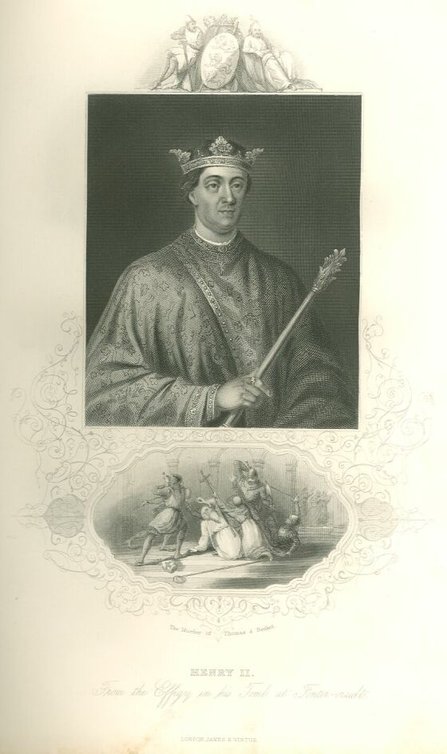
No sooner had Henry breathed his last, than Stephen, insensible to all the ties of gratitude and fidelity, and blind to danger, gave full reins to his criminal ambition; and trusted that, even without any previous intrigue, the celerity of his enterprise, and the boldness of his attempt, might overcome the weak attachment which the English and Normans in that age bore to the laws and to the rights of their sovereign. He hastened over to England, and though the citizens of Dover and those of Canterbury, apprised of his purpose, shut their gates against him, he stopped not till he arrived at London, where some of the lower rank, instigated by his emissaries, as well as moved by his general popularity, immediately saluted him king. His next point was to acquire the good will of the clergy; and by performing the ceremony of his coronation, to put himself in possession of the throne, from which he was confident it would not be easy afterwards to expel him. His brother, the bishop of Winchester, was useful to him in these capital articles; having gained Roger, bishop of Salisbury, who, though he owed a great fortune and advancement to the favor of the late king, preserved no sense of gratitude to that prince's family, he applied, in conjunction with that prelate, to William, archbishop of Canterbury, and required him, in virtue of his office, to give the royal unction to Stephen. The primate, who, as all the others, had sworn fealty to Matilda, refused to perform this ceremony; but his opposition was overcome by an expedient equally dishonorable with the other steps by which this revolution was effected. Hugh Bigod, steward of the household, made oath before the primate, that the late king, on his death-bed, had shown a dissatisfaction with his daughter Matilda, and had expressed his intention of leaving the count of Boulogne heir to all his dominions.[*] William, either believing or feigning to believe Bigod's testimony, anointed Stephen, and put the crown upon his head; and from this religious ceremony, that prince, without any shadow, either of hereditary title or consent of the nobility or people, was allowed to proceed to the exercise of sovereign authority. Very few barons attended his coronation;[**] but none opposed his usurpation, however unjust or flagrant.
The sentiment of religion which, if corrupted into superstition, has often little efficacy in fortifying the duties of civil society, was not affected by the multiplied oaths taken in favor of Matilda, and only rendered the people obedient to a prince who was countenanced by the clergy, and who had received from the primate the rite of royal unction and consecration.[*]
Stephen, that he might further secure his tottering throne passed a charter, in which he made liberal promises to all orders of men; to the clergy, that he would speedily fill all vacant benefices, and would never levy the rents of any of them during the vacancy; to the nobility, that he would reduce the royal forests to their ancient boundaries, and correct all encroachments; and to the people, that he would remit the tax of danegelt, and restore the laws of King Edward.[**] The late king had a great treasure at Winchester, amounting to a hundred thousand pounds; and Stephen, by seizing this money, immediately turned against Henry's family the precaution which that prince had employed for their grandeur and security; an event which naturally attends the policy of amassing treasures. By means of this money, the usurper insured the compliance, though not the attachment, of the principal clergy and nobility; but not trusting to this frail security, he invited over from the continent, particularly from Brittany and Flanders, great numbers of those bravoes, or disorderly soldiers, with whom every country in Europe, by reason of the general ill police and turbulent government, extremely abounded.[***] These mercenary troops guarded his throne by the terrors of the sword; and Stephen, that he might also overawe all malecontents by new and additional terrors of religion, procured a bull from Rome, which ratified his title, and which the pope, seeing this prince in possession of the throne, and pleased with an appeal to his authority in secular controversies, very readily granted him.[****]
1136.
Matilda and her husband Geoffrey were as unfortunate in Normandy as they had been in England. The Norman nobility, moved by an hereditary animosity against the Angevins, first applied to Theobold, count of Blois, Stephen's elder brother for protection and assistance; but hearing afterwards that Stephen had got possession of the English crown, and having, many of them, the same reasons as formerly for desiring a continuance of their union with that kingdom, they transferred their allegiance to Stephen, and put him in possession of their government. Lewis the younger, the reigning king of France, accepted the homage of Eustace, Stephen's eldest son, for the duchy; and the more to corroborate his connections with that family, he betrothed his sister Constantia to the young prince. The count of Blois assigned all his pretensions, and received in lieu of them an annual pension of two thousand marks; and Geoffrey himself was obliged to conclude a truce for two years with Stephen, on condition of the king's paying him, during that time, a pension of five thousand.[*] Stephen, who had taken a journey to Normandy, finished all these transactions in person, and soon after returned to England.
Robert, earl of Glocester, natural son of the late king, was a man of honor and abilities; and as he was much attached to the interests of his sister Matilda, and zealous for the lineal succession, it was chiefly from his intrigues and resistance that the king had reason to dread a new revolution of government. This nobleman, who was in Normandy when he received intelligence of Stephen's accession, found himself much embarrassed concerning the measures which he should pursue in that difficult emergency. To swear allegiance to the usurper appeared to him dishonorable, and a breach of his oath to Matilda: to refuse giving this pledge of his fidelity was to banish himself from England, and be totally incapacitated from serving the royal family, or contributing to their restoration.[**] He offered Stephen to do him homage, and to take the oath of fealty; but with an express condition, that the king should maintain all his stipulations, and should never invade any of Robert's rights or dignities; and Stephen, though sensible that this reserve, so unusual in itself, and so unbefitting the duty of a subject, was meant only to afford Robert a pretence for a revolt on the first favorable opportunity, was obliged by the numerous friends and retainers of that nobleman, to receive him on those terms.[***]
The clergy, who could scarcely at this time be deemed subjects to the crown, imitated that dangerous example: they annexed to their oaths of allegiance this condition, that they were only bound so long as the king defended the ecclesiastical liberties, and supported the discipline of the church.[*] The barons, in return for their submission, exacted terms still more destructive of public peace, as well as of royal authority. Many of them required the right of fortifying their castles, and of putting themselves in a posture of defence; and the king found himself totally unable to refuse his consent to this exorbitant demand.[**] All England was immediately filled with those fortresses, which the noblemen garrisoned either with their vassals, or with licentious soldiers, who flocked to them from all quarters. Unbounded rapine was exercised upon the people for the maintenance of these troops; and private animosities, which had with difficulty been restrained by law, now breaking out without control, rendered England a scene of uninterrupted violence and devastation. Wars between the nobles were carried on with the utmost fury in every quarter; the barons even assumed the right of coining money, and of exercising, without appeal, every act of jurisdiction; [***] and the inferior gentry, as well as the people, finding no defence from the laws during this total dissolution of sovereign authority, were obliged, for their immediate safety, to pay court to some neighboring chieftain, and to purchase his protection, both by submitting to his exactions, and by assisting him in his rapine upon others. The erection of one castle proved the immediate cause of building many others; and even those who obtained not the king's permission, thought that they were entitled, by the great principle of self-preservation, to put themselves on an equal footing with their neighbors, who commonly were also their enemies and rivals. The aristocratical power, which is usually so oppressive in the Feudal governments, had now risen to its utmost height, during the reign of a prince who, though endowed with vigor and abilities, had usurped the throne without the pretence of a title, and who was necessitated to tolerate in others the same violence to which he himself had been holden for his sovereignty.
But Stephen was not of a disposition to submit long to these usurpations, without making some effort for the recovery of royal authority. Finding that the legal prerogatives of the crown were resisted and abridged, he was also tempted to make his power the sole measure of his conduct, and to violate all those concessions which he himself had made on his accession,[*] as well as the ancient privileges of his subjects. The mercenary soldiers, who chiefly supported his authority, having exhausted the royal treasure, subsisted by depredations; and every place was filled with the best grounded complaints against the government. The earl of Glocester, having now settled with his friends the plan of an insurrection, retired beyond sea, sent the king a defiance, solemnly renounced his allegiance, and upbraided him with the breach of those conditions which had been annexed to the oath of fealty sworn by that nobleman.[**]
1137.
David, king of Scotland, appeared at the head of an army in defence of his niece's title, and penetrating into Yorkshire, committed the most barbarous devastations on that country.
1138.
The fury of his massacres and ravages enraged the northern nobility, who might otherwise have been inclined to join him; and William, earl of Albemarle, Robert de Ferrers, William Piercy, Robert de Brus, Roger Moubray, Ilbert Lacy, Walter l'Espee, powerful barons in those parts, assembled an army, with which they encamped at North Allerton, and awaited the arrival of the enemy. A great battle was here fought, called the battle of the Standard, from a high crucifix, erected by the English on a wagon, and carried along with the army as a military ensign. The king of Scots was defeated; and he himself, as well as his son Henry, narrowly escaped falling into the hands of the English. This success overawed the malecontents in England, and might have given some stability to Stephen's throne, had he not been so elated with prosperity as to engage in a controversy with the clergy, who were at that time an overmatch for any monarch.
Though the great power of the church, in ancient times, weakened the authority of the crown, and interrupted the course of the laws, it may be doubted whether, in ages of such violence and outrage, it was not rather advantageous that some limits were set to the power of the sword, both in the hands of the prince and nobles, and that men were taught to pay regard to some principles and privileges.
1139.
The chief misfortune was, that the prelates, on some occasions, acted entirely as barons, employed military power against their sovereign or their neighbors, and thereby often increased those disorders which it was their duty to repress. The bishop of Salisbury, in imitation of the nobility, had built two strong castles, one at Sherborne, another at the Devizes, and had laid the foundations of a third at Malmsbury: his nephew; Alexander, bishop of Lincoln, had erected a fortress at Newark; and Stephen, who was now sensible from experience of the mischiefs attending these multiplied; citadels, resolved to begin with destroying those of the clergy, who by their function seemed less entitled than the barons to such military securities.[*] Making pretence of a fray, which had arisen in court between the retinue of the bishop of Salisbury and that of the earl of Brittany, he seized both that prelate and the bishop of Lincoln, threw them into prison, and obliged them by menaces to deliver up those places of strength which they had lately erected.[**]
Henry, bishop of Winchester, the king's brother, being armed with a legantine commission, now conceived himself to be an ecclesiastical sovereign no less powerful than the civil; and forgetting the ties of blood which connected him with the king, he resolved to vindicate the clerical privileges which, he pretended, were here openly violated. He assembled a synod at Westminster, and there complained of the impiety of Stephen's measures, who had employed violence against the dignitaries of the church, and had not awaited the sentence of a spiritual court, by which alone, he affirmed, they could lawfully be tried and condemned, if their conduct had anywise merited censure or punishment.[***] The synod, ventured to send a summons to the king, charging him to appear before them, and to justify his measures;[****] and Stephen, instead of resenting this indignity, sent Aubrey de Vere to plead his cause before that assembly. De Vere accused; the two prelates of treason and sedition; but the synod refused, to try the cause, or examine their conduct, till those castles of which they had been dispossessed, were previously restored to them.[*****] The bishop of Salisbury declared, that he would appeal to the pope; and had not Stephen and his partisans employed menaces, and even shown a disposition of executing violence by the hands of the soldiery, affairs had instantly come to extremity between the crown and the mitre.[******]
While this quarrel, joined to so many other grievances, increased the discontents among the people, the empress, invited by the opportunity, and secretly encouraged by the legate himself, landed in England, with Robert, earl of Glocester, and a retinue of a hundred and forty knights. She fixed her residence at Arundel Castle, whose gates were opened to her by Adelais, the queen dowager, now married to William de Albini, earl of Sussex; and she excited, by messengers, her partisans to take arms in every county of England. Adelais, who had expected that her daughter-in-law would have invaded the kingdom with a much greater force, became apprehensive of danger; and Matilda, to ease her of her fears, removed first to Bristol, which belonged to her brother Robert, thence to Glocester, where she remained under the protection of Milo, a gallant nobleman in those parts, who had embraced her cause. Soon after, Geoffrey Talbot, William Mohun, Ralph Lovell, William Fitz-John, William Fitz-Alan, Paganell, and many other barons, declared for her; and her party, which was generally favored in the kingdom, seemed every day to gain ground upon that of her antagonist.
Were we to relate all the military events transmitted to us by contemporary and authentic historians, it would be easy to swell our accounts of this reign into a large volume; but those incidents, so little memorable in themselves, and so confused both in time and place, could afford neither instruction nor entertainment to the reader. It suffices to say, that the war was spread into every quarter; and that those turbulent barons, who had already shaken off, in a great measure, the restraint of government, having now obtained the pretence of a public cause, carried on their devastations with redoubled fury, exercised implacable vengeance on each other, and set no bounds to their oppressions over the people. The castles of the nobility were become receptacles of licensed robbers, who, sallying forth day and night, committed spoil on the open country, on the villages, and even on the cities; put the captives to torture, in order to make them reveal their treasures; sold their persons to slavery; and set fire to their houses, after they had pillaged them of every thing valuable. The fierceness of their disposition, leading them to commit wanton destruction, frustrated their rapacity of its purpose; and the property and persons even of the ecclesiastics, generally so much revered, were at last, from necessity, exposed to the same outrage which had laid waste the rest of the kingdom. The land was left untilled; the instruments of husbandry were destroyed or abandoned; and a grievous famine, the natural result of those disorders, affected equally both parties, and reduced the spoilers, as well as the defenceless people, to the most extreme want and indigence.[*]
1140.
After several fruitless negotiations and treaties of peace, which never interrupted these destructive hostilities, there happened at last an event which seemed to promise some end of the public calamities. Ralph, earl of Chester, and his half-brother, William de Roumara, partisans of Matilda, had surprised the Castle of Lincoln; but the citizens, who were better affected to Stephen, having invited him to their aid, that prince laid close siege to the castle, in hopes of soon rendering himself master of the place, either by assault or by famine. The earl of Glocester hastened with an army to the relief of his friends; and Stephen, informed of his approach, took the field with a resolution of giving him battle.
1141.
After a violent shock, the two wings of the royalists were put to flight; and Stephen himself, surrounded by the enemy, was at last, after exerting great efforts of valor, borne down by numbers and taken prisoner. He was conducted to Glocester; and though at first treated with humanity, was soon after, on some suspicion, thrown into prison, and loaded with irons.
Stephen's party was entirely broken by the captivity of their leader, and the barons came in daily from all quarters, and did homage to Matilda. The princess, however, amidst all her prosperity, knew that she was not secure of success, unless she could gain the confidence of the clergy; and as the conduct of the legate had been of late very ambiguous, and showed his intentions to have rather aimed at humbling his brother, than totally ruining him, she employed every endeavor to fix him in her interests. She held a conference with him in an open plain near Winchester; where she promised upon oath, that if he would acknowledge her for sovereign, would recognize her title as the sole descendant of the late king, and would again submit to the allegiance which he, as well as the rest of the kingdom, had sworn to her, he should in return be entire master of the administration, and in particular should, at his pleasure, dispose of all vacant bishoprics and abbeys. Earl Robert, her brother, Brian Fitz-Count, Milo of Glocester, and other great men, became guaranties for her observing these engagements;[*] and the prelate was at last induced to promise her allegiance, but that still burdened with the express condition, that she should on her part fulfil her promises. He then conducted her to Winchester, led her in procession to the cathedral, and with great solemnity, in the presence of many bishops and abbots, denounced curses against all those who cursed her, poured out blessings on those who blessed her granted absolution to such as were obedient to her, and excommunicated such as were rebellious.[**] Theobald, archbishop of Canterbury, soon after came also to court, and swore allegiance to the empress.[***]
Matilda, that she might further insure the attachment of the clergy, was willing to receive the crown from their hands; and instead of assembling the states of the kingdom, the measure which the constitution, had it been either fixed or regarded, seemed necessarily to require, she was content that the legate should summon an ecclesiastical synod, and that her title to the throne should there be acknowledged. The legate, addressing himself to the assembly, told them, that in the absence of the empress, Stephen, his brother, had been permitted to reign, and, previously to his ascending the throne, had seduced them by many fair promises, of honoring and exalting the church, of maintaining the laws, and of reforming all abuses; that it grieved him to observe how much that prince had in every particular been wanting to his engagements; public peace was interrupted, crimes were daily committed with impunity, bishops were thrown into prison and forced to surrender their possessions, abbeys were put to sale, churches were pillaged and the most enormous disorders prevailed in the administration; that he himself, in order to procure a redress of these grievances, had formerly summoned the king before a council of bishops; but instead of inducing him to amend his conduct, had rather offended him by that expedient; that, how much soever misguided, that prince was still his brother, and the object of his affections; but his interests, however, must be regarded as subordinate to those of their heavenly Father, who had now rejected him, and thrown him into the hands of his enemies; that it principally belonged to the clergy to elect and ordain kings; he had summoned them together for that purpose; and having invoked the divine assistance, he now pronounced Matilda, the only descendant of Henry, their late sovereign, queen of England. The whole assembly, by their acclamations or silence, gave or seemed to give, their assent to this declaration.[*]
The only laymen summoned to this council, which decided the fate of the crown, were the Londoners; and even these were required not to give their opinion, but to submit to the decrees of the synod. The deputies of London, however, were not so passive; they insisted that their king should be delivered from prison; but were told by the legate, that it became not the Londoners, who were regarded as noblemen in England, to take part with those barons who had basely forsaken their lord in battle, and who had treated holy church with contumely. It is with reason that the citizens of London assumed so much authority, if it be true, what is related by Fitz-Stephen, a contemporary author, that that city should at this time bring into the field no less than eighty thousand combatants.[**]
London, notwithstanding its great power, and its attachment to Stephen, was at length obliged to submit to Matilda; and her authority, by the prudent conduct of Earl Robert, seemed to be established over the whole kingdom; but affairs remained not long in this situation. That princess, besides the disadvantages of her sex, which weakened her influence over a turbulent and martial people, was of a passionate, imperious spirit, and knew not how to temper with affability the harshness of a refusal. Stephen's queen, seconded by many of the nobility, petitioned for the liberty of her husband; and offered, that, on this condition, he should renounce the crown, and retire into a convent. The legate desired that Prince Eustace, his nephew, might inherit Boulogne and the other patrimonial estates of his father.[*] The Londoners applied for the establishment of King Edward's laws, instead of those of King Henry, which, they said, were grievous and oppressive.[**] All these petitions were rejected in the most haughty and peremptory manner.
The legate, who had probably never been sincere in his compliance with Matilda's government, availed himself of the ill humor excited by this imperious conduct, and secretly instigated the Londoners to a revolt. A conspiracy was entered into to seize the person of the empress, and she saved herself from the danger by a precipitate retreat. She fled to Oxford: soon after she went to Winchester, whither the legate, desirous to save appearances, and watching the opportunity to ruin her cause, had retired. But having assembled all his retainers, he openly joined his force to that of the Londoners, and to Stephen's mercenary troops, who had not yet evacuated the kingdom; and he besieged Matilda in Winchester. The princess, being hard pressed by famine, made her escape; but in the flight, Earl Robert, her brother, fell into the hands of the enemy. This nobleman, though a subject, was as much the life and soul of his own party, as Stephen was of the other: and the empress, sensible of his merit and importance, consented to exchange the prisoners on equal terms. The civil war was again kindled with greater fury than ever.
1142.
Earl Robert, finding the successes on both sides nearly balanced, went over to Normandy, which, during Stephen's captivity, had submitted to the earl of Anjou; and he persuaded Geoffrey to allow his eldest son, Henry, a young prince of great hopes, to take a journey into England, and appear at the head of his partisans.
1143.
This expedient, however, produced nothing decisive. Stephen took Oxford after a long siege: he was defeated by Earl Robert at Wilton; and the empress, though of a masculine spirit, yet being harassed with a variety of good and bad fortune, and alarmed with continual dangers to her person and family, at last retired into Normandy,
1146.
whither she had sent her son some time before. The death of her brother, which happened nearly about the same time, would have proved fatal to her interests, hail not some incidents occurred which checked the course of Stephen's prosperity. This prince, finding that the castles built by the noblemen of his own party encouraged the spirit of independence, and were little less dangerous than those which remained in the hands of the enemy, endeavored to extort from them a surrender of those fortresses and he alienated the affections of many of them by this equitable demand. The artillery, also, of the church, which his brother had brought over to his side, had, after some interval, joined the other party. Eugenius III. had mounted the papal throne; the bishop of Winchester was deprived of the legantine commission, which was conferred on Theobald, archbishop of Canterbury, the enemy and rival of the former legate. That pontiff, also, having summoned a general council at Rheims, in Champagne, instead of allowing the church of England, as had been usual, to elect its own deputies, nominated five English bishops to represent that church, and required their attendance in the council. Stephen, who, notwithstanding his present difficulties, was jealous of the rights of his crown, refused them permission to attend;[*] and the pope, sensible of his advantage in contending with a prince who reigned by a disputed title, took revenge by laying all Stephen's party under an interdict.[**]
1147.
The discontents of the royalists at being thrown into this situation, were augmented by a comparison with Matilda's party, who enjoyed all the benefits of the sacred ordinances; and Stephen was at last obliged, by making proper submissions to the see of Rome, to remove the reproach from his party.[***]
1148.
The weakness of both sides, rather than any decrease of mutual animosity, having produced a tacit cessation of arms in England, many of the nobility, Roger de Moubray, William de Warrenne, and others, finding no opportunity to exert their military ardor at home, enlisted themselves in a new crusade, which, with surprising success after former disappointments and misfortunes, was now preached by St. Barnard.[****] But an event soon after happened which threatened a revival of hostilities in England. Prince Henry, who had reached his sixteenth year, was desirous of receiving the honor of knighthood; a ceremony which every gentleman in that age passed through before he was admitted to the use of arms, and which was even deemed requisite for the greatest princes.
He intended to receive his admission from his great-uncle, David, king of Scotland; and for that purpose he passed through England with a great retinue, and was attended by the most considerable of his partisans. He remained some time with the king of Scotland, made incursions into England, and by his dexterity and vigor in all manly exercises, by his valor in war, and his prudent conduct in every occurrence, he roused the hopes of his party, and gave symptoms of those great qualities which he afterwards displayed when he mounted the throne of England.
1150.
Soon after his return to Normandy, he was, by Matilda's consent, invested in that duchy, and upon the death of his father Geoffrey, which happened in the subsequent year, he took possession both of Anjou and Maine, and concluded a marriage which brought him a great accession of power, and rendered him extremely formidable to his rival. Eleanor, the daughter and heir of William, duke of Guienne, and earl of Poictou, had been married sixteen years to Lewis VII., king of France, and had attended him in a crusade which that monarch conducted against the infidels; but having there lost the affections of her husband, and even fallen under some suspicion of gallantry with a handsome Saracen, Lewis, more delicate than politic, procured a divorce from her, and restored her those rich provinces, which, by her marriage, she had annexed to the crown of France. Young Henry, neither discouraged by the inequality of years, nor by the reports of Eleanor's gallantries, made successful courtship to that princess, and espousing her six weeks after her divorce, got possession of all her dominions as her dowry.
1152.
The lustre which he received from this acquisition, and the prospect of his rising fortune, had such an elect in England, that when Stephen, desirous to insure the crown to his son Eustace, required the archbishop of Canterbury to anoint that prince as his successor, the primate refused compliance, and made his escape beyond sea, to avoid the violence and resentment of Stephen.
1153.
Henry, informed of these dispositions in the people, made an invasion on England: having gained some advantage over Stephen at Malmsbury, and having taken that place, he proceeded thence to throw succors into Wallingford, which the king had advanced with a superior army to besiege. A decisive action was every day expected, when the great men of both sides, terrified at the prospect of further bloodshed and confusion, interposed with their good offices, and set on foot a negotiation between the rival princes, The death of Eustace, during the course of the treaty, facilitated its conclusion: an accommodation was settled, by which it was agreed that Stephen should possess the crown during his lifetime, that justice should be administered in his name, even in the provinces which had submitted to Henry, and that this latter prince should, on Stephen's demise, succeed to the kingdom, and William, Stephen's son, to Boulogne and his patrimonial estate. After all the barons had sworn to the observance of this treaty, and done homage to Henry, as to the heir of the crown, that prince evacuated the kingdom; and the death of Stephen which happened next year, [October 25, 1154,] after a short illness, prevented all those quarrels and jealousies which were likely to have ensued in so delicate a situation.
England suffered great miseries during the reign of this prince: but his personal character, allowing for the temerity and injustice of his usurpation, appears not liable to any great exception; and he seems to have been well qualified, had he succeeded by a just title, to have promoted the happiness and prosperity of his subjects.[*] He was possessed of industry, activity, and courage, to a great degree; though not endowed with a sound judgment, he was not deficient in abilities; he had the talent of gaining men's affections, and notwithstanding his precarious situation, he never indulged himself in the exercise of any cruelty or revenge. His advancement to the throne procured him neither tranquillity nor happiness; and though the situation of England prevented the neighboring states from taking any durable advantage of her confusions, her intestine disorders were to the last degree ruinous and destructive. The court of Rome was also permitted, during those civil wars, to make further advances in her usurpations; and appeals to the pope, which had always been strictly prohibited by the English laws, became now common in every ecclesiastical controversy.
1154.
The extensive confederacies, by which the European potentates are now at once united and set in opposition to each other, and which, though they are apt to diffuse the least spark of dissension throughout the whole, are at least attended with this advantage, that they prevent any violent revolutions or conquests in particular states, were totally unknown in ancient ages; and the theory of foreign politics in each kingdom formed a speculation much less complicated and involved than at present. Commerce had not yet bound together the most distant nations in so close a chain: wars, finished in one campaign, and often in one battle, were little affected by the movements of remote states: the imperfect communication among the kingdoms, and their ignorance of each other's situation, made it impracticable for a great number of them to combine in one object or effort: and above all, the turbulent spirit and independent situation of the barons or great vassals in each state, gave so much occupation to the sovereign, that he was obliged to confine his attention chiefly to his own state and his own system of government, and was more indifferent about what passed among his neighbors. Religion alone, not politics, carried abroad the views of princes, while it either fixed their thoughts on the Holy Land, whose conquest and defence was deemed a point of common honor and interest, or engaged them in intrigues with the Roman pontiff, to whom they had yielded the direction of ecclesiastical affairs, and who was every day assuming more authority than they were willing to allow him.
Before the conquest of England by the duke of Normandy, this island was as much separated from the rest of the world in politics as in situation; and except from the inroads of the Danish pirates, the English, happily confined at home, had neither enemies nor allies on the continent. The foreign dominions of William connected them with the king and great vassals of France; and while the opposite pretensions of the pope and emperor in Italy produced a continual intercourse between Germany and that country, the two great monarchs of France and England formed, in another part of Europe, a separate system, and carried on their wars and negotiations, without meeting either with opposition or support from the others.
On the decline of the Carlovingian race, the nobles in every province of France, taking advantage of the weakness of the sovereign, and obliged to provide each for his own defence against the ravages of the Norman freebooters, had assumed, both in civil and military affairs, an authority almost independent, and had reduced within very narrow limits the prerogative of their princes. The accession of Hugh Capet, by annexing a great fief to the crown, had brought some addition to the royal dignity; but this fief, though considerable for a subject, appeared a narrow basis of power for a prince who was placed at the head of so great a community. The royal demesnes consisted only of Paris, Orleans, Estampes, Compiegne, and a few places scattered over the northern provinces: in the rest of the kingdom, the prince's authority was rather nominal than real: the vassals were accustomed, nay, entitled, to make war, without his permission, on each other: they were even entitled, if they conceived themselves injured, to turn their arms against their sovereign: they exercised all civil jurisdiction, without appeal, over their tenants and inferior vassals: their common jealousy of the crown easily united them against any attempt on their exorbitant privileges; and as some of them had attained the power and authority of great princes, even the smallest baron was sure of immediate and effectual protection. Besides six ecclesiastical peerages, which, with the other immunities of the church, cramped extremely the general execution of justice, there were six lay peerages, Burgundy, Normandy Guienne, Flanders, Toulouse, and Champagne, which formed very extensive and puissant sovereignties. And though the combination of all those princes and barons could on urgent occasions, muster a mighty power, yet was it very difficult to set that great machine in movement; it was almost impossible to preserve harmony in its parts; a sense of common interest alone could, for a time, unite them under their sovereign against a common enemy; but if the king attempted to turn the force of the community against any mutinous vassal, the same sense of common interest made the others oppose themselves to the success of his pretensions. Lewis the Gross, the last sovereign, marched, at one time, to his frontiers against the Germans at the head of an army of two hundred thousand men; but a petty lord of Corbeil, of Puiset, of Couci, was able, at another period, to set that prince at defiance, and to maintain open war against him.
The authority of the English monarch was much more extensive within his kingdom, and the disproportion much greater between him and the most powerful of his vassals. His demesnes and revenue were large, compared to the greatness of his state: he was accustomed to levy arbitrary exactions on his subjects: his courts of judicature extended their jurisdiction into every part of the kingdom: he could crush by his power, or by a judicial sentence, well or ill founded, any obnoxious baron: and though the feudal institutions, which prevailed in his kingdom, had the same tendency, as in other states, to exalt the aristocracy and depress the monarchy, it required in England, according to its present constitution, a great combination of the vassals to oppose their sovereign lord, and there had not hitherto arisen any baron so powerful, as of himself to levy war against the prince, and to afford protection to the inferior barons.
While such were the different situations of France and England, and the latter enjoyed so many advantages above the former, the accession of Henry II., a prince of great abilities, possessed of so many rich provinces on the continent, might appear an event dangerous, if not fatal to the French monarchy, and sufficient to break entirely the balance between the states. He was master, in the right of his father, of Anjou and Touraine; in that of his mother, of Normandy and Maine; in that of his wife, of Guienne, Poictou, Xaintonge, Auvergne, Perigord, Angoumois, the Limousin. He soon after annexed Brittany to his other states, and was already possessed of the superiority over that province, which, on the first cession of Normandy to Rollo the Dane, had been granted by Charles the Simple in vassalage to that formidable ravager. These provinces composed above a third of the whole French monarchy, and were much superior, in extent and opulence, to those territories which were subjected to the immediate jurisdiction and government of the king. The vassal was here more powerful than his liege lord: the situation which had enabled Hugh Capet to depose the Carlovingian princes, seemed to be renewed, and that with much greater advantages on the side of the vassal: and when England was added to so many provinces, the French king had reason to apprehend, from this conjuncture, some great disaster to himself and to his family. But, in reality, it was this circumstance, which appeared so formidable, that saved the Capetian race, and, by its consequences, exalted them to that pitch of grandeur which they at present enjoy.
The limited authority of the prince in the feudal constitutions, prevented the king of England from employing with advantage the force of so many states which were subjected to his government; and these different members, disjoined in situation, and disagreeing in laws, language, and manners, were never thoroughly cemented into one monarchy. He soon became, both from his distant place of residence and from the incompatibility of interests, a kind of foreigner to his French dominions; and his subjects on the continent considered their allegiance as more naturally due to their superior lord, who lived in their neighborhood, and who was acknowledged to be the supreme head of their nation. He was always at hand to invade them; their immediate lord was often at too great a distance to protect them; and any disorder in any part of his dispersed dominions gave advantages against him The other powerful vassals of the French crown were rather pleased to see the expulsion of the English, and were not affected with that jealousy which would have arisen from the oppression of a co-vassal who was of the same rank with themselves. By this means, the king of France found it more easy to conquer those numerous provinces from England than to subdue a duke of Normandy or Guienne, a count of Anjou, Maine, or Poietou. And after reducing such extensive territories, which immediately incorporated with the body of the monarchy, he found greater facility in uniting to the crown the other great fiefs which still remained separate and independent.
But as these important consequences could not be foreseen by human wisdom, the king of France remarked with terror the rising grandeur of the house of Anjou or Plantagenet; and in order to retard its progress, he had ever maintained a strict union with Stephen, and had endeavored to support the tottering fortunes of that bold usurper. But after this prince's death, it was too late to think of opposing the succession of Henry, or preventing the performance of those stipulations which, with the unanimous consent of the nation, he had made with his predecessor. The English, harassed with civil wars, and disgusted with the bloodshed and depredations which, during the course of so many years, had attended them were little disposed to violate their oaths, by excluding the lawful heir from the succession of their monarchy.* Many of the most considerable fortresses were in the hands of his partisans; the whole nation had had occasion to see the noble qualities with which he was endowed, and to compare them with the mean talents of William, the son of Stephen; and as they were acquainted with his great power, and were rather pleased to see the accession of so many foreign dominions to the crown of England, they never entertained the least thoughts of resisting him. Henry himself, sensible of the advantages attending his present situation, was in no hurry to arrive in England; and being engaged in the siege of a castle on the frontiers of Normandy, when he received intelligence of Stephen's death, he made it a point of honor not to depart from his enterprise till he had brought it to an issue. He then set out on his journey, and was received in England with the acclamations of all orders of men, who swore with pleasure the oath of fealty and allegiance to him.
1155.
The first act of Henry's government corresponded to the high idea entertained of his abilities, and prognosticated the reestablishment of justice and tranquillity, of which the kingdom had so long been bereaved. He immediately dismissed all those mercenary soldiers who had committed great disorders in the nation; and he sent them abroad, together with William of Ypres, their leader, the friend and confidant of Stephen. He revoked all the grants made by his predecessor, even those which necessity had extorted from the empress Matilda; and that princess, who had resigned her rights in favor of Henry, made no opposition to a measure so necessary for supporting the dignity of the crown. He repaired the coin, which had been extremely debased during the reign of his predecessor; and he took proper measures against the return of a like abuse. He was rigorous in the execution of justice, and in the suppression of robbery and violence; and that he might restore authority to the laws, he caused all the new erected castles to be demolished, which had proved so many sanctuaries to freebooters and rebels. The earl of Albemarle, Hugh Mortimer, and Roger the son of Milo of Glocester, were inclined to make some resistance to this salutary measure; but the approach of the king with his forces soon obliged them to submit.
1156.
Everything being restored to full tranquillity in England, Henry went abroad in order to oppose the attempts of his brother Geoffrey, who, during his absence, had made an incursion into Anjou and Maine,
1157.
had advanced some pretensions to those provinces, and had got possession of a considerable part of them. On the king's appearance, the people returned to their allegiance; and Geoffrey, resigning his claim for an annual pension of a thousand pounds, departed and took possession of the county of Nantz, which the inhabitants, who had expelled Count Iloel, their prince, had put into his hands. Henry returned to England the following year: the incursions of the Welsh then provoked him to make an invasion upon them; where the natural fastnesses of the country occasioned him great difficulties, and even brought him into danger. His vanguard, being engaged in a narrow pass, was put to rout: Henry de Essex, the hereditary standard-bearer, seized with a panic, threw down the standard, took to flight, and exclaimed that the king was slain; and had not the prince immediately appeared in person, and led on his troops with great gallantry, the consequences might have proved fatal to the whole army. For this misbehavior, Essex was afterwards accused of felony by Robert de Montfort; was vanquished in single combat; his estate was confiscated; and he himself was thrust into a convent. The submissions of the Welsh procured them an accommodation with England.
1158.
The martial disposition of the princes in that age engaged them to head their own armies in every enterprise, even the most frivolous; and their feeble authority made it commonly impracticable for them to delegate, on occasion, the command to their generals. Geoffrey, the king's brother, died soon after he had acquired possession of Nantz; though he had no other title to that county than the voluntary submission or election of the inhabitants two years before, Henry laid claim to the territory as devolved to him by hereditary right, and he went over to support his pretensions by force of arms. Conan, duke or earl of Brittany (for these titles are given indifferently by historians to those princes) pretended that Nantz had been lately separated by rebellion from his principality, to which of right it belonged; and immediately on Geoffrey's death, he took possession of the disputed territory. Lest Lewis, the French king, should interpose in the controversy, Henry paid him a visit; and so allured him by caresses and civilities, that an alliance was contracted between them; and they agreed that young Henry, heir to the English monarchy, should be affianced to Margaret of France, though the former was only five years of age; the latter was still in her cradle. Henry, now secure of meeting with no interruption on this side, advanced with his army into Brittany; and Conan, in despair of being able to make resistance, delivered up the county of Nantz to him. The able conduct of the king procured him further and more important advantages from this incident. Conan, harassed with the turbulent disposition of his subjects, was desirous of procuring to himself the support of so great a monarch; and he betrothed his daughter and only child, yet an infant, to Geoffrey, the king's third son, who was of the same tender years. The duke of Brittany died about seven years after; and Henry, being mesne lord and also natural guardian to his son and daughter-in-law, put himself in possession of that principality, and annexed it for the present to his other great dominions.
1159.
The king had a prospect of making still further acquisitions; and the activity of his temper suffered no opportunity of that kind to escape him. Philippa, duchess of Guienne, mother of Queen Eleanor, was the only issue of William IV., count of Toulouse; and would have inherited his dominions, had not that prince, desirous of preserving the succession in the male line, conveyed the principality to his brother Raymond de St. Gilles, by a contract of sale which was in that age regarded as fictitious and illusory. By this means the title to the county of Toulouse came to be disputed between the male and female heirs; and the one or the other, as opportunities favored them, had obtained possession. Raymond, grandson of Raymond de St. Gilles was the reigning sovereign; and on Henry's reviving his wife's claim, this prince had recourse for protection to the king of France, who was so much concerned in policy to prevent the further aggrandizement of the English monarch. Lewis himself, when married to Eleanor, had asserted the justice of her claim, and had demanded possession of Toulouse; but his sentiments changing with his interest, he now determined to defend, by his power and authority, the title of Raymond. Henry found that it would be requisite to support his pretensions against potent antagonists; and that nothing but a formidable army could maintain a claim which he had in vain asserted by arguments and manifestoes.
An army composed of feudal vassals was commonly very intractable and undisciplined, both because of the independent spirit of the persons who served in it, and because the commands were not given either by the choice of the sovereign or from the military capacity and experience of the officers. Each baron conducted his own vassals: his rank was greater or less, proportioned to the extent of his property: even the supreme command under the prince was often attached to birth; and as the military vassals were obliged to serve only forty days at their own charge, though, if the expedition were distant, they were put to great expense, the prince reaped little benefit from their attendance. Henry, sensible of these inconveniences, levied upon his vassals in Normandy and other provinces, which were remote from Toulouse, a sum of money in lieu of their service; and this commutation, by reason of the great distance, was still more advantageous to his English vassals. He imposed, therefore, a scutage of one hundred and eighty thousand pounds on the knights' fees, a commutation to which, though it was unusual, and the first perhaps to be met with in history,[*] 16 the military tenants willingly submitted; and with this money he levied an army which was more under his command, and whose service was more durable and constant.
Assisted by Berenger, count of Barcelona, and Trincaval, count of Nismes, whom he had gained to his party, he invaded the county of Toulouse; and after taking Verdun, Castlenau, and other places, he besieged the capital of the province, and was likely to prevail in the enterprise; when Lewis, advancing before the arrival of his main body, threw himself into the place with a small reenforcement. Henry was urged by some of his ministers to prosecute the siege, to take Lewis prisoner, and to impose his own terms in the pacification; but he either thought it so much his interest to maintain the feudal principles, by which his foreign dominions were secured, or bore so much respect to his superior lord, that he declared he would not attack a place defended by him in person; and he immediately raised the siege. He marched into Normandy to protect that province against an incursion which the count of Dreux, instigated by King Lewis, his brother, had made upon it. War was now openly carried on between the two monarchs, but produced no memorable event: it soon ended in a cessation of arms, and that followed by a peace, which was not, however, attended with any confidence or good correspondence between those rival princes.
1160.
The fortress of Gisors, being part of the dowry stipulated to Margaret of France, had been consigned by agreement to the knights templars, on condition that it should be delivered into Henry's hands after the celebration of the nuptials. The king, that he might have a pretence for immediately demanding the place, ordered the marriage to be solemnized between the prince and princess, though both infants; and he engaged the grand master of the templars, by large presents, as was generally suspected, to put him in possession of Gisors.[*]
1161.
Lewis, resenting this fraudulent conduct, banished the templars, and would have made war upon the king of England, had it not been for the mediation and authority of Pope Alexander III., who had been chased from Rome by the antipope, Victor IV., and resided at that time in France.
1162.
Henry, soon after he had accommodated his differences with Lewis by the pope's mediation, returned to England; where he commenced an enterprise, which, though required by sound policy, and even conducted in the main with prudence, bred him great disquietude, involved him in danger, and was not concluded without some loss and dishonor.
The usurpations of the clergy, which had at first been gradual, were now become so rapid, and had mounted to such a height, that the contest between the regale and pontificale was really arrived at a crisis in England; and it became necessary to determine whether the king or the priests, particularly the archbishop of Canterbury, should be sovereign of the kingdom. The aspiring spirit of Henry, which gave inquietude to all his neighbors, was not likely long to pay a tame submission to the encroachments of subjects; and as nothing opens the eyes of men so readily as their interest, he was in no danger of falling, in this respect, into that abject superstition which retained his people in subjection. From the commencement of his reign, in the government of his foreign dominions, as well as of England, he had shown a fixed purpose to repress clerical usurpations, and to maintain those prerogatives which had been transmitted to him by his predecessors. During the schism of the papacy between Alexander and Victor, he had determined, for some time, to remain neuter; and when informed that the archbishop of Rouen and the bishop of Mans had, from their own authority, acknowledged Alexander as legitimate pope, he was so enraged, that, though he spared the archbishop on account of his great age, he immediately issued orders for overthrowing the houses of the bishop of Mans and archdeacon of Rouen;[*] 17 and it was not till he had deliberately examined the matter, by those views which usually enter into the councils of princes, that he allowed that pontiff to exercise authority over any of his dominions.
In England, the mild character and advanced years of Theobald, archbishop of Canterbury, together with his merits in refusing to put the crown on the head of Eustace, son of Stephen, prevented Henry, during the lifetime of that primate, from taking any measures against the multiplied encroachments of the clergy; but after his death, the king resolved to exert himself with more activity; and that he might be secure against any opposition, he advanced to that dignity Becket, his chancellor, on whose compliance he thought he could entirely depend.
Thomas à Becket, the first man of English descent who, since the Norman conquest, had, during the course of a whole century, risen to any considerable station, was born of reputable parents in the city of London; and being endowed both with industry and capacity, he early insinuated himself into the favor of Archbishop Theobald, and obtained from that prelate some preferments and offices. By their means he was enabled to travel for improvement to Italy, where he studied the civil and canon law at Bologna; and on his return he appeared to have made such proficiency in knowledge, that he was promoted by his patron to the archdeaconry of Canterbury, an office of considerable trust and profit. He was afterwards employed with success by Theobald in transacting business at Rome; and on Henry's accession, he was recommended to that monarch as worthy of further preferment Henry, who knew that Becket had been instrumental in supporting that resolution of the archbishop, which had tended so much to facilitate his own advancement to the throne, was already prepossessed in his favor; and finding on further acquaintance, that his spirit and abilities entitled him to any trust he soon promoted him to the dignity of chancellor, one of the first civil offices in the kingdom. The chancellor, in that age, besides the custody of the great seal, had possession of all vacant prelacies and abbeys; he was the guardian of all such minors and pupils as were the king's tenants; all baronies which escheated to the crown were under his administration; he was entitled to a place in council, even though he were not particularly summoned; and as he exercised also the office of secretary of state, and it belonged to him to countersign all commissions, writs, and letters patent, he was a kind of prime minister and was concerned in the despatch of every business of importance. Besides exercising this high office, Becket by the favor of the king or archbishop, was made provost of Beverley, dean of Hastings, and constable of the Tower: he was put in possession of the honors of Eye and Berkham large baronies that had escheated to the crown; and to complete his grandeur, he was intrusted with the education of Prince Henry, the king's eldest son, and heir of the monarchy. The pomp of his retinue, the sumptuousness of his furniture, the luxury of his table, the munificence of his presents, corresponded to these great preferments; or rather exceeded any thing that England had ever before seen in any subject. His historian and secretary, Fitz-Stephens, mentions, among other particulars, that his apartments were every day in winter covered with clean straw or hay, and in summer with green rushes or boughs, lest the gentlemen who paid court to him and who could not, by reason of their great number, find a place at table, should soil their fine clothes by sitting on a dirty floor.[*] A great number of knights were retained in his service; the greatest barons were proud of being received at his table; his house was a place of education for the sons of the chief nobility; and the king himself frequently vouchsafed to partake of his entertainments. As his way of life was splendid and opulent, his amusements and occupations were gay, and partook of the cavalier spirit, which, as he had only taken deacon's orders, he did not think unbefitting his character. He employed himself at leisure hours in hunting, hawking, gaming, and horsemanship; he exposed his person in several military actions; he carried over, at his own charge, seven hundred knights to attend the king in his wars at Toulouse; in the subsequent wars on the frontiers of Normandy, he maintained, during forty days, twelve hundred knights, and four thousand of their train; and in an embassy to France, with which he was intrusted, he astonished that court by the number and magnificence of his retinue.
Henry, besides committing all his more important business to Becket's management, honored him with his friendship and intimacy; and whenever he was disposed to relax himself by sports of any kind, he admitted his chancellor to the party. An instance of their familiarity is mentioned by Fitz-Stephens which, as it shows the manners of the age, it may not be improper to relate. One day, as the king and the chancellor were riding together in the streets of London, they observed a beggar, who was shivering with cold. "Would it not be very praiseworthy," said the king, "to give that poor man a warm coat in this severe season?" "It would, surely," replied the chancellor; "and you do well, sir, in thinking of such good actions." "Then he shall have one presently," cried the king; and seizing the skirt of the chancellor's coat, which was scarlet, and lined with ermine, began to pull it violently. The chancellor defended himself for some time; and they had both of them like to have tumbled off their horses in the street, when Becket, after a vehement struggle, let go his coat; which the king bestowed on the beggar, who, being ignorant of the quality of the persons, was not a little surprised at the present.
Becket, who, by his complaisance and good humor, had rendered himself agreeable, and by his industry and abilities useful, to his master, appeared to him the fittest person for supplying the vacancy made by the death of Theobold. As he was well acquainted with the king's intentions of retrenching, or rather confining within the ancient bounds, all ecclesiastical privileges, and always showed a ready disposition to comply with them, Henry, who never expected any resistance from that quarter, immediately issued orders for electing him archbishop of Canterbury. But this resolution, which was taken contrary to the opinion of Matilda, and many of the ministers, drew after it very unhappy consequences; and never prince of so great penetration appeared, in the issue, to have so little understood the genius and character of his minister.
No sooner was Becket installed in this high dignity, which rendered him for life the second person in the kingdom, with some pretensions of aspiring to be the first, than he totally altered his demeanor and conduct, and endeavored to acquire the character of sanctity, of which his former busy and ostentatious course of life might, in the eyes of the people, have naturally bereaved him. Without consulting the king, he immediately returned into his hands the commission of chancellor; pretending that he must thenceforth detach himself from secular affairs, and be solely employed in the exercise of his spiritual function; but in reality, that he might break off all connections with Henry, and apprise him that Becket, as primate of England, was now become entirely a new personage. He maintained, in his retinue and attendants alone, his ancient pomp and lustre, which was useful to strike the vulgar; in his own person he affected the greatest austerity and most rigid mortification, which he was sensible would have an equal or a greater tendency to the same end. He wore sackcloth next his skin, which, by his affected care to conceal it, was necessarily the more remarked by all the world: he changed it so seldom, that it was filled with dirt and vermin: his usual diet was bread; his drink water, which he even rendered further unpalatable by the mixture of unsavory herbs: he tore his back with the frequent discipline which he inflicted on it: he daily on his knees washed, in imitation of Christ, the feet of thirteen beggars, whom he afterwards dismissed with presents: he gained the affections of the monks by his frequent charities to the convents and hospitals: every one who made profession of sanctity, was admitted to his conversation, and returned full of panegyrics on the humility, as well as on the piety and mortification, of the holy primate: he seemed to be perpetually employed in reciting prayers and pious lectures, or in perusing religious discourses: his aspect wore the appearance of seriousness, and mental recollection, and secret devotion; and all men of penetration plainly saw that he was meditating some great design, and that the ambition and ostentation of his character had turned itself towards a new and a more dangerous object.
1163.
Becket waited not till Henry should commence those projects against the ecclesiastical power, which he knew had been formed by that prince: he was himself the aggressor, and endeavored to overawe the king by the intrepidity and boldness of his enterprises. He summoned the earl of Clare to surrender the barony of Tunbridge, which, ever since the conquest, had remained in the family of that nobleman, but which, as it had formerly belonged to the see of Canterbury, Becket pretended his predecessors were prohibited by the canons to alienate. The earl of Clare, besides the lustre which he derived from the greatness of his own birth and the extent of his possessions, was allied to all the principal families in the kingdom; his sister, who was a celebrated beauty, had further extended his credit among the nobility and was even supposed to have gained the king's affections; and Becket could not better discover, than by attacking so powerful an interest, his resolution of maintaining with vigor the rights, real or pretended, of his see.
William de Eynsford, a military tenant of the crown, was patron of a living which belonged to a manor that held of the archbishop of Canterbury; but Becket, without regard to William's right, presented, on a new and illegal pretext, one Laurence to that living, who was violently expelled by Eynsford. The primate, making himself, as was usual in spiritual courts, both judge and party, issued in a summary manner the sentence of excommunication against Eynsford, who complained to the king, that he, who held "in capite" of the crown, should, contrary to the practice established by the Conqueror, and maintained ever since by his successors, be subjected to that terrible sentence without the previous consent of the sovereign. Henry, who had now broken off all personal intercourse with Becket, sent him, by a messenger, his orders to absolve Eynsford; but received for answer, that it belonged not for the king to inform him whom he should absolve and whom excommunicate; and it was not till after many remonstrances and menaces that Becket, though with the worst grace imaginable, was induced to comply with the royal mandate.
Henry, though he found himself thus grievously mistaken in the character of the person whom he had promoted to the primacy, determined not to desist from his former intention of retrenching clerical usurpations. He was entirely master of his extensive dominions: the prudence and vigor of his administration, attended with perpetual success, had raised his character above that of any of his predecessors: the papacy seemed to be weakened by a schism which divided all Europe; and he rightly judged that, if the present favorable opportunity were neglected, the crown must, from the prevalent superstition of the people, be in danger of falling into entire subordination under the mitre.
The union of the civil and ecclesiastical power serves extremely, in every civilized government, to the maintenance of peace and order; and prevents those mutual encroachments which, as there can be no ultimate judge between them, are often attended with the most dangerous consequences Whether the supreme magistrate who unites these powers receives the appellation of prince or prelate, is not material. The superior weight which temporal interests commonly bear in the apprehensions of men above spiritual, renders the civil part of his character most prevalent; and in time prevents those gross impostures and bigoted persecutions which, in all false religions, are the chief foundation of clerical authority. But during the progress of ecclesiastical usurpations, the state, by the resistance of the civil magistrate, is naturally thrown into convulsions; and it behoves the prince, both for his own interest and for that of the public, to provide in time sufficient barriers against so dangerous and insidious a rival. This precaution had hitherto been much neglected in England, as well as in other Catholic countries; and affairs at last seemed to have come to a dangerous crisis: a sovereign of the greatest abilities was now on the throne: a prelate of the most inflexible and intrepid character was possessed of the primacy: the contending powers appeared to be armed with their full force and it was natural to expect some extraordinary event to result from their conflict.
Among their other inventions to obtain money, the clergy had inculcated the necessity of penance as an atonement for sin; and having again introduced the practice of paying them large sums as a commutation, or species of atonement for the remission of those penances, the sins of the people, by these means, had become a revenue to the priests; and the king computed, that by this invention alone they levied more money upon his subjects than flowed, by all the funds and taxes, into the royal exchequer. That he might ease the people of so heavy and arbitrary an imposition, Henry required that a civil officer of his appointment should be present in all ecclesiastical courts, and should, for the future, give his consent to every composition which was made with sinners for their spiritual offences.
The ecclesiastics in that age had renounced all immediate subordination to the magistrate: they openly pretended to an exemptior, in criminal accusations, from a trial before courts of justice; and were gradually introducing a like exemption in civil causes: spiritual penalties alone could be inflicted on their offences; and as the clergy had extremely multiplied in England, and many of them were consequently of very low characters, crimes of the deepest dye—murders, robberies, adulteries, rapes—were daily committed with impunity by the ecclesiastics. It had been found, for instance, on inquiry, that no less than a hundred murders had, since the king's accession, been perpetrated by men of that profession, who had never been called to account for these offences; and holy orders were become a full protection for all enormities. A clerk in Worcestershire, having debauched a gentleman's daughter, had, at this time, proceeded to murder the father; and the general indignation against this crime moved the king to attempt the remedy of an abuse which was become so palpable, and to require that the clerk should be delivered up, and receive condign punishment from the magistrate. Becket insisted on the privileges of the church; confined the criminal in the bishop's prison, lest he should be seized by the king's officers; maintained that no greater punishment could be inflicted on him than degradation; and when the king demanded that, immediately after he was degraded, he should be tried by the civil power, the primate asserted that it was iniquitous to try a man twice upon the same accusation, and for the same offence.
Henry, laying hold of so plausible a pretence, resolved to push the clergy with regard to all their privileges, which they had raised to an enormous height, and to determine at once those controversies which daily multiplied between the civil and the ecclesiastical jurisdictions. He summoned an assembly of all the prelates in England; and he put to them this concise and decisive question, whether or not they were willing to submit to the ancient laws and customs of the kingdom? The bishops unanimously replied, that they were willing, "saving their own order;" a device by which they thought to elude the present urgency of the king's demand, yet reserve to themselves, on a favorable opportunity, the power of resuming all their pretensions. The king was sensible of the artifice, and was provoked to the highest indignation. He left the assembly with visible marks of his displeasure: he required the primate instantly to surrender the honors and castles of Eye and Berkham: the bishops were terrified, and expected still further effects of his resentment. Becket alone was inflexible; and nothing but the interposition of the pope's legate and almoner, Philip, who dreaded a breach with so powerful a prince at so unseasonable a juncture, could have prevailed on him to retract the saving clause, and give a general and absolute promise of observing the ancient customs.
But Henry was not content with a declaration in these general terms; he resolved, ere it was too late, to define expressly those customs with which he required compliance, and to put a stop to clerical usurpations, before they were fully consolidated, and could plead antiquity, as they already did a sacred authority, in their favor. The claims of the church were open and visible. After a gradual and insensible progress during many centuries, the mask had at last been taken off, and several ecclesiastical councils, by their canons, which were pretended to be irrevocable and infallible, had positively defined those privileges and immunities which gave such general offence, and appeared so dangerous to the civil magistrate. Henry, therefore, deemed it necessary to define with the same precision the limits of the civil power; to oppose his legal customs to their divine ordinances; to determine the exact boundaries of the rival jurisdictions; and for this purpose he summoned a general council of the nobility and prelates at Clarendon, to whom he submitted this great and important question. [15th Jan. 1164.]
The barons were all gained to the king's party, either by the reasons which he urged, or by his superior authority. The bishops were overawed by the general combination against them; and the following laws, commonly called the "Constitutions of Clarendon," were voted without opposition by this assembly. It was enacted, that all suits concerning the advowson and presentation of churches should be determined in the civil courts: that the churches, belonging to the king's fee, should not be granted in perpetuity without his consent; that clerks, accused of any crime, should be tried in the civil courts: that no person, particularly no clergyman of any rank, should depart the kingdom without the king's license: that excommunicated persons should not be bound to give security for continuing in their present place of abode: that laics should not be accused in spiritual courts, except by legal and reputable promoters and witnesses: that no chief tenant of the crown should be excommunicated, nor his lands be put under an interdict, except with the king's consent: that all appeals in spiritual causes should be carried from the archdeacon to the bishop, from the bishop to the primate, from him to the king; and should be carried no farther without the king's consent: that if any lawsuit arose between a layman and a clergyman concerning a tenant, and it be disputed whether the land be a lay or an ecclesiastical fee, it should first be determined by the verdict of twelve lawful men to what class it belonged; and if it be found to be a lay fee, the cause should finally be determined in the civil courts: that no inhabitant in demesne should be excommunicated for non-appearance in a spiritual court, till the chief officer of the place where he resides be consulted, that he may compel him by the civil authority to give satisfaction to the church: that the archbishops, bishops, and other spiritual dignitaries, should be regarded as barons of the realm; should possess the privileges and be subjected to the burdens belonging to that rank; and should be bound to attend the king in his great councils, and assist at all trials, till the sentence, either of death or loss of members, be given against the criminal: that the revenue of vacant sees should belong to the king; the chapter, or such of them as he pleases to summon, should sit in the king's chapel till they made the new election with his consent, and that the bishop elect should do homage to the crown: that if any baron or tenant "in capite" should refuse to submit to the spiritual courts, the king should employ his authority in obliging him to make such submissions; if any of them throw off his allegiance to the king, the prelates should assist the king with their censures in reducing him: that goods forfeited to the king should not be protected in churches or churchyards: that the clergy should no longer pretend to the right of enforcing payment of debts contracted by oath or promise; but should leave these lawsuits, equally with others, to the determination of the civil courts; and that the sons of villains should not be ordained clerks, without the consent of their lord.
These articles, to the number of sixteen, were calculated to prevent the chief abuses which had prevailed in ecclesiastical affairs, and to put an effectual stop to the usurpations of the church, which, gradually stealing on, had threatened the total destruction of the civil power. Henry, therefore, by reducing those ancient customs of the realm to writing, and by collecting them in a body, endeavored to prevent all future dispute with regard to them; and by passing so many ecclesiastical ordinances in a national and civil assembly, he fully established the superiority of the legislature above all papal decrees or spiritual canons, and gained a signal victory over the ecclesiastics. But as he knew that the bishops, though overawed by the present combination of the crown and the barons, would take the first favorable opportunity of denying the authority which had enacted these constitutions, he resolved that they should all set their seal to them, and give a promise to observe them. None of the prelates dared to oppose his will, except Becket, who, though urged by the earls of Cornwall and Leicester, the barons of principal authority in the kingdom, obstinately withheld his assent. At last, Richard de Hastings, grand prior of the templars in England, threw himself on his knees before him, and with many tears entreated him, if he paid any regard either to his own safety or that of the church, not to provoke, by a fruitless opposition, the indignation of a great monarch, who was resolutely bent on his purpose, and who was determined to take full revenge on every one that should dare to oppose him. Becket, finding himself deserted by all the world, even by his own brethren, was at last obliged to comply; and he promised, "legally, with good faith, and without fraud or reserve," to observe the constitutions; and he took an oath to that purpose. The king, thinking that he had now finally prevailed in this great enterprise, sent the constitutions to Pope Alexander, who then resided in France; and he required that pontiff's ratification of them; but Alexander, who, though he had owed the most important obligations to the king, plainly saw that these laws were calculated to establish the independency of England on the papacy, and of the royal power on the clergy, condemned them in the strongest terms; abrogated, annulled, and rejected them. There were only six articles, the least important, which, for the sake of peace, he was willing to ratify.
Becket, when he observed that he might hope for support in an opposition, expressed the deepest sorrow for his compliance; and endeavored to engage all the other bishops in a confederacy to adhere to their common rights, and to the ecclesiastical privileges, in which he represented the interest and honor of God to be so deeply concerned. He redoubled his austerities in order to punish himself for his criminal assent to the constitutions of Clarendon: he proportioned his discipline to the enormity of his supposed offence: and he refused to exercise any part of his archiepiscopal function, till he should receive absolution from the pope, which was readily granted him. Henry, informed of his present dispositions, resolved to take vengeance for this refractory behavior; and he attempted to crush him by means of that very power which Becket made such merit in supporting. He applied to the pope that he should grant the commission of legate in his dominions to the archbishop of York; but Alexander, as politic as he, though he granted the commission, annexed a clause, that it should not empower the legate to execute any act in prejudice of the archbishop of Canterbury: and the king, finding how fruitless such an authority would prove, sent back the commission by the same messenger that brought it.
The primate, however, who found himself still exposed to the king's indignation, endeavored twice to escape secretly from the kingdom; but was as often detained by contrary winds: and Henry hastened to make him feel the effects of an obstinacy which he deemed so criminal. He instigated John, mareschal of the exchequer, to sue Becket in the archiepiscopal court for some lands, part of the manor of Pageham; and to appeal thence to the king's court for justice. On the day appointed for trying the cause, the primate sent four knights to represent certain irregularities in John's appeal; and at the same time to excuse himself, on account of sickness, for not appearing personally that day in the court. This slight offence (if it even deserve the name) was represented as a grievous contempt; the four knights were menaced, and with difficulty escaped being sent to prison, as offering falsehoods to the court;[*] 18 and Henry, being determined to prosecute Becket to the utmost, summoned at Northampton a great council, which he purposed to make the instrument of his vengeance against the inflexible prelate.
[* See note R, at the end of the volume.]
The king had raised Becket from a low station to the highest offices, had honored him with his countenance and friendship, had trusted to his assistance in forwarding his favorite project against the clergy; and when he found him become of a sudden his most rigid opponent, while every one beside complied with his will, rage at the disappointment, and indignation against such signal ingratitude, transported him beyond all bounds of moderation; and there seems to have entered more of passion than of justice, or even of policy, in this violent prosecution. The barons, notwithstanding, in the great council voted whatever sentence he was pleased to dictate to them; and the bishops themselves, who undoubtedly bore a secret favor to Becket, and regarded him as the champion of their privileges, concurred with the rest in the design of oppressing their primate. In vain did Becket urge that his court was proceeding with the utmost regularity and justice in trying the mareschal's cause; which, however, he said, would appear, from the sheriff's testimony, to be entirely unjust and iniquitous: that he himself had discovered no contempt of the king's court; but, on the contrary, by sending four knights to excuse his absence, had virtually acknowledged its authority: that he also, in consequence of the king's summons, personally appeared at present in the great council, ready to justify his cause against the mareschal, and to submit his conduct to their inquiry and jurisdiction: that even should it be found that he had been guilty of non-appearance, the laws had affixed a very slight penalty to that offence; and that as he was an inhabitant of Kent, where his archiepiscopal palace was seated, he was by law entitled to some greater indulgence than usual in the rate of his fine. Notwithstanding these pleas, he was condemned as guilty of a contempt of the king's court, and as wanting in the fealty which he had sworn to his sovereign; all his goods and chattels were confiscated; and that this triumph over the church might be carried to the utmost, Henry, bishop of Winchester, the prelate who had been so powerful in the former reign, was in spite of his remonstrances, obliged, by order of the court, to pronounce the sentence against him. The primate submitted to the decree; and all the prelates, except Folliot, bishop of London, who paid court to the king by this singularity, became sureties for him. It is remarkable, that several Norman barons voted in this council; and we may conclude, with some probability, that a like practice had prevailed in many of the great councils summoned since the conquest. For the contemporary historian, who has given us a full account of these transactions, does not mention this circumstance as anywise singular; and Becket, in all his subsequent remonstrances with regard to the severe treatment which he had met with, never founds any objection on an irregularity, which to us appears very palpable and flagrant. So little precision was there at that time in the government and constitution!
The king was not content with this sentence, however violent and oppressive. Next day he demanded of Becket the sum of three hundred pounds, which the primate had levied upon the honors of Eye and Berkham, while in his possession. Becket, after premising that he was not obliged to answer to this suit, because it was not contained in his summons; after remarking that he had expended more than that sum in the repairs of those castles, and of the royal palace at London, expressed, however, his resolution, that money should not be any ground of quarrel between him and his sovereign; he agreed to pay the sum, and immediately gave sureties for it. In the subsequent meeting, the king demanded five hundred marks, which, he affirmed, he had lent Becket during the war at Toulouse; and another sum to the same amount, for which that prince had been surety for him to a Jew. Immediately after these two claims, he preferred a third, of still greater importance; he required him to give in the accounts of his administration while chancellor, and to pay the balance due from the revenues of all the prelacies, abbeys, and baronies, which had, during that time, been subjected to his management.[*] Becket observed that, as this demand was totally unexpected, he had not come prepared to answer it; but he required a delay, and promised in that case to give satisfaction. The king insisted upon sureties; and Becket desired leave to consult his suffragans in a case of such importance.[**]
It is apparent, from the known character of Henry, and from the usual vigilance of his government, that, when he promoted Becket to the see of Canterbury, he was, on good grounds, well pleased with his administration in the former high office with which he had intrusted him; and that, even if that prelate had dissipated money beyond the income of his place, the king was satisfied that his expenses were not blamable, and had in the main been calculated for his service.[***] Two years had since elapsed; no demand had during that time been made upon him; it was not till the quarrel arose concerning ecclesiastical privileges, that the claim was started, and the primate was, of a sudden, required to produce accounts of such intricacy and extent before a tribunal which had shown a determined resolution to ruin and oppress him. To find sureties that he should answer so boundless and uncertain a claim, which in the king's estimation amounted to forty-four thousand marks,[****] was impracticable; and Becket's suffragans were extremely at a loss what counsel to give him in such a critical emergency. By the advice of the bishop of Winchester he offered two thousand marks as a general satisfaction for all demands; but this offer was rejected by the king,[*****] Some prelates exhorted him to resign his see, on condition of receiving an acquittal; others were of opinion that he ought to submit himself entirely to the king's mercy;[******] but the primate, thus pushed to the utmost, had too much courage to sink under oppression; he determined to brave all his enemies, to trust to the sacredness of his character for protection, to involve his cause with that of God and religion, and to stand the utmost efforts of royal indignation.
After a few days spent in deliberation Becket went to church, and said mass, where he had previously ordered that the entroit to the communion service should begin with these words, "Princes sat and spake against me;" the passage appointed for the martyrdom of St. Stephen, whom the primate thereby tacitly pretended to resemble in his sufferings for the sake of righteousness. He went thence to court arrayed in his sacred vestments: as soon as he arrived within the palace gate, he took the cross into his own hands, bore it aloft as his protection, and marched in that posture into the royal apartments.[*] The king, who was in an inner room, was astonished at this parade, by which the primate seemed to menace him and his court with the sentence of excommunication; and he sent some of the prelates to remonstrate with him on account of such audacious behavior. These prelates complained to Becket, that, by subscribing himself to the constitutions of Clarendon, he had seduced them to imitate his example; and that now, when it was too late, he pretended to shake off all subordination to the civil power, and appeared desirous of involving them in the guilt which must attend any violation of those laws, established by their consent and ratified by their subscriptions.[**]
Becket replied, that he had indeed subscribed the constitutions of Clarendon, "legally, with good faith, and without fraud or reserve;" but in these words was virtually implied a salvo for the rights of their order, which, being connected with the cause of God and his church, could never be relinquished by their oaths and engagements: that if he and they had erred in resigning the ecclesiastical privileges, the best atonement they could now make was to retract their consent, which in such a case could never Be obligatory, and to follow the pope's authority, who had solemnly annulled the constitutions of Clarendon, and had absolved them from all oaths which they had taken to observe them: that a determined resolution was evidently embraced to oppress the church; the storm had first broken upon him; for a slight offence, and which too was falsely imputed to him, he had been tyrannically condemned to a grievous penalty; a new and unheard-of claim was since started, in which he could expect no justice; and he plainly saw that he was the destined victim, who, by his ruin, must prepare the way for the abrogation of all spiritual immunities: that he strictly prohibited them who were his suffragans from assisting at any such trial, or giving their sanction to any sentence against him; he put himself and his see under the protection of the supreme pontiff; and appealed to him against any penalty which his iniquitous judges might think proper to inflict upon him; and that, however terrible the indignation of so great a monarch as Henry, his sword could only kill the body; while that of the church, intrusted into the hands of the primate, could kill the soul, and throw the disobedient into infinite and eternal perdition.[*]
Appeals to the pope, even in ecclesiastical causes, had been abolished by the constitutions of Clarendon, and were become criminal by law but an appeal in a civil cause, such as the king's demand upon Becket, was a practice altogether new and unprecedented; it tended directly to the subversion of the government, and could receive no color of excuse, except from the determined resolution, which was but too apparent to Henry and the great council, to effectuate, without justice, but under color of law, the total ruin of the inflexible primate. The king, having now obtained a pretext so much more plausible for his violence, would probably have pushed the affair to the utmost extremity against him; but Becket gave him no leisure to conduct the prosecution. He refused so much as to hear the sentence which the barons, sitting apart from the bishops, and joined to some sheriffs and barons of the second rank,[**] had given upon the king's claim; he departed from the palace; asked Henry's immediate permission to leave Northampton; and upon meeting with a refusal, he withdrew secretly, wandered about in disguise for some time, and at last took shipping and arrived safely at Gravelines.
The violent and unjust prosecution of Becket had a natural tendency to turn the public favor on his side, and to make men overlook his former ingratitude towards the king and his departure from all oaths and engagements, as well as the enormity of those ecclesiastical privileges, of which he affected to be the champion. There were many other reasons which procured him countenance and protection in foreign countries. Philip, earl of Flanders,[*] and Lewis, king of France,[**] jealous of the rising greatness of Henry, were well pleased to give him disturbance in his government; and forgetting that this was the common cause of princes, they affected to pity extremely the condition of the exiled primate; and the latter even honored him with a visit at Soissons, in which city he had invited him to fix his residence.[***]
The pope, whose interests were more immediately concerned in supporting him, gave a cold reception to a magnificent embassy which Henry sent to accuse him; while Becket himself, who had come to Sens in order to justify his cause before the sovereign pontiff was received with the greatest marks of distinction. The king in revenge, sequestered the revenues of Canterbury; and by conduct which might be esteemed arbitrary, had there been at that time any regular check on royal authority, he banished all the primate's relations and domestics, to the number of four hundred, whom he obliged to swear, before their departure, that they would instantly join their patron. But this policy, by which Henry endeavored to reduce Becket sooner to necessity, lost its effect; the pope, when they arrived beyond sea, absolved them from their oath, and distributed them among the convents in Franc? and Flanders; a residence was assigned to Becket himself, in the convent of Pontigny, where he lived for some years in great magnificence, partly from a pension granted him on the revenues of that abbey, partly from remittances made him by the French monarch.
1165.
The more to ingratiate himself with the pope, Becket resigned into his hands the see of Canterbury, to which, he affirmed, he had been uncanonically elected, by the authority of the royal mandate; and Alexander, in his turn, besides investing him anew with that dignity, pretended to abrogate by a bull, the sentence which the great council of England had passed against him. Henry, after attempting in vain to procure a conference with the pope, who departed soon after for Rome, whither the prosperous state of his affairs now invited him, made provisions against the consequences of that breach which impended between his kingdom and the apostolic see. He issued orders to his justiciaries, inhibiting, under severe penalties, all appeals to the pope or archbishop, forbidding any one to receive any mandates from them, or apply in any case to their authority; declaring it treasonable to bring from either of them an interdict upon the kingdom, and punishable in secular clergymen, by the loss of their eyes and by castration, in regulars by amputation of their feet, and in laies with death; and menacing with sequestration and banishment the persons themselves, as well as their kindred, who should pay obedience to any such interdict; and he further obliged all his subjects to swear to the observance of those orders.[*] These were edicts of the utmost importance, affected the lives and properties of all the subjects, and even changed, for the time, the national religion, by breaking off all communication with Rome; yet were they enacted by the sole authority of the king, and were derived entirely from his will and pleasure.
The spiritual powers, which, in the primitive church, were, in a great measure, dependent on the civil, had, by a gradual progress, reached an equality and independence; and though the limits of the two jurisdictions were difficult to ascertain or define, it was not impossible but, by moderation on both sides, government might still have been conducted in that imperfect and irregular manner which attends all human institutions But as the ignorance of the age encouraged the ecclesiastics daily to extend their privileges, and even to advance maxims totally incompatible with civil government,[**] Henry had thought it high time to put an end to their pretensions, and formally, in a public council, to fix those powers which belonged to the magistrate, and which he was for the future determined to maintain. In this attempt he was led to reestablish customs which, though ancient, were beginning to be abolished by a contrary practice, and which were still more strongly opposed by the prevailing opinions and sentiments of the age.
Principle, therefore, stood on the one side, power on the other; and if the English had been actuated by conscience more than by present interest, the controversy must soon, by the general defection of Henry's subjects, have been decided against him, Becket, in order to forward this event, filled all places with exclamations against the violence which he had suffered. He compared himself to Christ, who had been condemned by a lay tribunal,[*] and who was crucified anew in the present oppressions under which his church labored: he took it for granted, as a point incontestable, that his cause was the cause of God:[**] he assumed the character of champion for the patrimony of the divinity: he pretended to be the spiritual father of the king and all the people of England:[***] he even told Henry that kings reign solely by the authority of the church,[****] and though he had thus torn off the veil more openly on the one side than that prince had on the other, he seemed still, from the general favor borne him by the ecclesiastics, to have all the advantage in the argument. The king, that he might employ the weapons of temporal power remaining in his hands, suspended the payment of Peter's pence; he made advances towards an alliance with the emperor Frederic Barbarossa, who was at that time engaged in violent wars with Pope Alexander; he discovered some intentions of acknowledging Pascal III., the present antipope, who was protected by that emperor; and by these expedients he endeavored to terrify the enterprising though prudent pontiff from proceeding to extremities against him.
1166.
But the violence of Becket, still more than the nature of the controversy, kept affairs from remaining long in suspense between the parties. That prelate, instigated by revenge, and animated by the present glory attending his situation, pushed matters to a decision, and issued a censure excommunicating the king's chief ministers by name, and comprehending in general all those who favored or obeyed the constitutions of Clarendon: these constitutions he abrogated and annulled; he absolved all men from the oaths which they had taken to observe them; and he suspended the spiritual thunder over Henry himself only that the prince might avoid the blow by a timely repentance.[*****]
The situation of Henry was so unhappy, that he could employ no expedient for saving his ministers from this terrible censure, but by appealing to the pope himself, and having recourse to a tribunal whose authority he had himself attempted to abridge in this very article of appeals, and which he knew was so deeply engaged on the side of his adversary. But even this expedient was not likely to be long effectual. Becket had obtained from the pope a legantine commission over England; and in virtue of that authority, which admitted of no appeal, he summoned the bishops of London, Salisbury, and others to attend him, and ordered, under pain of excommunication, the ecclesiastics, sequestered on his account, to be restored in two months to all their benefices. But John of Oxford, the king's agent with the pope, had the address to procure orders for suspending this sentence; and he gave the pontiff such hopes of a speedy reconcilement between the king and Becket, that two legates, William of Pavia and Otho, were sent to Normandy, where the king then resided, and they endeavored to find expedients for that purpose. But the pretensions of the parties were as yet too opposite to admit of an accommodation: the king required that all the constitutions of Clarendon should be ratified; Becket, that previously to any agreement, he and his adherents should be restored to their possessions; and as the legates had no power to pronounce a definite sentence on either side, the negotiation soon after came to nothing. The cardinal of Pavia also, being much attached to Henry, took care to protract the negotiation; to mitigate the pope by the accounts which he sent of that prince's conduct, and to procure him every possible indulgence from the see of Rome. About this time, the king had also the address to obtain a dispensation for the marriage of his third son, Geoffrey, with the heiress of Brittany; a concession which, considering Henry's demerits towards the church, gave great scandal both to Becket, and to his zealous patron, the king of France.
1167.
The intricacies of the feudal law had, in that age, rendered the boundaries of power between the prince and his vassals, and between one prince and another, as uncertain as those between the crown and the mitre; and all wars took their origin from disputes, which, had there been any tribunal possessed of power to enforce their decrees, ought to have been decided only before a court of judicature. Henry, in prosecution of some controversies in which he was involved with the count of Auvergne, a vassal of the duchy of Guienne, bad invaded the territories of that nobleman; who had recourse to the king of France, his superior lord, for protection, and thereby kindled a war between the two monarchs. Bur the war was, as usual, no less feeble in its operations than it wail frivolous in its cause and object; and after occasioning some mutual depredations,[*] and some insurrections among the barons of Poictou and Guienne, was terminated by a peace. The terms of this peace were rather disadvantageous to Henry, and prove that that prince had, by reason of his contest with the church, lost the superiority which he had hitherto maintained over the crown of France; an additional motive to him for accommodating those differences.
The pope and the king began at last to perceive that, in the present situation of affairs, neither of them could expect a final and decisive victory over the other, and that they had more to fear than to hope from the duration of the controversy. Though the vigor of Henry's government had confirmed his authority in all his dominions, his throne might be shaken by a sentence of excommunication; and if England itself could, by its situation, be more easily guarded against the contagion of superstitious prejudices, his French provinces at least, whose communication was open with the neighboring states, would be much exposed, on that account, to some great revolution or convulsion, He could not, therefore, reasonably imagine that the pope, while he retained such a check upon him, would formally recognize the constitutions of Clarendon, which both put an end to papal pretensions in England,[**] and would give an example to other states of asserting a like independency.[***]
Pope Alexander, on the other hand, being still engaged in dangerous wars with the emperor Frederic, might justly apprehend that Henry, rather than relinquish claims of such importance, would join the party of his enemy; and as the trials hitherto made of the spiritual weapons by Becket had not succeeded to his expectation, and every thing had remained quiet in all the king's dominions, nothing seemed impossible to the capacity and vigilance of so great a monarch. The disposition of minds on both sides, resulting from these circumstances, produced frequent attempts towards an accommodation; but as both parties knew that the essential articles of the dispute could not then be terminated, they entertained a perpetual jealousy of each other, and were anxious not to lose the least advantage in the negotiation. The nuncios, Gratian and Vivian, having received a commission to endeavor a reconciliation, met with the king in Normandy; and after all differences seemed to be adjusted, Henry offered to sign the treaty, with a salvo to his royal dignity; which gave such umbrage to Becket, that the negotiation in the end became fruitless, and the excommunications were renewed against the king's ministers. Another negotiation was conducted at Montmirail, in presence of the king of France and the French prelates where Becket also offered to make his submissions, with a salvo to the honor of God and the liberties of the church; which, for a like reason, was extremely offensive to the king, and rendered the treaty abortive,
1169.
A third conference, under the same mediation, was broken off, by Becket's insisting on a like reserve in his submissions; and even in a fourth treaty, when all the terms were adjusted, and when the primate expected to be introduced to the king, and to receive the kiss of peace, which it was usual for princes to grant in those times, and which was regarded as a sure pledge of forgiveness, Henry refused him that honor, under pretence that, during his anger, he had made a rash vow to that purpose. This formality served, among such jealous spirits, to prevent the conclusion of the treaty; and though the difficulty was attempted to be overcome by a dispensation which the pope granted to Henry from his vow, that prince could not be pre vailed on to depart from the resolution which he had taken.
In one of these conferences, at which the French king was present, Henry said to that monarch, "There have been many kings of England, some of greater, some of less authority than myself: there have also been many archbishops of Canterbury, holy and good men, and entitled to every kind of respect: let Becket but act towards me with the same submission which the greatest of his predecessors have paid to the least of mine, and there shall be no controversy between us." Lewis was so struck with this state of the case, and with an offer which Henry made to submit his cause to the French clergy, that he could not forbear condemning the primate, and withdrawing his friendship from him during some time; but the bigotry of that prince, and their common animosity against Henry, soon produced a renewal of their former good correspondence.
1170.
All difficulties were at last adjusted between the parties; and the king allowed Becket to return, on conditions which may be esteemed both honorable and advantageous to that prelate. He was not required to give up any rights of the church, or resign any of those pretensions which had been the original ground of the controversy. It was agreed that all these questions should be buried in oblivion; but that Becket and his adherents should, without making further submission, be restored to all their livings, and that even the possessors of such benefices as depended on the see of Canterbury and had been filled during the primate's absence, should be expelled, and Becket have liberty to supply the vacancies.[*] In return for concessions which intrenched so deeply on the honor and dignity of the crown, Henry reaped only the advantage of seeing his ministers absolved from the sentence of excommunication pronounced against them, and of preventing the interdict, which, if these hard conditions had not been complied with, was ready to be laid on all his dominions.[**] It was easy to see how much he dreaded that event, when a prince of so high a spirit could submit to terms so dishonorable, in order to prevent it. So anxious was Henry to accommodate all differences, and to reconcile himself fully with Becket, that he took the most extraordinary steps to flatter his vanity, and even on one occasion humiliated himself so far as to hold the stirrup of that haughty prelate while he mounted.[***]
But the king attained not even that temporary tranquillity which he had hoped to reap from these expedients. During the heat of his quarrel with Becket, while he was every day expecting an interdict to be laid on his kingdom, and a sentence of excommunication to be fulminated against his person, he had thought it prudent to have his son. Prince Henry, associated with him in the royalty, and to make him be crowned king, by the hands of Roger, archbishop of York. By this precaution, he both insured the succession of that prince, which, considering the many past irregularities in that point, could not but be esteemed somewhat precarious; and he preserved at least his family on the throne, if the sentence of excommunication should have the effect which he dreaded, and should make his subjects renounce their allegiance to him. Though his design was conducted with expedition and secrecy, Becket, before it was carried into execution, had got intelligence of it, and being desirous of obstructing all Henry's measures, as well as anxious to prevent this affront to himself, who pretended to the sole right, as archbishop of Canterbury, to officiate in the coronation, he had inhibited all the prelates of England from assisting at this ceremony, had procured from the pope a mandate to the same purpose, and had incited the king of France to protest against the coronation of young Henry, unless the princess, daughter of that monarch, should at the same time receive the royal unction. There prevailed in that age an opinion which was akin to its other superstitions, that the royal unction was essential to the exercise of royal power: it was therefore natural, both for the king of France, careful of his daughter's establishment and for Becket, jealous of his own dignity, to demand, in the treaty with Henry, some satisfaction in this essential point. Henry, after apologizing to Lewis for the omission with regard to Margaret, and excusing it on account of the secrecy and despatch requisite for conducting that measure, promised that the ceremony should be renewed in the persons both of the prince and princess; and he assured Becket, that besides receiving the acknowledgments of Roger and the other bishops for the seeming affront put on the see of Canterbury, the primate should, as a further satisfaction, recover his rights by officiating in this coronation. But the violent spirit of Becket, elated by the power of the church, and by the victory which he had already obtained over his sovereign, was not content with this voluntary compensation, but resolved to make the injury, which he pretended to have suffered, a handle for taking revenge on all his enemies. On his arrival in England, he met the archbishop of York and the bishops of London and Salisbury, who were on their journey to the king in Normandy. He notified to the archbishop the sentence of suspension, and to the two bishops that of excommunication, which, at his solicitation, the pope had pronounced against them. Reginald de Warrenne and Gervase de Cornhill, two of the king's ministers, who were employed on their duty in Kent, asked him, on hearing of this bold attempt whether he meant to bring fire and sword into the kingdom. But the primate, heedless of the reproof, proceeded in the most ostentatious manner to take possession of his diocese in Rochester and all the towns through which he passed, he was received with the shouts and acclamations of the populace. As he approached Southwark, the clergy, the laity, men of all ranks and ages, came forth to meet him, and celebrated with hymns of joy his triumphant entrance. And though he was obliged, by order of the young prince, who resided at Woodstock, to return to his diocese, he found that he was not mistaken, when he reckoned upon the highest veneration of the public towards his person and his dignity. He proceeded, therefore, with the more courage to dart his spiritual thunders. He issued the sentence of excommunication against Robert de Broc and Nigel de Sackville, with many others, who either had assisted at the coronation of the prince, or been active in the late persecution of the exiled clergy. This violent measure, by which he, in effect, denounced war against the king himself, is commonly ascribed to the vindictive disposition and imperious character of Becket; but as this prelate was also a man of acknowledged abilities, we are not in his passions alone to look for the cause of his conduct, when he proceeded to these extremities against his enemies. His sagacity had led him to discover all Henry's intentions; and he proposed, by this bold and unexpected assault, to prevent the execution of them.
The king, from his experience of the dispositions of his people, was become sensible that his enterprise had been too bold, in establishing the constitutions of Clarendon, in defining all the branches of royal power, and in endeavoring to extort from the church of England, as well as from the pope, an express avowal of these disputed prerogatives. Conscious also of his own violence in attempting to break or subdue the inflexible primate, he was not displeased to undo that measure which had given his enemies such advantage against him, and he was contented that the controversy should terminate in that ambiguous manner, which was the utmost that princes, in those ages, could hope to attain in their disputes with the see of Rome. Though he dropped for the present the prosecution of Becket, he still reserved to himself the right of maintaining, that the constitutions of Clarendon, the original ground of the quarrel, were both the ancient customs and the present law of the realm; and though he knew that the papal clergy asserted them to be impious in themselves, as well as abrogated by the sentence of the sovereign pontiff, he intended, in spite of their clamors, steadily to put those laws in execution, and to trust to his own abilities, and to the course of events, for success in that perilous enterprise. He hoped that Becket's experience of a six years' exile would, after his pride was fully gratified by his restoration, be sufficient tc teach him more reserve in his opposition; or if any controversy arose, he expected thenceforth to engage in a more favorable cause, and to maintain with advantage, while the primate was now in his power, the ancient and undoubted customs of the kingdom against the usurpations of the clergy. But Becket, determined not to betray the ecclesiastical privileges by his connivance, and apprehensive lest a prince of such profound policy, if allowed to proceed in his own way, might probably in the end prevail, resolved to take all the advantage which his present victory gave him, and to disconcert the cautious measures of the king, by the vehemence and rigor of his own conduct. Assured of support from Rome, he was little intimidated by dangers which his courage taught him to despise, and which, even if attended with the most fatal consequences, would serve only to gratify his ambition and thirst of glory.
When the suspended and excommunicated prelates arrived at Baieux, where the king then resided, and complained to him of the violent proceedings of Becket, he instantly perceived the consequences; was sensible that his whole plan of operations was overthrown; foresaw that the dangerous contest between the civil and spiritual powers, a contest which he himself had first roused, but which he had endeavored, by all his late negotiations and concessions, to appease, must come to an immediate and decisive issue; and he was thence thrown into the most violent commotion. The archbishop of York remarked to him, that so long as Becket lived, he could never expect to enjoy peace or tranquillity. The king himself, being vehemently agitated, burst forth into an exclamation against his servants, whose want of zeal, he said, had so long left him exposed to the enterprises of that ungrateful and imperious prelate. Four gentlemen of his household, Reginald Fitz-Urse, William de Traci, Hugh de Moreville, and Richard Brito, taking these passionate expressions to be a hint for Becket's death, immediately communicated their thoughts to each other; and swearing to avenge their prince's quarrel secretly withdrew from court. Some menacing expressions which they had dropped, gave a suspicion of their design; and the king despatched a messenger after them, charging them to attempt nothing against the person of the primate; but these orders arrived too late to prevent their fatal purpose. The four assassins, though they took different roads to England, arrived nearly about the same time at Saltwoode, near Canterbury; and being there joined by some assistants, they proceeded in a great haste to the archiepiscopal palace. They found the primate, who trusted entirely to the sacredness of his character, very slenderly attended; and though they threw out many menaces and reproaches against him, he was so incapable of fear, that, without using any precautions against their violence, he immediately went to St. Benedict's church, to hear vespers. They followed him thither, attacked him before the altar, and having cloven his head with many blows, retired without meeting any opposition. This was the tragical end of Thomas à Becket, a prelate of the most lofty, intrepid, and inflexible spirit, who was able to cover to the world, and probably to himself, the enterprises of pride and ambition, under the disguise of sanctity, and of zeal for the interests of religion; an extraordinary personage, surely, had he been allowed to remain in his first station, and had directed the vehemence of his character to the support of law and justice; instead of being engaged, by the prejudices of the times, to sacrifice all private duties and public connections to ties which he imagined, or represented, as superior to every civil and political consideration. But no man, who enters into the genius of that age, can reasonably doubt of this prelate's sincerity. The spirit of superstition was so prevalent, that it infallibly caught every careless reasoner, much more every one whose interest, and honor, and ambition were engaged to support it. All the wretched literature of the times was enlisted on that side. Some faint glimmerings of common sense might sometimes pierce through the thick cloud of ignorance, or, what was worse, the illusions of perverted science, which had blotted out the sun, and enveloped the face of nature; but those who preserved themselves untainted by the general contagion, proceeded on no principles which they could pretend to justify; they were more indebted to their total want of instruction than to their knowledge, if they still retained some share of understanding; folly was possessed of all the schools as well as all the churches; and her votaries assumed the garb of philosophers, together with the ensigns of spiritual dignities. Throughout that large collection of letters which bears the name of St. Thomas, we find, in all the retainers of that aspiring prelate, no less than in himself, a most entire and absolute conviction of the reason and piety of their own party, and a disdain of their antagonists; nor is there less cant and grimace in their style, when they address each other, than when they compose manifestoes for the perusal of the public. The spirit of revenge, violence, and ambition which accompanied their conduct, instead of forming a presumption of hypocrisy, are the surest pledges of their sincere attachment to a cause which so much flattered these domineering passions.
Henry, on the first report of Becket's violent measures, had purposed to have him arrested, and had already taken some steps towards the execution of that design; but the intelligence of his murder threw the prince into great consternation; and he was immediately sensible of the dangerous consequences which he had reason to apprehend from so unexpected an event. An archbishop of reputed sanctity assassinated before the altar, in the exercise of his functions, and on account of his zeal in maintaining ecclesiastical privileges, must attain the highest honors of martyrdom; while his murderer would be ranked among the most bloody tyrants that ever were exposed to the hatred and detestation of mankind. Interdicts and excommunications, weapons in themselves so terrible, would, he foresaw, be armed with double force, when employed in a cause so much calculated to work on the human passions, and so peculiarly adapted to the eloquence of popular preachers and declaimers. In vain would he plead his own innocence, and even his total ignorance of the fact; he was sufficiently guilty, if the church thought proper to esteem him such; and his concurrence in Becket's martyrdom, becoming a religious opinion, would be received with all the implicit credit which belonged to the most established articles of faith. These considerations gave the king the most unaffected concern; and as it was extremely his interest to clear himself from all suspicion, he took no care to conceal the depth of his affliction. He shut himself up from the light of day, and from all commerce with his servants; he even refused, during three days, all food and sustenance; the courtiers, apprehending dangerous effects from his despair were at last obliged to break in upon his solitude; and they employed every topic of consolation, induced him to accept of nourishment, and occupied his leisure in taking precautions against the consequences which he so justly apprehended from the murder of the primate.
1171.
The point of chief importance to Henry was to convince the pope of his innocence; or rather, to persuade him that he would reap greater advantages from the submissions of England than from proceeding to extremities against that kingdom. The archbishop of Rouen, the bishops of Worcester and Evreux, with five persons of inferior quality, were immediately despatched to Rome, and orders were given them to perform their journey with the utmost expedition. Though the name and authority of the court of Rome were so terrible in the remote countries of Europe, which were sunk in profound ignorance, and were entirely unacquainted with its character and conduct, the pope was so little revered at home, that his inveterate enemies surrounded the gates of Rome itself, and even controlled his government in that city; and the ambassadors, who, from a distant extremity of Europe, carried to him the humble, or rather abject submissions of the greatest potentate of the age, found the utmost difficulty to make their way to him and to throw themselves at his feet. It was at length agreed that Richard Barre, one of their number, should leave the rest behind, and run all the hazards of the passage, in order to prevent the fatal consequences which might ensue from any delay in giving satisfaction to his holiness. He found, on his arrival, that Alexander was already wrought up to the greatest rage against the king, that Becket's partisans were daily stimulating him to revenge, that the king of France had exhorted him to fulminate the most dreadful sentence against England, and that the very mention of Henry's name before the sacred college, was received with every expression of horror and execration.
The Thursday before Easter was now approaching, when it is customary for the pope to denounce annual curses against all his enemies; and it was expected that Henry should, with all the preparations peculiar to the discharge of that sacred artillery, be solemnly comprehended in the number. But Barre found means to appease the pontiff, and to deter him from a measure which, if it failed of success, could not afterwards be easily recalled: the anathemas were only levelled in general against all the actors, accomplices and abettors of Becket's murder. The abbot of Valasse, and the archdeacons of Salisbury and Lisieux, with others of Henry's ministers, who soon after arrived, besides asserting their prince's innocence, made oath before the whole consistory, that he would stand to the pope's judgment in the affair, and make every submission that should be required of him. The terrible blow was thus artfully eluded; the cardinals Albert and Theodin were appointed legates to examine the cause, and were ordered to proceed to Normandy for that purpose; and though Henry's foreign dominions were already laid under an interdict by the archbishop of Sens, Becket's great partisan, and the pope's legate in France, the general expectation that the monarch would easily exculpate himself from any concurrence in the guilt, kept every one in suspense, and prevented all the bad consequences which might be dreaded from that sentence.
The clergy, meanwhile, though their rage was happily diverted from falling on the king, were not idle in magnifying the sanctity of Becket, in extolling the merits of his martyrdom, and in exalting him above all that devoted tribe who, in several ages, had, by their blood, cemented the fabric of the temple. Other saints had only borne testimony by their sufferings to the general doctrines of Christianity; but Becket had sacrificed his life to the power and privileges of the clergy; and this peculiar merit challenged, and not in vain, a suitable acknowledgment to his memory. Endless were the panegyrics on his virtues; and the miracles wrought by his relics were more numerous, more nonsensical, and more impudently attested than those which ever filled the legend of any confessor or martyr. Two years after his death, he was canonized by Pope Alexander; a solemn jubilee was established for celebrating his merits; his body was removed to a magnificent shrine, enriched with presents from all parts of Christendom; pilgrimages were performed to obtain his intercession with Heaven, and it was computed, that in one year above a hundred thousand pilgrims arrived in Canterbury, and paid their devotions at his tomb. It is indeed a mortifying reflection to those who are actuated by the love of fame, so justly denominated the last infirmity of noble minds, that the wisest legislator and most exalted genius that ever reformed or enlightened the world, can never expect such tributes of praise an are lavished on the memory of pretended saints, whose whole conduct was probably to the last degree odious or contemptible, and whose industry was entirely directed to the pursuit of objects pernicious to mankind. It is only a conqueror, a personage no less entitled to our hatred, who can pretend to the attainment of equal renown and glory.
It may not be amiss to remark, before we conclude this subject of Thomas à Becket, that the king, during his controversy with that prelate, was on every occasion more anxious than usual to express his zeal for religion, and to avoid all appearance of a profane negligence on that head. He gave his consent to the imposing of a tax on all his dominions, for the delivery of the Holy Land, now threatened by the famous Salad me: this tax amounted to twopence a pound for one year, and a penny a pound for the four subsequent.[*] Almost all the princes of Europe laid a like imposition on their subjects, which received the name of Saladine's tax. During this period there came over from Germany about thirty heretics of both sexes, under the direction of one Gerard, simple, ignorant people, who could give no account of their faith, but declared themselves ready to suffer for the tenets of their master. They made only one convert in England, a woman as ignorant as themselves; yet they gave such umbrage to the clergy, that they were delivered over to the secular arm, and were punished by being burned on the forehead, and then whipped through the streets. They seemed to exult in their sufferings, and as they went along sung the beatitude, "Blessed are ye, when men hate you and persecute you."[**]
After they were whipped, they were thrust out almost naked in the midst of winter, and perished through cold and hunger; no one daring, or being willing, to give them the least relief. We are ignorant of the particular tenets of these people; for it would be imprudent to rely on the representations left of them by the clergy, who affirm, that they denied the efficacy of the sacraments and the unity of the church. It is probable that their departure from the standard of orthodoxy was still more subtile and minute. They seem to have been the first that ever suffered for heresy in England.
As soon as Henry found that he was in no immediate danger from the thunders of the Vatican, he undertook an expedition against Ireland; a design which he had long projected, and by which he hoped to recover his credit, somewhat impaired by his late transactions with the hierarchy.
1172.
As Britain was first peopled from Gaul, so was Ireland probably from Britain; and the inhabitants of all these countries seem to have been so many tribes of the Celtae, who derive their origin from an antiquity that lies far beyond the records of any history or tradition. The Irish, from the beginning of time, had been buried in the most profound barbarism and ignorance; and as they were never conquered or even invaded by the Romans, from whom all the western world derived its civility, they continued still in the most rude state of society, and were distinguished by those vices alone, to which human nature, not tamed by education or restrained by laws, is forever subject. The small principalities into which they were divided, exercised perpetual rapine and violence against each other: the uncertain succession of their princes was a continual source of domestic convulsions; the usual title of each petty sovereign was the murder of his predecessor; courage and force, though exercised in the commission of crimes, were more honored than any pacific virtues; and the most simple arts of life, even tillage and agriculture, were almost wholly unknown among them. They had felt the invasions of the Danes and the other northern tribes; but these inroads, which had spread barbarism in other parts of Europe, tended rather to improve the Irish; and the only towns which were to be found in the island, had been planted along the coast by the freebooters of Norway and Denmark. The other inhabitants exercised pasturage in the open country, sought protection from any danger in their forests and morasses, and being divided by the fiercest animosities against each other, were still more intent on the means of mutual injury than on the expedients for common or even for private interest.
Besides many small tribes, there were in the age of Henry II. five principal sovereignties in the island, Minister, Leinster Meath, Ulster, and Connaught; and as it had been usual for the one or the other of these to take the lead in their wars, there was commonly some prince, who seemed, for the time, to act as monarch of Ireland. Roderic O'Connor, king of Connaught, was then advanced to this dignity;[*] but his government, ill obeyed even within his own territory, could not unite the people in any measures, either for the establishment of order, or for defence against foreigners.
The ambition of Henry had, very early in his reign, been moved, by the prospect of these advantages, to attempt the subjecting of Ireland; and a pretence was only wanting to invade a people who, being always confined to their own island, had never given any reason of complaint to any of their neighbors. For this purpose he had recourse to Rome, which assumed a right to dispose of kingdoms and empires; and not foreseeing the dangerous disputes which he was one day to maintain with that see, he helped, for present, or rather for an imaginary convenience, to give sanction to claims which were now become dangerous to all sovereigns. Adrian III., who then filled the papal chair, was by birth an Englishman; and being on that account the more disposed to oblige Henry, he was easily persuaded to act as master of the world, and to make, without any hazard or expense, the acquisition of a great island to his spiritual jurisdiction. The Irish had, by precedent missions from the Britons, been imperfectly converted to Christianity; and, what the pope regarded as the surest mark of their imperfect conversion, they followed the doctrines of their first teachers, and had never acknowledged any subjection to the see of Rome. Adrian, therefore, in the year 1156 issued a bull in favor of Henry; in which, after premising that this prince had ever shown an anxious care to enlarge the church of God on earth, and to increase the number of his saints and elect in heaven, he represents his design of subduing Ireland as derived from the same pious motives: he considers his care of previously applying for the apostolic sanction as a sure earnest of success and victory; and having established it as a point incontestable, that all Christian kingdoms belong to the patrimony of St. Peter, he acknowledges it to be his own duty to sow among them the seeds of the gospel, which might in the last day fructify to their eternal salvation: he exhorts the king to invade Ireland, in order to extirpate the vice and wickedness of the natives, and oblige them to pay yearly, from every house a penny to the see of Rome: he gives him entire right and authority over the island, commands all the inhabitants to obey him as their sovereign, and invests with full power all such godly instruments as he should think proper to employ in an enterprise thus calculated for the glory of God and the salvation of the souls of men.[*] Henry, though armed with this authority, did not immediately put his design in execution; but being detained by more interesting business on the continent, waited for a favorable opportunity of invading Ireland. Dermot Macmorrogh, king of Leinster, had, by his licentious tyranny, rendered himself odious to his subjects, who seized with alacrity the first occasion that offered of throwing off the yoke, which was become grievous and oppressive to them. This prince had formed a design on Dovergilda, wife of Ororic, prince of Breffny; and taking advantage of her husband's absence, who, being obliged to visit a distant part of his territory, had left his wife secure, as he thought, in an island surrounded by a bog, he suddenly invaded the place, and carried off the princess.[**] This exploit, though usual among the Irish, and rather deemed a proof of gallantry and spirit,[***] provoked the resentment of the husband; who, having collected forces, and being strengthened by the alliance of Roderic, king of Connaught, invaded the dominions of Dermot, and expelled him his kingdom. The exiled prince had recourse to Henry, who was at this time in Guienne, craved his assistance in restoring him to his sovereignty, and offered, on that event, to hold his kingdom in vassalage under the crown of England. Henry, whose views were already turned towards making acquisitions in Ireland, readily accepted the offer; but being at that time embarrassed by the rebellions of his French subjects, as well as by his disputes with the see of Rome, he declined, for the present, embarking in the enterprise, and gave Dermot no further assistance than letters patent, by which he empowered all his subjects to aid the Irish prince in the recovery of his dominions.[****]
Dermot, supported by this authority, came to Bristol; and after endeavoring, though for some time in vain, to engage adventurers in the enterprise, he at last formed a treaty with Richard, surnamed Strongbow, earl of Strigul. This nobleman, who was of the illustrious house of Clare, had impaired his fortune by expensive pleasures; and being ready for any desperate undertaking, he promised assistance to Dermot, on condition that he should espouse Eva, daughter of that prince, and be declared heir to all his dominions. While Richard was assembling his succors, Dermot went into Wales; and meeting with Robert Fitz-Stephens, constable of Abertivi, and Maurice Fitz-Gerald he also engaged them in his service, and obtained their promise of invading Ireland. Being now assured of succor, he returned privately to his own state; and lurking in the monastery of Fernes, which he had founded, (for this ruffian was also a founder of monasteries,) he prepared every thing for the reception of his English allies.
The troops of Fitz-Stephens were first ready. That gentleman landed in Ireland with thirty knights, sixty esquires, and three hundred archers; but this small body, being brave men, not unacquainted with discipline, and completely armed,—a thing almost unknown in Ireland,—struck a great terror into the barbarous inhabitants, and seemed to menace them with some signal revolution. The conjunction of Maurice de Prendergast, who, about the same time, brought over ten knights and sixty archers, enabled Fitz-Stephens to attempt the siege of Wexford, a town inhabited by the Danes; and after gaining an advantage, he made himself master of the place. Soon after, Fitz-Gerald arrived with ten knights, thirty esquires, and a hundred archers; and being joined by the former adventurers, composed a force which nothing in Ireland was able to withstand. Roderic, the chief monarch of the island, was foiled in different actions: the prince of Ossory was obliged to submit, and give hostages for his peaceable behavior; and Dermot, not content with being restored to his kingdom of Leinster, projected the dethroning of Roderic, and aspired to the sole dominion over the Irish.
In prosecution of these views, he sent over a messenger to the earl of Strigul, challenging the performance of his promise, and displaying the mighty advantages which might now be reaped by a reënforcement of warlike troops from England. Richard, not satisfied with the general allowance given by Henry to all his subjects, went to that prince, then in Normandy, and having obtained a cold or ambiguous permission, prepared himself for the execution of his designs. He first sent over Raymond, one of his retinue, with ten knights and seventy archers, who, landing near Waterford, defeated a body of three thousand Irish that had ventured to attack him, and as Richard himself, who brought over two hundred horse and a body of archers, joined, a few days after, the victorious English, they made themselves masters of Waterford, and proceeded to Dublin, which was taken by assault. Roderic, in revenge, cut off the head of Dermot's natural son, who had been left as a hostage in his hands; and Richard, marrying Eva, became soon after, by the death of Dermot, master of the kingdom of Leinster, and prepared to extend his authority over all Ireland. Roderic, and the other Irish princes, were alarmed at the danger; and combining together, besieged Dublin with an army of thirty thousand men; but Earl Richard, making a sudden sally at the head of ninety knights with their followers, put this numerous army to rout, chased them off the field, and pursued them with great slaughter. None in Ireland now dared to oppose themselves to the English.
Henry, jealous of the progress made by his own subjects, sent orders to recall all the English, and he made preparations to attack Ireland in person; but Richard and the other adventurers found means to appease him, by making him the most humble submissions, and offering to hold all their acquisitions in vassalage to his crown. That monarch landed in Ireland at the head of five hundred knights, besides other soldiers; he found the Irish so dispirited by their late misfortunes, that, in a progress which he made through the island, he had no other occupation than to receive the homage of his new subjects. He left most of the Irish chieftains or princes in possession of their ancient territories; bestowed some lands on the English adventurers; gave Earl Richard the commission of seneschal of Ireland; and after a stay of a few months, returned in triumph to England. By these trivial exploits, scarcely worth relating, except for the importance of the consequences, was Ireland subdued, and annexed to the English crown.
The low state of commerce and industry during those ages made it impracticable for princes to support regular armies, which might retain a conquered country in subjection; and the extreme barbarism and poverty of Ireland could still less afford means of bearing the expense. The only expedient by which a durable conquest could then be made or maintained, was by pouring in a multitude of new inhabitants, dividing among them the lands of the vanquished, establishing them in all offices of trust and authority, and thereby transforming the ancient inhabitants into a new people. By this policy the northern invaders of old, and of late the duke of Normandy, had been able to fix their dominions, and to erect kingdoms which remained stable on their foundations, and were transmitted to the posterity of the first conquerors. But the state of Ireland rendered that island so little inviting to the English, that only a few of desperate fortunes could be persuaded, from time to time, to transport themselves thither; and instead of reclaiming the natives from their uncultivated manners, they were gradually assimilated to the ancient inhabitants, and degenerated from the customs of their own nation. It was also found requisite to bestow great military and arbitrary powers on the leaders, who commanded a handful of men amidst such hostile multitudes; and law and equity, in a little time, became as much unknown in the English settlements, as they had ever been among the Irish tribes. Palatinates were erected in favor of the new adventurers; independent authority conferred; the natives, never fully subdued, still retained their animosity against the conquerors; their hatred was retaliated by like injuries; and from these causes the Irish, during the course of four centuries, remained still savage and untractable: it was not till the latter end of Elizabeth's reign, that the island was fully subdued; nor till that of her successor, that it gave hopes of becoming a useful conquest to the English nation.
Besides that the easy and peaceable submission of the Irish left Henry no further occupation in that island, he was recalled from it by another incident, which was of the last importance to his interest and safety. The two legates, Albert and Theodin, to whom was committed the trial of his conduct in the murder of Archbishop Becket, were arrived in Normandy; and being impatient of delay, sent him frequent letters, full of menaces, if he protracted any longer making his appearance before them. He hastened therefore to Normandy, and had a conference with them at Savigny, where their demands were so exorbitant, that he broke off the negotiation, threatened to return to Ireland, and bade them do their worst against him. They perceived that the season was now past for taking advantage of that tragical incident; which, had it been hotly pursued by interdicts and excommunications, was capable of throwing the whole kingdom into combustion. But the time which Henry had happily gained, had contributed to appease the minds of men; the event could not now have the same influence as when it was recent; and as the clergy every day looked for an accommodation with the king, they had not opposed the pretensions of his partisans, who had been very industrious in representing to the people his entire innocence in the murder of the primate, and his ignorance of the designs formed by the assassins. The legates, therefore, found themselves obliged to lower their terms; and Henry was so fortunate as to conclude an accommodation with them. He declared upon oath, before the relics of the saints, that so far from commanding or desiring the death of the arch bishop, he was extremely grieved when he received intelligence of it; but as the passion which he had expressed on account of that prelate's conduct, had probably been the occasion of his murder, he stipulated the following conditions as an atonement for the offence. He promised, that he should pardon all such as had been banished for adhering to Becket, and should restore them to their livings; that the see of Canterbury should be reinstated in all its ancient possessions; that he should pay the templars a sum of money sufficient for the subsistence of two hundred knights during a year in the Holy Land; that he should himself take the cross at the Christmas following, and, if the pope required it, serve three years against the infidels, either in Spain or Palestine; that he should not insist on the observance of such customs derogatory to ecclesiastical privileges, as had been introduced in his own time; and that he should not obstruct appeals to the pope in ecclesiastical causes, but should content himself with exacting sufficient security from such clergymen as left his dominions to prosecute an appeal, that they should attempt nothing against the rights of his crown. Upon signing these concessions, Henry received absolution from the legates, and was confirmed in the grant of Ireland made by Pope Adrian; and nothing proves more strongly the great abilities of this monarch than his extricating himself on such easy terms from so difficult a situation. He had always insisted, that the laws established at Clarendon contained not any new claims, but the ancient customs of the kingdom; and he was still at liberty, notwithstanding the articles of this agreement, to maintain his pretensions. Appeals to the pope were indeed permitted by that treaty; but as the king was also permitted to exact reasonable securities from the parties, and might stretch his demands on this head as far as he pleased, he had it virtually in his power to prevent the pope from reaping any advantage by this seeming concession. And on the whole, the constitutions of Clarendon remained still the law of the realm; though the pope and his legates seem so little to have conceived the king's power to lie under any legal limitations, that they were satisfied with his departing, by treaty, from one of the most momentous articles of these constitutions, without requiring any repeal by the states of the kingdom.
Henry, freed from this dangerous controversy with the ecclesiastics and with the see of Rome, seemed now to have reached the pinnacle of human grandeur and felicity, and to be equally happy in his domestic situation and in his political government. A numerous progeny of sons and daughters gave both lustre and authority to his crown, prevented the danger of a disputed succession, and repressed all pretensions of the ambitious barons. The king's precaution also, in establishing the several branches of his family, seemed well calculated to prevent all jealousy among the brothers, and to perpetuate the greatness of his family. He had appointed Henry, his eldest son, to be his successor in the kingdom of England, the duchy of Normandy, and the counties of Anjou, Maine, and Touraine; territories which lay contiguous, and which, by that means, might easily lend to each other mutual assistance both against intestine commotions and foreign invasions. Richard, his second son, was invested in the duchy of Guienne and county of Poictou; Geoffrey, his third son, inherited, in right of his wife, the duchy of Brittany, and the new conquest of Ireland was destined for the appanage of John, his fourth son. He had also negotiated, in favor of this last prince, a marriage with Adelais, the only daughter of Humbert, count of Savoy and Maurienne; and was to receive as her dowry considerable demesnes in Piedmont, Savoy, Bresse, and Dauphiny. But this exaltation of his family excited the jealousy of all his neighbors, who made those very sons, whose fortunes he had so anxiously established, the means of imbittering his future life, and disturbing his government.
Young Henry, who was rising to man's estate, began to display his character, and aspire to independence: brave, ambitious, liberal, munificent, affable: he discovered qualities which give great lustre to youth; prognosticate a shining fortune; but, unless tempered in mature age with discretion, are the forerunners of the greatest calamities. It is said that at the time when this prince received the holy unction, his father, in order to give greater dignity to the ceremony, officiated at table as one of the retinue; and observed to his son that never king was more royally served. "It is nothing extraordinary," said young Henry to one of his courtiers, "if the son of a count should serve the son of a king." This saying, which might pass only for an innocent pleasantry, or even for an oblique compliment to his father, was, however, regarded as a symptom of his aspiring temper; and his conduct soon after justified the conjecture.
1173.
Henry, agreeable to the promise which he had given both to the pope and French king, permitted his son to be crowned anew by the hands of the archbishop of Rouen, and associated the Princess Margaret, spouse to young Henry, in the ceremony.[*] He afterwards allowed him to pay a visit to his father-in-law at Paris, who took the opportunity of instilling into the young prince those ambitious sentiments to which he was naturally but too much inclined.