1081.
This state of affairs gave William leisure to begin and finish an undertaking, which proves his extensive genius and does honor to his memory; it was a general survey of all the lands in the kingdom, their extent in each district, their proprietors, tenures, value; the quantity of meadow, pasture, wood, and arable land, which they contained; and in some counties, the number of tenants, cottagers, and slaves of all denominations, who lived upon them. He appointed commissioners for this purpose, who entered every particular in their register by the verdict of juries; and after a labor of six years, (for the work was so long in finishing,) brought him an exact account of all the landed property of his kingdom.[*]
This monument, called domesday-book, the most valuable piece of antiquity possessed by any nation, is still preserved in the exchequer; and though only some extracts of it have hitherto been published, it serves to illustrate to us, in many particulars, the ancient state of England. The great Alfred had finished a like survey of the kingdom in his time, which was long kept at Winchester, and which probably served as a model to William in this undertaking.[*]
The king was naturally a great economist; and though no prince had ever been more bountiful to his officers and servants, it was merely because he had rendered himself universal proprietor of England, and had a whole kingdom to bestow. He reserved an ample revenue for the crown; and in the general distribution of land among his followers, he kept possession of no less than one thousand four hundred and twenty—two manors in different parts of England,[**] which paid him rent either in money, or in corn, cattle, and the usual produce of the soil. An ancient historian computes that his annual fixed income, besides escheats, fines, reliefs, and other casual profits to a great value, amounted to near four hundred thousand pounds a year;[***] a sum which, if all circumstances be attended to, will appear wholly incredible. A pound in that age, as we have already observed, contained three times the weight of silver that it does at present; and the same weight of silver, by the most probable computation, would purchase near ten times more of the necessaries of life, though not in the same proportion of the finer manufactures. This revenue, therefore, of William, would be equal to at least nine or ten millions at present; and as that prince had neither fleet nor army to support, the former being only an occasional expense, and the latter being maintained, without any charge to him, by his military vassals, we must thence conclude that no emperor or prince, in any age or nation, can be compared to the Conqueror for opulence and riches. This leads us to suspect a great mistake in the computation of the historian; though, if we consider that avarice is always imputed to William as one of his vices, and that, having by the sword rendered himself master of all the lands in the kingdom, he would certainly, in the partition, retain a great proportion for his own share, we can scarcely be guilty of any error in asserting, that perhaps no king of England was ever more opulent, was more able to support by his revenue the splendor and magnificence of a court, or could bestow more on his pleasures, or in liberalities to his servants and favorites.[****]
There was one pleasure to which William, as well as all the Normans and ancient Saxons, was extremely addicted, and that was hunting; but this pleasure he indulged more at the expense of his unhappy subjects, whose interests he always disregarded, than to the loss or diminution of his own revenue. Not content with those large forests which former kings possessed in all parts of England, he resolved to make a new forest near Winchester, the usual place of his residence; and for that purpose, he laid waste the country in Hampshire for an extent of thirty miles, expelled the inhabitants from their houses, seized their property, even demolished churches and convents, and made the sufferers no compensation for the injury.[*] At the same time, he enacted new laws, by which he prohibited all his subjects from hunting in any of his forests, and rendered the penalties more severe than ever had been inflicted for such offences. The killing of a deer or boar, or even a hare, was punished with the loss of the delinquent's eyes; and that at a time when the killing of a man could be atoned for by paying a moderate fine or composition.
The transactions recorded during the remainder of this reign may be considered more as domestic occurrences, which concern the prince, than as national events, which regard England. Odo, bishop of Baieux, the king's uterine brother, whom he had created earl of Kent, and intrusted with a great share of power during his whole reign, had amassed immense riches; and agreeably to the usual progress of human wishes, he began to regard his present acquisitions but as a step to further grandeur. He had formed the chimerical project of buying the papacy; and though Gregory, the reigning pope, was not of advanced years, the prelate had confided so much in the predictions of an astrologer, that he reckoned upon the pontiff's death, and upon attaining, by his own intrigues and money, that envied state of greatness. Resolving, therefore, to remit all his riches to Italy, he had persuaded many considerable barons, and among the rest Hugh, earl of Chester, to take the same course; in hopes that, when he should mount the papal throne, he would bestow on them more considerable establishments in that country. The king, from whom all these projects had been carefully concealed, at last got intelligence of the design, and ordered Odo to be arrested. His officers, from respect to the immunities which the ecclesiastics now assumed, scrupled to execute the command, till the king himself was obliged in person to seize him; and when Odo insisted that he was a prelate, and exempt from all temporal jurisdiction, William replied, that he arrested him, not as bishop of Baieux, but as earl of Kent. He was sent prisoner to Normandy; and notwithstanding the remonstrances and menaces of Gregory, was detained in custody during the remainder of this reign.
1083.
Another domestic event gave the king much more concern: it was the death of Matilda, his consort, whom he tenderly loved, and for whom he had ever preserved the most sincere friendship. Three years afterwards he passed into Normandy, and carried with him Edgar Atheling, to whom he willingly granted permission to make a pilgrimage to the Holy Land. He was detained on the continent by a misunderstanding which broke out between him and the king of France, and which was occasioned by inroads made into Normandy by some French barons on the frontiers.
1087.
It was little in the power of princes at that time to restrain their licentious nobility; but William suspected, that these barons durst not have provoked his indignation, had they not been assured of the countenance and protection of Philip. His displeasure was increased by the account he received of some railleries which that monarch had thrown out against him. William, who was become corpulent, had been detained in bed some time by sickness; upon which Philip expressed his surprise that his brother of England should be so long in being delivered of his big belly. The king sent him word, that, as soon as he was up, he would present so many lights at Notre-dame, as would perhaps give little pleasure to the king of France; alluding to the usual practice at that time of women after childbirth. Immediately on his recovery, he led an army into L'Isle de France, and laid every thing waste with fire and sword. He took the town of Mante, which he reduced to ashes. But the progress of these hostilities was stopped by an accident which soon after put an end to William's life. His horse starting aside of a sudden, he bruised his belly on the pommel of the saddle; and being in a bad habit of body, as well as somewhat advanced in years, he began to apprehend the consequences, and ordered himself to be carried in a litter to the monastery of St Gervas. Finding his illness increase, and being sensible of the approach of death, he discovered at last the vanity of all human grandeur, and was struck with remorse for those horrible cruelties and acts of violence, which, in the attainment and defence of it, he had committed during the course of his reign over England. He endeavored to make atonement by presents to churches and monasteries; and he issued orders that Earl Morcar, Siward, Bearne, and other English prisoners, should be set at liberty. He was even prevailed on, though not without reluctance, to consent, with his dying breath, to release his brother Odo, against whom he was extremely incensed. He left Normandy and Maine to his eldest son, Robert: he wrote to Lanfranc, desiring him to crown William king of England; he bequeathed to Henry nothing but the possessions of his mother, Matilda; but foretold that he would one day surpass both his brothers in power and opulence. He expired in the sixty-third year of his age, in the twenty-first year of his reign over England, and in the fifty-fourth of that over Normandy.
Few princes have been more fortunate than this great monarch, or were better entitled to grandeur and prosperity, from the abilities and the vigor of mind which he displayed in all his conduct. His spirit was bold and enterprising, yet guided by prudence; his ambition, which was exorbitant, and lay little under the restraints of justice, still less under those of humanity, ever submitted to the dictates of sound policy. Born in an age when the minds of men were intractable, and unacquainted with submission, he was yet able to direct them to his purposes, and, partly from the ascendant of his vehement character, partly from art and dissimulation, to establish an unlimited authority. Though not insensible to generosity, he was hardened against compassion; and he seemed equally ostentatious and equally ambitious of show and parade in his clemency and in his severity. The maxims of his administration were austere, but might have been useful, had they been solely employed to preserve order in an established government:[*] they were ill calculated for softening the rigors which, under the most gentle management, are inseparable from conquest.
His attempt against England was the last great enterprise of the kind, which, during the course of seven hundred years, has fully succeeded in Europe, and the force of his genius broke through those limits which first the feudal institutions, chen the refined policy of princes, have fixed to the several states of Christendom. Though he rendered himself infinitely odious to his English subjects, he transmitted his power to his posterity, and the throne is still filled by his descendants; a proof that the foundations which he laid were firm and solid, and that, amidst all his violence, while he seemed only to gratify the present passion, he had still an eye towards futurity.
Some writers have been desirous of refusing to this prince the title of conqueror, in the sense which that term commonly bears; and on pretence that the word is sometimes in old books applied to such as make an acquisition of territory by any means, they are willing to reject William's title, by right of war, to the crown of England. It is needless to enter, into a controversy, which, by the terms of it, must necessarily degenerate into a dispute of words. It suffices to say, that the duke of Normandy's first invasion of the island was hostile; that his subsequent administration was entirely supported by arms; that in the very frame of his laws he made a distinction between the Normans and English, to the advantage of the former;[*] that he acted in every thing as absolute master over the natives, whose interests and affections he totally disregarded; and that if there was an interval when he assumed the appearance of a legal sovereign, the period was very short, and was nothing but a temporary Sacrifice, which he, as has been the case with most conquerors, was obliged to make, of his inclination to his present policy.
Scarce any of those revolutions, which, both in history and in common language, have always been denominated conquests, appear equally violent, or were attended with so sudden an alteration both of power and property. The Roman state, which spread its dominion over Europe, left the rights of individuals in a great measure untouched; and those civilized conquerors, while they made their own country the seat of empire, found that they could draw most advantage from the subjected provinces, by securing to the natives the free enjoyment cf their own laws and of their private possessions. The barbarians who subdued the Roman empire, though they settled in the conquered countries, yet being accustomed to a rude, uncultivated life, found a part only of the land sufficient to supply all their wants; and they were not tempted to seize extensive possessions, which they knew neither how to cultivate nor enjoy. But the Normans and other foreigners who followed the standard of William while they made the vanquished kingdom the seat of government, were yet so far advanced in arts as to be acquainted with the advantages of a large property; and having totally subdued the natives, they pushed the rights of conquest (very extensive in the eyes of avarice and ambition, however narrow in those of reason) to the utmost extremity against them. Except the former conquest of England by the Saxons themselves, who were induced, by peculiar circumstances, to proceed even to the extermination of the natives, it would be difficult to find in all history a revolution more destructive, or attended with a more complete subjection of the ancient inhabitants. Contumely seems even co have been wantonly added to oppression;[*] and the natives were universally reduced to such a state of meanness and poverty, that the English, name became a term of reproach; and several generations elapsed before one family of Saxon pedigree was raised to any considerable honors, or could so much as attain the rank of baron of the realm.[**] These facts are so apparent from the whole tenor of the English history, that none would have been tempted to deny or elude them, were they no heated by the controversies of faction; while one party was absurdly afraid of those absurd consequences which they saw the other party inclined to draw from this event. But it is evident that the present rights and privileges of the people, who are a mixture of English and Normans, can never be affected by a transaction which passed seven hundred years ago; and as all ancient authors,[***] 12 who lived nearest the time, and best knew the state of the country, unanimously speak of the Norman dominion as a conquest by war and arms, no reasonable man, from the fear of imaginary consequences, will ever be tempted to reject their concurring and undoubted testimony.
King William had issue, besides his three sons who survived him, five daughters, to wit, first, Cicily, a nun in the monastery of Feschamp, afterwards abbess in the Holy Trinity at Caen, where she died in 1127. Second, Constantia, married to Alan Fergant, earl of Brittany: she died without issue. Third Alice, contracted to Harold. Fourth, Adela, married to Stephen, earl of Blois, by whom she had four sons, William, Theobold, Henry, and Stephen; of whom the elder was neglected, on account of the imbecility of his understanding. Fifth, Agatha, who died a virgin; but was betrothed to the king of Gallicia. She died on her journey thither before she joined her bridegroom.
1087.
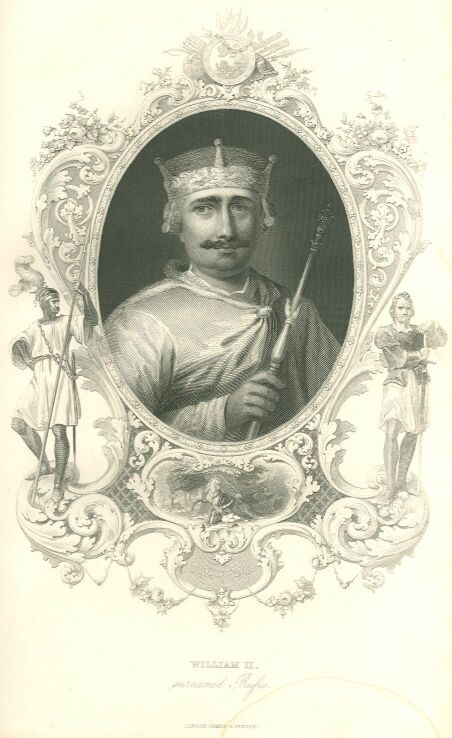
WILLIAM, surnamed Rufus, or the Red, from the color of his hair, had no sooner procured his father's recommendatory letter to Lanfranc, the primate, than he hastened to take measures for securing to himself the government of England. Sensible that a deed so unformal, and so little prepared, which violated Robert's right of promigeniture, might meet with great opposition, he trusted entirely for success to his own celerity; and having left St. Gervas while William was breathing his last, he arrived in England before intelligence of his father's death had reached that kingdom.[*] Pretending orders from the king, he secured the fortresses of Dover, Pevensey, and Hastings, whose situation rendered them of the greatest importance; and he got possession of the royal treasure at Winchester, amounting to the sum of sixty thousand pounds, by which he hoped to encourage and increase his partisans,[**] The primate, whose rank and reputation in the kingdom gave him great authority, had been intrusted with the care of his education, and had conferred on him the honor of knighthood;[***] and being connected with him by these ties, and probably deeming his pretensions just, declared that he would pay a willing obedience to the last will of the Conqueror, his friend and benefactor. Having assembled some bishops and some of the principal nobility, he instantly proceeded to the ceremony of crowning the new king;[****] and by this despatch endeavored to prevent all faction and resistance. At the same time, Robert, who had been already acknowledged successor to Normandy, took peaceable possession of that duchy.
But though this partition appeared to have been made without any violence or opposition, there remained in England many causes of discontent, which seemed to menace that kingdom with a sudden revolution. The barons, who generally possessed large estates both in England and in Normandy, were uneasy at the separation of those territories; and foresaw that, as it would be impossible for them to preserve long their allegiance to two masters, they must necessarily resign either their ancient patrimony or their new acquisitions.[*]
Robert's title to the duchy they esteemed incontestable; his claim to the kingdom plausible; and they all desired that this prince, who alone had any pretensions to unite these states, should be put in possession of both. A comparison also of the personal qualities of the two brothers led them to give the preference to the elder. The duke was brave, open, sincere, generous: even his predominant faults, his extreme indolence and facility, were not disagreeable to those haughty barons, who affected independence, and submitted with reluctance to a vigorous administration in their sovereign. The king, though equally brave, was violent, haughty, tyrannical; and seemed disposed to govern more by the fear than by the love of his subjects. Odo, bishop of Baieux, and Robert, earl of Mortaigne, maternal brothers of the Conqueror, envying the great credit of Lanfranc, which was increased by his late services enforced all these motives with their partisans, and engaged them in a formal conspiracy to dethrone the king. They communicated their design to Eustace, count of Boulogne Roger, earl of Shrewsbury and Arundel, Robert de Belesme, his eldest son, William, bishop of Durham, Robert de Moubray, Roger Bigod, Hugh de Grentmesnil; and they easily procured the assent of these potent noblemen. The conspirators, retiring to their castles, hastened to put themselves in a military posture; and expecting to be soon supported by a powerful army from Normandy, they had already begun hostilities in many places.
The king, sensible of his perilous situation, endeavored to engage the affections of the native English, As that people were now so thoroughly subdued that they no longer aspired to the recovery of their ancient liberties, and were content with the prospect of some mitigation in ihe tyranny of the Norman princes, they zealously embraced William's cause, upon receiving general promises of good treatment, and of enjoying the license of hunting in the royal forests. The king was soon in a situation to take the field; and as he knew the danger of delay, he suddenly marched into Kent, where his uncles had already seized the fortresses of Pevensey and Rochester. These places he successively reduced by famine; and though he was prevailed on by the earl of Chester, William de Warrenne, and Robert Fitz-Hammon, who had embraced his cause, to spare the lives of the rebels, he confiscated all their estates, and banished them the kingdom.[*] This success gave authority to his negotiations with Roger, earl of Shewsbury, whom he detached from the confederates; and as his powerful fleet, joined to the indolent conduct of Robert, prevented the arrival of the Norman succors, all the other rebels found no resource but in flight or submission. Some of them received a pardon; but the greater part were attainted; and the king bestowed their estates on the Norman barons who had remained faithful to him.
1089.
William, freed from the danger of these insurrections, took little care of fulfilling his promises to the English, who still found themselves exposed to the same oppressions which they had undergone during the reign of the Conqueror, and which were rather augmented by the violent, impetuous temper of the present monarch. The death of Lanfranc, who retained great influence over him, gave soon after a full career to his tyranny; and all orders of men found reason to complain of an arbitrary and illegal administration. Even the privileges of the church, held sacred in those days, were a feeble rampart against his usurpations. He seized the temporalities of all the vacant bishoprics and abbeys; he delayed the appointing of successors to those dignities, that he might the longer enjoy the profits of their revenue; he bestowed some of the church lands in property on his captains and favorites; and he openly set to sale such sees and abbeys as he thought proper to dispose of. Though the murmurs of the ecclesiastics, which were quickly propagated to the nation, rose high against this grievance, the terror of William's authority, confirmed by the suppression of the late insurrections, retained everyone in subjection, and preserved general tranquillity in England.
1090.
The king, even thought himself enabled to disturb his brother in the possession of Normandy. The loose and negligent administration of that prince had imboldened the Norman barons to affect a great independency; and their mutual quarrels and devastations had rendered that whole territory a scene of violence and outrage. Two of them, Walter and Odo, were bribed by William to deliver the fortresses of St. Valori and Albemarle into his hands: others soon after imitated the example of revolt, while Philip, king of France, who ought to have protected his vassal in the possession of his fief, was, after making some efforts in his favor, engaged by large presents to remain neuter. The duke had also reason to apprehend danger from the intrigues of his brother Henry.
This young prince, who had inherited nothing of his father's great possessions but some of his money, has furnished Robert, while he was making his preparations against England, with ihe sum of three thousand marks; and in return for so slender a supply, had been put in possession of the Cotentin, which comprehended near a third of the duchy of Normandy. Robert afterwards, upon some suspicion, threw him into prison; but finding himself exposed to invasion from the king of England, ind dreading the conjunction of the two brothers against him, he now gave Henry his liberty, and even made use of his assistance in suppressing the insurrections of his rebellious subjects. Conan, a rich burgess of Rouen, had entered into a conspiracy to deliver that city to William; but Henry, on the detection of his guilt, carried the traitor up to a high tower and with his own hands flung him from the battlements.
The king appeared in Normandy at the head of an army and affairs seemed to have come to extremity between the brothers, when the nobility on both sides, strongly connected by interest and alliances, interposed, and meditated an accommodation. The chief advantage of this treaty accrued to William, who obtained possession of the territory of Eu, the towns of Aumule, Fescamp, and other places; but in return he promised, that he would assist his brother in subduing Maine, which had rebelled; and that the Norman barons, attainted in Robert's cause, should be restored to their estates in England. The two brothers also stipulated, that, on the demise of either without issue, the survivor should inherit all his dominions; and twelve of the most powerful barons on each side swore that they would employ their power to insure the effectual execution of the whole treaty,[*] a strong proof of the great independence and authority of the nobles in those ages.
Prince Henry, disgusted that so little care had been taken of his interests in this accommodation, retired to St. Michael's Mount, a strong fortress on the coast of Normandy, and infested the neighborhood with his incursions. Robert and William, with their joint forces, besieged him in this place, and had nearly reduced him by the scarcity of water, when the elder, hearing of his distress, granted him permission to supply himself, and also sent him some pipes of wine for his own table. Being reproved by William for this ill-timed generosity, he replied, "What, shall I suffer my brother to die of thirst? Where shall we find another when he is gone?" The king also, during this siege, performed an act of generosity which was less suitable to his character. Riding out one day alone, to take a survey of the fortress, he was attacked by two soldiers, and dismounted. One of them drew his sword in order to despatch him, when the king exclaimed, "Hold, knave! I am the king of England." The soldier suspended his blow and, raising the king from the ground with expressions of respect, received a handsome reward, and was taken into his service. Prince Henry was soon after obliged to capitulate; and being despoiled of all his patrimony, wandered about for some time with very few attendants, and often in great poverty.
1091.
The continued intestine discord among the barons was alone in that age destructive; the public wars were commonly short and feeble, produced little bloodshed, and were attended with no memorable event. To this Norman war, which was so soon concluded, there succeeded hostilities with Scotland, which were not of longer duration. Robert here Commanded his brother's army, and obliged Malcolm to accept of peace, and do homage to the crown of England. This peace was not more durable.
1093.
Malcolm, two years after, levying an army, invaded England; and after ravaging, Northumberland, he laid siege to Alnwick, where, a party of Earl Moubray's troops falling upon him by surprise, a sharp action ensued in which Malcolm was slain. This incident interrupted for some years the regular succession to the Scottish crown, Though Malcolm left legitimate sons, his brother Donald, on account of the youth of these princes, was advanced to the throne; but kept not long possession of it. Duncan, natural son of Malcolm, formed a conspiracy against him; and being assisted by William with a small force, made himself master of the kingdom. New broils ensued with Normandy. The frank, open, remiss temper of Robert was ill fitted to withstand the interested, rapacious character of William, who, supported by greater power, was still encroaching on his brother's possessions, and instigating his turbulent barons to rebellion against him. The king, having gone over to Normandy to support his partisans, ordered an army of twenty thousand men to be levied in England, and to be conducted to the sea-coast, as if they were instantly to be embarked.
1094.
Here Ralph Flambard, the king's minister, and the chief instrument of his extortions, exacted ten shillings apiece from them, in lieu of their service, and then dismissed them into their several counties. This money was so skilfully employed by William that it rendered him better service than he could have expected from the army. He engaged the French king by new presents to depart from the protection of Robert; and he daily bribed the Norman barons to desert his service; but was prevented from pushing his advantages by an incursion of the Welsh, which obliged him to return to England, tie found no difficulty in repelling the enemy; but was not able to make any considerable impression on a country guarded by its mountainous situation. A conspiracy of his own barons which was detected at this time, appeared a more serious concern, and engrossed all his attention.
1095.
Robert Moubray, earl of Northumberland, was at the head of this combination; and he engaged in it the count d'Eu, Richard de Tunbridge, Roger de Lacy, and many others. The purpose of the conspirators was to dethrone the king, and to advance in his stead Stephen, count of Aumale, nephew to the Conqueror. William's despatch prevented the design from taking effect, and disconcerted the conspirators. Moubray made some resistance; but being taken prisoner, was attainted and thrown into confinement, where he died about thirty years after.
1096.
The count d'Eu denied his concurrence in the plot, and to justify himself, fought, in the presence of the court at Windsor, a duel with Geoffrey Bainard, who accused him. But being worsted in the combat, he was condemned to be castrated, and to have his eyes put out. William de Alderi, another conspirator, was supposed to be treated with more rigor when he was sentenced to be hanged.
But the noise of these petty wars and commotions was quite sunk in the tumult of the crusades, which now engrossed the attention of Europe, and have ever since engaged the curiosity of mankind, as the most signal and most durable monument of human folly that has yet appeared in any age or nation. After Mahomet had, by means of his pretended revelations, united the dispersed Arabians under one head, they issued forth from their deserts in great multitudes; and being animated with zeal for their new religion, and supported by the vigor of their new government, they made deep impression on the eastern empire, which was far in the decline with regard both to military discipline and to civil policy. Jerusalem, by its situation, became one of their most early conquests; and the Christians had the mortification to see the holy sepulchre, and the other places consecrated by the presence of their religious founder, fallen into the possession of infidels. But the Arabians or Saracens were so employed in military enterprises, by which they spread their empire, in a few years, from the banks of the Ganges to the Straits of Gibraltar, that they had no leisure for theological controversy; and though the Alcoran, the original monument of their faith, seems to contain some violent precepts, they were much less infected with the spirit of bigotry and persecution than the indolent and speculative Greeks, who were continually refining on the several articles of their religious system. They gave little disturbance to those zealous pilgrims who daily flocked to Jerusalem; and they allowed every man, after paying a moderate tribute, to visit the holy sepulchre, to perform his religious duties, and so return in peace. But the Turcomans or Turks, a tribe of Tartars, who had embraced Mahometanism, having wrested Syria from the Saracens, and having in the year 1065 made themselves masters of Jerusalem, rendered the pilgrimage much more difficult and dangerous to the Christians. The barbarity of their manners, and the confusions attending their unsettled government, exposed the pilgrims to many insults, robberies, and extortions; and these zealots, returning from their meritorious fatigues and sufferings, filled all Christendom with indignation against the infidels, who profaned the holy city by their presence, and derided the sacred mysteries in the very place of their completion. Gregory VII., among the other vast ideas which he entertained, had formed the design of uniting all the western Christians against the Mahometans; but the egregious and violent invasions of that pontiff on the civil power of princes had created him so many enemies, and had rendered his schemes so suspicious, that he was not able to make great progress in this undertaking. The work was reserved for a meaner instrument, whose low condition ir life exposed aim to no jealousy, and whose folly was well calculated to coincide with the prevailing principles of the times.
Peter, commonly called the Hermit, a native of Amiens, in Picardy, had made the pilgrimage to Jerusalem. Being deeply affected with the dangers to which that act of piety now exposed the pilgrims, as well as with the instances of oppression under which the eastern Christians labored, he entertained the bold, and, in all appearance, impracticable project of leading into Asia, from the farthest extremities of the west, armies sufficient to subdue those potent and warlike nations which now held the holy city in subjection.[*] He proposed his views to Martin II., who filled the papal chair, and who, though sensible of the advantages which the head of the Christian religion must reap from a religious war, and though he esteemed the blind zeal of Peter a proper means for effecting the purpose,[**] resolved not to interpose his authority till he saw a greater probability of success. He summoned a council at Placentia, which consisted of four thousand ecclesiastics and thirty thousand seculars; and which was so numerous that no hall could contain the multitude, and it was necessary to hold the assembly in a plain.
The harangues of the pope, and of Peter himself, representing the dismal situation of their brethren in the East, and the indignity suffered by the Christian name, in allowing the holy city to remain in the hands of infidels, here found the minds of men so well prepared, that the whole multitude suddenly and violently declared for the war, and solemnly devoted themselves to perform this service, so meritorious, as they believed it, to God and religion.
But though Italy seemed thus to have zealously embraced the enterprise, Martin knew that, in order to insure success, it was necessary to enlist the greater and more warlike nations in the same engagement; and having previously exhorted Peter to visit the chief cities and sovereigns of Christendom, he summoned another council at Clermont, in Auvergne.[*] The fame of this great and pious design being now universally diffused, procured the attendance of the greatest prelates, nobles, and princes; and when the pope and the hermit renewed their pathetic exhortations, the whole assembly, as if impelled by an immediate inspiration, not moved by their preceeding impressions, exclaimed with one voice, "It is the will of God, It is the will of God"—words deemed so memorable and so much the result of a divine influence, that they were employed as the signal of rendezvous and battle in all the future exploits of those adventurers.[**] Men of all ranks flew to arms with the utmost ardor; and an exterior symbol too—a circumstance of chief moment,—was here chosen by the devoted combatants. The sign of the cross, which had been hitherto so much revered among Christians, and which, the more it was an object of reproach among the pagan world, was the more passionately cherished by them, became the badge of union, and was affixed to their right shoulder by all who enlisted themselves in this sacred warfare.[***]
Europe was at this time sunk into profound ignorance and superstition. The ecclesiastics had acquired the greatest ascendant over the human mind; the people, who, being little restrained by honor, and less by law, abandoned themselves to the worst crimes and disorders, knew of no other expiation than the observances imposed on them by their spiritual pastors; and it was easy to represent the holy war as an equivalent for all penances,[****] and an atonement for every violation of justice and humanity.
But amidst the abject superstition which now prevailed, the military spirit also had universally diffused itself; and though not supported by art or discipline, was become the general passion of the nations governed by the feudal law. All the great lords possessed the right of peace and war: they were engaged in perpetual hostilities with each other: the open country was become a scene of outrage and disorder: the cities, still mean and poor, were neither guarded by walls nor protected by privileges, and were exposed to every insult: individuals were obliged to depend for safety on their own force, or their private alliances; and valor was the only excellence which was held in esteem, or gave one man the preeminence above another. When all the particular superstitions, therefore, were here united in one great object, the ardor for military enterprises took the same direction; and Europe, impelled by its two ruling passions, was loosened, as it were, from its foundations, and seemed to precipitate itself in one united body upon the East.
All orders of men, deeming the crusades the only road to heaven, enlisted themselves under these sacred banners, and were impatient to open the way with their sword to the holy city. Nobles, artisans, peasants, even priests,[*] enrolled their names; and to decline this meritorious service was branded with the reproach of impiety, or, what perhaps was esteemed still more disgraceful, of cowardice and pusillanimity.[**] The infirm and aged contributed to the expedition by presents and money; and many of them, not satisfied with the merit of this atonement, attended it in person, and were determined, if possible, to breathe their last in sight of that city where their Savior had died for them. Women themselves, concealing their sex under the disguise of armor, attended the camp; and commonly forgot still more the duty of their sex, by prostituting themselves without reserve to the army.[***] The greatest criminals were forward in a service which they regarded as a propitiation for all crimes; and the most enormous disorders were, during the course of those expeditions, committed by men inured to wickedness, encouraged by example, and impelled by necessity. The multitude of the adventurers soon became so great, that their more sagacious leaders, Hugh, count of Vermandois, brother to the French king, Raymond, count of Toulouse, Godfrey of Bouillon, prince of Brabant, and Stephen, count of Blois,[****] became apprehensive lest the greatness itself of the armament should disappoint its purpose; and they permitted an undisciplined multitude, computed at three hundred thousand men, to go before them, under the command of Peter the Hermit, and Walter the Moneyless.[*****]
These men took the road towards Constantinople, through Hungary and Bulgaria; and trusting that Heaven, by supernatural assistance, would supply all their necessities, they made no provision for subsistence on their march. They soon found themselves obliged to obtain by plunder what they had vainly expected from miracles; and the enraged inhabitants of the countries through which they passed, gathering together in arms, attacked the disorderly multitude, and put them to slaughter without resistance. The more disciplined armies followed after; and passing the straits at Constantinople, they were mustered in the plains of Asia, and amounted in the whole to the number of seven hundred thousand combatants.[*]
Amidst this universal frenzy, which spread itself by contagion throughout Europe, especially in France and Germany, men were not entirely forgetful of their present interests; and both those who went on this expedition, and those who stain behind, entertained schemes of gratifying by its means their avarice or their ambition. The nobles who enlisted themselves were moved, from the romantic spirit of the age, to hope for opulent establishments in the East, the chief seat of arts and commerce during those ages; and in pursuit of these chimerical projects, they sold at the lowest price their ancient castles and inheritances, which had now lost all value in their eyes. The greater princes, who remained at home, besides establishing peace in their dominions by giving occupation abroad to the inquietude and martial disposition of their subjects, took the opportunity of annexing to their crown many considerable fiefs, either by purchase or by the extinction of heirs. The pope frequently turned the zeal of the crusaders from the infidels against his own enemies, whom he represented as equally criminal with the enemies of Christ. The convents and other religious societies bought the possessions of the adventurers; and as the contributions of the faithful were commonly intrusted to their management, they often diverted to this purpose what was intended to be employed against the infidels.[**] But no one was a more immediate gainer by this epidemic fury than the king of England, who kept aloof from all connections with those fanatical and romantic warriors.
Robert, duke of Normandy, impelled by the bravery and mistaken generosity of his spirit, had early enlisted himself in the crusade; but being always unprovided with money, he found that it would be impracticable for him to appear in a manner suitable to his rank and station, at the head of his numerous vassals and subjects, who, transported with the general rage, were determined to follow him into Asia. He resolved, therefore, to mortgage, or rather to sell, his dominions, which he had not talents to govern; and he offered them to his brother William for the very unequal sum of ten thousand marks.[*] The bargain was soon concluded: the king raised the money by violent extortions on his subjects of all ranks, even on the convents, who were obliged to melt their plate in order to furnish the quota demanded of them[**] he was put in possession of Normandy and Maine; and Robert, providing himself with a magnificent train, set out for the Holy Land, in pursuit of glory, and in full confidence of securing his eternal salvation.
The smallness of this sum, with the difficulties which William found in raising it, suffices alone to refute the account which is heedlessly adopted by historians, of the enormous revenue of the Conqueror. Is it credible that Robert would consign to the rapacious hands of his brother such considerable dominions, for a sum which, according to that account, made not a week's income of his father's English revenue alone? or that the king of England could not on demand, without oppressing his subjects, have been able to pay him the money? The Conqueror, it is agreed, was frugal as well as rapacious, yet his treasure at his death exceeded not sixty thousand pounds, which hardly amounted to his income for two months; another certain refutation of that exaggerated account.
The fury of the crusades during this age less infected England than the neighboring kingdoms; probably because the Norman conquerors, finding their settlement in that kingdom still somewhat precarious, durst not abandon their homes in quest of distant adventures. The selfish, interested spirit also of the king, which kept him from kindling in the general flame, checked its progress among his subjects; and as he is accused of open profaneness,[***] and was endued with a sharp wit,[****] it is likely that he made the romantic chivalry of the crusaders the object of his perpetual raillery.
As an instance of his religion, we are told that he once accepted of sixty marks from a Jew, whose son had been converted to Christianity, and who engaged him by that present to assist him in bringing back the youth to Judaism. William employed both menaces and persuasion for that purpose; but finding the convert obstinate in his new faith, he sent for the father, and told him that as he had not succeeded, it was not just that he should keep the present; but as he had done his utmost, it was but equitable that he should be paid for his pains; and he would therefore retain only thirty marks of the money.[*] At another time, it is said, he sent for some learned Christian theologians and some rabbies, and bade them fairly dispute the question of their religion in his presence. He was perfectly indifferent between them; had his ears open to reason and conviction; and would embrace that doctrine which, upon comparison, should be found supported by the most solid arguments.[**] If this story be true, it is probable that he meant only to amuse himself by turning both into ridicule; but we must be cautious of admitting every thing related by the monkish historians to the disadvantage of this prince. He had the misfortune to be engaged in quarrels with the ecclesiastics, particularly with Anselm, commonly called St. Anselm, archbishop of Canterbury; and it is no wonder his memory should be blackened by the historians of that order.
After the death of Lanfranc, the king for several years retained in his own hands the revenues of Canterbury, as he did those of many other vacant bishoprics: but falling into a dangerous sickness, he was seized with remorse; and the clergy represented to him, that he was in danger of eternal perdition, if before his death he did not make atonement for those multiplied impieties and sacrileges of which he had been guilty.[***] He resolved, therefore, to supply instantly the vacancy of Canterbury; and for that purpose he sent for Anselm, a Piedmontese by birth, abbot of Bee, in Normandy, who was much celebrated for his learning and piety. The abbot earnestly refused the dignity, fell on his knees, wept, and entreated the king to change his purpose,[****] and when he found the prince obstinate in forcing the pastoral staff upon him, he kept his fist so fast clinched, that it required the utmost violence of the bystanders to open it, and force him to receive that ensign of spiritual dignity.[*****]
William soon after recovered; and his passions regaining their wonted vigor, he returned to his former violence and rapine. He detained in prison several persons whom he had ordered to be freed during the time of his penitence; he still preyed upon the ecclesiastical benefices; the sale of spiritual dignities continued as open as ever; and he kept possession of a considerable part of the revenues belonging to the see of Canterbury.[**] But he found in Anselm that persevering opposition which he had reason to expect from the ostentatious humility which that prelate had displayed in refusing his promotion.
The opposition made by Anselm was the more dangerous on account of the character of piety which he soon acquired in England by his great zeal against all abuses, particularly those in dress and ornament. There was a mode which, in that age, prevailed throughout Europe, both among men and women, to give an enormous length to their shoes, to draw the toe to a sharp point, and to affix to it the figure of a bird's bill, or some such ornament, which was turned upwards, and which was often sustained by gold or silver chains tied to the knee.[***] The ecclesiastics took exception at this ornament, which, they said, was an attempt to bely the Scripture, where it is affirmed, that no man can add a cubit to his stature; and they declaimed against it with great vehemence, nay, assembled some synods, who absolutely condemned it. But—such are the strange contradictions in human nature—though the clergy, at that time, could overturn thrones, and had authority sufficient to send above a million of men on their errand to the deserts of Asia, they could never prevail against these long-pointed shoes: on the contrary, that caprice, contrary to all other modes, maintained its ground during several centuries; and if the clergy had not at last desisted from their persecution of it, it might still have been the prevailing fashion in Europe.
But Anselm was more fortunate in decrying the particular mode which was the object of his aversion, and which probably had not taken such fast hold of the affections of the people. He preached zealously against the long hair and curled locks which were then fashionable among the courtiers; he refused the ashes on Ash-Wednesday to those who were so accoutred; and his authority and eloquence had such influence, that the young men universally abandoned that ornament, and appeared in the cropped hair which was recommended to them by the sermons of the primate. The noted historian of Anselm, who was also his companion and secretary, celebrates highly this effort of his zeal and piety.[*]
When William's profaneness therefore returned to him with his health, he was soon engaged in controversies with this austere prelate. There was at that time a schism in the church between Urban and Clement, who both pretended to the papacy;[**] and Anselm, who, as abbot of Bee, had already acknowledged the former, was determined, without the king's consent, to introduce his authority into England.[***] William, who, imitating his father's example, had prohibited his subjects from recognizing any pope whom he had not previously received, was enraged at this attempt, and summoned a synod at Buckingham, with an intention of deposing Anselm; but the prelate's suffragans declared, that, without the papal authority, they knew of no expedient for inflicting that punishment on their primate.[****] The king was at last engaged by other motives to give the preference to Urban's title; Anselm received the pall from that pontiff; and matters seemed to be accommodated between the king and the primate,[*****] when the quarrel broke out afresh from a new cause. William had undertaken an expedition against Wales, and required the archbishop to furnish his quota of soldiers for that service, but Anselm, who regarded the demand as an oppression on the church, and yet durst not refuse compliance, sent them so miserably accoutred, that the king was extremely displeased, and threatened him with a prosecution.[******] Anselm, on the other hand, demanded positively that all the revenues of his see should be restored to him; appealed to Borne against the king's injustice;[*******] and affairs came to such extremities, that the primate, finding it dangerous to remain in the kingdom, desired and obtained the king's permission to retire beyond sea. All his temporalities were seized;[********] but he was received with great respect by Urban, who considered him as a martyr in the cause of religion, and even menaced the king, on account of his proceedings against the primate and the church with the sentence of excommunication.
Anselm assisted at the council of Bari, where, besides fixing the controversy between the Greek and Latin churches concerning the procession of the Holy Ghost,[*] the right of election to church preferments was declared to belong to the clergy alone, and spiritual censures were denounced against all ecclesiastics who did homage to laymen for their sees or benefices, and against all laymen who exacted it.[**] The rite of homage, by the feudal customs, was, that the vassal should throw himself on his knees, should put his joined hands between those of his superior, and should in that posture swear fealty to him.[***] But the council declared & execrable that pure hands, which could create God, and could offer him up as a sacrifice for the salvation of mankind, should be put, after this humiliating manner, between profane hands, which, besides being inured to rapine and bloodshed, were employed day and night in impure purposes and obscene contacts.[****] Such were the reasonings prevalent in that age; reasonings which, though they cannot be passed over in silence, without omitting the most curious and perhaps not the least instructive part of history, can scarcely be delivered with the requisite decency and gravity.
1097.
The cession of Normandy and Maine by Duke Robert increased the king's territories; but brought him no great increase of power, because of the unsettled state of those countries the mutinous disposition of the barons, and the vicinity of the French king, who supported them in all their insurrections. Even Helie, lord of La Fleche, a small town in Anjou, was able to give him inquietude; and this great monarch was obliged to make several expeditions abroad, without being able to prevail over so petty a baron, who had acquired the confidence and affections of the inhabitants of Maine. He was, however, so fortunate as at last to take him prisoner in a rencounter, but having released him, at the intercession of the French king and the count of Anjou, he found the province of Maine still exposed to his intrigues and incursions. Helie, being introduced by the citizens into the town of Mans, besieged the garrison in the citadel,
1099.
William, who was hunting in the new forest when he received intelligence of this hostile attempt, was so provoked, that he immediately turned his horse, and galloped to the sea-shore at Dartmouth, declaring that he would not stop a moment till he had taken, vengeance for the offence. He found the weather so cloudy and tempestuous, that the mariners thought it dangerous to put to sea: but the king hurried on board, and ordered them to set sail instantly; telling them that they never yet heard of a king that was drowned.[*] By this vigor and celerity he delivered the citadel of Mans from its present danger, and pursuing Helie into his own territories, he laid siege to Majol, a small castle in those parts:
1100.
but a wound which he received before this place, obliged him to raise the siege; and he returned to England.
The weakness of the greatest monarchs during this age, in their military expeditions against their nearest neighbors, appears the more surprising, when we consider the prodigious numbers, which even petty princes, seconding the enthusiastic rage of the people, were able to assemble, and to conduct in dangerous enterprises to the remote provinces of Asia. William earl of Poitiers and duke of Guienne, inflamed with the glory and not discouraged by the misfortunes, which had attended the former adventurers in the crusades, had put himself at the head of an immense multitude, computed by some historians to amount to sixty thousand horse, and a much greater number of foot,[**] and he purposed to lead them into the Holy Land against the infidels. He wanted money to forward the preparations requisite for this expedition, and he offered to mortgage all his dominions to William, without entertaining any scruple on account of that rapacious and iniquitous hand to which he resolved to consign them.[***]
The king accepted the offer; and had prepared a fleet and an army, in order to escort the money and take possession of the rich provinces of Guienne and Poictou; when an accident put an end to his life, and to all his ambitious projects. He was engaged in hunting, the sole amusement, and indeed the chief occupation of princes in those rude times, when society was little cultivated and the arts afforded few objects worthy of attention. Walter Tyrrel, a French gentleman, remarkable for his address in archery, attended him in this recreation, of which the new forest was the scene: and as William had dismounted after a chase, Tyrrel, impatient to show his dexterity, let fly an arrow at a stag which suddenly started before him. The arrow, glancing from a tree, struck the king in the breast, and instantly slew him;[*] while Tyrrel, without informing any one of the accident, put spurs to his horse, hastened to the sea-shore, embarked for France, and joined the crusade in an expedition to Jerusalem; a penance which he imposed on himself for this involuntary crime. The body of William was found in the forest by the country people, and was buried without any pomp or ceremony at Winchester. His courtiers were negligent in performing the last duties to a master who was so little beloved; and every one was too much occupied in the interesting object of fixing his successor, to attend the funeral of a dead sovereign.
The memory of this monarch is transmitted to us with little advantage by the churchmen, whom he had offended; and though we may suspect in general that their account of his vices is somewhat exaggerated, his conduct affords little reason for contradicting the character which they have assigned him, or for attributing to him any very estimable qualities. He seems to have been a violent and tyrannical prince; a perfidious, encroaching, and dangerous neighbor; an unkind and ungenerous relation. He was equally prodigal and rapacious in the management of his treasury; and if he possessed abilities, he lay so much under the government of impetuous passions, that he made little use of them in his administration; and he indulged without reserve that domineering policy which suited his temper, and which, if supported, as it was it him, with courage and vigor, proves often more successful in disorderly times, than the deepest foresight and most refined artifice.
The monuments which remain of this prince in England are the Tower, Westminster Hall, and London Bridge, which he built. The most laudable foreign enterprise which he undertook was the sending of Edgar Atheling, three years before his death, into Scotland, with a small army, to restore Prince Edgar, the true heir of that kingdom, son of Malcolm, and of Margaret, sister of Edgar Atheling; and the enterprise proved successful. It was remarked in that age, that Richard, an elder brother of William's, perished by an accident in the new forest; Richard, his nephew, natural son of Duke Robert, lost his life in the same place after the same manner; and all men, upon the king's fate, exclaimed that, as the Conqueror had been guilty of extreme violence in expelling all the inhabitants of that large district to make room for his game, the just vengeance of Heaven was signalized in the same place by the slaughter of his posterity. William was killed in the thirteenth year of his reign, and about the fortieth of his age. As he was never married, he left no legitimate issue.
In the eleventh year of this reign, Magnus, king of Norway, made a descent on the Isle of Anglesea; but was repulsed by Hugh, earl of Shrewsbury. This is the last attempt made by the northern nations upon England. That restless people seem about this time to have learned the practice of tillage, which thenceforth kept them at home, and freed the other nations of Europe from the devastations spread over them by those piratical invaders. This proved one great cause of the subsequent settlement and improvement of the southern nations.
1100.
After the adventurers in the holy war were assembled on the banks of the Bosphorus, opposite to Constantinople, they proceeded on their enterprise; but immediately experienced those difficulties which their zeal had hitherto concealed from them, and for which, even if they had foreseen them, it would have been almost impossible to provide a remedy. The Greek emperor, Alexis Comnenus, who had applied to the western Christians for succor against the Turks, entertained hopes, and those but feeble ones, of obtaining such a moderate supply as, acting under his command, might enable him to repulse the enemy; but he was extremely astonished to see his dominions overwhelmed on a sudden by such an inundation of licentious barbarians, who, though they pretended friendship, despised his subjects as unwarlike, and detested them as heretical. By all the arts of policy, in which he excelled, he endeavored to divert the torrent; but while he employed professions, caresses, civilities, and seeming services towards the leaders of the crusade, he secretly regarded those imperious allies as more dangerous than the open enemies by whom his empire had been formerly invaded. Having effected that difficult point of disembarking them safely in Asia, he entered into a private correspondence with Soliman, emperor of the Turks; and practised every insidious art which his genius, his power, or his situation enabled him to employ, for disappointing the enterprise, and, discouraging the Latins from making thenceforward any such prodigious migrations. His dangerous policy was seconded by the disorders inseparable from so vast a multitude, who were not united under one head, and were conducted by leaders of the most independent, intractable spirit, unacquainted with military discipline, and determined enemies to civil authority and submission. The scarcity of provisions, the excess of fatigue, the influence of unknown climates, joined to the want of concert in their operations, and to the sword of a warlike enemy, destroyed the adventurers by thousands, and would have abated the ardor of men impelled to war by less powerful motives. Their zeal, however, their bravery, and their irresistible force still carried them forward, and continually advanced them to the great end of their enterprise. After an obstinate siege, they took Nice, the seat of the Turkish empire; they defeated Soliman in two great battles; they made themselves masters of Antioch; and entirely broke the force of the Turks, who had so long retained those countries in subjection. The soldan of Egypt, whose alliance they had hitherto courted, recovered, on the fall of the Turkish power, his former authority in Jerusalem; and he informed them by his ambassadors, that if they came disarmed to that city, they might now perform their religious vows, and that all Christian pilgrims, who should thenceforth visit the holy sepulchre, might expect the same good treatment which they had ever received from his predecessors. The offer was rejected; the soldan was required to yield up the city to the Christians; and on his refusal, the champions of the cross advanced to the siege of Jerusalem, which they regarded as the consummation of their labors. By the detachments which they had made, and the disasters which they had undergone, they were diminished to the number of twenty thousand foot and fifteen hundred horse; but these were still formidable from their valor, their experience, and the obedience which, from past calamities, they had learned to pay to their leaders. After a siege of five weeks, they took Jerusalem by assault; and, impelled by a mixture of military and religious rage, they put the numerous garrison and inhabitants to the sword, without distinction. Neither arms defended the valiant, nor submission the timorous; no age or sex was spared; infants on the breast were pierced by the same blow with their mothers, who implored for mercy; even a multitude, to the number of ten thousand persons, who had surrendered themselves prisoners and were promised quarter, were butchered in cold blood by those ferocious conquerors.[*] The streets of Jerusalem were covered with dead bodies;[**] and the triumphant warriors, after every enemy was subdued and slaughtered, immediately turned themselves, with the sentiments of humiliation and contrition, towards the holy sepulchre.
They threw aside their arms, still streaming with blood; they advanced with reclined bodies, and naked feet and heads, to that sacred monument; they sung anthems to their Savior, who had there purchased their salvation by his death and agony; and their devotion enlivened by the presence of the place where he had suffered, so overcame their fury, that they dissolved in tears, and bore the appearance of every soft and tender sentiment. So inconsistent is human nature with itself! and so easily does the most effeminate superstition ally, both with the most heroic courage and with the fiercest barbarity!
This great event happened on the fifth of July in the last year of the eleventh century. The Christian princes and nobles, after choosing Godfrey of Bouillon king of Jerusalem, began to settle themselves in their new conquests; while some of them returned to Europe, in order to enjoy at home that glory which their valor had acquired them in this popular and meritorious enterprise. Among these was Robert, duke of Normandy, who, as he had relinquished the greatest dominions of any prince that attended the crusade, had all along distinguished himself by the most intrepid courage, as well as by that affable disposition and unbounded generosity which gain the hearts of soldiers, and qualify a prince to shine in a military life. In passing through Italy, he became acquainted with Sibylla, daughter of the count of Conversana, a young lady of great beauty and merit, whom he espoused: indulging himself in this new passion, as well as fond of enjoying ease and pleasure after the fatigues of so many rough campaigns, he lingered a twelvemonth in that delicious climate; and though his friends in the north looked every moment for his arrival, none of them knew when they could with certainty expect it. By this delay he lost the kingdom of England, which the great fame he had acquired during the crusades, as well as his undoubted title, both by birth and by the preceding agreement with his deceased brother, would, had he been present, have infallibly secured to him.
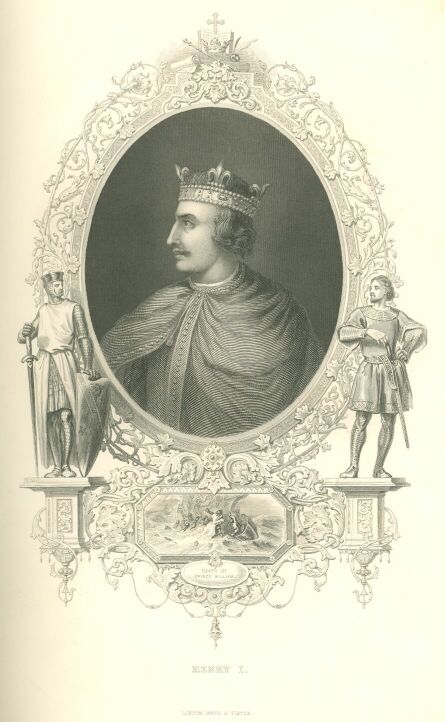
Prince Henry was hunting with Rufus in the new forest, when intelligence of that monarch's death was brought him, and being sensible of the advantage attending the conjuncture he hurried to Winchester, in order to secure the royal treasure, which he knew to be a necessary implement for facilitating his designs on the crown. He had scarcely reached the place when William de Breteuil, keeper of the treasure, arrived, and opposed himself to Henry's pretensions. This nobleman, who had been engaged in the same party of hunting, had no sooner heard of his master's death, than he hastened to take care of his charge; and he told the prince, that this treasure, as well as the crown, belonged to his elder brother, who was now his sovereign; and that he himself, for his part, was determined, in spite of all other pretensions, to maintain his allegiance to him. But Henry, drawing his sword, threatened him with instant death if he dared to disobey him; and as others of the late king's retinue, who came every moment to Winchester, joined the prince's party, Breteuil was obliged to withdraw his opposition, and to acquiesce in this violence.[*]
Henry, without losing a moment, hastened with the money to London; and having assembled some noblemen and prelates, whom his address, or abilities, or presents, gained to his side, he was suddenly elected, or rather saluted king; and immediately proceeded to the exercise of royal authority. In less than three days after his brother's death, the ceremony of his coronation was performed by Maurice, bishop of London, who was persuaded to officiate on that occasion;[**] and thus, by his courage and celerity, he intruded himself into the vacant throne.
No one had sufficient spirit or sense of duty to appear in defence of the absent prince; all men were seduced or intimidated; present possession supplied the apparent defects in Henry's title, which was indeed founded on plain usurpation; and the barons, as well as the people, acquiesced in a claim, which, though it could neither be justified nor comprehended, could now, they found, be opposed through the perils alone of civil war and rebellion.
But as Henry foresaw that a crown usurped against all rules of justice would sit unsteady on his head, he resolved, by fair professions at least, to gain the affections of all his subjects. Besides taking the usual coronation oath to maintain the laws and execute justice, he passed a charter, which was calculated to remedy many of the grievous oppressions which had been complained of during the reigns of his father and brother.[*] He there promised, that, at the death of any bishop or abbot, he never would seize the revenues of the see or abbey during the vacancy, but would leave the whole to be reaped by the successor; and that he would never let to farm any ecclesiastical benefice, nor dispose of it for money. After this concession to the church, whose favor was of so great importance, he proceeded to enumerate the civil grievances which he purposed to redress. He promised that, upon the death of any earl, baron, or military tenant, his heir should be admitted to the possession of his estate, on paying a just and lawful relief, without being exposed to such violent exactions as had been usual during the late reigns: he remitted the wardship of minors, and allowed guardians to be appointed, who should be answerable for the trust: he promised not to dispose of any heiress in marriage but by the advice of all the barons; and if any baron intended to give his daughter sister, niece, or kinswoman in marriage, it should only be necessary for him to consult the king, who promised to take no money for his consent, nor ever to refuse permission, unless the person to whom it was purposed to marry her should happen to be his enemy: he granted his barons and military tenants the power of bequeathing by will their money or personal estates; and if they neglected to make a will, he promised that their heirs should succeed to them: he renounced the right of imposing moneyage, and of levying taxes at pleasure on the farms which the barons retained in their own hands:[**] he made some general professions of moderating fines: he offered a pardon for all offences; and he remitted all debts due to the crown: he required that the vassals of the barons should enjoy the same privileges which he granted to his own barons; and he promised a general confirmation and observance of the laws of King Edward. This is the substance of the chief articles contained in that famous charter.[***]
To give greater authenticity to these concessions, Henry lodged a copy of his charter in some abbey of each county, as if desirous that it should be exposed to the view of all his subjects, and remain a perpetual rule for the limitation and direction of his government: yet it is certain that, after the present purpose was served, he never once thought, during his reign, of observing one single article of it; and the whole fell so much into neglect and oblivion, that, in the following century, when the barons, who had heard an obscure tradition of it, desired to make it the model of the Great Charter which they exacted from King John, they could with difficulty find a copy of it in the kingdom. But as to the grievances here meant to be redressed, they were still continued in their full extent; and the royal authority, in all those particulars, lay under no manner of restriction. Reliefs of heirs, so capital an article, were never effectually fixed till the time of Magna Charta;[*] and it is evident that the general promise here given, of accepting a just and lawful relief, ought to have been reduced to more precision, in order to give security to the subject. The oppression of wardship and marriage was perpetuated even till the reign of Charles II.; and it appears from Glanville,[**] the famous justiciary of Henry II., that in his time, where any man died intestate—an accident which must have been very frequent when the art of writing was so little known—the king, or the lord of the fief, pretended to seize all the movables, and to exclude every heir, even the children of the deceased; a sure mark of a tyrannical and arbitrary government.
The Normans, indeed, who domineered in England, were, during this age, so licentious a people, that they may be pronounced incapable of any true or regular liberty; which requires such improvement in knowledge and morals, as can only be the result of reflection and experience, and must grow to perfection during several ages of settled and established government. A people so insensible to the rights of their sovereign, as to disjoint, without necessity, the hereditary succession, and permit a younger brother to intrude himself into the place of the elder, whom they esteemed, and who was guilty of no crime but being absent, could not expect that. What is called a relief in the Conqueror's laws, preserved by Ingulf, seems to have been the heriot; since reliefs, as well as the other burdens of the feudal law, were unknown in the age of the Confessor, whose laws these originally were. This practice was contrary to the laws of King Edward, ratified by the Conqueror, as we learn from Ingulf, p. 91. But laws had at that time very little influence: power and violence governed every thing. Prince would pay any greater regard to their privileges, or allow his engagements to fetter his power, and debar him from any considerable interest or convenience. They had indeed arms in their hands, which prevented the establishment of a total despotism, and left their posterity sufficient power, whenever they should attain a sufficient degree of reason, to assume true liberty; but their turbulent disposition frequently prompted them to make such use of their arms, that they were more fitted to obstruct the execution of justice, than to stop the career of violence and oppression. The prince, finding that greater opposition was often made to him when he enforced the laws than when he violated them, was apt to render his own will and pleasure the sole rule of government; and on every emergency to consider more the power of the persons whom he might offend, than the rights of those whom he might injure. The very form of this charter of Henry proves, that the Norman barons (for they, rather than the people of England, are chiefly concerned in it,) were totally ignorant of the nature of limited monarchy, and were ill qualified to conduct, in conjunction with their sovereign, the machine of government. It is an act of his sole power, is the result of his free grace, contains some articles which bind others as well as himself, and is therefore unfit to be the deed of any one who possesses not the whole legislative power, and who may not at pleasure revoke all his concessions.
Henry, further to increase his popularity, degraded and committed to prison Ralph Flambard, bishop of Durham, who had been the chief instrument of oppression under his brother.[*] But this act was followed by another, which was a direct violation of his own charter, and was a bad prognostic of his sincere intentions to observe it: he kept the see of Durham vacant for five years, and during that time retained possession of all its revenues. Sensible of the great authority which Anselm had acquired by his character of piety, and by the persecutions which he had undergone from William, he sent repeated messages to him at Lyons, where he resided, and invited him to return and take possession of his dignities.[**] On the arrival of the prelate, he proposed to him the renewal of that homage which he had done his brother, and which had never been refused by any English bishop; but Anslem had acquired other sentiments by his journey to Rome, and gave the king an absolute refusal.
He objected the decrees of the council of Bari, at which he himself had assisted; and he declared, that, so far from doing homage for his spiritual dignity, he would not so much as communicate with any ecclesiastic who paid that submission, or who accepted of investitures from laymen. Henry, who expected, in his present delicate situation, to reap great advantages from the authority and popularity of Anselm, durst not insist on his demand;[*] he only desired that the controversy might be suspended, and that messengers might be sent to Rome, in order to accommodate matters with the pope, and obtain his confirmation of the laws and customs of England.
There immediately occurred an important affair, in which the king was obliged to have recourse to the authority of Anselm. Matilda, daughter of Malcolm III., king of Scotland, and niece to Edgar Atheling, had, on her father's death, and the subsequent revolutions in the Scottish government, been brought to England, and educated under her aunt Christina, in the nunnery of Rumsey. This princess Henry purposed to marry; but as she had worn the veil, though never taken the vows, doubts might arise concerning the lawfulness of the act; and it behoved him to be very careful not to shock, in any particular, the religious prejudges of his subjects. The affair was examined by Anselm, in a council of the prelates and nobles, which was summoned at Lambeth; Matilda there proved, that she had put on the veil, not with a view of entering into a religious life, but merely in consequence of a custom familiar to the English ladies who protected their chastity from the brutal violence of the Normans by taking shelter under that habit,[**] which, amidst the horrible licentiousness of the times, was yet generally revered. The council, sensible that even a princess had otherwise no security for her honor, admitted this reason as valid: they pronounced that Matilda was still free to marry;[***] and her espousals with Henry were celebrated by Anselm with great pomp and solemnity.[****] No act of the king's reign rendered him equally popular with his English subjects, and tended more to establish him on the throne. Though Matilda, during the life of her uncle and brothers, was not heir of the Saxon line, she was become very dear to the English on account of her connections with it; and that people, who, before the conquest, had fallen into a kind of indifference towards their ancient royal family, had felt so severely the tyranny of the Normans, that they reflected with extreme regret on their former liberty, and hoped for a more equal and mild administration, when the blood of their native princes should be mingled with that of their new sovereigns.[*****]
But the policy and prudence of Henry, which, if time had been allowed for these virtues to produce their full effect, would have secured him possession of the crown, ran great hazard of being frustrated by the sudden appearance of Robert, who returned to Normandy about a month after the death of his brother William.
1101.
He took possession, without opposition, of that duchy; and immediately made preparations for recovering England, of which, during his absence, he had, by Henry's intrigues, been so unjustly defrauded. The great fame which he had acquired in the East forwarded his pretensions, and the Norman barons, sensible of the consequences, expressed the same discontent at the separation of the duchy and kingdom, which had appeared on the accession of William. Robert de Belesme, earl of Shrewsbury and Arundel, William de Warrenne, earl of Surrey, Arnulf de Montgomery, Walter Giffard, Robert de Pontefract, Robert de Mallet, Yvo de Grentmesnil, and many others of the principal nobility,[*] invited Robert to make an attempt upon England, and promised on his landing to join him with all their forces.
Even the seamen were affected with the general popularity of his name, and they carried over to him the greater part of a fleet which had been equipped to oppose his passage. Henry, in this extremity, began to be apprehensive for his life, as well as for his crown and had recourse to the superstition of the people, in order to oppose their sentiment of justice. He paid diligent court to Anselm, whose sanctity and wisdom he pretended to revere. He consulted him in all difficult emergencies; seemed to be governed by him in every measure; promised a strict regard to ecclesiastical privileges; professed a great attachment to Rome, and a resolution of persevering in an implicit obedience to the decrees of councils, and to the will of the sovereign pontiff. By these caresses and declarations he entirely gained the confidence of the primate, whose influence over the people, and authority with the barons, were of the utmost service to him in his present situation. Anselm scrupled not to assure the nobles of the king's sincerity in those professions which he made, of avoiding the tyrannical and oppressive government of his father and brother: he even rode through the ranks of the army, recommended to the soldiers the defence of their prince, represented the duty of keeping their oaths of allegiance, and prognosticated to them the greatest happiness from the government of so wise and just a sovereign. By this expedient, joined to the influence of the earls of Warwick and Mellent, of Roger Bigod, Richard de Redvers, and Robert Fitz-Hamon, powerful barons, who still adhered to the present government, the army was retained in the king's interests, and marched, with seeming union and firmness, to oppose Robert, who had landed with his forces at Portsmouth.
The two armies lay in sight of each other for some days without coming to action; and both princes, being apprehensive of the event, which would probably be decisive, hearkened the more willingly to the counsels of Anselm and the other great men, who mediated an accommodation between them. After employing some negotiation, it was agreed, that Robert should resign his pretensions to England, and receive, in lieu of them, an annual pension of three thousand marks; that, if either of the princes died without issue, the other should succeed to his dominions; that the adherents of each should be pardoned, and restored to all their possessions either in Normandy or England; and that neither Robert nor Henry should thenceforth encourage, receive, or protect the enemies of the other.[*]
1102.
This treaty, though calculated so much for Henry's advantage, he was the first to violate. He restored indeed the estates of all Robert's adherents; but was secretly determined, that noblemen so powerful and so ill affected, who had both inclination and ability to disturb his government, should not long remain unmolested in their present opulence and grandeur. He began with the earl of Shrewsbury, why was watched for some time by spies, and then indicted on a charge, consisting of forty-five articles. This turbulent nobleman, knowing his own guilt, as well as the prejudices of his judges and the power of his prosecutor, had recourse to aims for defence; but being soon suppressed by the activity and address of Henry, he was banished the kingdom, and his great estate was confiscated. His ruin involved that of his two brothers, Arnulf de Montgomery, and Roger, earl of Lancaster. Soon after followed the prosecution and condemnation of Robert de Pontefract and Robert de Mallet, who had distinguished themselves among Robert's adherents. William de Warrenne was the next victim;
1103.
even William, earl of Cornwall, son of the earl of Mortaigne, the king's uncle, having given matter of suspicion against him, lost all the vast acquisitions of his family in England. Though the usual violence and tyranny of the Norman barons afforded a plausible pretence for those prosecutions, and it is probable that none of the sentences pronounced against these noblemen was wholly iniquitous, men easily saw, or conjectured, that the chief part of their guilt was not the injustice or illegality of their conduct Robert, enraged at the fate of his friends, imprudently ventured to come into England; and he remonstrated with his brother, in severe terms, against this breach of treaty; but met with so bad a reception, thai he began to apprehend danger to his own liberty, and was glad to purchase an escape by resigning his pension.
The indiscretion of Robert soon exposed him to more fatal injuries. This prince, whose bravery and candor procured him respect while at a distance, had no sooner attained the possession of power and enjoyment of peace, than all the vigor of his mind relaxed; and he fell into contempt among those who approached his person, or were subjected to his authority. Alternately abandoned to dissolute pleasures and to womanish superstition, he was so remiss, both in the care of his treasure and the exercise of his government, that his servants pillaged his money with impunity, stole from him his very clothes, and proceeded thence to practise every species of extortion on his defenceless subjects. The barons, whom a severe administration alone could have restrained, gave way to their unbounded rapine upon their vassals, and inveterate animosities against each other; and all Normandy, during the reign of this benign prince, was become a scene of violence and depredation. The Normans at last, observing the regular government which Henry, notwithstanding his usurped title, had been able to establish in England, applied to him, that he might use his authority for the suppression of these disorders and they thereby afforded him a pretence for interposing in the affairs of Normandy. Instead of employing his mediation to render his brother's government respectable, or to redress the grievances of the Normans, he was only attentive to support his own partisans, and to increase their number by every art of bribery, intrigue, and insinuation. Having found, in a visit which he made to that duchy, that the nobility were more disposed to pay submission to him than to their legal sovereign, he collected, by arbitrary extortions on England a great army and treasure, and returned next year to Normandy, in a situation to obtain, either by violence or corruption, the dominion of that province.
1105.
He took Baieux by storm, after an obstinate siege; he made himself master of Caen, by the voluntary submission of the inhabitants; but being repulsed at Falaise, and obliged, by the winter season, to raise the siege, he returned into England; after giving assurances to his adherents, that he would persevere in supporting and protecting them.
1106.
Next year he opened the campaign with the siege of Tenchebray; and it became evident, from his preparations and progress, that he intended to usurp the entire possession of Normandy. Robert was at last roused from his lethargy; and being supported by the earl of Mortaigne and Robert de Belesme, the king's inveterate enemies, he raised a considerable army, and approached his brother's camp, with a view of finishing, in one decisive battle, the quarrel between them. He was now entered on that scene of action in which alone he was qualified to excel; and he so animated his troops by his example, that they threw the English into disorder, and had nearly obtained the victory,[*] when the flight of Belesme spread a panic among the Normans, and occasioned their total defeat. Henry, besides doing great execution on the enemy, made near ten thousand prisoners; among whom was Duke Robert himself, and all the most considerable barons, who adhered to his interests.[**]
This victory was followed by the final reduction of Normandy: Rouen immediately submitted to the conqueror: Falaise, after some negotiation, opened its gates; and by this acquisition, besides rendering himself master of an important fortress, he got into his hands Prince William, the only son of Robert: he assembled the states of Normandy; and having received the homage of all the vassals of the duchy, having settled the government, revoked his brother's donations, and dismantled the castles lately built, he returned into England and carried along with him the duke as prisoner. That unfortunate prince was detained in custody during the remainder of his life, which was no less than twenty-eight years, and he died in the castle of Cardiff in Glamorganshire; happy, if, without losing his liberty, he could have relinquished that power which he was not qualified either to hold or exercise. Prince William was committed to the care of Helie de St. Saen, who had married Robert's natural daughter, and who, being a man of probity and honor, beyond what was usual in those ages, executed the trust with great affection and fidelity, Edgar Atheling, who had followed Robert in the expedition to Jerusalem, and who had lived with him ever since in Normandy, was another illustrious prisoner taken in the battle of Tenchebray.[*] Henry gave him his liberty, and settled a small pension on him, with which he retired; and he lived to a good old age in England, totally neglected and forgotten. This prince was distinguished by personal bravery; but nothing can be a stronger proof of his mean talents in every other respect, than that, notwithstanding he possessed the affections of the English, and enjoyed the only legal title to the throne, he was allowed, during the reigns of so many violent and jealous usurpers, to live unmolested, and go to his grave in peace.
1107.
A little after Henry had completed the conquest of Normandy, and settled the government of that province, he finished a controversy which had been long depending between him and the pope, with regard to the investitures in ecclesiastical benefices; and though he was here obliged to relinquish some of the ancient rights of the crown, he extricated himself from the difficulty on easier terms than most princes, who in that age were so unhappy as to be engaged in disputes with the apostolic see. The king's situation in the beginning of his reign, obliged him to pay great court to Anselm: the advantages which he had reaped from the zealous friendship of that prelate, had made him sensible how prone the minds of his people were to superstition, and what an ascendant the ecclesiastics had been able to assume over them. He had seen, on the accession of his brother Rufus, that though the rights of primogeniture were then violated, and the inclinations of almost all the barons thwarted, yet the authority of Lanfranc, the primate, had prevailed over all other considerations: his own case, which was still more unfavorable, afforded an instance in which the clergy had more evidently shown their influence and authority. These recent examples, while they made him cautious not to offend that powerful body, convinced him, at the same time, that it was extremely his interest to retain the former prerogative of the crown in filling offices of such vast importance, and to check the ecclesiastics in that independence to which they visibly aspired. The choice which his brother, in a fit of penitence, had made of Anselm, was so far unfortunate to the king's pretensions, that this prelate was celebrated for his piety and zeal, and austerity of manners; and though his monkish devotion and narrow principles prognosticated no great knowledge of the world or depth of policy, he was, on that very account, a more dangerous instrument in the hands of politicians, and retained a greater ascendant over the bigoted populace. The prudence and temper of the king appear in nothing more conspicuous than in the management of this delicate affair; where he was always sensible that it had become necessary for him to risk his whole crown, in order to preserve the most invaluable jewel of it.[*]
Anselm had no sooner returned from banishment, than his refusal to do homage to the king raised a dispute, which Henry evaded at that critical juncture, by promising to send a messenger, in order to compound the matter with Pascal II, who then filled the papal throne. The messenger, as was probably foreseen, returned with an absolute refusal of the king's demands;[**] and that fortified by many reasons which were well qualified to operate on the understandings of men in those ages. Pascal quoted the Scriptures to prove that Christ was the door; and he thence inferred that all ecclesiastics must enter into the church through Christ alone, not through the civil magistrate, or any profane laymen.[***]
"It is monstrous," added the pontiff, "that a son should pretend to beget his father, or a man to create his God: priests are called gods in Scripture, as being the vicars of God; and will you, by your abominable pretensions to grant them their investiture, assume the right of creating them?"[*]
But how convincing soever these arguments, they could not persuade Henry to resign so important a prerogative; and perhaps, as he was possessed of great reflection and learning, he thought that the absurdity of a man's creating his God, even allowing priests to be gods, was not urged with the best grace by the Roman pontiff. But as he desired still to avoid, at least to delay, the coming to any dangerous extremity with the church, he persuaded Anselm that he should be able, by further negotiation, to attain some composition with Pascal; and for that purpose he despatched three bishops to Rome, while Anselm sent two messengers of his own, to be more fully assured of the pope's intentions.[**] Pascal wrote back letters equally positive and arrogant, both to the king and primate, urging to the former that, by assuming the right of investitures, he committed a kind of spiritual adultery with the church, who was the spouse of Christ, and who must not admit of such a commerce with any other person;[***] and insisting with the latter, that the pretension of kings to confer benefices was the source of all simony; a topic which had but too much foundation in those ages.[****]
Henry had now no other expedient than to suppress the letter addressed to himself, and to persuade the three bishops to prevaricate, and assert, upon their episcopal faith, that Pascal had assured them in private of his good intentions towards Henry, and of his resolution not to resent any future exertion of his prerogative in granting investitures, though he himself scrupled to give this assurance under his hand, lest other princes should copy the example and assume a like privilege.[*****]
Anselm's two messengers, who were monks, affirmed to him that it was impossible this story could have any foundation; but their word was not deemed equal to that of three bishops; and the king, as if he had finally gained his cause, proceeded to fill the sees of Hereford and Salisbury, and to invest the new bishops in the usual manner.[*] But Anselm, who, as he had good reason, gave no credit to the asseveration of the king's messengers, refused not only to consecrate them, but even to communicate with them; and the bishops' themselves, finding how odious they were become, returned to Henry the ensigns of their dignity. The quarrel every day increased between the king and the primate. The former, notwithstanding the prudence and moderation of his temper, threw out menaces against such as should pretend to oppose him in exerting the ancient prerogatives of his crown; and Anselm, sensible of his own dangerous situation, desired leave to make a journey to Rome, in order to lay the case before the sovereign pontiff. Henry, well pleased to rid himself without violence of so inflexible an antagonist, readily granted him permission. The prelate was attended to the shore by infinite multitudes, not only of monks and clergymen, but people of all ranks, who scrupled not in this manner to declare for their primate against their sovereign, and who regarded his departure as the final abolition of religion and true piety in the kingdom.[**] The king, however, seized all the revenues of his see; and sent William de Warelwast to negotiate with Pascal, and to find some means of accommodation in this delicate affair.
The English minister told Pascal, that his master would rather lose his crown than part with the right of granting investitures. "And I," replied Pascal, "would rather lose my head than allow him to retain it."[***] Henry secretly prohibited Anselm from returning, unless he resolved to conform himself to the laws and usages of the kingdom; and the primate took up his residence at Lyons, in expectation that the king would at last be obliged to yield the point which was the present object of controversy between them. Soon after, he was permitted to return to his monastery at Bec, in Normandy; and Henry, besides restoring to him the revenues of his see, treated him with the greatest respect, and held several conferences with him, in order to soften his opposition, and bend him to submission.[****]
The people of England, who thought all differences now accommodated, were inclined to blame their primate for absenting, himself so long from his charge; and he daily received letters from his partisans representing the necessity of his speedy return. The total extinction, they told him, of religion and Christianity was likely to ensue from the want of his fatherly care: the most shocking customs prevail in England; and the dread of his severity being now removed, sodomy and the practice of wearing long hair gain ground among all ranks of men, and these enormities openly appear every where, without sense of shame or fear of punishment.[*]
The policy of the court of Rome has commonly been much admired; and men, judging by success, have bestowed the highest eulogies on that prudence by which a power, from such slender beginnings, could advance, without force of arms, to establish a universal and almost absolute monarchy in Europe. But the wisdom of so long a succession of men who filled the papal throne, and who were of such different ages, tempers, and interests, is not intelligible, and could never have place in nature. The instrument, indeed, with which they wrought, the ignorance and superstition of the people, is so gross an engine, of such universal prevalence, and so little liable to accident or disorder, that it may be successful even in the most unskilful hands; and scarce any indiscretion can frustrate its operations. While the court of Rome was openly abandoned to the most flagrant disorders, even while it was torn with schisms and factions, the power of the church daily made a sensible progress in Europe; and the temerity of Gregory and caution of Pascal were equally fortunate in promoting it. The clergy, feeling the necessity which they lay under of being protected against the violence of princes, or rigor of the laws, were well pleased to adhere to a foreign head, who, being removed from the fear of the civil authority, could freely employ the power of the whole church in defending her ancient or usurped properties and privileges, when invaded in any particular country. The monks, desirous of an independence on their diocesans, professed a still more devoted attachment to the triple crown; and the stupid people possessed no science or reason which they could oppose to the most exorbitant pretensions. Nonsense passed for demonstration: the most criminal means were sanctified by the piety of the end: treaties were not supposed to be binding, where the interests of God were concerned: the ancient laws and customs of states had no authority against a divine right: impudent forgeries were received as authentic monuments of antiquity: and the champions of holy church, if successful, were celebrated as heroes; if unfortunate, were worshipped as martyrs; and all events thus turned out equally to the advantage of clerical usurpations. Pascal himself, the reigning pope, was, in the course of this very controversy concerning investitures, involved in circumstances, and necessitated to follow a conduct which would have drawn disgrace and ruin on any temporal prince that had been so unfortunate as to fail into a like situation. His person was seized by the emperor Henry V., and he was obliged, by a formal treaty, to resign to that monarch the right of granting investitures, for which they had so long contended.[*] In order to add greater solemnity to this agreement, the emperor and pope communicated together on the same host; one half of which was given to the prince, the other taken by the pontiff. The most tremendous imprecations were publicly denounced on either of them who should violate the treaty; yet no sooner did Pascal recover his liberty, than he revoked all his concessions, and pronounced the sentence of excommunication against the emperor, who, in the end, was obliged to submit to the terms required of him, and to yield up all his pretensions, which he never could resume.[**]
The king of England had very nearly fallen into the same dangerous situation: Pascal had already excommunicated the earl of Mallent, and the other ministers of Henry who were instrumental in supporting his pretensions:[***] he daily menaced the king himself with a like sentence, and he suspended the blow only to give him leisure to prevent it by a timely submission. The malecontents waited impatiently for the opportunity of disturbing his government by conspiracies and insurrections:[****] the king's best friends were anxious at the prospect of an incident which would set their religious and civil duties at variance; and the countess of Blois, his sister, a princess of piety, who had great influence over him, was affrightened with the danger of her brother's eternal damnation.[*****]
Henry, on the other hand, seemed determined to run all hazards, rather than resign a prerogative of such importance, which had been enjoyed by all his predecessors; and it seemed probable from his great prudence and abilities, that he might be able co sustain his rights, and finally prevail in the contest. While Pascal and Henry thus stood mutually in awe; of each other, it was the more easy to bring about an accommodation between them, and to find a medium in which they might agree.
Before bishops took possession of their dignities, they had formerly been accustomed to pass through two ceremonies: they received from the hands of the sovereign a ring and crosier, as symbols of their office; and this was called their investiture: they also made those submissions to the prince which were required of vassals by the rites of the feudal law, and which received the name of homage. And as the king might refuse both to grant the investiture and to receive the homage, though the chapter had, by some canons of the middle age, been endowed with the right of election, the sovereign had in reality the sole power of appointing prelates. Urban II. had equally deprived laymen of the rights of granting investiture and of receiving homage:[*] the emperors never were able, by all their wars and negotiations, to make any distinction be admitted between them: the interposition of profane laymen, in any particular, was still represented as impious and abominable; and the church openly aspired to a total independence on the state. But Henry had put England, as well as Normandy, in such a situation as gave greater weight to his negotiations, and Pascal was for the present satisfied with his resigning the right of granting investitures, by which the spiritual dignity was supposed to be conferred; and he allowed the bishops to do homage for their temporal properties and privileges.[**] The pontiff was well pleased to have made this acquisition, which, he hoped, would in time involve the whole; and the king, anxious to procure an escape from a very dangerous situation, was content to retain some, though a more precarious authority, in the election of prelates.
After the principal controversy was accommodated, it was not difficult to adjust the other differences. If the pope allowed Anselm to communicate with the prelates who had already received investitures from the crown; and he only required of them some submissions for their past misconduct.[*] He also granted Anselm a plenary power of remedying every other disorder, which, he said, might arise from the barbarousness of he country.[**] Such was the idea which the popes then entertained of the English; and nothing can be a stronger proof of the miserable ignorance in which that people were then plunged, than that, a man who sat on the papal throne, and who subsisted by absurdities and nonsense, should think himself entitled to treat them as barbarians.
During the course of these controversies, a synod was held at Westminster, where the king, intent only on the mam dispute, allowed some canons of less importance to be enacted, which tended to promote the usurpations of the clergy. The celibacy of priests was enjoined; a point which it was still found very difficult to carry into execution; and even laymen were not allowed to marry within the seventh degree of affinity.[***] By this contrivance, the pope augmented the profits which he reaped from granting dispensations, and likewise those from divorces. For as the art of writing was then rare, and parish registers were not regularly kept, it was not easy to ascertain the degrees of affinity even among people of rank; and any man, who had money sufficient to pay for it, might obtain a divorce, on pretence that his wife was more nearly related to him than was permitted by the canons. The synod also passed a vote, prohibiting the laity from wearing long hair.[****] The aversion of the clergy to this mode was not confined to England. When the king went to Normandy, before he had conquered that province, the bishop of Seeze, in a formal harangue, earnestly exhorted him to redress the manifold disorders under which the government labored, and to oblige the people to poll their hair in a decent form. Henry, though he would not resign his prerogatives to the church willingly parted with his hair: he cut it in the form which they required of him, and obliged all the courtiers to imitate his example.[*****]
The acquisition of Normandy was a great point of Henry's ambition; being the ancient patrimony of his family, and the only territory winch, while in his possession, gave him any weight or consideration on the continent: but the injustice of his usurpation was the source of great inquietude, involved him in frequent wars, and obliged him to impose on his English subjects those many heavy and arbitrary taxes, of which all the historians of that age unanimously complain.[*] His nephew William was but six years of age when he committed him to the care of Helie de St. Saen; and it is probable that his reason for intrusting that important charge to a man of so unblemished a character, was to prevent all malignant suspicions, in case any accident should befall the life of the young prince,
1110.
He soon repented of his choice; but when he desired to recover possession of William's person, Helie withdrew his pupil, and carried him to the court of Fulk, count of Anjou, who gave him protection.[**]
In proportion as the prince grew up to man's estate, he discovered virtues becoming his birth; and wandering through different courts of Europe, he excited the friendly compassion of many princes, and raised a general indignation against his uncle, who had so unjustly bereaved him of his inheritance. Lewis the Gross son of Philip, was at this time king of France, a brave and generous prince, who, having been obliged, during the lifetime of his father, to fly into England, in order to escape the persecutions of his step-mother Gertrude, had been protected by Henry, and had thence conceived a personal friendship for him. But these ties were soon dissolved after the accession of Lewis, who found his interests to be, in so many particulars opposite to those of the English monarch, and who became sensible of the danger attending the annexation of Normandy to England. He joined, therefore, the counts of Anjou and Flanders in giving disquiet to Henry's government; and this monarch, in order to defend his foreign dominions, found himself obliged to go over to Normandy, where he resided two years. The war which ensued among those princes was attended with no memorable event, and produced only slight skirmishes on the frontiers, agreeably to the weak condition of the sovereigns in that age, whenever their subjects were not roused by some great and urgent occasion. Henry, by contracting his eldest son, William, to the daughter of Fulk, detached that prince from the alliance, and obliged the others to come to an accommodation with him. This peace was not of long duration. His nephew William retired to the court of Baldwin, earl of Flanders, who espoused his cause; and the king of France, having soon after, for other reasons, joined the party, a new war was kindled in Normandy, which produced no event more memorable than had attended the former.
1118.
At last the death of Baldwin, who was slain in an action near Eu, gave some respite to Henry, and enabled him to carry on war with more advantage against his enemies.
Lewis, finding himself unable to wrest Normandy from the king by force of arms, had recourse to the dangerous expedient of applying to the spiritual power, and of affording the ecclesiastics a pretence to interpose in the temporal concerns of princes.
1019.
He carried young William to a general council, which was assembled at Rheims, by Pope Calixtus II., presented the Norman prince to them, complained of the manifest usurpation and injustice of Henry, craved the assistance of the church for reinstating the true heir in his dominions, and represented the enormity of detaining in captivity so brave a prince as Robert, one of the most eminent champions of the cross, and who, by that very quality, was placed under the immediate protection of the holy see. Henry knew how to defend the rights of his crown with vigor, and yet with dexterity. He had sent over the English bishops to this synod; but at the same time had warned them, that, if any further claims were started by the pope or the ecclesiastics, he was determined to adhere to the laws and customs of England and maintain the prerogatives transmitted to him by his predecessors. "Go," said he to them, "salute the pope in my name; hear his apostolical precepts; but take care to bring none of his new inventions into my kingdom." Finding, however, that it would be easier for him to elude than oppose the efforts of Calixtus, he gave his ambassadors orders to gain the pope and his favorites by liberal presents and promises. The complaints of the Norman prince were thenceforth heard with great coldness by the council; and Calixtus confessed, after a conference which he had the same sunaaier with Henry, and when that prince probably renewed his presents, that, of all men whom he had ever yet been acquainted with, he was, beyond comparison, the most eloquent and persuasive.
The warlike measures of Lewis proved as ineffectual as his intrigues. He had laid a scheme for surprising Noyon; but Henry, having received intelligence of the design, marched to the relief of the place, and suddenly attacked the French at Brenneville, as they were advancing towards it. A sharp conflict ensued, where Prince William behaved with great bravery, and the king himself was in the most imminent danger. He was wounded in the head by Crispin, a gallant Norman officer, who had followed the fortunes of William;[*] but being rather animated than terrified by the blow, he immediately beat his antagonist to the ground, and so encouraged his troops by the example, that they put the French to total rout, and had very nearly taken their king prisoner. The dignity of the persons engaged in this skirmish rendered it the most memorable action of the war; for in other respects it was not of great importance. There were nine hundred horsemen who fought on both sides, yet were there only two persons slain. The rest were defended by that heavy armor worn by the cavalry in those times.[**] An accommodation soon after ensued between the kings of France and England, and the interests of young William were entirely neglected in it.
1120.
But this public prosperity of Henry was much overbalanced by a domestic calamity, which befell him. His only son, William, had now reached his eighteenth year; and the king, from the facility with which he himself had usurped the crown, dreading that a like revolution might subvert his family, had taken care to have him recognized successor by the states of the kingdom, and had carried him over to Normandy, that he might receive the homage of the barons of that duchy. The king, on his return, set sail from Barfleur, and was soon carried by a fair wind out of sight of land. The prince was detained by some accident; and his sailors, as well as their captain, Thomas Fitz-Stephens, having spent me interval in drinking, were so flustered, that, being in a hurry to follow the king, they heedlessly carried the ship on a rock, where she immediately foundered. William was put into the long boat, and had got clear of the ship, when, hearing the cries of his natural sister, the countess of Perche, he ordered the seamen to row back, in hopes of saving her: but the numbers who then crowded in, soon sunk the boat; and the prince with all his retinue perished. Above a hundred and forty young noblemen, of the principal families of England and Normandy, were lost on this occasion. A butcher of Rouen was the only person on board who escaped:[*] he clung to the mast, and was taken up next morning by fishermen. Fitz-Stephens also took hold of the mast; but being informed by the butcher that Prince William had perished, he said that he would not survive the disaster; and he threw himself headlong into the sea.[**] Henry entertained hopes for three days that his son had put into some distant port of England; but when certain intelligence of the calamity was brought him, he fainted away; and it was remarked, that he never after was seen to smile, nor ever recovered his wonted cheerfulness.[***]
The death of William may be regarded, in one respect, as a misfortune to the English; because it was the immediate source of those civil wars which, after the demise of the king, caused such confusion in the kingdom; but it is remarkable, that the young prince had entertained a violent aversion to the natives; and had been heard to threaten, that when he should be king he would make them draw the plough, and would turn them into beasts of burden. These prepossessions he inherited from his father; who, though he was wont, when it might serve his purpose, to value himself on his birth, as a native of England,[****] showed, in the course of his government, an extreme prejudice against that people. All hopes of preferment to ecclesiastical as well as civil dignities were denied them during this whole reign; and any foreigner, however ignorant or worthless, was sure to have the preference in every competition.[*****] As the English had given no disturbance to the government during the course of fifty years, this inveterate antipathy in a prince of so much temper as well as penetration, forms a presumption that the English of that age were still a rude and barbarous people even compared to the Normans, and impresses us with no very favorable idea of the Anglo-Saxon manners.
Prince William left no children; and the king had not now any legitimate issue, except one daughter, Matilda, whom, in 1110, he had betrothed, though only eight years of age,[******] to the emperor Henry V., and whom he had then sent over to be educated in Germany.[*******] 13
But as her absence from the kingdom, and her marriage into a foreign family, might endanger the succession, Henry, who was now a widower, was induced to marry, in hopes of having male heirs; and he made his addresses to Adelais, daughter of Godfrey, duke of Lovainc, and niece of Pope Calixtus, a young princess of an amiable person.[*]
1121.
But Adelais brought him no children; and the prince who was most likely to dispute the succession, and even the immediate possession of the crown, recovered hopes of subverting his rival, who had successively seized all his patrimonial dominions. William, the son of Duke Robert, was still protected in the French court; and as Henry's connections with the count of Anjou were broken off by the death of his son, Fulk joined the party of the unfortunate prince, gave him his daughter in marriage, and aided him in raising disturbances in Normandy. But Henry found the means of drawing off the count of Anjou, by forming anew with him a nearer connection than the former, and one more material to the interests of that count's family.
1127.
The emperor, his son-in-law, dying without issue, he bestowed his daughter on Geoffrey, the eldest son of Fulk, and endeavored to insure her succession, by having her recognized heir to all his dominions, and obliging the barons both of Normandy and England to swear fealty to her. He hoped that the choice of this husband would be more agreeable to all his subjects than that of the emperor; as securing them from the danger of falling under the dominion of a great and distant potentate,
1128.
who might bring them into subjection, and reduce their country to the rank of a province; but the barons were displeased that a step so material to national interests had been taken without consulting them;[**] and Henry had too sensibly experienced the turbulence of their disposition not to dread the effects of their resentment.
It seemed probable that his nephew's party might gain force from the increase of the malecontents; an accession of power, which that prince acquired a little after, tended to render his pretensions still more dangerous. Charles, earl of Flanders, being assassinated during the celebration of divine service, King Lewis immediately put the young prince in possession of that county, to which he had pretensions in the right of his grandmother Matilda, wife to the Conqueror. But William survived a very little time this piece of good fortune, which seemed to open the way to still further prosperity. He was killed in a skirmish with the landgrave of Alsace, his competitor for Flanders; and his death put an end, for the present, to the jealousy and inquietude of Henry.
The chief merit of this monarch's government consists in the profound tranquillity which he established and maintained throughout all his dominions during the greater part of his reign. The mutinous barons were retained in subjection; and his neighbors, in every attempt which they made upon him, found him so well prepared that they were discouraged from continuing or renewing their enterprises. In order to repress the incursions of the Welsh, he brought over some Flemings in the year 1111, and settled them in Pembrokeshire, where they long maintained a different language, and customs, and manners, from their neighbors. Though his government seems to have been arbitrary in England, it was judicious and prudent; and was as little oppressive as the necessity of his affairs would permit. He wanted not attention to the redress of grievances; and historians mention in particular the levying of purveyance, which he endeavored to moderate and restrain. The tenants in the king's demesne lands were at that time obliged to supply, gratis, the court with provisions, and to furnish carriages on the same hard terms, when the king made a progress, as he did frequently, into any of the counties. These exactions were so grievous, and levied in so licentious a manner, that the farmers, when they heard of the approach of the court, often deserted their houses, as if an enemy had invaded the country;[*] and sheltered their persons and families in the woods, from the insults of the king's retinue. Henry prohibited those enormities, and punished the persons guilty of them by cutting off their hands, legs, or other members.[**] But the prerogative was perpetual; the remedy applied by Henry was temporary; and the violence itself of this remedy, so far from giving security to the people, was only a proof of the ferocity of the government, and threatened a quick return of like abuses.
One great and difficult object of the king's prudence was the guarding against the encroachments of the court of Rome, and protecting the liberties of the church of England. The pope, in the year 1101, had sent Guy, archbishop of Vienne, as legate into Britain; and though he was the first that for many years had appeared there in that character, and his commission gave general surprise,[*] the king, who was then in the commencement of his reign, and was involved in many difficulties, was obliged to submit to this encroachment on his authority. But in the year 1116, Anselm, abbot of St. Sabas, who was coming over with a like legantine commission, was prohibited from entering the kingdom;[**] and Pope Calixtus, who in his turn was then laboring under many difficulties, by reason of the pretensions of Gregory, an antipope, was obliged to promise that he never would for the future, except when solicited by the king himself, send any legate into England.[***] Notwithstanding this engagement, the pope, as soon as he had suppressed his antagonist, granted the cardinal De Crema a legantine commission over that kingdom; and the king, who, by reason of his nephew's intrigues and invasions, found himself at that time in a dangerous situation, was obliged to submit to the exercise of this commission.[****] A synod was called by the legate at London; where, among other canons, a vote passed enacting severe penalties on the marriages of the clergy.[*****] The cardinal, in a public harangue, declared it to be an unpardonable enormity, that a priest should dare to consecrate and touch the body of Christ immediately after he had risen from the side of a strumpet; for that was the decent appellation which he gave to the wives of the clergy. But it happened, that the very next night the officers of justice, breaking into a disorderly house, found the cardinal in bed with a courtesan;[******] an incident which threw such ridicule upon him, that he immediately stole out of the kingdom; the synod broke up; and the canons against the marriage of clergymen were worse executed than ever.[*******]
It is remarkable that this last writer, who was a clergyman as well as the others, makes an apology for using such freedom with the fathers of the church; but says, that the fact was notorious, and ought not to be concealed.
Henry, in order to prevent this alternate revolution of concessions and encroachments, sent William, then archbishop of Canterbury, to remonstrate with the court of Rome against those abuses, and to assert the liberties of the English church. It was a usual maxim with every pope, when he found that he could not prevail in any pretension, to grant princes or states a power which they had always exercised, to resume at a proper juncture the claim which seemed to be resigned, and to pretend that the civil magistrate had possessed the authority only from a special indulgence of the Roman pontiff. After this manner, the pope, finding that the French nation would not admit his claim of granting investitures, had passed a bull, giving the king that authority; and he now practised a like invention to elude the complaints of the king of England. He made the archbishop of Canterbury his legate, renewed his commission from time to time, and still pretended that the rights which that prelate had ever exercised as metropolitan, were entirely derived from the indulgence of the apostolic see. The English princes, and Henry in particular, who were glad to avoid any immediate contest of so dangerous a nature, commonly acquiesced by their silence in these pretensions of the court of Rome.[*] 14
1131.
As every thing in England remained in tranquillity, Henry took the opportunity of paying a visit to Normandy, to which he was invited, as well by his affection for that country as by his tenderness for his daughter the empress Matilda, who was always his favorite. Some time after, that princess was delivered of a son,
1132.
who received the name of Henry; and the king, further to insure her succession, made all the nobility of England and Normandy renew the oath of fealty,
1135.
which they had already sworn to her.[*] The joy of this event, and the satisfaction which he reaped from his daughter's company, who bore successively two other sons, made his residence in Normandy very agreeable to him;[**] and he seemed determined to pass the remainder of his days in that country, when an incursion of the Welsh obliged him to think of returning into England. He was preparing for the journey, but was seized with a sudden illness at St. Dennis le Forment, from eating too plentifully of lampreys, a food which always agreed better with his palate than his constitution.[***]
He died in the sixty-seventh year of his age and the thirty-fifth year of his reign, leaving by will his daughter Matilda heir of all his dominions, without making any mention of her husband, Geoffrey, who had given him several causes of displeasure.[*]
This prince was one of the most accomplished that has filled the English throne, and possessed all the great qualities both of body and mind, natural and acquired, which could fit him for the high station to which he attained. His person was manly, his countenance engaging, his eyes clear serene, and penetrating. The affability of his address encouraged those who might be overawed by the sense of his dignity or of his wisdom; and though he often indulged his facetious humor, he knew how to temper it with discretion, and ever kept at a distance from all indecent familiarities with his courtiers. His superior eloquence and judgment would have given him an ascendant, even had he been born in a private station; and his personal bravery would have procured him respect, though it had been less supported by art and policy. By his great progress in literature, he acquired the name of 'Beauclerk,' or the scholar; but his application to those sedentary pursuits abated nothing of the activity and vigilance of his government; and though the learning of that age was better fitted to corrupt than improve the understanding, his natural good sense preserved itself untainted both from the pedantry and superstition which were then so prevalent among men of letters. His temper was susceptible of the sentiments as well of friendship as of resentment; and his ambition, though high, might be deemed moderate and reasonable, had not his conduct towards his brother and nephew showed that he was too much disposed to sacrifice to it all the maxims of justice and equity. But the total incapacity of Robert for government afforded his younger brother a reason or pretence for seizing the sceptre both of England and Normandy; and when violence and usurpation are once begun, necessity obliges a prince to continue in the same criminal course, and engages him in measures which his better judgment and sounder principles would otherwise have induced him to reject with warmth and indignation.
King Henry was much addicted to women; and historians mention no less than seven illegitimate sons and six daughters born to him.[*] Hunting was also one of his favorite amusements; and he exercised great rigor against those who encroached on the royal forests, which were augmented during his reign,[**] though their number and extent were already too great. To kill a stag was as criminal as to murder a man: he made all the dogs be mutilated which were kept on the borders of his forests; and he sometimes deprived his subjects of the liberty of hunting on their own lands, or even cutting their own woods. In other respects he executed justice, and that with rigor; the best maxim which a prince in that age could follow. Stealing was first made capital in this reign;[***] false coining, which was then a very common crime, and by which the money had been extremely debased, was severely punished by Henry.* Near fifty criminals of this kind were at one time hanged or mutilated; and though these punishments seem to have been exercised in a manner somewhat arbitrary, they were grateful to the people, more attentive to present advantages than jealous of general laws. There is a code which passes under the name of Henry I.; but the best antiquaries have agreed to think it spurious. It is, however, a very ancient compilation, and may be useful to instruct us in the manners and customs of the times. We learn from it, that a great distinction was then made between the English and Normans, much to the advantage of the latter.* The deadly feuds and the liberty of private revenge, which had been avowed by the Saxon laws, were still continued, and were not yet wholly illegal.[****]
Among the laws granted on the king's accession, it is remarkable that the reunion of the civil and ecclesiastical courts, as in the Saxon times, was enacted.[*****] But this law, like the articles of his charter, remained without effect, probably from the opposition of Archbishop Anselm.
Henry, on his accession, granted a charter to London, which seems to have been the first step towards rendering that city a corporation. By this charter, the city was empowered to keep the farm of Middlesex at three hundred pounds a year, to elect its own sheriff and justiciary, and to bold pleas of the crown; and it was exempted from scot, danegelt, trials by combat, and lodging the king's retinue These, with a confirmation of the privileges of their court of hustings, wardmotes, and common halls, and their liberty of hunting in Middlesex and Surrey, are the chief articles of this charter.[*]
It is said [**] that this prince, from indulgence to his tenants, changed the rents of his demesnes, which were formerly paid in kind, into money, which was more easily remitted to the exchequer. But the great scarcity of coin would render that commutation difficult to be executed, while at the same time provisions could not be sent to a distant quarter of the kingdom. This affords a probable reason why the ancient kings of England so frequently changed their place of abode: they carried their court from one place to another, that they might consume upon the spot the revenue of their several demesnes.
1135.
IN the progress and settlement of the feudal law, the male succession to fiefs had taken place some time before the female was admitted; and estates, being considered as military benefices, not as property, were transmitted to such only as could serve in the armies, and perform in person the conditions upon which they were originally granted. But when the continuance of rights, during some generations, in the same family, had, in a great measure, obliterated the primitive idea, the females were gradually admitted to the possession of feudal property; and the same revolution of principles which procured them the inheritance of private estates, naturally introduced their succession to government and authority. The failure, therefore, of male heirs to the kingdom of England and duchy of Normandy, seemed to leave the succession open, without a rival, to the empress Matilda; and as Henry had made all his vassals in both states swear fealty to her, he presumed that they would not easily be induced to depart at once from her hereditary right, and from their own reiterated oaths and engagements. But the irregular manner in which he himself had acquired the crown might have instructed him, that neither his Norman nor English subjects were as yet capable of adhering to a strict rule of government; and as every precedent of this kind seems to give authority to new usurpations, he had reason to dread, even from his own family, some invasion of his daughter's title, which he had taken such pains to establish.
Adela, daughter of William the Conqueror, had been married to Stephen, count of Blois, and had brought him several sons; among whom Stephen and Henry, the two youngest, had been invited over to England by the late king and had received great honors, riches, and preferment, from the zealous friendship which that prince bore to every one that had been so fortunate as to acquire his favor and good opinion. Henry, who had betaken himself to the ecclesiastical profession, was created abbot of Glastonbury and bishop of Winchester; and though these dignities were considerable, Stephen had, from his uncle's liberality, attained establishments still more solid and durable.[*] The king had married him to Matilda, who was daughter and heir of Eustace, count of Boulogne, and who brought him, besides that feudal sovereignty in France, an immense property in England, which, in the distribution of lands, had been conferred by the Conqueror on the family of Boulogne. Stephen also by this marriage acquired a new connection with the royal family of England, as Mary, his wife's mother, was sister to David, the reigning king of Scotland, and to Matilda, the first wife of Henry, and mother of the empress. The king, still imagining that he strengthened the interests of his family by the aggrandizement of Stephen, took pleasure in enriching him by the grant of new possessions; and he conferred on him the great estate forfeited by Robert Mallet in England, and that forfeited by the earl of Mortaigne in Normandy. Stephen, in return, professed great attachment to his uncle, and appeared so zealous for the succession of Matilda, that, when the barons swore fealty to that princess, he contended with Robert, earl of Glocester, the king's natural son, who should first be admitted to give her this testimony of devoted zeal and fidelity.[**] Meanwhile he continued to cultivate, by every art of popularity, the friendship of the English nation; and many virtues with which he seemed to be endowed, favored the success of his intentions. By his bravery, activity, and vigor, he acquired the esteem of the barons; by his generosity, and by an affable and familiar address, unusual in that age among men of his high quality, he obtained the affections of the people, particularly of the Londoners.[***] And though he dared not to take any steps towards his further grandeur, lest he should expose himself to the jealousy of so penetrating a prince as Henry, he still hoped that, by accumulating riches and power, and by acquiring popularity, he might in time be able to open his way to the throne.