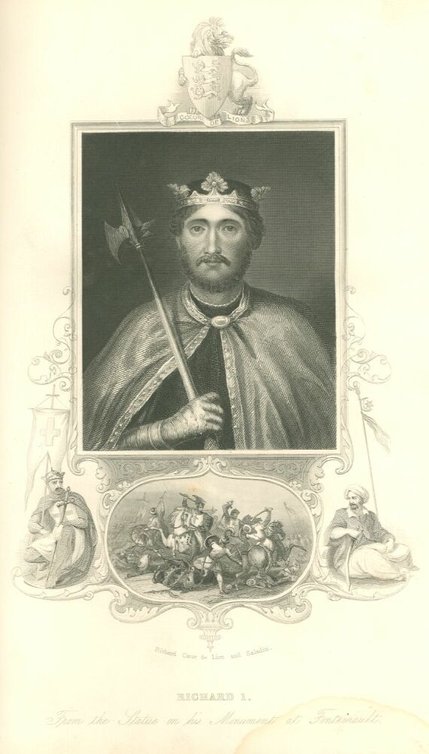
Though it had been the constant practice of France, ever since the accession of the Capetian line, to crown the son during the lifetime of the father without conferring on him any present participation of royalty; Lewis persuaded his son-in-law, that, by this ceremony, which in those ages was deemed so important, he had acquired a title to sovereignty, and that the king could not, without injustice, exclude him from immediate possession of the whole, or at least a part of his dominions. In consequence of these extravagant ideas, young Henry, on his return, desired the king to resign to him either the crown of England or the duchy of Normandy; discovered great discontent on the refusal; spake in the most undutiful terms of his father; and soon after, in concert with Lewis, made his escape to Paris, where he was protected and supported by that monarch.
While Henry was alarmed at this incident, and had the prospect of dangerous intrigues, or even of a war, which, whether successful or not, must be extremely calamitous and disagreeable to him, he received intelligence of new misfortunes, which must have affected him in the most sensible manner. Queen Eleanor, who had disgusted her first husband by her gallantries, was no less offensive to her second by her jealousy; and after this manner carried to extremity, in the different periods of her life, every circumstance of female weakness. She communicated her discontents against Henry to her two younger sons, Geoffrey and Richard; persuaded them that they were also entitled to present possession of the territories assigned to them; engaged them to fly secretly to the court of France; and was meditating herself an escape to the same court, and had even put on man's apparel for that purpose, when she was seized by orders from her husband, and thrown into confinement. Thus Europe saw with astonishment the best and most indulgent of parents at war with his whole family; three boys, scarcely arrived at the age of puberty, require a great monarch, in the full vigor of his age and height of his reputation, to dethrone himself in their favor; and several princes not ashamed to support them in these unnatural and absurd pretensions.
Henry, reduced to this perilous and disagreeable situation, had recourse to the court of Rome. Though sensible of the danger attending the interposition of ecclesiastical authority in temporal disputes, he applied to the pope, as his superior lord, to excommunicate his enemies, and by these censures to reduce to obedience his undutiful children, whom he found such reluctance to punish by the sword of the magistrate.[*] Alexander, well pleased to exert his power in so justifiable a cause, issued the bulls required of him; but it was soon found, that these spiritual weapons had not the same force as when employed in a spiritual controversy; and that the clergy were very negligent in supporting a sentence which was nowise calculated to promote the immediate interests of their order. The king, after taking in vain this humiliating step, was obliged to have recourse to arms, and to enlist such auxiliaries as are the usual resource of tyrants, and have seldom been employed by so wise and just a monarch.
The loose government which prevailed in all the states of Europe, the many private wars carried on among the neighboring nobles, and the impossibility of enforcing any general execution of the laws, had encouraged a tribe of banditti to disturb every where the public peace, to infest the highways, to pillage the open country, and to brave all the efforts of the civil magistrate, and even the excommunications of the church, which were fulminated against them. Troops of them were sometimes enlisted in the service of one prince or baron, sometimes in that of another: they often acted in an independent manner, under leaders of their own; the peaceable and industrious inhabitants, reduced to poverty by their ravages, were frequently obliged for subsistence to betake themselves to a like disorderly course of life; and a continual intestine war, pernicious to industry, as well as to the execution of justice, was thus carried on in the bowels of every kingdom. Those desperate ruffians received the name sometimes of Brabançons, sometimes of Routiers or Cottereaux; but for what reason is not agreed by historians; and they formed a kind of society or government among themselves, which set at defiance the rest of mankind. The greatest monarchs were not ashamed, on occasion, to have recourse to their assistance; and as their habits of war and depredation had given them experience, hardiness, and courage, they generally composed the most formidable part of those armies which decided the political quarrels of princes. Several of them were enlisted among the forces levied by Henry's enemies; but the great treasures amassed by that prince enabled him to engage more numerous troops of them in his service; and the situation of his affairs rendered even such banditti the only forces on whose fidelity he could repose any confidence.
His licentious barons, disgusted with a vigilant government, were more desirous of being ruled by young princes, ignorant of public affairs, remiss in their conduct, and profuse in their grants; and as the king had insured to his sons the succession to every particular province of his dominions, the nobles dreaded no danger in adhering to those who, they knew, must some time become their sovereigns. Prompted by these motives, many of the Norman nobility had deserted to his son Henry; the Breton and Gascon barons seemed equally disposed to embrace the quarrel of Geoffrey and Richard. Disaffection had crept in among the English; and the earls of Leicester and Chester in particular had openly declared against the king. Twenty thousand Brabançons, therefore, joined to some troops which he brought over from Ireland, and a few barons of approved fidelity, formed the sole force with which he intended to resist his enemies.
Lewis, in order to bind the confederates in a closer union, summoned at Paris an assembly of the chief vassals of the crown, received their approbation of his measures, and engaged them by oath to adhere to the cause of young Henry. This prince, in return, bound himself by a like tie never to desert his French allies; and having made a new great seal, he lavishly distributed among them many considerable parts of those territories which he purposed to conquer from his father. The counts of Flanders, Boulogne, Blois, and Eu, partly moved by the general jealousy arising from Henry's power and ambition, partly allured by the prospect of reaping advantage from the inconsiderate temper and the necessities of the young prince, declared openly in favor of the latter. William, king of Scotland, had also entered into this great confederacy; and a plan was concerted for a general invasion on different parts of the king's extensive and factious dominions.
Hostilities were first commenced by the counts of Flanders and Boulogne on the frontiers of Normandy. Those princes laid siege to Aumale, which was delivered into their hands by the treachery of the count of that name: this nobleman surrendered himself prisoner; and on pretence of thereby paying his ransom, opened the gates of all his other fortresses. The two counts next besieged and made themselves masters of Drincourt; but the count of Boulogne was here mortally wounded in the assault; and this incident put some stop to the progress of the Flemish arms.
In another quarter, the king of France, being strongly assisted by his vassals, assembled a great army of seven thousand knights and their followers on horseback, and a proportionable number of infantry; carrying young Henry along with him he laid siege to Verneuil, which was vigorously defended by Hugh de Lacy and Hugh de Beauchamp, the governors. After he had lain a month before the place, the garrison, being straitened for provisions, were obliged to capitulate; and they engaged, if not relieved within three days, to surrender the town, and to retire into the citadel. On the last of these days, Henry appeared with his army upon the heights above Verneuil. Lewis, dreading an attack, sent the archbishop of Sens and the count of Blois to the English camp, and desired that next day should be appointed for a conference, in order to establish a general peace, and terminate the difference between Henry and his sons. The king, who passionately desired this accommodation, and suspected no fraud, gave his consent; but Lewis, that morning, obliging the garrison to surrender, according to the capitulation, set fire to the place, and began to retire with his army. Henry, provoked at this artifice, attacked the rear with vigor, put them to rout, did some execution, and took several prisoners. The French army, as their time of service was now expired, immediately dispersed themselves into their several provinces, and left Henry free to prosecute his advantages against his other enemies.
The nobles of Brittany, instigated by the earl of Chester and Ralph de Fougeres, were all in arms; but their progress was checked by a body of Brabançons, which the king, after Lewis's retreat, had sent against them. The two armies came to an action near Dol, where the rebels were defeated, fifteen hundred killed on the spot, and the leaders, the earls of Chester and Fougeres, obliged to take shelter in the town of Dol. Henry hastened to form the siege of that place, and carried on the attack with such ardor, that he obliged the governor and garrison to surrender themselves prisoners. By these rigorous measures and happy successes, the insurrections were entirely quelled in Brittany; and the king, thus fortunate in all quarters, willingly agreed to a conference with Lewis, in hopes that his enemies, finding all their mighty efforts entirely frustrated, would terminate hostilities on some moderate and reasonable conditions.
The two monarchs met between Trie and Gisofs; and Henry had here the mortification to see his three sons in the retinue of his mortal enemy. As Lewis had no other pretence for war than supporting the claims of the young princes, the king made them such offers as children might be ashamed to insist on, and could be extorted from him by nothing but his parental affection, or by the present necessity of his affairs.[*] He insisted only on retaining the sovereign authority in all his dominions; but offered young Henry half the revenues of England, with some places of surety in that kingdom; or, if he rather chose to reside in Normandy, half the revenues of that duchy, with all those of Anjou. He made a like offer to Richard in Guienne; he promised to resign Brittany to Geoffrey; and if these concessions were not deemed sufficient, he agreed to add to them whatever the pope's legates, who were present, should require of him.[**] The earl of Leicester was also present at the negotiation; and either from the impetuosity of his temper, or from a view of abruptly breaking off a conference which must cover the allies with confusion, he gave vent to the most violent reproaches against Henry, and he even put his hand to his sword, as if he meant to attempt some violence against him. This furious action threw the whole company into confusion, and put an end to the treaty.[***]
The chief hopes of Henry's enemies seemed now to depend oft the state of affairs in England, where his authority was exposed to the most imminent danger. One article of Prince Henry's agreement with his foreign confederates was, that he should resign Kent, with Dover, and all its other fortresses, into the hands of ihe earl of Flanders:[****] yet so little national or public spirit prevailed among the independent English nobility, so wholly bent were they on the aggrandizement each of himself and his own family, that, notwithstanding this pernicious concession, which must have produced the ruin of the kingdom, the greater part of them had conspired to make an insurrection, and to support the prince's pretensions.
The king's principal resource lay in the church and the bishops with whom he was now in perfect agreement; whether that the decency of their character made them ashamed of supporting so unnatural a rebellion, or that they were entirely satisfied with Henry's atonement for the murder of Becket and for his former invasion of ecclesiastical immunities. That prince, however, had resigned none of the essential rights of his crown in the accommodation: he maintained still the same prudent jealousy of the court of Rome; admitted no legate into England, without his swearing to attempt nothing against the royal prerogatives; and he had even obliged the monks of Canterbury, who pretended to a free election on the vacancy made by the death of Becket, to choose Roger, prior of Dover, in the place of that turbulent prelate.[*]
The king of Scotland made an irruption into Northumberland, and committed great devastations; but being opposed by Richard de Lucy, whom Henry had left guardian of the realm, he retreated into his own country, and agreed to a cessation of arms. This truce enabled the guardian to march southwards with his army, in order to oppose an invasion which the earl of Leicester, at the head of a great body of Flemings, had made upon Suffolk. The Flemings had been joined by Hugh Bigod, who made them masters of his castle of Framlingham; and marching into the heart of the kingdom, where they hoped to be supported by Leicester's vassals, they were met by Lucy, who, assisted by Humphry Bohun, the constable, and the earls of Arundel, Glocester, and Cornwall, had advanced to Farnham with a less numerous, but braver army to oppose them. The Flemings, who were mostly weavers and artificers, (for manufactures were now beginning to be established in Flanders,) were broken in an instant, ten thousand of them were put to the sword, the earl of Leicester was taken prisoner, and the remains of the invaders were glad to compound for a safe retreat into their own country.
1174.
This great defeat did not dishearten the malecontents; who, being supported by the alliance of so many foreign princes, and encouraged by the king's own sons, determined to persevere in their enterprise. The earl of Ferrars, Roger de Moubray, Archetil de Mallory, Richard de Moreville, Hamo de Mascie, together with many friends of the earls of Leicester and Chester, rose in arms: the fidelity of the earls of Clare and Glocester was suspected; and the guardian, though vigorously supported by Geoffrey, bishop of Lincoln, the king's natural son by the fair Rosamond, found it difficult to defend himself, on all quarters, from so many open and concealed enemies. The more to augment the confusion, the king of Scotland, on the expiration of the truce, broke into the northern provinces with a great army[*] of eighty thousand men; which, though undisciplined and disorderly, and better fitted for committing devastation, than for executing any military enterprise, was become dangerous from the present factious and turbulent spirit of the kingdom.
Henry, who had baffled all his enemies in France, and had put his frontiers in a posture of defence, now found England the seat of danger; and he determined by his presence to overawe the malecontents, or by his conduct and courage to subdue them. He lauded at Southampton; and knowing the influence of superstition over the minds of the people, he hastened to Canterbury, in order to make atonement to the ashes of Thomas à Becket, and tender his submissions to a dead enemy. As soon as he came within sight of the church of Canterbury, he dismounted walked barefoot towards it, prostrated himself before the shrine of the saint, remained in fasting and prayer during a whole day, and watched all night the holy relics. Not content with this hypocritical devotion towards a man whose violence and ingratitude had so long disquieted his government, and had been the object of his most inveterate animosity, he submitted to a penance still more singular and humiliating. He assembled a chapter of the monks, disrobed himself before them, put a scourge of discipline into the hands of each, and presented his bare shoulders to the lashes which these ecclesiastics successively inflicted upon him. Next day he received absolution; and, departing for London, got soon after the agreeable intelligence of a great victory which his generals had obtained over the Scots, and which, being gained, as was reported, on the very day of his absolution, was regarded as the earnest of his final reconciliation with Heaven and with Thomas a Becket William, king of Scots, though repulsed before the castle of Prudhow, and other fortified places, had committed the most horrible depredations upon the northern provinces; but on the approach of Ralph de Glanville, the famous justiciary, seconded by Bernard de Baliol, Robert de Stuteville, Odonel de Umfreville, William de Vesci, and other northern barons together with the gallant bishop of Lincoln, he thought proper to retreat nearer his own country, and he fixed his camp at Alnwick. He had here weakened his army extremely, by sending out numerous detachments in order to extend his ravages; and he lay absolutely safe, as he imagined, from any attack of the enemy. But Glanville, informed of his situation, made a hasty and fatiguing march to Newcastle; and allowing his soldiers only a small interval for refreshment, he immediately set out towards evening for Alnwick. He marched that night above thirty miles; arrived in the morning, under cover of a mist, near the Scottish camp; and regardless of the great numbers of the enemy, he began the attack with his small but determined body of cavalry. William was living in such supine security that he took the English at first for a body of his own ravagers who were returning to the camp; but the sight of their banners convincing him of his mistake, he entered on the action with no greater body than a hundred horse, in confidence that the numerous army which surrounded him would soon hasten to his relief. He was dismounted on the first shock, and taken prisoner; while his troops, hearing of this disaster, fled on all sides with the utmost precipitation. The dispersed ravagers made the best of their way to their own country; and discord arising among them, they proceeded even to mutual hostilities, and suffered more from each other's sword than from that of the enemy.
This great and important victory proved at last decisive in favor of Henry, and entirely broke the spirit of the English rebels. The bishop of Durham, who was preparing to revolt, made his submissions; Hugh Bigod, though he had received a strong reénforcement of Flemings, was obliged to surrender all his castles, and throw himself on the king's mercy; no better resource was left to the earl of Ferrars and Roger de Moubray; the inferior rebels imitating the example, all England was restored to tranquillity in a few weeks; and as the king appeared to be under the immediate protection of Heaven, it was deemed impious any longer to resist him. The clergy exalted anew the merits and powerful intercession of Becket; and Henry, instead of opposing this superstition, plumed himself on the new friendship of the-saint, and propagated an opinion which was so favorable to his interests.[*]
Prince Henry, who was ready to embark at Gravelines with the earl of Flanders and a great army, hearing that his partisans in England were suppressed, abandoned all thoughts of the enterprise, and joined the camp of Lewis, who, during the absence of the king, had made an irruption into Normandy and had laid siege to Rouen.[*] The place was defended with great vigor by the inhabitants;[**] and Lewis, despairing of success by open force, tried to gain the town by a stratagem, which, in that superstitious age, was deemed not very honor able. He proclaimed in his own camp a cessation of arms on pretence of celebrating the festival of St. Laurence; and when the citizens, supposing themselves in safety, were so imprudent as to remit their guard, he purposed to take advantage of their security. Happily, some priests had, from mere curiosity, mounted a steeple, where the alarm bell hung; and observing the French camp in motion, they immediately rang the bell, and gave warning to the inhabitants, who ran to their several stations. The French, who, on hearing the alarm hurried to the assault, had already mounted the walls in several places; but being repulsed by the enraged citizens were obliged to retreat with considerable loss.[***] Next day, Henry, who had hastened to the defence of his Norman dominions, passed over the bridge in triumph; and entered Rouen in sight of the French army. The city was now in absolute safety; and the king, in order to brave the French, monarch, commanded the gates, which had been walled up, to be opened; and he prepared to push his advantages against the enemy. Lewis saved himself from this perilous situation by a new piece of deceit, not so justifiable. He proposed a conference for adjusting the terms of a general peace, which he knew would be greedily embraced by Henry; and while the king of England trusted to the execution of his promise, he made a retreat with his army into France.
There was, however, a necessity on both sides for an accommodation. Henry could no longer bear to see his three sons in the hands of his enemy; and Lewis dreaded lest this great monarch, victorious in all quarters, crowned with glory, and absolute master of his dominions, might take revenge for the many dangers and disquietudes which the arms, and still more the intrigues, of France had, in his disputes both with Becket and his sons, found means to raise him. After making a cessation of arms, a conference was agreed on near Tours; where Henry granted his sons much less advantageous terms than he had formerly offered; and he received their submissions. The most material of his concessions were some pensions which he stipulated to pay them, and some castles which he granted them for the place of their residence; together with an indemnity for all their adherents, who were restored to their estates and honors.[*]
Of all those who had embraced the cause of the young princes, William, king of Scotland, was the only considerable loser by that invidious and unjust enterprise. Henry delivered from confinement, without exacting any ransom, about nine hundred knights, whom he had taken prisoners; but it cost William the ancient independency of his crown as the price of his liberty. He stipulated to do homage to Henry for Scotland and all his other possessions; he engaged that all the barons and nobility of his kingdom should also do homage; that the bishops should take an oath of fealty; that both should swear to adhere to the king of England against their native prince, if the latter should break his engagements; and that the fortresses of Edinburgh, Stirling, Berwick, Roxborough, and Jedborough should be delivered into Henry's hands, till the performance of articles.[**]
1175.
This severe and humiliating treaty was executed in its full rigor. William, being released, brought up all his barons, prelates, and abbots; and they did homage to Henry in the cathedral of York, and acknowledged him and his successors for their superior lord.[***]
The English monarch stretched still further the rigor of the conditions which he exacted. He engaged the king and states of Scotland to make a perpetual cession of the fortresses of Berwick and Roxborough, and to allow the castle of Edinburgh to remain in his hands for a limited time This was the first great ascendant which England obtained over Scotland; and indeed the first important transaction which had passed between the kingdoms. Few princes have been so fortunate as to gain considerable advantages over their weaker neighbors with less violence and injustice than was practised by Henry against the king of Scots, whom he had taken prisoner in battle, and who had wantonly engaged in a war, in which all the neighbors of that prince, and even his own family, were, without provocation, combined against him.[*]
Henry having thus, contrary to expectation, extricated himself with honor from a situation in which his throne was exposed to great danger, was employed for several years in the administration of justice, in the execution of the laws, and in guarding against those inconveniencies, which either the past convulsions of his state, or the political institutions of that age, unavoidably occasioned. The provisions which he made, show such largeness of thought as qualified him for being a legislator; and they were commonly calculated as well for the future as the present happiness of his kingdom.
1176.
He enacted severe penalties against robbery, murder, false coining, arson; and ordained that these crimes should be punished by the amputation of the right hand and right foot.[**] The pecuniary commutation for crimes, which has a false appearance of lenity, had been gradually disused; and seems to have been entirely abolished by the rigor of these statutes. The superstitious trial by water ordeal, though condemned by the church,[***] still subsisted; but Henry ordained, that any man accused of murder, or any heinous felony, by the oath of the legal knights of the county, should, even though acquitted by the ordeal, be obliged to abjure the realm.[****]
All advances towards reason and good sense are slow and gradual. Henry, though sensible of the great absurdity attending the trial by duel or battle, did not venture to abolish it: he only admitted either of the parties to challenge a trial by an assize or jury of twelve freeholders.[*****]
This latter method of trial seems to have been very ancient in England, and was fixed by the laws of King Alfred: but the barbarous and violent genius of the age had of late given more credit to the trial by battle, which had become the general method of deciding all important controversies. It was never abolished by law in England; and there is an instance of it so late as the reign of Elizabeth: but the institution revived by this king, being found more reasonable and more suitable to a civilized people, gradually prevailed over it.
The partition of England into four divisions, and the appointment of itinerant justices to go the circuit in each division, and to decide the causes in the counties, was another important ordinance of this prince, which had a direct tendency to curb the oppressive barons, and to protect the inferior gentry and common people in their property.[*] Those justices were either prelates or considerable noblemen; who, besides carrying the authority of the king's commission, were able, by the dignity of their own character, to give weight and credit to the laws.
That there might be fewer obstacles to the execution of justice, the king was vigilant in demolishing all the new erected castles of the nobility, in England as well as in his foreign dominions; and he permitted no fortress to remain in the custody of those whom he found reason to suspect.[**]
But lest the kingdom should be weakened by this demolition of the fortresses, the king fixed an assize of arms, by which all his subjects were obliged to put themselves in a situation for defending themselves and the realm. Every man possessed of a knight's fee was ordained to have for each fee, a coat of mail, a helmet, a shield, and a lance; every free layman, possessed of goods to the value of sixteen marks, was to be armed in like manner; every one that possessed ten marks was obliged to have an iron gorget, a cap of iron, and a lance; all burgesses were to have a cap of iron, a lance, and a wambais; that is, a coat quilted with wool, tow, or such like materials.[***] It appears that archery, for which the English were afterwards so renowned, had not at this time become very common among them. The spear was the chief weapon employed in battle.
The clergy and the laity were, during that age, in a strange situation with regard to each other, and such as may seem totally incompatible with a civilized, and indeed with any species of government. If a clergyman were guilty of murder, he could be punished by degradation only: if he were murdered, the murderer was exposed to nothing but excommunication and ecclesiastical censures; and the crime was atoned for by penances and submission.[*] Hence the assassins of Thomas à Becket himself, though guilty of the most atrocious wickedness, and the most repugnant to the sentiments of that age, lived securely in their own houses, without being called to account by Henry himself, who was so much concerned, both in honor and interest, to punish that crime, and who professed or affected, on all occasions, the most extreme abhorrence of it. It was not till they found their presence shunned by every one as excommunicated persons, that they were induced to take a journey to Rome, to throw themselves at the feet of the pontiff, and to submit to the penances imposed upon them; after which, they continued to possess without molestation their honors and fortunes, and seem even to have recovered the countenance and good opinion of the public. But as the king, by the constitutions of Clarendon, which he endeavored still to maintain,[**] had subjected the clergy to a trial by the civil magistrate, it seemed but just to give them the protection of that power, to which they owed obedience: it was enacted, that the murderers of clergymen should be tried before the justiciary, in the presence of the bishop or his official; and besides the usual punishment for murder, should be subjected to a forfeiture of their estates, and a confiscation of their goods and chattels.[***]
The king passed an equitable law, that the goods of a vassal should not be seized for the debt of his lord, unless the vassal be surety for the debt; and that the rents of vassals should be paid to the creditors of the lord, not to the lord himself. It is remarkable, that this law was enacted by the king in a council which he held at Verneuil, and which consisted of some prelates and barons of England, as well as some of Normandy, Poictou, Anjou, Maine, Touraine, and Brittany and the statute took place in all these last-mentioned territories,[*] though totally unconnected with each other;[**] a certain proof how irregular the ancient feudal government was, and how near the sovereigns, in some instances, approached to despotism, though in others they seemed scarcely to possess any authority. If a prince, much dreaded and revered like Henry, obtained but the appearance of general consent to an ordinance which was equitable and just, it became immediately an established law, and all his subjects acquiesced in it, If the prince was hated or despised; if the nobles, who supported him, had small influence; if the humors of the times disposed the people to question the justice of his ordinance; the fullest and most authentic assembly had no authority. Thus all was confusion and disorder; no regular idea of a constitution; force and violence decided every thing.
The success which had attended Henry in his wars, did not much encourage his neighbors to form any attempt against him; and his transactions with them, during several years, contain little memorable. Scotland remained in that state of feudal subjection to which he had reduced it, and gave him no further inquietude. He sent over his fourth son, John, into Ireland, with a view of making a more complete conquest of the island; but the petulance and incapacity of this prince, by which he enraged the Irish chieftains, obliged the king soon after to recall him.[***]
The king of France had fallen into an abject superstition; and was induced, by a devotion more sincere than that of Henry, to make a pilgrimage to the tomb of Becket, in order to obtain his intercession for the cure of Philip, his eldest son. He probably thought himself well entitled to the favor of that saint, on account of their ancient intimacy; and hoped that Becket, whom he had protected while on earth, would not now, when he was so highly exalted in heaven, forget his old friend and benefactor. The monks, sensible that their saint's honor was concerned in the case, failed not to publish that Lewis's prayers were answered, and that the young prince was restored to health by Becket's intercession. That king himself was soon after struck with an apoplexy, which deprived him of his understanding: Philip though a youth of fifteen, took on him the administration, till his father's death, which happened soon after,
1180.
opened his way to the throne; and he proved the ablest and greatest monarch that had governed that kingdom since the age of Charlemagne. The superior years, however, and experience of Henry, while they moderated his ambition, gave him such an ascendant over this prince, that no dangerous rivalship for a long time arose between them. The English monarch, instead of taking advantage of his own situation, rather employed his good offices in composing the quarrels which arose in the royal family of France; and he was successful in mediating a reconciliation between Philip and his mother and uncles. These services were but ill requited by Philip, who, when he came to man's estate, fomented all the domestic discords in the royal family of England, and encouraged Henry's sons in their ungrateful and undutiful behavior towards him. Prince Henry, equally impatient of obtaining power, and incapable of using it, renewed to the king the demand of his resigning Normandy; and on meeting with a refusal, he fled with his consort to the court of France: but not finding Philip at that time disposed to enter into war for his sake, he accepted of his father's offers of reconciliation, and made him submissions. It was a cruel circumstance in the king's fortune, that he could hope for no tranquillity from the criminal enterprises of his sons but by their mutual discord and animosities, which disturbed his family and threw his state into convulsions. Richard, whom he had made master of Guienne, and who had displayed his valor and military genius by suppressing the revolts of his mutinous barons refused to obey Henry's orders, in doing homage to his elder brother for that duchy; and he defended himself against young Henry and Geoffrey, who, uniting their arms, carried war into his territories.[**]
The king with some difficulty composed this difference; but immediately found his eldest son engaged in conspiracies, and ready to take arms against himself. While the young prince was conducting these criminal intrigues, he was seized with a fever at Martel,
1183.
a castle near Turenne to which he had retired in discontent; and seeing the approaches of death, he was at last struck with remorse for his undutiful behavior towards his father. He sent a message to the king, who was not far distant; expressed his contrition for his faults; and entreated the favor of a visit, that he might at least die with the satisfaction of having obtained his forgiveness. Henry, who had so often experienced the prince's ingratitude and violence, apprehended that his sickness was entirely feigned, and he durst not intrust himself into his son's hands: but when he soon after received intelligence of young Henry's death, and the proofs, of his sincere repentance, this good prince was affected with the deepest sorrow; he thrice fainted away; he accused his own hard hearted ness in refusing the dying request of his son; and he lamented that he had deprived that prince of the last opportunity of making atonement for his offences, and of pouring out his soul in the bosom of his reconciled father.[*] This prince died in the twenty-eighth year of his age.
The behavior of his surviving children did not tend to give the king any consolation for the loss. As Prince Henry had left no posterity, Richard was become heir to all his dominions; and the king intended that John, his third surviving son and favorite, should inherit Guienne as his appanage; but Richard refused his consent, fled into that duchy, and even made preparations for carrying on war, as well against his father as against his brother Geoffrey, who was now put in possession of Brittany. Henry sent for Eleanor, his queen, the heiress of Guienne, and required Richard to deliver up to her the dominion of these territories; which that prince, either dreading an insurrection of the Gascons in her favor, or retaining some sense of duty towards her, readily performed; and he peaceably returned to his father's court. No sooner was this quarrel accommodated, than Geoffrey, the most vicious perhaps of all Henry's unhappy family, broke out into violence; demanded Anjou to be annexed to his dominions of Brittany; and on meeting with a refusal, fled to the court of France, and levied forces against his father.[**]
1185.
Henry was freed from this danger by his son's death who was killed in a tournament at Paris.[***]
The widow of Geoffrey, soon after his decease, was delivered of a son who received the name of Arthur, and was invested in the duchy of Brittany, under the guardianship of his grandfather, who, is duke of Normandy, was also superior lord of that territory. Philip, as lord paramount, disputed some time his title to this wardship; but was obliged to yield to the inclinations of the Bretons, who preferred the government of Henry.
But the rivalship between these potent princes, and all their inferior interests, seemed now to have given place to the general passion for the relief of the Holy Land and the expulsion of the Saracens. Those infidels, though obliged to yield to the immense inundation of Christians in the first crusade, had recovered courage after the torrent was past; and attacking on all quarters the settlements of the Europeans, had Deduced these adventurers to great difficulties, and obliged them to apply again for succors from the west. A second crusade, under the emperor Conrade, and Lewis VII., king of France, in which there perished above two hundred thousand men, brought them but a temporary relief; and those princes, after losing such immense armies, and seeing the flower of their nobility fall by their side, returned with little honor into Europe. But these repeated misfortunes, which drained the western world of its people and treasure, were not yet sufficient to cure men of their passion for those spiritual adventures; and a new incident rekindled with fresh fury the zeal of the ecclesiastics and military adventurers among the Latin Christians. Saladin, a prince of great generosity, bravery, and conduct, having fixed himself on the throne of Egypt, began to extend his conquests over the East; and finding the settlement of the Christians in Palestine an invincible obstacle to the progress of his arms, he bent the whole force of his policy and valor to subdue that small and barren, but important territory. Taking advantage of dissensions which prevailed among the champions of the cross, and having secretly gained the count of Tripoli, who commanded their armies, he invaded the frontiers with a mighty power and, aided by the treachery of that count, gained over them at Tiberiade a complete victory, which utterly annihilated the force of the already languishing kingdom of Jerusalem
1187.
The holy city itself fell into his hands after a feeble resistance; the kingdom of Antioch was almost entirely subdued and except some maritime towns, nothing considerable remained of thope boasted conquests, which, near a century before, it had cost the efforts of all Europe to acquire.
The western Christians were astonished on receiving this dismal intelligence. Pope Urban III., it is pretended, died of grief; and his successor, Gregory VIII., employed the whole time of his short pontificate in rousing to arms all the Christians who acknowledged his authority. The general cry was, that they were unworthy of enjoying any inheritance in heaven, who did not vindicate from the dominion of the infidels the inheritance of God on earth, and deliver from slavery that country which had been consecrated by the foot-steps of their Redeemer.
1188.
William, archbishop of Tyre, having procured a conference between Henry and Philip near Gisors, enforced all these topics; gave a pathetic description of the miserable state of the eastern Christians; and employed every argument to excite the ruling passions of the age, superstition, and jealousy of military honor. The two monarchs immediately took the cross; many of their most considerable vassals imitated the example; and as the emperor Frederic I. entered into the same confederacy, some well-grounded hopes of success were entertained; and men flattered themselves that an enterprise, which had failed under the conduct of many independent leaders, or of imprudent princes, might at last, by the efforts of such potent and able monarchs, be brought to a happy issue.
The kings of France and England imposed a tax, amounting to the tenth of all movable goods, on such as remained at home; but as they exempted from this burden most of the regular clergy, the secular aspired to the same immunity; pretended that their duty obliged them to assist the crusade with their prayers alone; and it was with some difficulty they were constrained to desist from an opposition, which in them who had been the chief promoters of those pious enterprises, appeared with the worst grace imaginable. This backwardness of the clergy is perhaps a symptom that the enthusiastic ardor which had at first seized the people for crusades, was now by time and ill success considerably abated; and that the frenzy was chiefly supported by the military genius and love of glory in the monarchs.
But before this great machine could be put in motion, there were still many obstacles to surmount. Philip, jealous of Henry's power, entered into a private confederacy with young Richard; and working on his ambitious and impatient temper, persuaded him, instead of supporting and aggrandizing that monarchy which he was one day to inherit, to seek present power and independence by disturbing and dismembering it.
1189.
In order to give a pretence for hostilities between the two kings, Richard broke into the territories of Raymond, count of Toulouse, who immediately carried complaints of this violence before the king of France, as his superior lord. Philip remonstrated with Henry; but received for answer, that Richard had confessed to the archbishop of Dublin, that his enterprise against Raymond had been undertaken by the approbation of Philip himself, and was conducted by his authority. The king of France, who might have been covered with shame and confusion by this detection, still prosecuted his design, and invaded the provinces of Berri and Auvergne, under color of revenging the quarrel of the count of Toulouse. Henry retaliated by making inroads upon the frontiers of France and burning Dreux. As this war, which destroyed all hopes of success in the projected crusade, gave great scandal, the two kings held a conference at the accustomed place between Gisors and Trie, in order to find means of accommodating their differences; they separated on worse terms than before; and Philip, to show his disgust, ordered a great elm, under which the conferences had been usually held, to be cut down; as if he had renounced all desire of accommodation, and was determined to carry the war to extremities against the king of England. But his own vassals refused to serve under him in so invidious a cause; and he was obliged to come anew to a conference with Henry, and to offer terms of peace. These terms were such as entirely opened the eyes of the king of England, and fully convinced him of the perfidy of his son, and his secret alliance with Philip, of which he had before only entertained some suspicion. The king of France required that Richard should be crowned king of England in the lifetime of his father, should be invested in all his transmarine dominions, and should immediately espouse Alice, Philip's sister, to whom he had been formerly affianced, and who had already been conducted into England. Henry had experienced such fatal effects, both from the crowning of his eldest son, and from that prince's alliance with the royal family of France, that he rejected these terms; and Richard, in con sequence of his secret agreement with Philip, immediately revolted from him, did homage to the king of France for all the dominions which Henry held of that crown, and received the investitures, as if he had already been the lawful possessor. Several historians assert, that Henry himself had become enamored of young Alice, and mention this as an additional reason for his refusing these conditions; but he had so many other just and equitable motives for his conduct, that it is superfluous to assign a cause, which the great prudence and advanced age of that monarch render somewhat improbable.
Cardinal Albano, the pope's legate, displeased with these increasing obstacles to the crusade, excommunicated Richard, as the chief spring of discord; but the sentence of excommunication, which, when it was properly prepared and was zealously supported by the clergy, had often great influence in that age, proved entirely ineffectual in the present case. The chief barons of Poictou, Guienne, Normandy, and Anjou, being attached to the young prince, and finding that he had now received the investiture from their superior lord, declared for him, and made inroads into the territories of such as still adhered to the king. Henry, disquieted by the daily revolts of his mutinous subjects, and dreading still worse effects from their turbulent disposition, had again recourse to papal authority; and engaged the cardinal Anagni, who had succeeded Albano in the legateship, to threaten Philip with laying an interdict on all his dominions. But Philip, who was a prince of great vigor and capacity, despised the menace, and told Anagni, that it belonged not to the pope to interpose in the temporal disputes of princes, much less in those between him and his rebellious vassal. He even proceeded so far as to reproach him with partiality, and with receiving bribes from the king of England; while Richard, still more outrageous, offered to draw his sword against the legate, and was hindered by the interposition alone of the company, from committing violence upon him.
The king of England was now obliged to defend his dominions by arms, and to engage in a war with France and with his eldest son, a prince of great valor, on such disadvantageous terms. Ferte-Bernard fell first into the hands of the enemy; Mans was next taken by assault; and Henry, who had thrown himself into that place, escaped with some difficulty; Amboise, Chaumont, and Château de Loire, opened their gates on the appearance of Philip and Richard: Tours was menaced; and the king, who had retired to Saumur, and had daily instances of the cowardice or infidelity of his governors, expected the most dismal issue to all his enterprises. While he was in this state of despondency, the duke of Burgundy, the earl of Flanders, and the archbishop of Rheims interposed with their good offices; and the intelligence which he received of the taking of Tours, and which made him fully sensible of the desperate situation of his affairs, so subdued his spirit, that he submitted to all the rigorous terms which, were imposed upon him. He agreed that Richard should marry the princess Alice; that that prince should receive the homage and oath of fealty of all his subjects both in England and his transmarine dominions; that he himself should pay twenty thousand marks to the king of France, as a compensation for the charges of the war; that his own barons should engage to make him observe this treaty by force, and in case of his violating it should promise to join Philip and Richard against him; and that all his vassals, who had entered into confederacy with Richard, should receive an indemnity for the offence.
But the mortification which Henry, who had been accustomed to give the law in most treaties, received from these disadvantageous terms, was the least that he met with on this occasion. When he demanded a list of those barons to whom he was bound to grant a pardon for their connections with Richard, he was astonished to find, at the head of them, the name of his second son, John; who had always been his favorite, whose interests he had ever anxiously at heart, and who had even, on account of his ascendant over him, often excited the jealousy of Richard. The unhappy father, already overloaded with cares and sorrows, finding this last disappointment in his domestic tenderness, broke out into expressions of the utmost despair, cursed the day in which he received his miserable being, and bestowed on his ungrateful and undutiful children a malediction which he never could be prevailed on to retract. The more his heart was disposed to friendship and affection, the more he resented the barbarous return which his four sons had successively made to his parental care; and this finishing blow, by depriving him of every comfort in life, quite broke his spirit, and threw him into a lingering fever, of which he expired, at the castle of Chinon, near Saumur. His natural son, Geoffrey, who alone had behaved dutifully towards him, attended his corpse to the nunnery of Fontervrault; where it lay in state in the abbey church. Next day, Richard, who came to visit the dead body of his father, and who, notwithstanding his criminal conduct, was not wholly destitute of generosity, was struck with horror and remorse at the sight; and as the attendants observed that, at that very instant, blood gushed from the mouth and nostrils of the corpse, he exclaimed, agreeably to a vulgar superstition, that he was his father's murderer; and he expressed a deep sense, though too late, of that undutiful behavior which had brought his parent to an untimely grave.
Thus died, in the fifty-eighth year of his age, and thirty-fifth of his reign, the greatest prince of his time for wisdom, virtue, and abilities, and the most powerful in the extent of dominion of all those that had ever filled the throne of England. His character in private, as well as in public life, is almost without a blemish; and he seems to have possessed every accomplishment, both of body and mind, which makes a man either estimable or amiable. He was of a middle stature, strong and well proportioned; his countenance was lively and engaging; his conversation affable and entertaining; his elocution easy, persuasive, and ever at command. He loved peace, but possessed both bravery and conduct in war; was provident without timidity; severe in the execution of justice without rigor; and temperate without austerity. He preserved health, and kept himself from corpulency, to which he was somewhat inclined, by an abstemious diet, and by frequent exercise, particularly hunting. When he could enjoy leisure, he recreated himself either in learned conversation or in reading; and he cultivated his natural talents by study above any prince of his time. His affections, as well as his enmities, were warm and durable; and his long experience of the ingratitude and infidelity of men never destroyed the natural sensibility of his temper, which disposed him to friendship and society. His character has been transmitted to us by several writers, who were his contemporaries; and it extremely resembles, in its most remarkable features, that of his maternal grandfather, Henry I.; excepting only, that ambition, which was a ruling passion in both, found not in the first Henry such unexceptionable means of exerting itself, and pushed that prince into measures which were both criminal in themselves, and were the cause of further crimes, from which his grandson's conduct was happily exempted.
This prince, like most of his predecessors of the Norman line, except Stephen, passed more of his time on the continent than in this island: he was surrounded with the English gentry and nobility when abroad: the French gentry and nobility attended him when he resided in England: both nations acted in the government as if they were the same people; and, on many occasions, the legislatures seem not to have been distinguished. As the king and all the English barons were of French extraction, the manners of that people acquired the ascendant, and were regarded as the models of imitation. All foreign improvements, therefore, such as they were, in literature and politeness, in laws and arts, seem now to have been, in a good measure, transplanted into England and that kingdom was become little inferior, in all the fashionable accomplishments, to any of its neighbors on the continent. The more homely but more sensible manners and principles of the Saxons, were exchanged for the affectations of chivalry, and the subtilties of school philosophy: the feudal ideas of civil government, the Romish sentiments in religion, had taken entire possession of the people: by the former, the sense of submission towards princes was somewhat diminished in the barons; by the latter, the devoted attachment to papal authority was much augmented among the clergy. The Norman and other foreign families established in England, had now struck deep root; and being entirely incorporated with the people, whom at first they oppressed and despised, they no longer thought that they needed the protection of the crown for the enjoyment of their possessions, or considered their tenure as precarious. They aspired to the same liberty and independence which they saw enjoyed by their brethren on the continent, and desired to restrain those exorbitant prerogatives and arbitrary practices, which the necessities of war and the violence of conquest had at first obliged them to indulge in their monarch. That memory also of a more equal government under the Saxon princes, which remained with the English, diffused still further the spirit of liberty, and made the barons both desirous of more independence to themselves and willing to indulge it to the people. And it was not long ere this secret revolution in the sentiments of men produced, first violent convulsions in the state, then an evident alteration in the maxims of government.
The history of all the preceding kings of England since the conquest, gives evident proofs of the disorders attending the feudal institutions; the licentiousness of the barons, their spirit of rebellion against the prince and laws, and of animosity against each other: the conduct of the barons in the transmarine dominions of those monarchs, afforded perhaps still more flagrant instances of these convulsions; and the history of France, during several ages, consists almost entirely of narrations of this nature. The cities, during the continuance of this violent government, could neither be very numerous nor populous; and there occur instances which seem to evince that, though these are always the first seat of law and liberty, their police was in general loose and irregular, and exposed to the same disorders with those by which the country was generally infested. It was a custom in London for great numbers, to the amount of a hundred or more, the sons and relations of considerable citizens, to form themselves into a licentious confederacy, to break into rich houses and plunder them, to rob and murder the passengers, and to commit with impunity all sorts of disorder. By these crimes it had become so dangerous to walk the streets by night, that the citizens durst no more venture abroad after sunset, than if they had been exposed to the incursions of a public enemy. The brother of the earl of Ferrars had been murdered by some of those nocturnal rioters; and the death of so eminent a person, which was much more regarded than that of many thousands of an inferior station, so provoked the king, that he swore vengeance against the criminals, and became thenceforth more rigorous in the execution of the laws.
There is another instance given by historians, which proves to what a height such riots had proceeded, and how open these criminals were in committing their robberies. A band of them had attacked the house of a rich citizen, with an intention of plundering it; had broken through a stone wall with hammers and wedges; and had already entered the house sword in hand, when the citizen, armed cap-á-pie, and supported by his faithful servants, appeared in the passage to oppose them: he cut off the right hand of the first robber that entered, and made such stout resistance that his neighbors had leisure to assemble and come to his relief. The man who lost his hand was taken; and was tempted by the promise of pardon to reveal his confederates; among whom was one John Senex, esteemed among the richest and best-born citizens in London. He was convicted by the ordeal; and though he offered five hundred marks for his life, the king refused the money, and ordered him to be hanged. It appears, from a statute of Edward I., that these disorders were not remedied even in that reign. It was then made penal to go out at night after the hour of the curfew, to carry a weapon, or to walk without a light or lantern. It is said in the preamble to this law, that both by night and by day there were continual frays in the streets of London.
Henry's care in administering justice had gained him so great a reputation, that even foreign and distant princes made him arbiter, and submitted their differences to his judgment. Sanchez, king of Navarre, having some controversies with Alphonso, king of Castile, was contented, though Alphonso had married the daughter of Henry, to choose this prince for a referee; and they agreed each of them to consign three castles into neutral hands, as a pledge of their not departing from his award. Henry made the cause be examined before his great council, and gave a sentence, which was submitted to by both parties. These two Spanish kings sent each a stout champion to the court of England, in order to defend his cause by arms, in case the way of duel had been chosen by Henry.
Henry so far abolished the barbarous and absurd practice of confiscating ships which had been wrecked on the coast, that he ordained if one man or animal were alive in the ship that the vessel and goods should be restored to the owners.
The reign of Henry was remarkable also for an innovation which was afterwards carried further by his successors, and was attended with the most important consequences. This prince was disgusted with the species of military force which was established by the feudal institutions, and which, though it was extremely burdensome to the subject, yet rendered very little service to the sovereign. The barons, or military tenants, came late into the field; they were obliged to serve only forty days; they were unskilful and disorderly in all their operations; and they were apt to carry into the camp the same refractory and independent spirit to which they were accustomed in their civil government. Henry, therefore, introduced the practice of making a commutation of their military service for money; and he levied scutages from his baronies and knights' fees, instead of requiring the personal attendance of his vassals. There is mention made, in the history of the exchequer, of these scutages in his second, fifth, and eighteenth year; and other writers give us an account of three more of them.[*] When the prince had thus obtained money, he made a contract with some of those adventurers in which Europe at that time abounded; they found him soldiers of the same character with themselves, who were bound to serve for a stipulated time: the armies were less numerous, but more useful, than when composed of all the military vassals of the crown: the feudal institutions began to relax: the kings became rapacious for money, on which all their power depended: the barons, seeing no end of exactions, sought to defend their property, and as the same causes had nearly the same effects in the different countries of Europe, the several crowns either lost or acquired authority, according to their different success in the contest.
This prince was also the first that levied a tax on the movables or personal estates of his subjects, nobles as well as commons. Their zeal for the holy wars made them submit to this innovation; and a precedent being once obtained, this taxation became, in following reigns, the usual method of supplying the necessities of the crown. The tax of danegelt, so generally odious to the nation, was remitted in this reign.
Since we are here collecting some detached incidents, which show the genius of the age, and which could not so well enter into the body of our history, it may not be improper to mention the quarrel between Roger, archbishop of York, and Richard, archbishop of Canterbury. We may judge of the violence of military men and laymen, when ecclesiastics could proceed to such extremities. Cardinal Haguezun, being sent, in 1176, as legate into Britain, summoned an assembly of the clergy at London; and, as both the archbishops pretended to sit on his right hand, this question of precedency begat a controversy between them. The monks and retainers of Archbishop Richard fell upon Roger, in the presence of the cardinal and of the synod, threw him to the ground, trampled him under foot, and so bruised him with blows, that he was taken up half dead, and his life was with difficulty saved from their violence. The archbishop of Canterbury was obliged to pay a large sum of money to the legate, in order to suppress all complaints with regard to this enormity.
We are told by Giraldus Cambrensis, that the monks and prior of St. Swithun threw themselves one day prostrate on the ground and in the mire before Henry, complaining, with many tears and much doleful lamentation, that the bishop of Winchester, who was also their abbot, had cut off three dishes from their table. "How many has he left you?" said the king. "Ten only," replied the disconsolate monks. "I myself," exclaimed the king, "never have more than three; and I enjoin your bishop to reduce you to the same number."
This king left only two legitimate sons, Richard, who succeeded him, and John, who inherited no territory, though his father had often intended to leave him a part of his extensive dominions. He was thence commonly denominated Lackland. Henry left three legitimate daughters; Maud, born in 1156, and married to Henry, duke of Saxony; Eleanor, born in 1162, and married to Alphonso, king of Castile: Joan, born in 1165, and married to William, king of Sicily.
Henry is said by ancient historians to have been of a very amorous disposition; they mention two of his natural sons by Rosamond, daughter of Lord Clifford; namely, Richard Longespée, or Longsword, (so called from the sword he usually wore,) who was afterwards married to Ela, the daughter and heir of the earl of Salisbury; and Geoffrey, first bishop of Lincoln, then archbishop of York. All the other circumstances of the story commonly told of that lady seem to be fabulous.
1189.
The compunction of Richard, for his undutiful behavior towards his father, was durable, and influenced him in the choice of his ministers and servants after his accession. Those who had seconded and favored his rebellion, instead of meeting with that trust and honor which they expected, were surprised to find that they lay under disgrace with the new king, and were on all occasions hated and despised by him. The faithful ministers of Henry, who had vigorously opposed all the enterprises of his sons, were received with open arms, and were continued in those offices which they had honorably discharged to their former master. This prudent conduct might be the result of reflection; but in a prince like Richard, so much guided by passion, and so little by policy, it was commonly ascribed to a principle still more virtuous and more honorable.
Richard, that he might make atonement to one parent for his breach of duty to the other, immediately sent orders for releasing the queen dowager from the confinement in which she had long been detained; and he intrusted her with the government of England, till his arrival in that kingdom. His bounty to his brother John was rather profuse and imprudent. Besides bestowing on him the county of Mortaigne, in Normandy, granting him a pension of four thousand marks a year, and marrying him to Avisa, the daughter of the earl of Glocester, by whom he inherited all the possessions of that opulent family, he increased this appanage, which the late king had destined him, by other extensive grants and concessions. He conferred on him the whole estate of William Peverell, which had escheated to the crown: he put him in possession of eight castles, with all the forests and honors annexed to them: he delivered over to him no less than six earldoms, Cornwall, Devon, Somerset, Nottingham, Dorset, Lancaster and Derby. And endeavoring, by favors, to fix that vicious prince in his duty, he put it too much in his power, whenever he pleased, to depart from it.
The king, impelled more by the love of military glory than by superstition, acted, from the beginning of his reign, as if the sole purpose of his government had been the relief of the Holy Land, and the recovery of Jerusalem from the Saracens. This zeal against infidels, being communicated to his subjects, broke out in London on the day of his coronation, and made them find a crusade less dangerous and attended with more immediate profit. The prejudices of the age had made the lending of money on interest pass by the invidious name of usury: yet the necessity of the practice had still continued it, and the greater part of that kind of dealing fell every where into the hands of the Jews, who, being already infamous on account of their religion, had no honor to lose, and were apt to exercise a profession, odious in itself, by every kind of rigor, and even sometimes by rapine and extortion. The industry and frugality of this people had put them in possession of all the ready money which the idleness and profusion common to the English with other European nations, enabled them to lend at exorbitant and unequal interest. The monkish writers represent it as a great stain on the wise and equitable government of Henry, that he had carefully protected this infidel race from all injuries and insults; but the zeal of Richard afforded the populace a pretence for venting their animosity against them. The king had issued an edict, prohibiting their appearance at his coronation; but some of them, bringing him large presents from their nation, presumed, in confidence of that merit, to approach the hall in which he dined: being discovered, they were exposed to the insults of the bystanders; they took to flight; the people pursued them; the rumor was spread that the king had issued orders to massacre all the Jews; a command so agreeable was executed in an instant on such as fell into the hands of the populace; those who had kept at home were exposed to equal danger; the people, moved by rapacity and zeal, broke into their houses which they plundered, after having murdered the owners; where the Jews barricadoed their doors, and defended themselves with vigor, the rabble set fire to their houses and made way through the flames to exercise the pillage and violence; the usual licentiousness of London, which the sovereign power with difficulty restrained, broke out with fury, and continued these outrages; the houses of the richest citizens, though Christians, were next attacked and plundered; and weariness and satiety at last put an end to the disorder: yet when the king empowered Glanville, the justiciary, to inquire into the authors of these crimes, the guilt was found to involve so many of the most considerable citizens, that it was deemed more prudent to drop the prosecution; and very few suffered the punishment due to this enormity. But the disorder stopped not at London. The inhabitants of the other cities of England, hearing of this slaughter of the Jews, imitated the example: in York five hundred of that nation, who had retired into the castle for safety, and found themselves unable to defend the place, murdered their own wives and children, threw the dead bodies over the walls upon the populace, and then setting fire to the houses, perished in the flames. The gentry of the neighborhood, who were all indebted to the Jews, ran to the cathedral, where their bonds were kept, and made a solemn bonfire of the papers before the altar. The compiler of the Annals of Waverley, in relating these events, blesses the Almighty for thus delivering over this impious race to destruction.
The ancient situation of England, when the people possessed little riches and the public no credit, made it impossible for sovereigns to bear the expense of a steady or durable war, even on their frontiers; much less could they find regular means for the support of distant expeditions like those into Palestine, which were more the result of popular frenzy than of sober reason or deliberate policy. Richard therefore knew that he must carry with him all the treasure necessary for his enterprise, and that both the remoteness of his own country and its poverty, made it unable to furnish him with those continued supplies, which the exigencies of so perilous a war must necessarily require. His father had left him a treasure of above a hundred thousand marks; and the king, negligent of every consideration but his present object, endeavored to augment his sum by all expedients, how pernicious soever ta the public, or dangerous to royal authority. He put to sale the revenues and manors of the crown; the offices of greatest trust and power, even those of forester and sheriff, which anciently were so important,[*] became venal; the dignity of chief justiciary, in whose hands was lodged the whole execution of the laws, was sold to Hugh de Puzas, bishop of Durham, for a thousand marks; the same prelate bought the earldom of Northumberland for life;[**] many of the champions of the cross, who had repented of their vow, purchased the liberty of violating it; and Richard, who stood less in need of men than of money, dispensed, on these conditions, with their attendance. Elated with the hopes of fame, which in that age attended no wars but those against the infidels, he was blind to every other consideration; and when some of his wiser ministers objected to this dissipation of the revenue and power of the crown, he replied, that he would sell London itself could he find a purchaser.[***] Nothing indeed could be a stronger proof how negligent he was of all future interests in comparison of the crusade, than his selling, for so small a sum as ten thousand marks, the vassalage of Scotland, together with the fortresses of Roxborough and Berwick, the greatest acquisition that had been made by his father during the course of his victorious reign; and his accepting the homage of William in the usual terms, merely for the territories which that prince held in England.[****] The English of all ranks and stations were oppressed by numerous exactions: menaces were employed both against the innocent and the guilty, in order to extort money from them; and where a pretence was wanting against the rich, the king obliged them, by the fear of his displeasure, to lend him sums which he knew it would never be in his power to repay.
But Richard, though he sacrificed every interest and consideration to the success of this pious enterprise, carried so little the appearance of sanctity in his conduct, that Fulk curate of Neuilly, a zealous preacher of the crusade, who from that merit had acquired the privilege of speaking the boldest truths, advised him to rid himself of his notorious vices, particularly his pride, avarice, and voluptuousness, which he called the king's three favorite daughters. "You counsel well," replied Richard; "and I hereby dispose of the first to the Templars, of the second to the Benedictines, and of the third to my prelates."
Richard, jealous of attempts which might be made on England during his absence, laid Prince John, as well as his natural brother Geoffrey, archbishop of York, under engagements, confirmed by their oaths, that neither of them should enter the kingdom till his return; though he thought proper, before his departure, to withdraw this prohibition. The administration was left in the hands of Hugh, bishop of Durham, and of Longchamp, bishop of Ely, whom he appointed justiciaries and guardians of the realm. The latter was a Frenchman of mean birth, and of a violent character; who by art and address had insinuated himself into favor, whom Richard had created chancellor, and whom he had engaged the pope also to invest with the legantine authority, that, by centring every kind of power in his person, he might the better insure the public tranquillity. All the military and turbulent spirits flocked about the person of the king, and were impatient to distinguish themselves against the infidels in Asia; whither his inclinations, his engagements, led him, and whither he was impelled by messages from the king of France, ready to embark in this enterprise.
The emperor Frederic, a prince of great spirit and conduct, had already taken the road to Palestine, at the head of one hundred and fifty thousand men, collected from Germany and all the northern states. Having surmounted every obstacle thrown in his way by the artifices of the Greeks and the power of the infidels, he had penetrated to the borders of Syria; when, bathing in the cold river Cydnus, during the greatest heat of the summer season, he was seized with a mortal distemper, which put an end to his life and his rash enterprise.[*]
His army, under the command of his son Conrade, reached Palestine; but was so diminished by fatigue famine, maladies, and the sword, that it scarcely amounted to eight thousand men, and was unable to make any progress against the great power, valor, and conduct of Saladin. These reiterated calamities attending the crusades, had taught the kings of France and England the necessity of trying another road to the Holy Land and they determined to conduct their armies thither by sea, to carry provisions along with them, and by means of their naval power to maintain an open communication with then own states, and with the western parts of Europe. The place of rendezvous was appointed in the plains of Vezelay, on the borders of Burgundy.[*]
1190.
Philip and Richard, on their arrival there, found their combined army amount to one hundred thousand men;[**] a mighty force, animated with glory and religion, conducted by two warlike monarchs, provided with every thing which their several dominions couid supply, and not to be overcome but by their own misconduct, or by the unsurmountable obstacles of nature.
The French prince and the English here reiterated their promises of cordial friendship, pledged their faith not to invade each other's dominions during the crusade, mutually exchanged the oaths of all their barons and prelates to the same effect, and subjected themselves to the penalty of interdicts and excommunications, if they should ever violate this public and solemn engagement. They then separated; Philip took the road to Genoa, Richard that to Marseilles, with a view of meeting their fleets, which were severally appointed to rendezvous in these harbors. They put to sea; and nearly about the same time were obliged, by stress of weather, to take shelter in Messina, where they were detained during the whole winter. This incident laid the foundation of animosities which proved fatal to their enterprise.
Richard and Philip were, by the situation and extent of their dominions, rivals in power; by their age and inclinations, competitors for glory; and these causes of emulation, which, had the princes been employed in the field against the common enemy, might have stimulated them to martial enterprises, soon excited, during the present leisure and repose, quarrels between monarchs of such a fiery character. Equally haughty, ambitious, intrepid, and inflexible, they were irritated with the least appearance of injury, and were incapable, by mutual condescensions, to efface those causes of complaint which unavoidably rose between them. Richard, candid, sincere, undesigning, impolitic, violent, laid himself open on every occasion to the designs of his antagonist; who, provident, interested, intriguing, failed not to take all advantages against him: and thus, both the circumstances of their disposition in which they were similar, and those in which they differed, rendered it impossible for them to persevere in that harmony which was so necessary to the success of their undertaking.
The last king of Sicily and Naples was William II., who had married Joan, sister to Richard, and who, dying without issue, had bequeathed his dominions to his paternal aunt Constantia, the only legitimate descendant surviving of Roger the first sovereign of those states who had been honored with the royal title. This princess had, in expectation of that rich inheritance, been married to Henry VI., the reigning emperor;[*] but Tancred, her natural brother, had fixed such an interest among the barons, that, taking advantage of Henry's absence, he had acquired possession of the throne, and maintained his claim, by force of arms, against all the efforts of the Germans.[**] The approach of the crusaders naturally gave him apprehensions for his unstable government; and he was uncertain whether he had most reason to dread the presence of the French or of the English monarch. Philip was engaged in a strict alliance with the emperor, his competitor: Richard was disgusted by his rigors towards the queen dowager, whom the Sicilian prince had confined in Palermo because she had opposed with all her interest his succession to the crown. Tancred, therefore, sensible of the present necessity, resolved to pay court to both these formidable princes; and he was not unsuccessful in his endeavors. He persuaded Philip that it was highly improper for him to interrupt his enterprise against the infidels by any attempt against a Christian state: he restored Queen Joan to her liberty; and even found means to make an alliance with Richard, who stipulated by treaty to marry his nephew Arthur; the young duke of Brittany, to one of the daughters of Tancred.[***]
But before these terms of friendship were settled. Richard, jealous both of Tancred and of the inhabitants of Messina, had taken up his quarters in the suburbs, and had possessed himself of a small fort, which commanded the harbor; and he kept himself extremely on his guard against their enterprises. The citizens took umbrage. Mutual insults and attacks passed between them and the English: Philip, who had quartered his troops in the town, endeavored to accommodate the quarrel, and held a conference with Richard for that purpose. While the two kings, meeting in the open fields, were engaged in discourse on this subject, a body of those Sicilians seemed to be drawing towards them; and Richard pushed forwards in order to inquire into the reason of this extraordinary movement.[*] The English, indolent from their power, and inflamed with former animosities, wanted but a pretence for attacking the Messinese: they soon chased them off the field, drove them into the town, and entered with them at the gates. The king employed his authority to restrain them from pillaging and massacring the defenceless inhabitants; but he gave orders, in token of his victory, that the standard of England should be erected on the walls. Philip, who considered that place as his quarters, exclaimed against the insult, and ordered some of his troops to pull down the standard: but Richard informed him by a messenger, that though he himself would willingly remove that ground of offence, he would not permit it to be done by others; and if the French king attempted such an insult upon him, he should not succeed but by the utmost effusion of blood. Philip, content with this species of haughty submission, recalled his orders:[**] the difference was seemingly accommodated, but still left the remains of rancor and jealousy in the breasts of the two monarchs.
Tancred, who for his own security desired to inflame their mutual hatred, employed an artifice which might have been attended with consequences still more fatal.
1191.
He showed Richard a letter, signed by the French king, and delivered to him, as he pretended, by the duke of Burgundy; in which that monarch desired Tancred to fall upon the quarters of the English, and promised to assist him in putting them to the sword as common enemies. The unwary Richard gave credit to the information; but was too candid not to betray his discontent to Philip, who absolutely denied the letter, and charged the Sicilian prince with forgery and falsehood. Richard either was, or pretended to be, entirely satisfied.[***]
Last these jealousies and complaints should multiply between them, it was proposed that they should, by a solemn treaty, obviate all future differences, and adjust every point that couid possibly hereafter become a controversy between them. But this expedient started a new dispute, which might have proved more dangerous than any of the foregoing, and which deeply concerned the honor of Philip's family. When Richard, in every treaty with the late king, insisted so strenuously on being allowed to marry Alice of France, he had only sought a pretence for quarrelling, and never meant to take to his bed a princess suspected of a criminal amour with his own father. After he became master, he no longer spake of that alliance: he even took measures for espousing Berengaria, daughter of Sanchez, king of Navarre, with whom he had become enamored during his abode in Guienne.[*] Queen Eleanor was daily expected with that princess at Messina;[**] and when Philip renewed to him his applications for espousing his sister Alice, Richard was obliged to give him an absolute refusal. It is pretended by Hoveden and other historians,[***] that he was able to produce such convincing proofs of Alice's infidelity, and even of her having borne a child to Henry, that her brother desisted from his applications, and chose to wrap up the dishonor of his family in silence and oblivion. It is certain, from the treaty itself which remains,[****] that, whatever were his motives, he permitted Richard to give his hand to Berengaria; and having settled all other controversies with that prince, he immediately set sail for the Holy Land. Richard awaited some time the arrival of his mother and bride, and when they joined him, he separated his fleet into two squadrons, and set forward on his enterprise. Queen Eleanor returned to England; but Berengaria, and the queen dowager of Sicily, his sister, attended him on the expedition.[*****]
The English fleet, on leaving the port of Messina, met with a furious tempest; and the squadron on which the two princesses were embarked was driven on the coast of Cyprus, and some of the vessels were wrecked near Limisso, in that island. Isaac, prince of Cyprus, who assumed the magnificent title of emperor, pillaged the ships that were stranded, brew the seamen and passengers into prison, and even refused to the princesses liberty, in their dangerous situation, of entering the harbor of Limisso. But Richard, who arrived soon after, took ample vengeance on him for the injury. He disembarked his troops; defeated the tyrant, who opposed his landing; entered Limisso by storm; gained next day a second victory; obliged Isaac to surrender at discretion; and established governors over the island. The Greek prince, being thrown into prison and loaded with irons, complained of the little regard with which he was treated; upon which Richard ordered silver fetters to be made for him; and this emperor, pleased with the distinction, expressed a sense of the generosity of his conqueror.[*] The king here espoused Berengaria, who, immediately embarking, carried along with her to Palestine the daughter of the Cypriot prince; a dangerous rival, who was believed to have seduced the affections of her husband. Such were the libertine character and conduct of the heroes engaged in this pious enterprise!
The English army arrived in time to partake in the glory of the siege of Acre or Ptolemais, which had been attacked for above two years by the united force of all the Christians in Palestine, and had been defended by the utmost efforts of Saladin and the Saracens. The remains of the German army, conducted by the emperor Frederic, and the separate bodies of adventurers who continually poured in from the west, had enabled the king of Jerusalem to form this important enterprise;[**] but Saladin having thrown a strong garrison into the place under the command of Caracos, his own master in the art of war, and molesting the besiegers with continual attacks and sallies, had protracted the success of the enterprise, and wasted the force of his enemies.
The arrival of Philip and Richard inspired new life into the Christians; and these princes acting by concert, and sharing the honor and danger of every action, gave hopes of a final victory over the infidels. They agreed on this plan of operations: when the French monarch attacked the town, the English guarded the trenches: next day, when the English prince conducted the assault, the French succeeded him in providing for the safety of the assailants. The emulation between those rival kings and rival nations produced extraordinary acts of valor: Richard, in particular animated with a more precipitate courage than Philip, and more agreeable to the romantic spirit of that age, drew to himself the general attention, and acquired a great and splendid reputation. But this harmony was of short duration, and occasions of discord soon arose between these jealous and haughty princes.
The family of Bouillon, which had first been placed on the throne of Jerusalem, ending in a female, Fulk, count of Anjou, grandfather to Henry II. of England, married the heiress of that kingdom, and transmitted his title to the younger branches of his family. The Anjevan race ending also in a female, Guy de Lusignan, by espousing Sibylla, the heiress, had succeeded to the title; and though he lost his kingdom by the invasion of Saladin, he was still acknowledged by all the Christians for king of Jerusalem.[*] But as Sibylla died without issue during the siege of Acre, Isabella, her younger sister, put in her claim to that titular kingdom, and required Lusignan to resign his pretensions to her husband, Conrade, marquis of Montferrat. Lusignan, maintaining that the royal title was unalienable and indefeasible, had recourse to the protection of Richard, attended on him before he left Cyprus, and engaged him to embrace his cause.[**] There needed no other reason for throwing Philip into the party of Conrade; and the opposite views of these great monarchs brought faction and dissension into the Christian army, and retarded all its operations. The templars, the Genoese, and the Germans, declared for Philip and Conrade; the Flemings, the Pisans, the knights of the hospital of St. John, adhered to Richard and Lusignan, But notwithstanding these disputes, as the length of the siege had reduced the Saracen garrison to the last extremity, they surrendered themselves prisoners; stipulated, in return for their lives, other advantages to the Christians, such as restoring of the Christian prisoners, and the delivery of the wood of the true cross;[***] and this great enterprise, which had long engaged the attention of all Europe and Asia, was at last, after the loss of three hundred thousand men, brought to a happy period.
But Philip, instead of pursuing the hopes of further conquest, and of redeeming the holy city from slavery, being disgusted with the ascendant assumed and acquired by Richard, and having views of many advantages which he might reap by his presence in Europe, declared his resolution of returning to France; and he pleaded his bad state of health as an excuse for his desertion of the common cause. He left however, to Richard ten thousand of his troops, under the command of the duke of Burgundy; and he renewed his oath never to commence hostilities against that prince's dominions during his absence. But he had no sooner reached Italy than he applied, it is pretended, to Pope Celestine III. for a dispensation from this vow; and when denied that request, he still proceeded, though after a covert manner, in a project which the present situation of England rendered inviting, and which gratified, in an eminent degree, both his resentment and his ambition.
Immediately after Richard had left England, and begun his march to the Holy Land, the two prelates whom he had appointed guardians of the realm, broke out into animosities against each other, and threw the kingdom into combustion. Longchamp, presumptuous in his nature, elated by the favor which he enjoyed with his master, and armed with the legantine commission, could not submit to an equality with the bishop of Durham: he even went so far as to arrest his colleague, and to extort from him a resignation of the earldom of Northumberland, and of his other dignities, as the price of his liberty.[*] The king, informed of these dissensions, ordered, by letters from Marseilles, that the bishop should be reinstated in his offices; but Longchamp had still the boldness to refuse compliance, on pretence that he himself was better acquainted with the king's secret intentions.[**] He proceeded to govern the kingdom by his sole authority; to treat all the nobility with arrogance; and to display his power and riches with an invidious ostentation. He never travelled without a strong guard of fifteen hundred foreign soldiers, collected from that licentious tribe, with which the age was generally infested: nobles and knights were proud of being admitted into his train his retinue wore the aspect of royal magnificence; and when in his progress through the kingdom, he lodged in any monastery, his attendants, it is said, were sufficient to devour in one night the revenue of several years.[***]
The king, who was detained in Europe longer than the haughty prelate expected, hearing of this ostentation, which exceeded even what the habits of that age indulged in ecclesiastics; being also informed of the insolent, tyrannical conduct of his minister, thought proper to restrain his power: he sent new orders, appointing Walter, archbishop of Rouen, William Mareshal, earl of Strigul, Geoffrey Fitz-Peter, William Brie were, and Hugh Bardolf, counsellors to Longchamp, and commanding him to take no measure of importance without their concurrence and approbation. But such general terror had this man impressed by his violent conduct, that even the archbishop of Rouen and the earl of Strigul durst not produce this mandate of the king's: and Longchamp still maintained an uncontrolled authority over the nation. But when he proceeded so far as to throw into prison Geoffrey, archbishop of York, who had opposed his measures, this breach of ecclesiastical privileges excited such a universal ferment, that Prince John, disgusted with the small share he possessed in the government, and personally disobliged by Longchamp, ventured to summon at Reading a general council of the nobility and prelates, and cite him to appear before them. Longchamp thought it dangerous to intrust his person in their hands, and he shut himself, up in the tower of London; but being soon obliged to surrender that fortress, he fled beyond sea, concealed under a female habit, and was deprived of his offices of chancellor and chief justiciary, the last of which was conferred on the archbishop of Rouen, a prelate of prudence and moderation. The commission of legate, however, which had been renewed to Longchamp by Pope Celestine, still gave him, notwithstanding his absence, great authority in the kingdom, enabled him to disturb the government, and forwarded the views of Philip, who watched every opportunity of annoying Richard's dominions.
1192.
That monarch first attempted to carry open war into Normandy: but as the French nobility refused to follow him in an invasion of a state which they had sworn to protect, and as the pope, who was the general guardian of all princes that had taken the cross, threatened him with ecclesiastical censures, he desisted from his enterprise, and employed against England the expedient of secret policy and intrigue. He debauched Prince John from his allegiance; promised him his sister Alice in marriage; offered to give him possession of all Richard's transmarine dominions; and had not the authority of Queen Eleanor, and the menaces of the English council, prevailed over the inclinations of that turbulent prince, he was ready to have crossed the seas, and to have put in execution his criminal enterprises.
The jealousy of Philip was every moment excited by the glory which the great actions of Richard were gaining him in the east, and which, being compared to his own desertion of that popular cause, threw a double lustre on his rival. His envy, therefore, prompted him to obscure that fame which he had not equalled; and he embraced every pretence of throwing the most violent and most improbable calumnies on the king of England. There was a petty prince in Asia, commonly called the Old Man of the Mountain, who had acquired such an ascendant over his fanatical subjects, that they paid the most implicit deference to his commands; esteemed assassination meritorious when sanctified by his mandate; courted danger, and even certain death, in the execution of his orders; and fancied, that when they sacrificed their lives for his sake, the highest joys of paradise were the infallible reward of their devoted obedience.[*] It was the custom of this prince, when he imagined himself injured, to despatch secretly some of his subjects against the aggressor, to charge them with the execution of his revenge, to instruct them in every art of disguising their purpose; and no precaution was sufficient to guard any man, however powerful, against the attempts of these subtle and determined ruffians. The greatest monarchs stood in awe of this prince of the assassins, (for that was the name of his people. whence the word has passed into most European languages,) and it was the highest indiscretion in Conrade, marquis of Montferrat, to offend and affront him. The inhabitants of Tyre, who were governed by that nobleman, had put to death some of this dangerous people: the prince demanded satisfaction; for as he piqued himself on never beginning any offence,[**] he had his regular and established formalities in requiring atonement: Conrade treated his messengers with disdain: the prince issued the fatal orders: two of his subjects, who had insinuated themselves in disguise among Conrade's guards, openly, in the streets of Sidon, wounded him mortally; and when they were seized and put to the most cruel tortures, they triumphed amidst their agonies, and rejoiced that they had been destined by Heaven to suffer in so just and meritorious a cause.
Every one in Palestine knew from what hand the blow came. Richard was entirely free from suspicion. Though that monarch had formerly maintained the cause of Lusignan against Conrade, he had become sensible of the bad effects attending those dissensions, and had voluntarily conferred on the former the kingdom of Cyprus, on condition that he should resign to his rival all pretensions on the crown of Jerusalem,[*] Conrade himself, with his dying breath, had recommended his widow to the protection of Richard;[**] the prince of the assassins avowed the action in a formal narrative which he sent to Europe; yet, on this foundation, the king of France thought fit to build the most egregious calumnies, and to impute to Richard the murder of the marquis of Montferrat, whose elevation he had once openly opposed. He filled all Europe with exclamations against the crime; appointed a guard for his own person, in order to defend himself against a like attempt; and endeavored, by these shallow artifices, to cover the infamy of attacking the dominions of a prince whom he himself had deserted, and who was engaged with so much glory in a war universally acknowledged to be the common cause of Christendom.
But Richard's heroic actions in Palestine were the best apology for his conduct. The Christian adventurers under his command determined, on opening the campaign, to attempt the siege of Ascalon, in order to prepare the way for that of Jerusalem; and they marched along the sea-coast with that intention. Saladin purposed to intercept their passage: and he placed himself on the road with an army, amounting to three hundred thousand combatants. On this occasion was fought one of the greatest battles of that age; and the most celebrated, for the military genius of the commanders, for the number and valor of the troops, and for the great variety of events which attended it. Both the right wing of the Christians, commanded by D'Avesnes, and the left conducted by the duke of Burgundy, were, in the beginning of the day, broken and defeated; when Richard, who led on the main body, restored the battle; attacked the enemy with intrepidity and presence of mind; performed the part both of a consummate general and gallant soldier; and not only gave his two wings leisure to recover from their confusion, but obtained a complete victory over the Saracens, of whom forty thousand are said to have perished in the field.[*] Ascalon soon after fell into the hands of the Christians: other sieges were carried on with equal success; Richard was even able to advance within sight of Jerusalem, the object of his enterprise; when he had the mortification to find that he must abandon all hopes of immediate success, and must put a stop to his career of victory. The crusaders, animated with an enthusiastic ardor for the holy wars, broke at first through all regards to safety or interest in the prosecution of their purpose; and trusting to the immediate assistance of Heaven, set nothing before their eyes but fame and victory in this world, and a crown of glory in the next. But long absence from home, fatigue, disease, want, and the variety of incidents which naturally attend war, had gradually abated that fury, which nothing was able directly to withstand; and every one except the king of England, expressed a desire of speedily returning into Europe. The Germans and the Italians declared their resolution of desisting from the enterprise: the French were still more obstinate in this purpose: the duke of Burgundy, in order to pay court to Philip, took all opportunities of mortifying and opposing Richard:[**] and there appeared an absolute necessity of abandoning for the present all hopes of further conquest, and of securing the acquisitions of the Christians by an accommodation with Saladin, Richard, therefore concluded a truce with that monarch; and stipulated that Acre, Joppa, and other seaport towns of Palestine, should remain in the hands of the Christians, and that every one of that religion should have liberty to perform his pilgrimage to Jerusalem unmolested. This truce was concluded for three years, three months, three weeks, three days, and three hours; a magical number, which had probably been devised by the Europeans, and which was suggested by a superstition well suited to the object of the war.
The liberty in which Saladin indulged the Christians, to perform their pilgrimages to Jerusalem, was an easy sacrifice on his part; and the furious wars which he waged in defence of the barren territory of Judea, were not with him, as with the European adventurers, the result of superstition, but of policy, The advantage indeed of science, moderation, humanity, was at that time entirely on the side of the Saracens; and this gallant emperor, in particular, displayed, during the course of the war, a spirit and generosity, which even his bigoted enemies were obliged to acknowledge and admire. Richard, equally martial and brave, carried with him more of the barbarian character, and was guilty of acts of ferocity which threw a stain on his celebrated victories. When Saladin refused to ratify the capitulation of Acre, the king of England ordered all his prisoners, to the number of five thousand, to be butchered; and the Saracens found themselves obliged to retaliate upon the Christians by a like cruelty.[*]
Saladin died at Damascus soon after concluding this truce with the princes of the crusade; it is memorable that, before he expired, he ordered his winding-sheet to be carried as a standard through every street of the city; while a crier went before, and proclaimed with a loud voice, "This is all that remains to the mighty Saladin, the conqueror of the East." By his last will, he ordered charities to be distributed to the poor, without distinction of Jew, Christian, or Mahometan.
There remained, after the truce, no business of importance to detain Richard in Palestine; and the intelligence which he received, concerning the intrigues of his brother John, and those of the king of France, made him sensible that his presence was necessary in Europe. As he dared not to pass through France, he sailed to the Adriatic; and being ship-wrecked near Aquileia, he put on the disguise of a pilgrim, with a purpose of taking his journey secretly through Germany. Pursued by the governor of Istria, he was forced out of the direct road to England, and was obliged to pass by Vienna, where his expenses and liberalities betrayed the monarch in the habit of the pilgrim; and he was arrested by orders of Leopold, duke of Austria. This prince had served under Richard at the siege of Acre; but being disgusted by some insult of that haughty monarch, he was so ungenerous as to seize the present opportunity of gratifying at once his avarice and revenge; and he threw the king into prison.
1193.
The emperor, Henry VI., who also considered Richard as an enemy, on account of the alliance contracted by him with Tancred, king of Sicily, despatched messengers to the duke of Austria, required the royal captive to be delivered to him, and stipulated a large sum of money as a reward for this service. Thus the king of England, who had filled the whole world with his renown, found himself, during the most critical state of his affairs, confined in a dungeon, and loaded with irons, in the heart of Germany,[*] and entirely at the mercy of his enemies, the basest and most sordid of mankind.
The English council was astonished on receiving this fatal intelligence, and foresaw all the dangerous consequences which might naturally arise from that event. The queen dowager wrote reiterated letters to Pope Celestine; exclaiming against the injury which her son had sustained, representing the impiety of detaining in prison the most illustrious prince that had yet carried the banners of Christ into the Holy Land; claiming the protection of the apostolic see, which was due even to the meanest of those adventurers; and upbraiding the pope, that, in a cause where justice, religion, and the dignity of the church, were so much concerned, a cause which it might well befit his holiness himself to support by taking in person a journey to Germany, the spiritual thunders should so long be suspended over those sacrilegious offenders.[**] The zeal of Celestine corresponded not to the impatience of the queen mother; and the regency of England were, for a long time, left to struggle alone with all their domestic and foreign enemies.
The king of France, quickly informed of Richard's confinement by a message from the emperor,[***] prepared himself to take advantage of the incident; and he employed every means of force and intrigue, of war and negotiation, against the dominions and the person of his unfortunate rival. He revived the calumny of Richard's assassinating the marquis of Montferrat; and by that absurd pretence he induced his barons to violate their oaths, by which they had engaged that, during the crusade, they never would, on any account, attack the dominions of the king of England. He made the emperor the largest offers, if he would deliver into his hands the royal prisoner, or at least detain him in perpetual captivity he even formed an alliance by marriage with the king of Denmark, desired that the ancient Danish claim to the crown of England should be transferred to him, and solicited a supply of shipping to maintain it.
But the most successful of Philip's negotiations was with Prince John, who, forgetting every tie to his brother, his sovereign, and his benefactor, thought of nothing but how to make his own advantage of the public calamities. That traitor, on the first invitation from the court of France, suddenly went abroad, had a conference with Philip, and made a treaty, of which the object was the perpetual ruin of his unhappy brother. He stipulated to deliver into Philip's hands a great part of Normandy:[*] he received, in return, the investiture of all Richard's transmarine dominions; and it is reported by several historians, that he even did homage to the French king for the crown of England.
In consequence of this treaty, Philip invaded Normandy; and by the treachery of John's emissaries, made himself master, without opposition, of many fortresses—Neufchatel, Neaufle, Gisors, Pacey, Ivrée: he subdued the counties of Eu and Aumale; and advancing to form the siege of Rouen, he threatened to put all the inhabitants to the sword if they dared to make resistance. Happily, Robert, earl of Leicester appeared in that critical moment, a gallant nobleman, who had acquired great honor during the crusade, and who, being more fortunate than his master in finding his passage homewards, took on him the command in Rouen, and exerted himself, by his exhortations and example, to infuse courage into the dismayed Normans. Philip was repulsed in every attack; the time of service from his vassals expired; and he consented to a truce with the English regency, received in return the promise of twenty thousand marks, and had four castles put into his hands as security for the payment.[**]
Prince John, who, with a view of increasing the general confusion, went over to England, was still less successful in his enterprises. He was only able to make himself master of the castles of Windsor and Wallingford; but when he arrived in London, and claimed the kingdom as heir to his brother, of whose death he pretended to have received certain intelligence he was rejected by all the barons, and measures were taken to oppose and subdue him.[*] The justiciaries, supported by the general affection of the people, provided so well for the defence of the kingdom, that John was obliged, after some fruitless efforts, to conclude a truce with them; and before its expiration, he thought it prudent to return into France, where he openly avowed his alliance with Philip.[**]
Meanwhile the high spirit of Richard suffered in Germany every kind of insult and indignity. The French ambassadors, in their master's name, renounced him as a vassal to the crown of France, and declared all his fiefs to be forfeited to his liege lord. The emperor, that he might render him more impatient for the recovery of his liberty, and make him submit to the payment of a larger ransom, treated him with the greatest severity, and reduced him to a condition worse than that of the meanest malefactor. He was even produced before the diet of the empire at Worms, and accused by Henry of many crimes and misdemeanors; of making an alliance with Tancred, the usurper of Sicily; of turning the arms of the crusade against a Christian prince, and subduing Cyprus; of affronting the duke of Austria before Acre; of obstructing the progress of the Christian arms by his quarrels with the king of France; of assassinating Conrade, marquis of Montferrat; and of concluding a truce with Saladin, and leaving Jerusalem in the hands of the Saracen emperor.[***]
Richard, whose spirit was not broken by his misfortunes, and whose genius was rather roused by these frivolous or scandalous imputations, after premising that his dignity exempted him from answering before any jurisdiction, except that of Heaven, yet condescended, for the sake of his reputation, to justify his conduct before that great assembly. He observed, that he had no hand in Tancred's elevation, and only concluded a treaty with a prince whom he found in possession of the throne: that the king, or rather tyrant, of Cyprus had provoked his indignation by the most ungenerous and unjust proceedings; and though he chastised this aggressor, he had not retarded a moment the progress of his chief enterprise: that if he had at any time been wanting in civility to the duke of Austria, he had already been sufficiently punished for that sally of passion; and it better became men, embarked together in so holy a cause, to forgive each other's infirmities, than to pursue a slight offence with such unrelenting vengeance: that it had sufficiently appeared by the event, whether the king of France or he were most zealous for the conquest of the Holy Land, and were most likely to sacrifice private passions and animosities to that great object: that if the whole tenor of his life had not shown him incapable of a base assassination, and justified him from that imputation in the eyes of his very enemies, it was in vain for him, at present, to make his apology, or plead the many irrefragable arguments which he could produce in his own favor: and that, however he might regret the necessity, he was so far from being ashamed of his truce with Saladin, that he rather gloried in that event; and thought it extremely honorable that, though abandoned by all the world, supported only by his own courage, and by the small remains of his national troops, he could yet obtain such conditions from the most powerful and most warlike emperor that the East had ever yet produced. Richard, after thus deigning to apologize for his conduct, burst out into indignation at the cruel treatment which he had met with; that he, the champion of the cross, still wearing that honorable badge, should, after expending the blood and treasure of his subjects in the common cause of Christendom, be intercepted by Christian princes in his return to his own country, be thrown into a dungeon, be loaded with irons, be obliged to plead his cause as if he were a subject and a malefactor, and, what he still more regretted, be thereby prevented from making preparations for a new crusade, which he had projected, after the expiration of the truce, and from redeeming the sepulchre of Christ, which had so long been profaned by the dominion of infidels. The spirit and eloquence of Richard made such impression on the German princes, that they exclaimed loudly against the conduct of the emperor; the pope threatened him with excommunication; and Henry, who had hearkened to the proposals of the king of France and Prince John, found that it would be impracticable for him to execute his and their base purposes, or to detain the king of England any longer in captivity. He therefore concluded with him a treaty for his ransom, and agreed to restore him to his freedom for the sum of one hundred and fifty thousand marks about three hundred thousand pounds of our present money of which one hundred thousand marks were to be paid before he received his liberty, and sixty-seven hostages delivered for the remainder.[*] The emperor, as if to gloss over the infamy of this transaction, made at the same time a present to Richard of the kingdom of Arles, comprehending Provence, Dauphiny, Narbonne, and other states, over which the empire had some antiquated claims; a present which the king very wisely neglected.
The captivity of the superior lord was one of the cases provided for by the feudal tenures; and all the vassals were in that event obliged to give an aid for his ransom. Twenty shillings were therefore levied on each knight's fee in England; but as this money came in slowly, and was not sufficient for the intended purpose, the voluntary zeal of the people readily supplied the deficiency. The churches and monasteries melted down their plate, to the amount of thirty thousand marks; the bishop, abbots, and nobles, paid a fourth of their yearly rent; the parochial clergy contributed a tenth of their tithes; and the requisite sura being thus collected queen Eleanor, and Walter, archbishop of Rouen, set out with it for Germany;
1194.
paid the money to the emperor and the duke of Austria at Mentz; delivered them hostages for the remainder, and freed. Richard from captivity. His escape was very critical. Henry had been detected in the assassination of the bishop of Liege, and in an attempt of a like nature on the duke of Louvaine; and finding himself extremely obnoxious to the German princes on account of these odious practices, he had determined to seek support from an alliance with the king of France; to detain Richard, the enemy of that prince, in perpetual captivity; to keep in his hands the money which he had already received for his ransom; and to extort fresh sums from Philip and prince John, who were very liberal in their offers to him. He therefore gave orders that Richard should be pursued and arrested; but the king, making all imaginable haste, had already embarked at the mouth of the Schelde, and was out of sight of land when the messengers of the emperor reached Antwerp.
The joy of the English was extreme on the appearance of their monarch, who had suffered so many calamities, who had acquired so much glory, and who had spread the reputation of their name into the farthest east, whither their fame had never before been able to extend. He gave them, soon after his arrival, an opportunity of publicly displaying their exultation, by ordering himself to be crowned anew at Winchester; as if he intended, by that ceremony, to reinstate himself in his throne, and to wipe off he ignominity of his captivity. Their satisfaction was not damped, even when he declared his purpose of resuming all those exorbitant grants which he had been necessitated to make before his departure for the Holy Land. The barons also, in a great council, confiscated, on account of his treason, all Prince John's possessions in England and they assisted the king in reducing the fortresses which still remained in the hands of his brother's adherents.[*] Richard, having settled every thing in England, passed over with an army into Normandy; being impatient to make war on Philip, and to revenge himself for the many injuries which he had received from that monarch.[**] As soon as Philip heard of the king's deliverance from captivity, he wrote to his confederate John in these terms: "Take care of yourself: the devil is broken loose."[***]
When we consider such powerful and martial monarchs, inflamed with personal animosity against each other, enraged by mutual injuries, excited by rivalship, impelled by opposite interests, and instigated by the pride and violence of their own temper, our curiosity is naturally raised, and we expect an obstinate and furious war, distinguished by the greatest events, and concluded by some remarkable catastrophe. Yet are the incidents which attended those hostilities so frivolous, that scarce any historian can entertain such a passion for military descriptions as to venture on a detail of them; a certain proof of the extreme weakness of princes in those ages, and of the little authority they possessed over their refractory vassals The whole amount of the exploits on both sides, is the taking of a castle, the surprise of a straggling party, a rencounter of horse, which resembles more a rout than a battle. Richard obliged Philip to raise the siege of Verneuil; he took Loches, a small town in Anjou; he made himself master of Beaumont, and some other places of little consequence; and after these trivial exploits, the two kings began already to hold conferences for an accommodation. Philip insisted that, if a general peace were concluded, the barons on each side should for the future be prohibited from carrying on private wars against each other; but Richard replied, that this was a right claimed by his vassals, and he could not debar them from it After this fruitless negotiation, there ensued an action between the French and English cavalry at Fretteval, in which the former were routed, and the king of France's cartulary and records, which commonly at that time attended his person, were taken. But this victory leading to no important advantages, a truce for a year was at last, from mutual weakness, concluded between the two monarchs.
During this war, Prince John deserted from Philip, threw himself at his brother's feet, craved pardon for his offences, and by the intercession of Queen Eleanor was received into favor. "I forgive him," said the king, "and hope I shall as easily forget his injuries as he will my pardon." John was incapable even of returning to his duty without committing a baseness. Before he left Philip's party, he invited to dinner all the officers of the garrison which that prince had placed in the citadel of Evreux; he massacred them during the entertainment; fell, with the assistance of the townsmen, on the garrison, whom he put to the sword; and then delivered up the place to his brother.
The king of France was the great object of Richard's resentment and animosity. The conduct of John, as well as that of the emperor and duke of Austria, had been so base, and was exposed to such general odium and reproach, that the king deemed himself sufficiently revenged for their injuries; and he seems never to have entertained any project of vengeance against any of them. The duke of Austria, about this time, having crushed his leg by the fall of his horse at a tournament, was thrown into a fever; and being struck, on the approaches of death, with remorse for his injustice to Richard, he ordered by will all the English hostages in his hands to be set at liberty and the remainder of the debt due to him to be remitted: his son, who seemed inclined to disobey these orders, was constrained by his ecclesiastics to execute them.[*]
1195.
The emperor also made advances for Richard's friendship, and offered to give him a discharge of all the debt not yet paid to him, provided he would enter into an offensive alliance against the king of France; a proposal which was very acceptable to Richard, and was greedily embraced by him. The treaty with the emperor took no effect; but it served to rekindle the war between France and England before the expiration of the truce.
This war was not distinguished by any more remarkable incidents than the foregoing. After mutually ravaging the open country, and taking a few insignificant castles, the two kings concluded a peace at Louviers, and made an exchange of some territories with each other.[*]
1196.
Their inability to wage war occasioned the peace; their mutual antipathy engaged them again in war before two months expired. Richard imagined that he had now found an opportunity of gaining great advantages over his rival, by forming an alliance with the counts of Flanders, Toulouse, Boulogne, Champagne, and other considerable vassals of the crown of France.[**] But he soon experienced the insincerity of those princes; and; was not able to make any impression on that kingdom, while governed by a monarch of so much vigor and activity as Philip. The most remarkable incident of this war was the taking prisoner, in battle, the bishop of Beauvais, a martial prelate who was of the family of Dreux, and a near relation of the French king. Richard, who hated that bishop, threw him into prison, and loaded him with irons; and when the pope demanded his liberty, and claimed him as his son, the king sent to his holiness the coat of mail which the prelate had worn in battle, and which was all besmeared with blood; and he replied to him in the terms employed by Jacob's sons to that patriarch: "This have we found: know now whether it be thy son's coat or no."[***] This new war between England and France, though carried on with such animosity that both kings frequently put out the eyes of their prisoners, was soon finished by a truce of five years; and immediately after signing this treaty, the kings were ready, on some new offence, to break out again into hostilities, when the mediation of the cardinal of St. Mary, the pope's legate, accommodated the difference.[****] This prelate even engaged the princes to commence a treaty for a more durable peace; but the death of Richard put an end to the negotiation.
1199.
Vidomar, viscount of Limoges, a vassal of the king, had found a treasure, of which he sent part to that prince as a present. Richard, as superior lord, claimed the whole; and, at the head of some Brabançons, besieged the viscount in the castle of Chalus, near Limoges, in order to make him comply with his demand.[*] The garrison offered to surrender; but the king replied, that since he had taken the pains to come thither and besiege the place in person, he would take it by force, and would hang every one of them. The same day Richard, accompanied by Marcadée, leader of his Brabançons, approached the castle in order to survey it, when one Bertrand de Gourdon, an archer, took aim at him, and pierced his shoulder with an arrow. The king, however, gave orders for the assault, took the place, and hanged all the garrison, except Gourdon, who had wounded him, and whom he reserved for a more deliberate and more cruel execution.[**]
The wound was not in itself dangerous; but the unskilfulness of the surgeon made it mortal; he so rankled Richard's shoulder in pulling out the arrow, that a gangrene ensued; and that prince was now sensible that his life was drawing towards a period. He sent for Gourdon, and asked him, "Wretch, what have I ever done to you, to oblige you to seek my life?" "What have you done to me?" replied coolly the prisoner: "you killed with your own hands my father, and my two brothers; and you intended to have hanged myself: I am now in your power, and you may take revenge by inflicting on me the most severe torments; but I shall endure them all with pleasure, provided I can think that I have been so happy as to rid the world of such a nuisance,"[***] Richard, struck with the reasonableness of this reply, and humbled by the near approach of death, ordered Gourdon to be set at liberty, and a sum of money to be given him; but Marcadée, unknown to him, seized the unhappy man, flayed him alive, and then hanged him. Richard died in the tenth year of his reign, and the forty-second of his age; and he left no issue behind him.
The most shining part of this prince's character are his military talents. No man, even in that romantic age, carried personal courage and intrepidity to a greater height, and this quality gained him the appellation of the Lion-hearted, "Coeur de Lion." He passionately loved glory, chiefly military glory; and as his conduct in the field was not inferior to his valor, he seems to have possessed every talent necessary for acquiring it. His resentments also were high; his pride unconquerable; and his subjects, as well as his neighbors, had therefore reason to apprehend, from the continuance of his reign, a perpetual scene of blood and violence. Of an impetuous and vehement spirit, he was distinguished by all the good, as well as the bad, qualities incident to that character; he was open, frank, generous, sincere, and brave; he was revengeful, domineering, ambitious, haughty, and cruel; and was thus better calculated to dazzle men by the splendor of his enterprises, than either to promote their happiness, or his own grandeur, by a sound and well-regulated policy. As military talents make great impression on the people, he seems to have been much beloved by his English subjects; and he is remarked to have been the first prince of the Norman line that bore any sincere regard to them. He passed, however, only four months of his reign in that kingdom; the crusade employed him near three years; he was detained about fourteen months in captivity; the rest of his reign was spent either in war or preparations for war against France; and he was so pleased with the fame which he had acquired in the East, that he determined, notwithstanding his past misfortunes, to have further exhausted his kingdom, and to have exposed himself to new hazards, by conducting another expedition against the infidels.
Though the English pleased themselves with the glory which the king's martial genius procured them, his reign was very oppressive, and somewhat arbitrary, by the high taxes which he levied on them, and often without consent of the states or great council. In the ninth year of his reign, he levied five shillings on each hide of land; and because the clergy refused to contribute their share, he put them out of the protection of law, and ordered the civil courts to give them no sentence for any debts which they might claim.[*] Twice in his reign he ordered all his charters to be sealed anew, and the parties to pay fees for the renewal.[**]
1133.
It is said that Hubert, his justiciary, sent him over to France, in the space of two years, no less a sum than one million one hundred thousand marks, besides bearing all the charges of the government in England. But this account is quite incredible, unless we suppose that Richard made a thorough dilapidation of the demesnes of the crown, which it is not likely he could do with any advantage after his former resumption of all grants. A king who possessed such a revenue, could never have endured fourteen months' captivity for not paying one hundred and fifty thousand marks to the emperor, and be obliged at last to leave hostages for a third of the sum. The prices of commodities in this reign are also a certain proof that no such enormous sum could be levied on the people. A hide of land, or about a hundred and twenty acres, was commonly let at twenty shillings a year, money of that time. As there were two hundred and forty-three thousand six hundred hides in England, it is easy to compute the amount of all the landed rents of the kingdom. The general and stated price of an ox was four shillings; of a laboring horse, the same; of a sow, one shilling; of a sheep with fine wool, tenpence with coarse wool, sixpence.[*] These commodities seem not to have advanced in their prices since the conquest,[**] 19 and to have still been ten times cheaper than at present.
Richard renewed the severe laws against transgressors in his forests, whom he punished by castration and putting out their eyes, as in the reign of his great-grandfather. He established by law one weight and measure throughout his kingdom;[***] a useful institution, which the mercenary disposition and necessities of his successor engaged him to dispense with for money.
The disorders in London, derived from its bad police, had risen to a great height during this reign; and in the year 1196, there seemed to be formed so regular a conspiracy among the numerous malefactors, as threatened the city with destruction. There was one William Fitz-Osbert, commonly called Longbeard, a lawyer, who had rendered himself extremely popular among the lower rank of citizens; and by defend ing-them on all occasions, had acquired the appellation of the advocate or savior of the poor. He exerted his authority by injuring and insulting the more substantial citizens, with whom he lived in a state of hostility, and who were every moment exposed to the most outrageous violences from him and his licentious emissaries. Murders were daily committed in the streets; houses were broken open and pillaged in daylight; and it is pretended, that no less than fifty-two thousand persons had entered into an association, by which they bound themselves to obey all the orders of this dangerous ruffian. Archbishop Hubert, who was then chief justiciary, summoned him before the council to answer for his conduct; but he came so well attended, that no one durst accuse him, or give evidence against him; and the primate, finding the impotence of law, contented himself with exacting from the citizens hostages for their good behavior. He kept, however, a watchful eye on Fitz-Osbert, and seizing a favorable opportunity, attempted to commit him to custody; but the criminal, murdering one of the public officers, escaped with his concubine to the church of St. Mary le Bow, where he defended himself by force of arms. He was at last forced from his retreat, condemned, and executed, amidst the regrets of the populace, who were so devoted to his memory, that they stole his gibbet, paid the same veneration to it as to the cross, and were equally zealous in propagating and attesting reports of the miracles wrought by it.[*] But though the sectaries of this superstition were punished by the justiciary,[**] it received so little encouragement from the established clergy whose property was endangered by such seditious practices, that it suddenly sunk and vanished.
It was during the crusades that the custom of using coats of arms was first introduced into Europe. The knights, cased up in armor, had no way to make themselves be known and distinguished in battle, but by the devices on their shields; and these were gradually adopted by their posterity and families, who were proud of the pious and military enterprises of their ancestors.
King Richard was a passionate lover of poetry: there even remain some poetical works of his composition: and he bears a rank among the Provençal poets or Trobadores, who were the first of the modern Europeans that distinguished themselves by attempts of that nature.
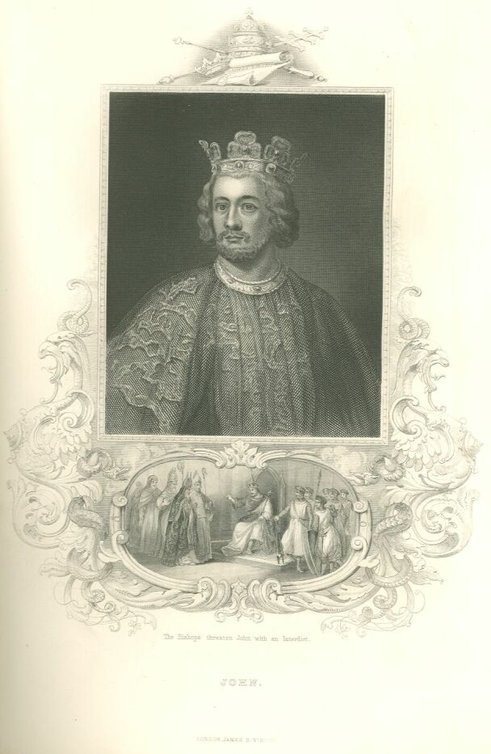
1199.
THE noble and free genius of the ancients, which made the government of a single person be always regarded as a species of tyranny and usurpation, and kept them from forming any conception of a legal and regular monarchy, had rendered them entirely ignorant both of the rights of primogeniture and a representation in succession; inventions so necessary for preserving order in the lines of princes, for obviating the evils of civil discord and of usurpation, and for begetting moderation in that species of government, by giving security to the ruling sovereign. These innovations arose from the feudal law; which, first introducing the right of primogeniture, made such a distinction between the families of he elder and younger brothers, that the son of the former was thought entitled to succeed to his grandfather, preferably to his uncles, though nearer allied to the deceased monarch. But though this progress of ideas was natural, it was gradual. In the age of which we treat, the practice of representation was indeed introduced, but not thoroughly established; and the minds of men fluctuated between opposite principles. Richard, when he entered on the holy war, declared his nephew Arthur, duke of Brittany, his successor; and by a formal deed he set aside, in his favor, the title of his brother John, who was younger than Godfrey, the father of that prince.[*]
But John so little acquiesced in that destination that when he gained the ascendant in the English ministry by expelling Longchamp, the chancellor and great justiciary, he engaged all the English barons to swear that they would maintain his right of succession; and Richard, on his return, took no steps towards restoring or securing the order which he had at first established. He was even careful, by his last will, to declare his brother John heir to all his dominions; whether, that he now thought Arthur, who was only twelve years of age, incapable of asserting his claim against John's faction, or was influenced by Eleanor, the queen mother, who hated Constantia, mother of the young duke, and who dreaded the credit which that princess would naturally acquire if her son should mount the throne. The authority of a testament was great in that age, even where the succession of a kingdom was concerned; and John had reason to hope, that this title, joined to his plausible right in other respects, would insure him the succession. But the idea of representation seems to have made, at this time, greater progress in France than in England; the barons of the transmarine provinces Anjou, Maine, and Touraine, immediately declared in favor of Arthur's title, and applied for assistance to the French monarch as their superior lord. Philip, who desired only an occasion to embarrass John, and dismember his dominions, embraced the cause of the young duke of Brittany, took him under his protection, and sent him to Paris to be educated along with his own son Lewis. In this emergency, John hastened to establish his authority in the chief members of the monarchy; and after sending Eleanor into Poictou and Guienne, where her right was incontestable, and was readily acknowledged, he hurried to Rouen, and having secured the duchy of Normandy, he passed over, without loss of time, to England. Hubert, archbishop of Canterbury, William Mareschal, earl of Strigul, who also passes by the name of earl of Pembroke, and Geoffrey Fitz-Peter, the justiciary, the three most favored ministers of the late king, were already engaged on his side; and the submission or acquiescence of all the other barons put him, without opposition, in possession of the throne.
The king soon returned to France, in order to conduct the war against Philip, and to recover the revolted provinces from his nephew Arthur. The alliances which Richard had formed with the earl of Flanders, and other potent French princes, though they had not been very effectual, still subsisted, and enabled John to defend himself against all the efforts of his enemy. In an action between the French and Flemings, the elect bishop of Cambray was taken prisoner by the former; and when the cardinal of Capua claimed his liberty, Philip, instead of complying, reproached him with the weak efforts which he had employed in favor of the bishop of Beauvais, who was in a like condition. The legate, to show his impartiality, laid at the same time the kingdom of France and the duchy of Normandy under an interdict; and the two kings found themselves obliged to make an exchange of these military prelates.
1200.
Nothing enabled the king to bring this war to a happy issue so much as the selfish, intriguing character of Philip, who acted, in the provinces that had declared for Arthur, without any regard to the interests of that prince. Constantia, seized with a violent jealousy that he intended to usurp the entire dominion of them, found means to carry off her son secretly from Paris: she put him into the hands of his uncle; restored the provinces which had adhered to the young prince; and made him do homage for the duchy of Brittany, which was regarded as a rere-fief of Normandy. From this incident, Philip saw that he could not hope to make any progress against John; and being threatened with an interdict on account of his irregular divorce from Ingelburga, the Danish princess whom he had espoused, he became desirous of concluding a peace with England. After some fruitless conferences, the terms were at last adjusted; and the two monarchy seemed in this treaty to have an intention, besides ending the present quarrel, of preventing all future causes of discord, and of obviating every controversy which could hereafter arise between them. They adjusted the limits of all their territories; mutually secured the interests of their vassals, and, to render the union more durable, John gave his niece, Blanche of Castile, in marriage to Prince Lewis, Philip's eldest son, and with her the baronies of Issoudun and Graçai, and other fiefs in Berri. Nine barons of the king of England, and as many of the king of France, were guaranties of this treaty; and all of them swore, that, if their sovereign violated any article of it, they would declare themselves against him, and embrace the cause of the injured monarch. John, now secure, as he imagined, on the side of France indulged his passion for Isabella, the daughter and heir of Aymar Tailleffer, count of Angouleme, a lady with whom he had become much enamored. His queen, the heiress of the family of Glocester, was still alive: Isabella was married to the count de la Marche, and was already consigned to the care of that nobleman; though, by reason of her tender years, the marriage had not been consummated. The passion of John made him overlook all these obstacles: he persuaded the count of Angouleme to carry off his daughter from her husband; and having, on some pretence or other, procured a divorce from his own wife, he espoused Isabella; regardless both of the menaces of the pope, who exclaimed against these irregular proceedings, and of the resentment of the injured count, who soon found means of punishing his powerful and insolent rival.
1201.
John had not the art of attaching his barons either by affection or by fear. The count de la Marche, and his brother, the count d'Eu, taking advantage of the general discontent against him, excited commotions in Poictou and Normandy, and obliged the king to have recourse to arms, in order to suppress the insurrection of his vassals. He summoned together the barons of England, and required them to pass the sea under his standard, and to quell the rebels: he found that he possessed as little authority in that kingdom as in his transmarine provinces. The English barons unanimously replied, that they would not attend him on this expedition, unless he would promise to restore and preserve their privileges; the first symptom of a regular association and plan of liberty among those noblemen. But affairs were not yet fully ripe for the revolution projected. John, by menacing the barons, broke the concert; and both engaged many of them to follow him into Normandy, and obliged the rest, who staid behind, to pay him a scutage of two marks on each knight's fee, as the price of their exemption from the service.
The force which John carried abroad with him, and that which joined him in Normandy, rendered him much superior to his malecontent barons; and so much the more, as Philip did not publicly give them any countenance, and seemed as yet determined to persevere steadily in the alliance which he had contracted with England. But the king, elated with his superiority, advanced claims which gave a universal alarm to his vassals, and diffused still wider the general discontent. As the jurisprudence of those times required that the causes in the lord's court should chiefly be decided by duel, he carried along with him certain bravos, whom he retained as champions, and whom he destined to fight with his barons, in order to determine any controversy which he might raise against them. The count de la Marche and other noblemen regarded this proceeding as an affront, as well as an injury; and declared, that they would never draw their swords against men of such inferior quality. The king menaced them with vengeance; but he had not vigor to employ against them the force in his hands, or to prosecute the injustice, by crushing entirely the nobles who opposed it.
This government, equally feeble and violent, gave the injured barons courage, as well as inclination, to carry further their opposition: they appealed to the king of France; complained of the denial of justice in John's court; demanded redress from him as their superior lord; and entreated him to employ his authority, and prevent their final ruin and oppression. Philip perceived his advantage, opened his mind to great projects, interposed in behalf of the French barons, and began to talk in a high and menacing style to the king of England.
1202.
John, who could not disavow Philip's authority, replied, that it belonged to himself first to grant them a trial by their peers in his own court; it was not till he failed in this duty, that he was answerable to his peers in the supreme court of the French king; and he promised, by a fair and equitable judicature, to give satisfaction to his barons. When the nobles, in consequence of this engagement, demanded a safe conduct, that they might attend his court, he at first refused it: upon the renewal of Philip's menaces, he promised to grant their demand; he violated this promise: fresh menaces extorted from him a promise to surrender to Philip the fortresses of Tillíeres and Boutavant, as a security for performance; he again violated this engagement: his enemies, sensible both of his weakness and want of faith combined still closer in the resolution of pushing him to extremities; and a new and powerful ally soon appeared to encourage them in their invasion of this odious and despicable government.
1203.
The young duke of Brittany, who was now rising to man's estate, sensible of the dangerous character of his uncle, determined to seek both his security and elevation by a union with Philip and the malecontent barons. He joined the French army which had begun hostilities against the king of England: he was received with great marks of distinction by Philip; was knighted by him; espoused his daughter Mary; and was invested not only in the duchy of Brittany, but in the counties of Anjou and Maine, which he had formerly resigned to his uncle. Every attempt succeeded with the allies. Tillieres and Boutavant were taken by Philip, after making a feeble defence: Mortimar and Lyons fell into his hands almost without resistance. That prince next invested Gournai; and opening the sluices of a lake which lay in the neighborhood, poured such a torrent of water into the place, that the garrison deserted it, and the French monarch, without striking a blow, made himself master of that important fortress. The progress of the French arms was rapid, and promised more considerable success than usually in that age attended military enterprises. In answer to every advance which the king made towards peace, Philip still insisted that he should resign all his transmarine dominions to his nephew and rest contented with the kingdom of England; when an event happened, which seemed to turn the scales in favor of John, and to give him a decisive superiority over his enemies.
Young Arthur, fond of military renown, had broken into Poictou at the head of a small army; and passing near Mirebeau, he heard that his grandmother, Queen Eleanor, who had always opposed his interests, was lodged in that place and was protected by a weak garrison and ruinous fortifications. He immediately determined to lay siege to the fortress, and make himself master of her person; but John, roused from his indolence by so pressing an occasion, collected an army of English and Brabançons, and advanced from Normandy with hasty marches to the relief of the queen mother. He fell on Arthur's camp, before that prince was aware of the danger; dispersed his army; took him prisoner together with the count de la Marche, Geoffrey de Lusignan, and the most considerable of the revolted barons, and returned in triumph to Normandy. Philip, who was lying before Arques, in that duchy, raised the siege and retired upon his approach. The greater part of the prisoners were sent over to England, but Arthur was shut up in the castle of Falaise.
The king had here a conference with his nephew; represented to him the folly of his pretensions; and required him to renounce the French alliance, which had encouraged him to live in a state of enmity with all his family; but the brave, though imprudent youth, rendered more haughty from misfortunes, maintained the justice of his cause; asserted his claim, not only to the French provinces, but to the crown of England; and, in his turn, required the king to restore the son of his elder brother to the possession of his inheritance; John, sensible, from these symptoms of spirit, that the young prince, though now a prisoner, might hereafter prove a dangerous enemy, determined to prevent all future peril by despatching his nephew; and Arthur was never more heard of. The circumstances which attended this deed of darkness were, no doubt, carefully concealed by the actors, and are variously related by historians; but the most probable account is as follows: The king, it is said, first proposed to William de la Braye, one of his servants, to despatch Arthur; but William replied that he was a gentleman, not a hangman; and he positively refused compliance. Another instrument of murder was found, and was despatched with proper orders to Falaise; but Huber de Bourg, chamberlain to the king, and constable of the castle, feigning that he himself would execute the king's mandate, sent back the assassin, spread the report that the young prince was dead, and publicly performed all the ceremonies of his interment; but finding that the Bretons vowed revenge for the murder, and that all the revolted barons persevered more obstinately in their rebellion, he thought it prudent to reveal the secret, and to inform the world that the duke of Brittany was still alive, and in his custody. This discovery proved fatal to the young prince: John first removed him to the castle of Rouen; and coming in a boat, during the night time, to that place, commanded Arthur to be brought forth to him. The young prince, aware of his danger, and now more subdued by the continuance of his misfortunes, and by the approach of death, threw himself on his knees before hia uncle, and begged for mercy: but the barbarous tyrant, making no reply, stabbed him with his own hands; and fastening a stone to the dead body, threw it into the Seine.
All men were struck with horror at this inhuman deed; and from that moment the king, detested by his subjects, retained a very precarious authority over both the people and the barons in his dominions. The Bretons, enraged at this disappointment in their fond hopes, waged implacable war against him; and fixing the succession of their government, put themselves in a posture to revenge the murder of their sovereign. John had got into his power his niece, Eleanor, sister to Arthur, commonly called 'the damsel of Brittany,' and carrying her over to England, detained her ever after in captivity:[*] but the Bretons, in despair of recovering this princess, chose Alice for their sovereign; a younger daughter of Constantia, by her second marriage with Gui de Thouars; and they intrusted the government of the duchy to that nobleman. The states of Brittany meanwhile carried their complaints before Philip as their liege lord, and demanded justice for the violence committed by John on the person of Arthur, so near a relation, who, notwithstanding the homage which he did to Normandy, was always regarded as one of the chief vassals of the crown. Philip received their application with pleasure; summoned John to stand a trial before him; and on his non-appearance, passed sentence, with the concurrence of the peers, upon that prince; declared him guilty of felony and parricide; and adjudged him to forfeit to his superior lord all his seigniories and fiefs in France.[**]