by pressing the Bookmarks tab on the left side of this window.
*****************************************************
We are the last.
The last generation to be unaugmented.
The last generation to be intellectually alone.
The last generation to be limited by our bodies.
We are the first.
The first generation to be augmented.
The first generation to be intellectually together.
The first generation to be limited only by our imaginations.
We stand both before and after, balancing on the razor edge of the Event
Horizon of the Singularity. That this sublime juxtapositional tautology
has gone unnoticed until now is itself remarkable.
We're so exquisitely privileged to be living in this time, to be born
right on the precipice of the greatest paradigm shift in human history,
the only thing that approaches the importance of that reality is finding
like minds that realize the same, and being able to make some connection
with them.
If these books have influenced you the same way that they have us, we
invite your contact at the email addresses listed below.
Enjoy,
Michael Beight, piman_314@yahoo.com
Steven Reddell, cronyx@gmail.com
Here are some new links that we’ve found interesting:
KurzweilAI.net
News articles, essays, and discussion on the latest topics in
technology and accelerating intelligence.
SingInst.org
The Singularity Institute for Artificial Intelligence: A
think tank devoted to increasing Humanity’s odds of
experiencing a safe, beneficial Singularity. Many
interesting articles on such topics as Friendly AI,
Existential Risks.
SingInst.org/Media
Videos, audio, and PowerPoints from the Singularity Summits;
and videos about SIAI’s purpose.
blinkx.com/videos/kurzweil
Videos on the internet in which the word “Kurzweil” is
spoken. Great new resource!
[Inside Jacket]:

U.S. $25.95
(continued from front flap)
C A N A D A $ 3 6 . 9 9
I
out brains along direct neural pathways;
magine a world where the difference
computers, for their part, will have read all
the world’s literature. The distinction
between man and machine blurs, where the
between us and computers will have
difference between humanity and
become sufficiently blurred that when the
technology fades, where the soul and the
machines claim to be conscious, we will
silicon chip unite. This is not science fiction.
believe them.
This is the twenty-first century according to
Ray Kurzweil, the “restless genius” (Wall
In The Age Of Spiritual Machines, the
Street Journal) and inventor of the most
“ultimate thinking machine” (Forbes) forges
innovative and compelling technology of our
the ultimate road to the next century.
era. In The Age of Spiritual Machines, the
brains behind the Kurzweil Reading
Machine, the Kurzweil Synthesizer,
advanced speech recognition, and other
technologies devises a framework for
envisioning the next century. In his inspiring
hands, life in the new millennium no longer
seems daunting. Instead, Kurzweil’s twenty-
first century promises to be age in which the
marriage of human sensitivity and artificial
Ray Kurzwe il
intelligence fundamentally alters and
is the author of The Age of Intelligent
improves the way we live.
Machines, which won the Association
American Publishers’ Award for The Most
The Age of Spiritual Machines is no mere list
Outstanding Computer Science Book of
of predictions but a prophetic blueprint for
1990. He was awarded the Dickson Prize,
the future. Kurzweil guides us through the
Carnegie Mellon’s top science prize, in 1994.
inexorable advances that will results in
The Massachusetts Institute of Technology
computers exceeding the memory capacity
named him the Inventor of the Year in 1988.
and computational ability of the human
He is the recipient of nine honorary
brain. According to Kurzweil, machines will
doctorates and honors from two U.S.
achieve all this by 2020, with human
presidents. Kurzweil lives in a suburb of
attributes not far behind. We will begin to
Boston.
have relationships with automated
JACKET DESIGN BY DAVID J. HIGH
personalities and use them as teachers,
AUTHOR PHOTOGRAPH BY JERRY BAUER
companions, and lovers. A mere ten years
later, information will be fed straight into
A Member of Penguin Putnam Inc
375 Hudson Street, New York, N.Y. 10014
http://www.penguinputnam.com
Printed in U.S.A.
(continued on back flap) 0199

THE AGE OF
SPIRITUAL
MACHINES
ALSO BY RAY KURZWEIL
The 10% Solution for a Healthy Life
The Age of Intelligent Machines
THE AGE OF
SPIRITUAL
MACHINES
WHEN COMPUTERS EXCEED HUMAN INTELLIGENCE
RAY KURZWEIL

VIKING
Published by the Penguin Group
Penguin Putnam Inc., 375 Hudson Street,
New York, New York 10014, U.S.A.
Penguin Books Ltd, 27 Wrights Lane, London W8 5TZ, England
Penguin Books Australia Ltd., Ringwood, Victoria, Australia
Penguin Books Canada Ltd., 10 Alcorn Avenue,
Toronto, Ontario, Canada M4V 3B2
Penguin Books (N.Z.) Ltd, 182–190 Wairau Road,
Auckland 10, New Zealand
Penguin India, 210 Chiranjiv Tower, 43 Nehru Place,
New Delhi 11009, India
Penguin Books Ltd, Registered Offices:
Harmondsworth, Middlesex, England
First Published in 1999 by Viking Penguin,
a member of Penguin Books Inc.
1 3 5 7 9 10 8 6 4 2
Copyright © Ray Kurzweil, 1999
All rights reserved
Illustrations credits
Pages 24, 26–27, 104, 156: Concept and text by Ray Kurzweil. Illustration by Rose Russo and Robert Brun.
Page 72: © 1977 by Sidney Harris
Pages 167–168: Paintings by Aaron, a computerized robot built and programmed by Harold Cohen.
Photographed by Becky Cohen.
Page 188: Roz Chast © 1998. From The Cartoon Bank. All rights reserved.
Page 194: Danny Shanahan © 1994. From The New Yorker Collection. All rights reserved.
Page 219: Peter Steiner © 1997. From The New Yorker Collection. All rights reserved.
LIBRARY OF CONGRESS CATALOGING IN PUBLICATION DATA
Kurzweil, Ray.
The age of spiritual machines / Ray Kurzweil.
p. cm.
Includes bibliographical references and index.
ISBN 0‐670‐88217‐8
1. Artificial Intelligence. 2. Computers. 3. Title.
Q335.K88 1999
006.3—dc21 98–38804
This book is printed on acid‐free paper.
Printed in the United States of America
Set in Berkeley Oldstyle
Without limiting the rights under copyright reserved above, no part of this publication may be
reproduced, stored in or introduced into a retrieval system, or transmitted, in any form or by any means
(electronic, mechanical, photocopying, recording or otherwise), without the prior written
permission of both the copyright owner and the above publisher of this book.
A NOTE TO THE READER
As a photon wends its way through an arrangement of glass panes and mirrors, its path remains ambiguous. It essentially takes every possible path available to it (apparently these photons have not read Robert Frostʹs poem ʺThe Road Not Takenʺ). This ambiguity remains until observation by a conscious observer forces the particle to decide which path it had taken. Then the uncertainty is resolved—retroactively—and it is as if the selected path had been taken all along.
Like these quantum particles, you—the reader—have choices to make in your path through this book. You can read the chapters as I intended them to be read, in sequential order. Or, after reading the Prologue, you may decide that the future canʹt wait, and you wish to immediately jump to the chapters in Part III on the twenty‐first century (the table of contents on the next pages offers a description of each chapter). You may then make your way back to the earlier chapters that describe the nature and origin of the trends and forces that will manifest themselves in this coming century. Or, perhaps, your course will remain ambiguous until the end. But when you come to the Epilogue,
any remaining ambiguity will be resolved, and it will be as if you had always intended to read the book in the order that you selected.
CONTENTS
A NOTE TO THE READER
9
ACKNOWLEDGEMENTS
13
PROLOGUE: AN INEXORABLE EMERGENCE
14
Before the next century is over, human beings will no longer be the most intelligent or capable type of entity
on the planet. Actually, let me take that back. The truth of that last statement depends on how we define
human.
PART ONE: PROBING THE PAST
CHAPTER ONE: THE LAW OF TIME AND CHAOS
19
For the past forty years, in accordance with Moore's Law, the power of transistor-based computing has been
growing exponentially. But by the year 2020, transistor features will be just a few atoms thick, and Moore's
Law will have run its course. What then? To answer this critical question, we need to understand the
exponential nature of time.
CHAPTER TWO: THE INTELLIGENCE OF THE UNIVERSE
40
Can an intelligence create another intelligence more intelligent than itself? Are we more intelligent than the
evolutionary process that created us? In turn, will the intelligence that we are creating come to exceed that of
its creator?
CHAPTER THREE: OF MIND AND MACHINES
47
"I am lonely and bored, please keep me company." If your computer displayed this message on its screen, would that convince you that it is conscious and has feelings? Before you say no too quickly, we need to
consider how such a plaintive message originated.
CHAPTER FOUR: A NEW FORM OF INTELLIGENCE ON EARTH
56
Intelligence rapidly creates satisfying, sometimes surprising plans that meet an array of constraints. Clearly,
no simple formula can emulate this most powerful of phenomena. Actually, that's wrong. All that is needed to
solve a surprisingly wide range of intelligent problems is exactly this: simple methods combined with heavy
doses of computation, itself a simple process.
CHAPTER FIVE: CONTEXT AND KNOWLEDGE
71
It is sensible to remember today's insights for tomorrow's challenges. It is not fruitful to rethink every
problem that comes along. This is particularly true for humans, due to the extremely slow speed of our
computing circuitry.
PART TWO: PREPARING THE PRESENT
CHAPTER SIX: BUILDING NEW BRAINS . . .
78
Evolution has found a way around the computational limitations of neural circuitry. Cleverly, it has created
organisms who in turn invented a computational technology a million times faster than carbon-based
neurons. Ultimately, the computing conducted on extremely slow mammalian neural circuits will be ported to
a far more versatile and speedier electronic (and photonic) equivalent.
CHAPTER SEVEN: . . . AND BODIES
98
A disembodied mind will quickly get depressed. So what kind of bodies will we provide for our twenty-first-
century machines? Later on, the question will become: What sort of bodies will they provide for themselves?
CHAPTER EIGHT: 1999
114
If all the computers in 1960 stopped functioning, few people would have noticed. Circa 1999 is another matter.
Although computers still lack a sense of humor, a gift for small talk, and other endearing qualities of human
thought, they are nonetheless mastering an increasingly diverse array of tasks that previously required
human intelligence.
PART THREE: TO FACE THE FUTURE
CHAPTER NINE: 2009
137
It is now 2009. A $1,000 personal computer can perform about a trillion calculations per second. Computers
are imbedded in clothing and jewelry. Most routine business transactions take place between a human and a
virtual personality. Translating telephones are commonly used. Human musicians routinely jam with
cybernetic musicians. The neo-Luddite movement is growing.
CHAPTER TEN: 2019
146
A $1,000 computing device is now approximately equal to the computational ability of the human brain.
Computers are now largely invisible and are embedded everywhere. Three-dimensional virtual-reality
displays, embedded in glasses and contact lenses, provide the primary interface for communication with other
persons, the Web, and virtual reality. Most interaction with computing is through gestures and two-way
natural-language spoken communication. Realistic all-encompassing visual, auditory, and tactile
environments enable people to do virtually anything with anybody regardless of physical proximity. People
are beginning to have relationships with automated personalities as companions, teachers, caretakers, and
lovers.
CHAPTER ELEVEN: 2029
161
A $1,000 unit of computation has the computing capacity of approximately one thousand human brains.
Direct neural pathways have been perfected for high-bandwidth connection to the human brain. A range of
neural implants is becoming available to enhance visual and auditory perception and interpretation, memory,
and reasoning. Computers have read all available human- and machine-generated literature and multimedia
material. There is growing discussion about the legal rights of computers and what constitutes being human.
Machines claim to be conscious and these claims are largely accepted.
CHAPTER TWELVE: 2099
173
There is a strong trend toward a merger of human thinking with the world of machine intelligence that the
human species initially created. There is no longer any clear distinction between humans and computers.
Most conscious entities do not have a permanent physical presence. Machine-based intelligences derived from
extended models of human intelligence claim to be human. Most of these intelligences are not tied to a
specific computational processing unit. The number of software-based humans vastly exceeds those still using
native neuron-cell-based computation. Even among those human intelligences still using carbon-based
neurons, there is ubiquitous use of neural-implant technology that provides enormous augmentation of
human perceptual and cognitive abilities. Humans who do not utilize such implants are unable to
meaningfully participate in dialogues with those who do. Life expectancy is no longer a viable term in relation
to intelligent beings.
EPILOGUE: THE REST OF THE UNIVERSE REVISITED
191
Intelligent beings consider the fate of the universe.
TIME LINE
196
HOW TO BUILD AN INTELLIGENT MACHINE IN THREE EASY PARADIGMS
213
GLOSSARY
227
NOTES
241
SUGGESTED READINGS
263
WEB LINKS
282
INDEX [Omitted]
289
ACKNOWLEDGMENTS
I would like to express my gratitude to the many persons who have provided inspiration, patience, ideas, criticism, insight, and all manner of assistance for this project. In particular, I would like to thank:
• My wife, Sonya, for her loving patience through the twists and turns of the creative process
• My mother for long engaging walks with me when I was a child in the Woods of Queens (yes, there were
forests in Queens, New York, when I was growing up) and for her enthusiastic interest in and early
support for my not‐always‐fully‐baked ideas
• My Viking editors, Barbara Grossman and Dawn Drzal, for their insightful guidance and editorial
expertise and the dedicated team at Viking Penguin, including Susan Petersen, publisher; Ivan Held and
Paul Slovak, marketing executives; John Jusino, copy editor; Betty Lew, designer; Jariya Wanapun,
editorial assistant, and Laura Ogar, indexer
• Jerry Bauer for his patient photography
• David High for actually devising a spiritual machine for the cover My literary agent, Loretta Barrett, for
helping to shape this project
• My wonderfully capable researchers, Wendy Dennis and Nancy Mulford, for their dedicated and
resourceful efforts, and Tom Garfield for his valuable assistance
• Rose Russo and Robert Brun for turning illustration ideas into beautiful visual presentations
• Aaron Kleiner for his encouragement and support
• George Gilder for his stimulating thoughts and insights
• Harry George, Don Gonson, Larry Janowitch, Hannah Kurzweil, Rob Pressman, and Mickey Singer for
engaging and helpful discussions on these topics
• My readers: Peter Arnold, Melanie Baker‐Futorian, Loretta Barrett, Stephen Baum, Bryan Bergeron, Mike
Brown, Cheryl Cordima, Avi Coren, Wendy Dennis, Mark Dionne, Dawn Drzal, Nicholas Fabijanic, Gil
Fischman, Ozzie Frankell, Vicky Frankell, Bob Frankston, Francis Ganong, Tom Garfield, Harry George,
Audra Gerhardt, George Gilder, Don Gonson, Martin Greenberger, Barbara Grossman, Larry Janowitch,
Aaron Kleiner, Jerry Kleiner, Allen Kurzweil, Amy Kurzweil, Arielle Kurzweil, Edith Kurzweil, Ethan
Kurzweil, Hannah Kurzweil, Lenny Kurzweil, Missy Kurzweil, Nancy Kurzweil, Peter Kurzweil, Rachel
Kurzweil, Sonya Kurzweil, Jo Lernout, Jon Lieff, Elliot Lobel, Cyrus Mehta, Nancy Mulford, Nicholas
Mullendore, Rob Pressman, Vlad Sejnoha, Mickey Singer, Mike Sokol, Kim Storey, and Barbara Tyrell for
their compliments and criticisms (the latter being the most helpful) and many invaluable suggestions
• Finally, all the scientists, engineers, entrepreneurs, and artists who are busy creating the age of spiritual
machines.
PROLOGUE:
AN INEXORABLE EMERGENCE
The gambler had not expected to be here. But on reflection, he thought he had shown some kindness in his time. And
this place was even more beautiful and satisfying than he had imagined. Everywhere there were magnificent crystal
chandeliers, the finest handmade carpets, the most sumptuous foods, and, yes, the most beautiful women, who seemed intrigued with their new heaven mate. He tried his hand at roulette, and amazingly his number came up time
after time. He tried the gaming tables and his luck was nothing short of remarkable: He won game after game. Indeed
his winnings were causing quite a stir, attracting much excitement from the attentive staff, and from the beautiful women.
This continued day after day, week after week, with the gambler winning every game, accumulating bigger and
bigger earnings. Everything was going his way. He just kept on winning. And week after week, month after month,
the gamblerʹs streak of success remained unbreakable.
After a while, this started to get tedious. The gambler was getting restless; the winning was starting to lose its meaning. Yet nothing changed. He just kept on winning every game, until one day, the now anguished gambler turned to the angel who seemed to be in charge and said that he couldnʹt take it anymore. Heaven was not for him
after all. He had figured he was destined for the ʺother placeʺ nonetheless, and indeed that is where he wanted to be.
ʺBut this is the other place,ʺ came the reply.
That is my recollection of an episode of The Twilight Zone that I saw as a young child. I donʹt recall the title, but I would call it ʺBe Careful What You Wish For.ʺ [1] As this engaging series was wont to do, it illustrated one of the paradoxes of human nature: We like to solve problems, but we donʹt want them all solved, not too quickly, anyway.
We are more attached to the problems than to the solutions.
Take death, for example. A great deal of our effort goes into avoiding it. We make extraordinary efforts to delay it, and indeed often consider its intrusion a tragic event. Yet we would find it hard to live without it. Death gives meaning to our lives. It gives importance and value to time. Time would become meaningless if there were too much
of it. If death were indefinitely put off, the human psyche would end up, well, like the gambler in The Twilight Zone episode.
We do not yet have this predicament. We have no shortage today of either death or human problems. Few observers feel that the twentieth century has left us with too much of a good thing. There is growing prosperity, fueled not incidentally by information technology, but the human species is still challenged by issues and difficulties not altogether different than those with which it has struggled from the beginning of its recorded history.
The twenty‐first century will be different. The human species, along with the computational technology it created,
will be able to solve age‐old problems of need, if not desire, and will be in a position to change the nature of mortality in a post‐biological future. Do we have the psychological capacity for all the good things that await us? Probably not.
That, however, might change as well.
Before the next century is over, human beings will no longer be the most intelligent or capable type of entity on
the planet. Actually, let me take that back. The truth of that last statement depends on how we define human. And
here we see one profound difference between these two centuries: The primary political and philosophical issue of the next century will be the definition of who we are. [2]
But I am getting ahead of myself. This last century has seen enormous technological change and the social upheavals that go along with it, which few pundits circa 1899 foresaw. The pace of change is accelerating and has been since the inception of invention (as I will discuss in the first chapter, this acceleration is an inherent feature of technology). The result will be far greater transformations in the first two decades of the twenty‐first century than we saw in the entire twentieth century. However, to appreciate the inexorable logic of where the twenty‐first century will bring us, we have to go back and start with the present.
TRANSITION TO THE TWENTY‐FIRST CENTURY
Computers today exceed human intelligence in a broad variety of intelligent yet narrow domains such as playing
chess, diagnosing certain medical conditions, buying and selling stocks, and guiding cruise missiles. Yet human intelligence overall remains far more supple and flexible. Computers are still unable to describe the objects on a crowded kitchen table, write a summary of a movie, tie a pair of shoelaces, tell the difference between a dog and a cat (although this feat, I believe, is becoming feasible today with contemporary neural nets—computer simulations of human neurons), [3] recognize humor, or perform other subtle tasks in which their human creators excel.
One reason for this disparity in capabilities is that our most advanced computers are still simpler than the human
brain currently about a million times simpler (give or take one or two orders of magnitude depending on the assumptions used). But this disparity will not remain the case as we go through the early part of the next century.
Computers doubled in speed every three years at the beginning of the twentieth century, every two years in the 1950s and 1960s, and are now doubling in speed every twelve months. This trend will continue, with computers achieving
the memory capacity and computing speed of the human brain by around the year 2020.
Achieving the basic complexity and capacity of the human brain will not automatically result in computers matching the flexibility of human intelligence. The organization and content of these resources—the software of intelligence—is equally important. One approach to emulating the brainʹs software is through reverse engineering—
scanning a human brain (which will be achievable early in the next century) [4] and essentially copying its neural circuitry in a neural computer (a computer designed to simulate a massive number of human neurons) of sufficient
capacity.
There is a plethora of credible scenarios for achieving human‐level intelligence in a machine. We will be able to evolve and train a system combining massively parallel neural nets with other paradigms to understand language and model knowledge, including the ability to read and understand written documents. Although the ability of todayʹs computers to extract and learn knowledge from natural‐language documents is quite limited, their abilities in this domain are improving rapidly. Computers will be able to read on their own, understanding and modeling what
they have read, by the second decade of the twenty‐first century. We can then have our computers read all of the worldʹs literature books, magazines, scientific journals, and other available material. Ultimately, the machines will gather knowledge on their own by venturing into the physical world, drawing from the full spectrum of media and
information services, and sharing knowledge with each other (which machines can do far more easily than their human creators).
Once a computer achieves a human level of intelligence, it will necessarily roar past it. Since their inception, computers have significantly exceeded human mental dexterity in their ability to remember and process information.
A computer can remember billions or even trillions of facts perfectly while we are hard pressed to remember a handful of phone numbers. A computer can quickly search a database with billions of records in fractions of a second.
Computers can readily share their knowledge bases. The combination of human‐level intelligence in a machine with a
computerʹs inherent superiority in the speed, accuracy, and sharing ability of its memory will be formidable.
Mammalian neurons are marvelous creations, but we wouldnʹt build them the same way. Much of their
complexity is devoted to supporting their own life processes, not to their information‐handling abilities. Furthermore, neurons are extremely slow; electronic circuits are at least a million times faster. Once a computer achieves a human level of ability in understanding abstract concepts, recognizing patterns, and other attributes of human intelligence, it will be able to apply this ability to a knowledge base of all human‐acquired‐and machine‐acquired‐knowledge.
A common reaction to the proposition that computers will seriously compete with human intelligence is to dismiss this specter based primarily on an examination of contemporary capability. After all, when I interact with my personal computer, its intelligence seems limited and brittle, if it appears intelligent at all. It is hard to imagine oneʹs personal computer having a sense of humor, holding an opinion, or displaying any of the other endearing qualities of human thought.
But the state of the art in computer technology is anything but static. Computer capabilities are emerging today
that were considered impossible one or two decades ago. Examples include the ability to transcribe accurately normal continuous human speech, to understand and respond intelligently to natural language, to recognize patterns in medical procedures such as electrocardiograms and blood tests with an accuracy rivaling that of human physicians,
and, of course, to play chess at a world‐championship level. In the next decade, we will see translating telephones that provide real‐time speech translation from one human language to another, intelligent computerized personal assistants that can converse and rapidly search and understand the worldʹs knowledge bases, and a profusion of other machines with increasingly broad and flexible intelligence.
In the second decade of the next century, it will become increasingly difficult to draw any clear distinction between the capabilities of human and machine intelligence. The advantages of computer intelligence in terms of speed, accuracy, and capacity will be clear. The advantages of human intelligence, on the other hand, will become increasingly difficult to distinguish.
The skills of computer software are already better than many people realize. It is frequently my experience that when demonstrating recent advances in, say, speech or character recognition, observers are surprised at the state of the art. For example, a typical computer userʹs last experience with speech‐recognition technology may have been a
low‐end freely bundled piece of software from several years ago that recognized a limited vocabulary, required pauses between words, and did an incorrect job at that. These users are then surprised to see contemporary systems
that can recognize fully continuous speech on a 60,000‐word vocabulary, with accuracy levels comparable to a human
typist.
Also keep in mind that the progression of computer intelligence will sneak up on us. As just one example, consider Gary Kasparovʹs confidence in 1990 that a computer would never come close to defeating him. After all, he
had played the best computers, and their chess‐playing ability—compared to his—was pathetic. But computer chess
playing made steady progress, gaining forty‐five rating points each year. In 1997, a computer sailed past Kasparov, at least in chess. There has been a great deal of commentary that other human endeavors are far more difficult to emulate than chess playing. This is true. In many areas—the ability to write a book on computers, for example—
computers are still pathetic. But as computers continue to gain in capacity at an exponential rate we will have the same experience in these other areas that Kasparov had in chess. Over the next several decades, machine competence
will rival—and ultimately surpass—any particular human skill one cares to cite, including our marvelous ability to place our ideas in a broad diversity of contexts.
Evolution has been seen as a billion‐year drama that led inexorably to its grandest creation: human intelligence.
The emergence in the early twenty‐first century of a new form of intelligence on Earth that can compete with, and ultimately significantly exceed, human intelligence will be a development of greater import than any of the events that have shaped human history. It will be no less important than the creation of the intelligence that created it, and will have profound implications for all aspects of human endeavor, including the nature of work, human learning, government, warfare, the arts, and our concept of ourselves.
This specter is not yet here. But with the emergence of computers that truly rival and exceed the human brain in
complexity will come a corresponding ability of machines to understand and respond to abstractions and subtleties.
Human beings appear to be complex in part because of our competing internal goals. Values and emotions represent
goals that often conflict with each other, and are an unavoidable by‐product of the levels of abstraction that we deal with as human beings. As computers achieve a comparable—and greater—level of complexity, and as they are increasingly derived at least in part from models of human intelligence, they, too, will necessarily utilize goals with implicit values and emotions, although not necessarily the same values and emotions that humans exhibit.
A variety of philosophical issues will emerge. Are computers thinking, or are they just calculating? Conversely, are human beings thinking, or are they just calculating? The human brain presumably follows the laws of physics, so
it must be a machine, albeit a very complex one. Is there an inherent difference between human thinking and machine
thinking? To pose the question another way, once computers are as complex as the human brain, and can match the
human brain in subtlety and complexity of thought, are we to consider them conscious? This is a difficult question even to pose, and some philosophers believe it is not a meaningful question; others believe it is the only meaningful question in philosophy. This question actually goes back to Platoʹs time, but with the emergence of machines that genuinely appear to possess volition and emotion, the issue will become increasingly compelling.
For example, if a person scans his brain through a noninvasive scanning technology of the twenty‐first century (such as an advanced magnetic resonance imaging), and downloads his mind to his personal computer, is the ʺpersonʺ who emerges in the machine the same consciousness as the person who was scanned?
That ʺpersonʺ may convincingly implore you that ʺheʺ grew up in Brooklyn, went to college in Massachusetts, walked into a scanner here, and woke up in the machine there. The original person who was scanned, on the other
hand, will acknowledge that the person in the machine does indeed appear to share his history, knowledge, memory,
and personality, but is otherwise an impostor, a different person.
Even if we limit our discussion to computers that are not directly derived from a particular human brain, they will
increasingly appear to have their own personalities, evidencing reactions that we can only label as emotions and articulating their own goals and purposes. They will appear to have their own free will. They will claim to have spiritual experiences. And people—those still using carbon‐based neurons or otherwise—will believe them.
One often reads predictions of the next several decades discussing a variety of demographic, economic, and political trends that largely ignore the revolutionary impact of machines with their own opinions and agendas. Yet we need to reflect on the implications of the gradual, yet inevitable, emergence of true competition to the full range of human thought in order to comprehend the world that lies ahead.
PART ONE
PROBING THE
PAST
C H A P T E R O N E
THE LAW OF TIME AND CHAOS
A (VERY BRIEF) HISTORY OF THE UNIVERSE:
TIME SLOWING DOWN
The universe is made of stories, not of atoms.
—Muriel Rukeyser
Is the universe a great mechanism, a great computation, a great symmetry, a great accident or a great thought?
—John D. Barrow
As we start at the beginning, we will notice an unusual attribute of the nature of time, one that is critical to our passage to the twenty‐first century. Our story begins perhaps 15 billion years ago. No conscious life existed to appreciate the birth of our Universe at the time, but we appreciate it now, so retroactively it did happen. (In retrospect—from one perspective of quantum mechanics—we could say that any Universe that fails to evolve conscious life to apprehend its existence never existed in the first place.)
It was not until 10‐43 seconds (a tenth of a millionth of a trillionth of a trillionth of a trillionth of a second) after the birth of the Universe [1] that the situation had cooled off sufficiently (to 100 million trillion trillion degrees) that a distinct force—gravity—evolved.
Not much happened for another 10‐34 seconds (this is also a very tiny fraction of a second, but it is a billion times longer than 10‐43 seconds), at which point an even cooler Universe (now only a billion billion billion degrees) allowed the emergence of matter in the form of electrons and quarks. To keep things balanced, antimatter appeared as well. It was an eventful time, as new forces evolved at a rapid rate. We were now up to three: gravity, the strong force, [2]
and the electroweak force. [3]
After another 10‐10 seconds (a tenth of a billionth of a second), the electroweak force split into the electromagnetic and weak forces [4] we know so well today.
Things got complicated after another 10‐5 seconds (ten millionths of a second). With the temperature now down to
a relatively balmy trillion degrees, the quarks came together to form protons and neutrons. The antiquarks did the same, forming antiprotons.
Somehow, the matter particles achieved a slight edge. How this happened is not entirely clear. Up until then, everything had seemed so, well, even. But had everything stayed evenly balanced, it would have been a rather boring
Universe. For one thing, life never would have evolved, and thus we could conclude that the Universe would never
have existed in the first place.
For every 10 billion antiprotons, the Universe contained 10 billion and 1 protons. The protons and antiprotons collided, causing the emergence of another important phenomenon: light (photons). Thus, almost all of the antimatter was destroyed, leaving matter as dominant. (This shows you the danger of allowing a competitor to achieve even a
slight advantage.)
Of course, had antimatter won, its descendants would have called it matter and would have called matter antimatter, so we would be back where we started (perhaps that is what happened).
After another second (a second is a very long time compared to some of the earlier chapters in the Universeʹs history, so notice how the time frames are growing exponentially larger), the electrons and antielectrons (called positrons) followed the lead of the protons and antiprotons and similarly annihilated each other, leaving mostly the electrons.
After another minute, the neutrons and protons began coalescing into heavier nuclei, such as helium, lithium, and
heavy forms of hydrogen. The temperature was now only a billion degrees.
About 300,000 years later (things are slowing down now rather quickly), with the average temperature now only
3,000 degrees, the first atoms were created as the nuclei took control of nearby electrons.
After a billion years, these atoms formed large clouds that gradually swirled into galaxies.
After another two billion years, the matter within the galaxies coalesced further into distinct stars, many with their own solar systems.
Three billion years later, circling an unexceptional star on the arm of a common galaxy, an unremarkable planet
we call the Earth was born.
Now before we go any further, letʹs notice a striking feature of the passage of time. Events moved quickly at the
beginning of the Universeʹs history. We had three paradigm shifts in just the first billionth of a second. Later on, events of cosmological significance took billions of years. The nature of time is that it inherently moves in an exponential fashion either geometrically gaining in speed, or, as in the history of our Universe, geometrically slowing down. Time only seems to be linear during those eons in which not much happens. Thus most of the time, the linear
passage of time is a reasonable approximation of its passage. But thatʹs not the inherent nature of time.
Why is this significant? Itʹs not when youʹre stuck in the eons in which not much happens. But it is of great significance when you find yourself in the ʺknee of the curve,ʺ those periods in which the exponential nature of the curve of time explodes either inwardly or outwardly. Itʹs like falling into a black hole (in that case, time accelerates exponentially faster as one falls in).
The Speed of Time
But wait a second, how can we say that time is changing its ʺspeedʺ? We can talk about the rate of a process, in terms of its progress per second, but can we say that time is changing its rate? Can time start moving at, say, two seconds per second?
Einstein said exactly this—time is relative to the entities experiencing it. [5] One manʹs second can be another womanʹs forty years. Einstein gives the example of a man who travels at very close to the speed of light to a star—say, twenty light‐years away. From our Earth‐bound perspective, the trip takes slightly more than twenty years in each direction. When the man gets back, his wife has aged forty years. For him, however, the trip was rather brief. If he travels at close enough to the speed of light, it may have only taken a second or less (from a practical perspective we would have to consider some limitations, such as the time to accelerate and decelerate without crushing his body).
Whose time frame is the correct one?
Einstein says they are both correct, and exist only relative to each other.
Certain species of birds have a life span of only several years. If you observe their rapid movements, it appears that they are experiencing the passage of time on a different scale. We experience this in our own lives. A young childʹs rate of change and experience of time is different from that of an adult. Of particular note, we will see that the acceleration in the passage of time for evolution is moving in a different direction than that for the Universe from which it emerges.
It is in the nature of exponential growth that events develop extremely slowly for extremely long periods of time,
but as one glides through the knee of the curve, events erupt at an increasingly furious pace. And that is what we will experience as we enter the twenty‐first century.
EVOLUTION: TIME SPEEDING UP
In the beginning was the word. . . . And the word became flesh.
—John 1:1,14
A great deal of the universe does not need any explanation. Elephants, for instance. Once molecules have learnt to compete and create other molecules in their own image, elephants, and things resembling elephants, will in due course be found roaming through the countryside.
—Peter Atkins
The further backward you look, the further forward you can see.
—Winston Churchill
Weʹll come back to the knee of the curve, but letʹs delve further into the exponential nature of time. In the nineteenth century, a set of unifying principles called the laws of thermodynamics [6] was postulated. As the name implies, they deal with the dynamic nature of heat and were the first major refinement of the laws of classical mechanics perfected by Isaac Newton a century earlier. Whereas Newton had described a world of clockwork perfection in which particles
and objects of all sizes followed highly disciplined, predictable patterns, the laws of thermodynamics describe a world of chaos. Indeed, that is what heat is. Heat is the chaotic—unpredictable—movement of the particles that make
up the world. A corollary of the second law of thermodynamics is that in a closed system (interacting entities and forces not subject to outside influence; for example, the Universe), disorder (called ʺentropyʺ) increases. Thus, left to its own devices, a system such as the world we live in becomes increasingly chaotic. Many people find this describes their lives rather well. But in the nineteenth century, the laws of thermodynamics were considered a disturbing discovery. At the beginning of that century, it appeared that the basic principles governing the world were both understood and orderly There were a few details left to be filled in, but the basic picture was under control.
Thermodynamics was the first contradiction to this complacent picture. It would not be the last.
The second law of thermodynamics, sometimes called the Law of Increasing Entropy, would seem to imply that
the natural emergence of intelligence is impossible. Intelligent behavior is the opposite of random behavior, and any system capable of intelligent responses to its environment needs to be highly ordered. The chemistry of life, particularly of intelligent life, is comprised of exceptionally intricate designs. Out of the increasingly chaotic swirl of particles and energy in the world, extraordinary designs somehow emerged. How do we reconcile the emergence of
intelligent life with the Law of increasing Entropy?
There are two answers here. First, while the Law of Increasing Entropy would appear to contradict the thrust of
evolution, which is toward increasingly elaborate order, the two phenomena are not inherently contradictory. The order of life takes place amid great chaos, and the existence of life‐forms does not appreciably affect the measure of entropy in the larger system in which life has evolved. An organism is not a closed system. It is part of a larger system we call the environment, which remains high in entropy In other words, the order represented by the existence of life-forms is insignificant in terms of measuring overall entropy.
Thus, while chaos increases in the Universe, it is possible for evolutionary processes that create increasingly intricate, ordered patterns to exist simultaneously. [7] Evolution is a process, but it is not a closed system. It is subject to outside influence, and indeed draws upon the chaos in which it is embedded. So the Law of Increasing Entropy does not rule out the emergence of life and intelligence.
For the second answer, we need to take a closer look at evolution, as it was the original creator of intelligence.
The Exponentially Quickening Pace of Evolution
As you will recall, after billions of years, the unremarkable planet called Earth was formed. Churned by the energy of the sun, the elements formed more and more complex molecules. From physics, chemistry was born.
Two billion years later, life began. That is to say, patterns of matter and energy that could perpetuate themselves
and survive perpetuated themselves and survived. That this apparent tautology went unnoticed until a couple of centuries ago is itself remarkable.
Over time, the patterns became more complicated than mere chains of molecules. Structures of molecules performing distinct functions organized themselves into little societies of molecules. From chemistry, biology was born.
Thus, about 3.4 billion years ago, the first earthly organisms emerged: anaerobic (not requiring oxygen) prokaryotes (single‐celled creatures) with a rudimentary method for perpetuating their own designs. Early innovations that followed included a simple genetic system, the ability to swim, and photosynthesis, which set the stage for more advanced, oxygen‐consuming organisms. The most important development for the next couple of billion years was the DNA‐based genetics that would henceforth guide and record evolutionary development.
A key requirement for an evolutionary process is a ʺwrittenʺ
record of achievement, for otherwise the process would be doomed to repeat finding solutions to problems already solved. For the earliest organisms, the record was written (embodied) in their bodies, coded directly into the chemistry of their primitive cellular structures. With the invention of DNA‐based genetics, evolution had designed a digital computer to record its handiwork. This design permitted more complex experiments. The aggregations of molecules called cells organized themselves into societies of cells with the appearance of the first multicellular plants and animals about 700 million years ago. For the next 130 million years, the basic body plans of modern animals were designed, including a spinal cord‐based skeleton that provided early fish with an efficient swimming style.
So while evolution took billions of years to design the first primitive cells, salient events then began occurring in hundreds of millions of years, a distinct quickening of the pace. [8] When some calamity finished off the dinosaurs 65
million years ago, mammals inherited the Earth (although the insects might disagree). [9] With the emergence of the
primates, progress was then measured in mere tens of millions of years. [10] Humanoids emerged 15 million years ago, distinguished by walking on their hind legs, and now weʹre down to millions of years. [11]
With larger brains, particularly in the area of the highly convoluted cortex responsible for rational thought, our own species, Homo sapiens, emerged perhaps 500,000 years ago. Homo sapiens are not very different from other advanced primates in terms of their genetic heritage. Their DNA is 98.6 percent the same as the lowland gorilla, and 97.8 percent the same as the orangutans. [12] The story of evolution since that time now focuses in on a human-sponsored variant of evolution: technology.
TECHNOLOGY: EVOLUTION BY OTHER MEANS
When a scientist states that something is possible, he is almost certainly right. When he states that something is impossible, he is very probably wrong.
The only way of discovering the limits of the possible is to venture a little way past them into the impossible.
Any sufficiently advanced technology is indistinguishable from magic.
—Arthur C. Clarkeʹs three laws of technology
A machine is as distinctively and brilliantly and expressively human as a violin sonata or a theorem in Euclid.
—Gregory Vlastos
Technology picks right up with the exponentially quickening pace of evolution. Although not the only tool‐using animal, Homo sapiens are distinguished by their creation of technology. [13] Technology goes beyond the mere fashioning and use of tools. It involves a record of tool making and a progression in the sophistication of tools. it requires invention and is itself a continuation of evolution by other means. The ʺgenetic codeʺ of the evolutionary process of technology is the record maintained by the tool‐making species. Just as the genetic code of the early life-forms was simply the chemical composition of the organisms themselves, the written record of early tools consisted of the tools themselves. Later on, the genesʺ of technological evolution evolved into records using written language and are now often stored in computer databases. Ultimately, the technology itself will create new technology. But we are getting ahead of ourselves.
Our story is now marked in tens of thousands of years. There were multiple subspecies of Homo sapiens. Homo sapiens neanderthalensis emerged about 100,000 years ago in Europe and the Middle East and then disappeared mysteriously about 35,000 to 40,000 years ago. Despite their brutish image, Neanderthals cultivated an involved culture that included elaborate funeral rituals—burying their dead with ornaments, including flowers. Weʹre not entirely sure what happened to our Homo sapiens cousins, but they apparently got into conflict with our own immediate ancestors Homo sapiens sapiens, who emerged about 90,000 years ago. Several species and subspecies of humanoids initiated the creation of technology. The most clever and aggressive of these subspecies was the only one
to survive. This established a pattern that would repeat itself throughout human history, in that the technologically more advanced group ends up becoming dominant. This trend may not bode well as intelligent machines themselves
surpass us in intelligence and technological sophistication in the twenty‐first century.
Our Homo sapiens sapiens subspecies was thus left alone among humanoids about 40,000 years ago.
Our forebears had already inherited from earlier hominid species and subspecies such innovations as the recording of events on cave walls, pictorial art, music, dance, religion, advanced language, fire, and weapons. For tens of thousands of years, humans had created tools by sharpening one side of a stone. It took our species tens of thousands of years to figure out that by sharpening both sides, the resultant sharp edge provided a far more useful
tool. One significant point, however, is that these innovations did occur, and they endured. No other tool‐using animal on Earth has demonstrated the ability to create and retain innovations in their use of tools.
The other significant point is that technology, like the evolution of life‐forms; that spawned it, is inherently an accelerating process. The foundations of technology—such as creating a sharp edge from a stone—took eons to perfect, although for human‐created technology, eons means thousands of years rather than the billions of years that the evolution of life‐forms required to get started.
Like the evolution of life‐forms, the pace of technology has greatly accelerated over time. [14] The progress of technology in the nineteenth century, for example, greatly exceeded that of earlier centuries, with the building of canals and great ships, the advent of paved roads, the spread of the railroad, the development of the telegraph, and the invention of photography, the bicycle, sewing machine, typewriter, telephone, phonograph, motion picture, automobile, and of course Thomas Edisonʹs light bulb. The continued exponential growth of technology in the first two decades of the twentieth century matched that of the entire nineteenth century. Today, we have major transformations in just a few yearsʹ time. As one of many examples, the latest revolution in communications—the World Wide Web—didnʹt exist just a few years ago.
WHAT IS TECHNOLOGY?
As technology is the continuation of evolution by other means, it shares the phenomenon of an exponentially
quickening pace. The word is derived from the Greek tekhnē, which means "craft" or "art," and logia, which means "the study of." Thus one interpretation of technology is the study of crafting, in which crafting refers to the shaping of resources for a practical purpose. I use the term resources rather than materials because
technology extends to the shaping of nonmaterial resources such as information.
Technology is often defined as the creation of tools to gain control over the environment, However, this
definition is not entirely sufficient. Humans are not alone in their use or even creation of tools. Orangutans in
Sumatra's Suaq Balimbing swamp make tools out of long sticks to break open termite nests. Crows fashion
tools from sticks and leaves. The leaf-cutter ant mixes dry leaves with its saliva to create a paste. Crocodiles
use tree roots to anchor dead prey. [15]
What is uniquely human is the application of knowledge—recorded knowledge—to the fashioning of tools.
The knowledge base represents the genetic code for the evolving technology. And as technology has evolved,
the means for recording this knowledge base has also evolved, from the oral traditions of antiquity to the
written design logs of nineteenth-century craftsmen to the computer-assisted design databases of the 1990s.
Technology also implies a transcendence of the materials used to comprise it. When the elements of an
invention are assembled in just the right way, they produce an enchanting effect that goes beyond the mere
parts. When Alexander Graham Bell accidentally wire-connected two moving drums and solenoids (metal cores
wrapped in wire) in 1875, the result transcended the materials he was working with. For the first time, a
human voice was transported, magically it seemed, to a remote location. Most assemblages are just that:
random assemblies. But when materials—and in the case of modern technology, information—are assembled
in just the right way, transcendence occurs. The assembled object becomes far greater than the sum of its
parts.
The same phenomenon of transcendence occurs in art, which may properly be regarded as another form of
human technology. When wood, varnishes, and strings are assembled in just the right way, the result is
wondrous: a violin, a piano. When such a device is manipulated in just the right way, there is magic of
another sort: music. Music goes beyond mere sound. It evokes a response—cognitive, emotional, perhaps
spiritual—in the listener, another form of transcendence. All of the arts share the same goal: communicating
from artist to audience. The communication is not of unadorned data, but of the more important items in the
phenomenological garden: feelings, ideas, experiences, longings. The Greek meaning of tekhnē logia includes
art as a key manifestation of technology.
Language is another form of human-created technology, One of the primary applications of technology is
communication, and language provides the foundation for Homo sapiens communication. Communication is a
critical survival skill. It enabled human families and tribes to develop cooperative strategies to overcome
obstacles and adversaries. Other animals communicate. Monkeys and apes use elaborate gestures and grunts
to communicate a variety of messages. Bees perform intricate dances in a figure-eight pattern to
communicate where caches of nectar may be found. Female tree frogs in Malaysia do tap dances to signal
their availability. Crabs wave their claws in one way to warn adversaries but use a different rhythm for
courtship. [16] But these methods do not appear to evolve, other than through the usual DNA-based
evolution. These species lack a way to record their means of communication, so the methods remain static
from one generation to the next. In contrast, human language does evolve, as do all forms of technology.
Along with the evolving forms of language itself, technology has provided ever-improving means for recording
and distributing human language.
Homo sapiens are unique in their use and fostering of all forms of what I regard as technology: art,
language, and machines, all representing evolution by other means. In the 1960s through 1990s, several well-
publicized primates were said to have mastered at least childlike language skills. Chimpanzees Lana and Kanzi
pressed sequences of buttons with symbols on them. Gorillas Washoe and Koko were said to be using
American Sign Language. Many linguists are skeptical, noting that many primate "sentences" were jumbles,
such as "Nim eat, Nim eat, drink eat me Nim, me gum me gum, tickle me, Nim play, you me banana me
banana you." Even if we view this phenomenon more generously, it would be the exception that proves the
rule. These primates did not evolve the languages they are credited with using, they do not appear to develop
these skills spontaneously, and their these skills is very limited. [17] They are at best participating
peripherally in what is still a uniquely human invention communicating using the recursive (self-referencing),
symbolic, evolving means called language.
The Inevitability of Technology
Once life takes hold on a planet, we can consider the emergence of technology as inevitable. The ability to expand the reach of oneʹs physical capabilities, not to mention mental facilities, through technology is clearly useful for survival.
Technology has enabled our subspecies to dominate its ecological niche. Technology requires two attributes of its creator: intelligence and the physical ability to manipulate the environment. Weʹll talk more in chapter 4, ʺA New Form of Intelligence on Earth,ʺ about the nature of intelligence, but it clearly represents an ability to use limited resources optimally, including time. This ability is inherently useful for survival, so it is favored. The ability to manipulate the environment is also useful; otherwise an organism is at the mercy of its environment for safety, food, and the satisfaction of its other needs. Sooner or later, an organism is bound to emerge with both attributes.
THE INEVITABILITY OF COMPUTATION
It is not a bad definition of man to describe him as a tool‐making animal. His earliest contrivances to support uncivilized life were tools of the simplest and rudest construction. His latest achievements in the substitution of machinery, not merely for the skill of the human hand, but for the relief of the human intellect, are founded on the use of tools of a still higher order.
—Charles Babbage
All of the fundamental processes we have examined—the development of the Universe, the evolution of life‐forms, the subsequent evolution of technology—have all progressed in an exponential fashion, some slowing down, some speeding up. What is the common thread here? Why did cosmology exponentially slow down while evolution accelerated? The answers are surprising, and fundamental to understanding the twenty‐first century.
But before I attempt to answer these questions, letʹs examine one other very relevant example of acceleration: the
exponential growth of computation.
Early in the evolution of life‐forms, specialized organs developed the ability to maintain internal states and respond differentially to external stimuli. The trend ever since has been toward more complex and capable nervous
systems with the ability to store extensive memories; recognize patterns in visual, auditory, and tactile stimuli; and engage in increasingly sophisticated levels of reasoning. The ability to remember and to solve problems—
computation—has constituted the cutting edge in the evolution of multicellular organisms.
The same value of computation holds true in the evolution of human‐created technology. Products are more useful if they can maintain internal states and respond differentially to varying conditions and situations. As machines moved beyond mere implements to extend human reach and strength, they also began to accumulate the ability to remember and perform logical manipulations. The simple cams, gears, and levers of the Middle Ages were
assembled into the elaborate automata of the European Renaissance. Mechanical calculators, which first emerged in
the seventeenth century, became increasingly complex, culminating in the first automated U.S. census in 1890.
Computers played a crucial role in at least one theater of the Second World War, and have developed in an accelerating spiral ever since.
THE LIFE CYCLE OF A TECHNOLOGY
Technologies fight for survival, evolve, and undergo their own characteristic life cycle. We can identify seven
distinct stages. During the precursor stage, the prerequisites of a technology exist, and dreamers may
contemplate these elements coming together. We do not, however, regard dreaming to be the same as
inventing, even if the dreams are written down. Leonardo da Vinci drew convincing pictures of airplanes and
automobiles, but he is not considered to have invented either.
The next stage, one highly celebrated in our culture, is invention, a very brief stage, not dissimilar in some respects to the process of birth after an extended period of labor. Here the inventor blends curiosity, scientific
skills, determination, and usually a measure of showmanship to combine methods in a new way to bring a
new technology to life.
The next stage is development, during which the invention is protected and supported by doting guardians
(which may include the original inventor). Often this stage is more crucial than invention and may involve
additional creation that can have greater significance than the original invention. Many tinkerers had
constructed finely hand-tuned horseless carriages, but it was Henry Ford's innovation of mass production that
enabled the automobile to take root and flourish.
The fourth stage is maturity. Although continuing to evolve, the technology now has a life of its own and
has become an independent and established part of the community. It may become so interwoven in the
fabric of life that it appears to many observers that it will last forever. This creates an interesting drama when
the next stage arrives, which I call the stage of the pretenders. Here an upstart threatens to eclipse the older technology. Its enthusiasts prematurely predict victory. While providing some distinct benefits, the newer
technology is found on reflection to be missing some key element of functionality or quality. When it indeed
fails to dislodge the established order, the technology conservatives take this as evidence that the original
approach will indeed live forever.
This is usually a short-lived victory for the aging technology. Shortly thereafter, another new technology
typically does succeed in rendering the original technology into the stage of obsolescence. In this part of the
life cycle, the technology lives out its senior years in gradual decline, its original purpose and functionality
now subsumed by a more spry competitor. This stage, which may comprise 5 to 10 percent of the life cycle,
finally yields to antiquity (examples today: the horse and buggy, the harpsichord, the manual typewriter, and the electromechanical calculator).
To illustrate this, consider the phonograph record. In the mid-nineteenth century, there were several
precursors, including Édouard-Léon Scott de Martinville's phonautograph, a device that recorded sound
vibrations as a printed pattern. It was Thomas Edison, however, who in 1877 brought all of the elements
together and invented the first device that could record and reproduce sound. Further refinements were
necessary for the phonograph to become commercially viable. It became a fully mature technology in 1948
when Columbia introduced the 33 revolutions-per-minute (rpm) long-playing record (LP) and RCA Victor
introduced the 45-rpm small disc. The pretender was the cassette tape, introduced in the 1960s and
popularized during the 1970s. Early enthusiasts predicted that its small size and ability to be re-recorded
would make the relatively bulky and scratchable record obsolete.
Despite these obvious benefits, cassettes lack random access (the ability to play selections in a desired
order) and are prone to their own forms of distortion and lack of fidelity. In the late 1980s and early 1990s,
the digital compact disc (CD) did deliver the mortal blow. With the CD providing both random access and a
level of quality close to the limits of the human auditory system, the phonograph record entered the stage of
obsolescence in the first half of the 1990s. Although still produced in small quantities, the technology that
Edison gave birth to more than a century ago is now approaching antiquity.
Another example is the print book, a rather mature technology today. It is now in the stage of the
pretenders, with the software-based "virtual" book as the pretender. Lacking the resolution, contrast, lack of flicker, and other visual qualities of paper and ink, the current generation of virtual book does not have the
capability of displacing paper-based publications. Yet this victory of the paper-based book will be short-lived
as future generations of computer displays succeed in providing a fully satisfactory alternative to paper.
The Emergence of Mooreʹs Law
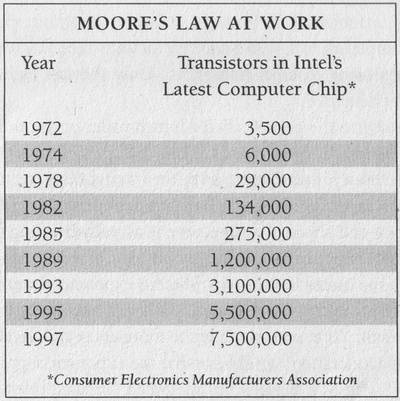
Gordon Moore, an inventor of the integrated circuit and then chairman of Intel, noted in 1965 that the surface area of a transistor (as etched on an integrated circuit) was being reduced by approximately 50 percent every twelve months.
In 1975, he was widely reported to have revised this observation to eighteen months. Moore claims that his 1975
update was to twenty‐four months, and that does appear to be a better fit to the data.
The result is that every two years, you can pack twice as many transistors on an integrated circuit. This doubles
both the number of components on a chip as well as its speed. Since the cost of an integrated circuit is fairly constant, the implication is that every two years you can get twice as much circuitry running at twice the speed for the same
price. For many applications, thatʹs an effective quadrupling of the value. The observation holds true for every type of circuit, from memory chips to computer processors.
This insightful observation has become known as Mooreʹs Law on Integrated Circuits, and the remarkable phenomenon of the law has been driving the acceleration of computing for the past forty years. But how much longer
can this go on? The chip companies have expressed confidence in another fifteen to twenty years of Mooreʹs Law by
continuing their practice of using increasingly higher resolutions of optical lithography (an electronic process similar to photographic printing) to reduce the feature size—measured today in millionths of a meter—of transistors and other key components. [18] But then—after almost sixty years—this paradigm will break down. The transistor insulators will then be just a few atoms thick, and the conventional approach of shrinking them wonʹt work.
What then?
We first note that the exponential growth of computing did not start with Mooreʹs Law on Integrated Circuits. In
the accompanying figure, ʺThe Exponential Growth of Computing, 1900–1998,ʺ [19] I plotted forty‐nine notable computing machines spanning the twentieth century on an exponential chart, in which the vertical axis represents powers of ten in computer speed per unit cost (as measured in the number of ʺcalculations per secondʺ that can be purchased for $1,000). Each point on the graph represents one of the machines. The first five machines used mechanical technology, followed by three electromechanical (relay based) computers, followed by eleven vacuum-tube machines, followed by twelve machines using discrete transistors. Only the last eighteen computers used integrated circuits.
I then fit a curve to the points called a fourth‐order polynomial, which allows for up to four bends. In other words, I did not try to fit a straight line to the points, just the closest fourth‐order curve. Yet a straight line is close to what I got. A straight line on an exponential graph means exponential growth. A careful examination of the trend shows that the curve is actually bending slightly upward, indicating a small exponential growth in the rate of exponential growth. This may result from the interaction of two different exponential trends, as I will discuss in chapter 6, ʺBuilding New Brains.ʺ Or there may indeed be two levels of exponential growth. Yet even if we take the more conservative view that there is just one level of acceleration, we can see that the exponential growth of computing did not start with Mooreʹs Law on Integrated Circuits, but dates back to the advent of electrical computing at the beginning of the twentieth century.
Mechanical Computing Devices
1. 1900
Analytical Engine
2. 1908
Hollerith Tabulator
3. 1911
Monroe Calculator
4. 1919
IBM Tabulator
5. 1928
National Ellis 3000
Electromechanical (Relay Based) Computers
6. 1939
Zuse 2
7. 1940
Bell Calculator Model 1
8. 1941
Zuse 3
Vacuum‐Tube Computers
9. 1943
Colossus
10. 1946
ENIAC
11. 1948
IBM SSEC
12. 1949
BINAC
13. 1949
EDSAC
14. 1951
Univac 1
15. 1953
Univac 1103
16. 1953
IBM 701
17. 1954
EDVAC
18. 1955
Whirlwind
19. 1955
IBM 704
Discrete Transistor Computers
20. 1958
Datamatic 1000
21. 1958
Univac II
22. 1959
Mobidic
23. 1959
IBM 7090
24. 1960
IBM 1620
25. 1960
DEC PDP‐1
26. 1961
DEC PDP‐4
27. 1962
Univac III
28. 1964
CDC 6600
29. 1965
IBM 1130
30. 1965
DEC PDP‐8
31. 1966
IBM 360 Model 75
Integrated Circuit Computers
32. 1968
DEC PDP‐10
33. 1973
Intellec‐8
34. 1973
Data General Nova
35. 1975
Altair 8800
36. 1976
DEC PDP‐11 Model 70
37. 1977
Cray I
38. 1977
Apple II
39. 1979
DEC VAX 11Model 780
40. 1980
Sun‐1
41. 1982
IBM PC
42. 1982
Compaq Portable
43. 1983
IBM AT‐80286
44. 1984
Apple Macintosh
45. 1986
Compaq Deskpro 386
46. 1987
Apple Mac II
47. 1993
Pentium PC
48. 1996
Pentium PC
49. 1998
Pentium II PC
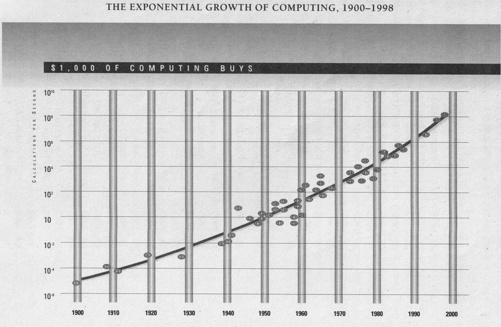
In the 1980s, a number of observers, including Carnegie Mellon University professor Hans Moravec, Nippon Electric Companyʹs David Waltz, and myself, noticed that computers have been growing exponentially in power, long
before the invention. of the integrated circuit in 1958 or even the transistor in 1947. [20] The speed and density of computation have been doubling every three years (at the beginning of the twentieth century) to one year (at the end of the twentieth century), regardless of the type of hardware used. Remarkably, this ʺExponential Law of Computingʺ
has held true for at least a century, from the mechanical card‐based electrical computing technology used in the 1890
U.S. census, to the relay‐based computers that cracked the Nazi Enigma code, to the vacuum‐tube‐based computers of
the 1950s, to the transistor‐based machines of the 1960s, and to all of the generations of integrated circuits of the past four decades. Computers are about one hundred million times more powerful for the same unit cost than they were a
half century ago. If the automobile industry had made as much progress in the past fifty years, a car today would cost a hundredth of a cent and go faster than the speed of light.
As with any phenomenon of exponential growth, the increases are so slow at first as to be virtually unnoticeable.
Despite many decades of progress since the first electrical calculating equipment was used in the 1890 census, it was not until the mid1960s that this phenomenon was even noticed (although Alan Turing had an inkling of it in 1950).
Even then, it was appreciated only by a small community of computer engineers and scientists. Today, you have only
to scan the personal computer ads—or the toy ads—in your local newspaper to see the dramatic improvements in the
price performance of computation that now arrive on a monthly basis.
So Mooreʹs Law on Integrated Circuits was not the first, but the fifth paradigm to continue the now one‐century‐
long exponential growth of computing. Each new paradigm came along just when needed. This suggests that exponential growth wonʹt stop with the end of Mooreʹs Law. But the answer to our question on the continuation of
the exponential growth of computing is critical to our understanding of the twenty‐first century. So to gain a deeper understanding of the true nature of this trend, we need to go back to our earlier questions on the exponential nature of time.
















THE LAW OF TIME AND CHAOS
In a process, the time interval between salient events (i.e., events that change the nature of the process,
or significantly affect the future of the process) expands or contracts along with the amount of chaos
THE LAW OF INCREASING CHAOS
THE LAW OF ACCELERATING RETURNS
As chaos exponentially increases, time exponentially
As order exponentially increases, time exponentially
slows down (i.e., the time interval between salient
speeds up (i.e., the time interval between salient
events grows longer as time passes).
events grows shorter as time passes).
THE LAW OF ACCELERATING RETURNS AS
THE LAW OF
THE LAW OF
APPLIED TO AN EVOLUTIONARY PROCESS
INCREASING CHAOS
INCREASING CHAOS
An evolutionary process is not a closed system;
AS APPLIED TO THE
AS APPLIED TO THE
therefore, evolution draws upon the chaos in the
UNIVERSE
LIFE OF AN
larger system in which it takes place for its options
The Universe started as
ORGANISM
for diversity; and
a "singularity," a single
The development of an
• Evolution builds on its own increasing order.
undifferentiated point
organism from
Therefore:
with no size and no
conception as a single
chaos, so early epochal
cell through maturation
• In an evolutionary process, order increases
events were extremely
is a process moving
exponentially.
rapid. The Univers grew
toward greater diversity
Therefore:
greatly in chaos as time
and thus greater
• Time exponentially speeds up.
went on. Thus time
disorder. Thus the time
Therefore:
slowed down (i.e., the
interval between salient
•
The returns (i.e., the valuable products of the
time interval between
events grows longer
process) accelerate.
salient events grew
over time.
exponentially longer
over time).
THE LAW OF ACCELERATING RETURNS AS
APPLIED TO THE EVOLUTION OF LIFE-FORMS
The time interval between salient events (e.g., a
significant new branch) grows exponentially
shorter as time passes.
THE EVOLUTION OF LIFE-FORMS LEADS TO
THE EVOLUTION OF TECHNOLOGY
The advance of technology is inherently an
evolutionary process. Indeed, it is a continuation
of the same evolutionary process that gave rise to
technology-creating species. Therefore, in
accordance with the Law of Accelerating Returns,
the time interval between salient advances grows
exponentially shorter as time passes. The
"returns" (i.e., the value) of technology increase
over time.



TECHNOLOGY BEGETS COMPUTATION
Computation if the essence of order in
technology. In accordance with the Law of
Accelerating Returns, the value—power—of
computation increases exponentially over time.
MOORE'S LAW ON INTEGRATED CIRCUITS
Transistor die sizes are cut in half every twenty-
four months, therefore both computing capacity
(i.e., the number of transistors on a chip) and the
speed of each transistor double every twenty-four
months. This is the fifth paradigm since the
inception of computation—after mechanical,
electromechanical (i.e., relay based), vacuum
tube, and discrete transistor technology—to
provide accelerating returns to computation.
THE LAW OF TIME AND CHAOS
Is the flow of time something real, or might our sense of time passing be just an illusion that hides the fact that what is real is only a vast collection of moments?
—Lee Smolin
Time is natureʹs way of preventing everything from happening at once.
—Graffito
Things are more like they are now than they ever were before.
—Dwight Eisenhower
Consider these diverse exponential trends:
• The exponentially slowing pace that the Universe followed, with three epochs in the first billionth of a second, with later salient events taking billions of years.
• The exponentially slowing pace in the development of an organism. In the first month after conception, we
grow a body, a head, even a tail. We grow a brain in the first couple of months. After leaving our maternal
confines, our maturation both physically and mentally, is rapid at first. In the first year, we learn basic forms
of mobility and communication. We experience milestones every month or so. Later on, key events march ever more slowly, taking years and then decades.
• The exponentially quickening pace of the evolution of life‐forms on Earth.
• The exponentially quickening pace of the evolution of human‐created technology, which picked up the pace
from the evolution of life‐forms.
• The exponential growth of computing. Note that exponential growth of a process over time is just another
way of expressing an exponentially quickening pace. For example, it took about ninety years to achieve the
first MIP (Million Instructions per Second) for a thousand dollars. Now we add an additional MIP per thousand dollars every day. The overall innovation rate is clearly accelerating as well.
• Mooreʹs Law on Integrated Circuits. As I noted, this was the fifth paradigm to achieve the exponential growth of computing.
Many questions come to mind:
What is the common thread between these varied exponential trends?
Why do some of these processes speed up while others slow down?
And what does this tell us about the continuation of the exponential growth of computing when Mooreʹs Law
dies?
Is Mooreʹs Law just a set of industry expectations and goals, as Randy Isaac, head of basic science at IBM, contends? Or is it part of a deeper phenomenon that goes far beyond the photolithography of integrated circuits?
After thinking about the relationship between these apparently diverse trends for several years, the surprising common theme became apparent to me.
What determines whether time speeds up or slows down? The consistent answer is that time moves in relation to the amount of chaos. We can state the Law of Time and Chaos as follows:
The Law of Time and Chaos: In a process, the time interval between salient events (that is, events that
change the nature of the process, or significantly affect the future of the process) expands or contracts
along with the amount of chaos.
When there is a lot of chaos in a process, it takes more time for significant events to occur. Conversely, as order
increases, the time periods between salient events decrease.
We have to be careful here in our definition of chaos. It refers to the quantity of disordered (that is, random) events that are relevant to the process. If weʹre dealing with the random movement of atoms and molecules in a gas or liquid, then; heat is an appropriate measure. If weʹre dealing with the process of evolution of life‐forms, then chaos represents the unpredictable events encountered by organisms, and the random mutations that are introduced in the
genetic code.
Letʹs see how the Law of Time and Chaos applies to our examples. If chaos is increasing, the Law of Time and Chaos implies the following sublaw:
The Law of Increasing Chaos: As chaos exponentially increases, time exponentially slows down (that is,
the time interval between salient events grows longer as time passes).
This fits the Universe rather well. When the entire Universe was just a ʺnakedʺ singularity—a perfectly orderly single point in space and time—there was no chaos and conspicuous events took almost no time at all. As the Universe grew in size, chaos increased exponentially, and so did the timescale for epochal changes. Now, with billions of galaxies sprawled out over trillions of light‐years of space, the Universe contains vast reaches of chaos, and indeed requires billions of years to get everything organized for a paradigm shift to take place.
We see a similar phenomenon in the progression of an organismʹs life. We start out as a single fertilized cell, so
thereʹs only rather limited chaos there. Ending up with trillions of cells, chaos greatly expands. Finally, at the end of our lives, our designs deteriorate, engendering even greater randomness. So the time period between salient biological events grows longer as we grow older. And that is indeed what we experience.
But it is the opposite spiral of the Law of Time and Chaos that is the most important and relevant for our purposes. Consider the inverse sublaw, which I call the Law of Accelerating Returns:
The Law of Accelerating Returns: As order exponentially increases, time exponentially speeds up (that is,
the time interval between salient events grows shorter as time passes).
The Law of Accelerating Returns (to distinguish it from a better‐known law in which returns diminish) applies specifically to evolutionary processes. In an evolutionary process, it is order—the opposite of chaos—that is increasing. And, as we have seen, time speeds up.
Disdisorder
I noted above that the concept of chaos in the Law of Time and Chaos is tricky. Chaos alone is not sufficient—
disorder for our purposes requires randomness that is relevant to the process we are concerned with. The opposite of disorder—which I called ʺorderʺ in the above Law of Accelerating Returns—is even trickier.
Letʹs start with our definition of disorder and work backward. If disorder represents a random sequence of events,
then the opposite of disorder should imply ʺnot random.ʺ And if random means unpredictable, then we might conclude that order means predictable. But that would be wrong.
Borrowing a page from information theory, [21] consider the difference between information and noise.
Information is a sequence of data that is meaningful in a process, such as the DNA code of an organism, or the bits in a computer program. Noise, on the other hand, is a random sequence. Neither noise nor information is predictable.
Noise is inherently unpredictable, but carries no information. Information, however, is also unpredictable. If we can predict future data from past data, then that future data stops being information. For example, consider a sequence
which simply alternates between zero and one (01010101 . . .). Such a sequence is certainly orderly, and very predictable. Specifically because it is so predictable, we do not consider it information bearing, beyond the first couple of bits.
Thus orderliness does not constitute order because order requires information. So, perhaps I should use the word
information instead of order. However, information alone is not sufficient for our purposes either. Consider a phone book. It certainly represents a lot of information, and some order as well. Yet if we double the size of the phone book, we have increased the amount of data, but we have not achieved a deeper level of order.
Order, then, is information that fits a purpose. The measure of order is the measure of how well the information
fits the purpose. In the evolution of life‐forms, the purpose is to survive. In an evolutionary algorithm (a computer program that simulates evolution to solve a problem) applied to, say, investing in the stock market, the purpose is to make money. Simply having more information does not necessarily result in a better fit. A superior solution for a purpose may very well involve less data.
The concept of ʺcomplexityʺ has been used recently to describe the nature of the information created by an evolutionary process. Complexity is a reasonably close fit to the concept of order that I am describing. After all, the designs created by the evolution of life‐forms on Earth appear to have become more complex over time. However, complexity is not a perfect fit, either. Sometimes, a deeper order —a better fit to a purpose—is achieved through simplification rather than further increases in complexity. As Einstein said, ʺEverything should be made as simple as possible, but no simpler.ʺ For example, a new theory that ties together apparently disparate ideas into one broader, more coherent theory reduces complexity but nonetheless may increase the ʺorder for a purposeʺ that I am describing.
Evolution has shown, however, that the general trend toward greater order does generally result in greater complexity. [22]
Thus improving a solution to a problem—which may increase or decrease complexity—increases order. Now that
just leaves the issue of defining the problem. And as we will see, defining a problem well is often the key to finding its solution.
The Law of Increasing Entropy Versus the Growth of Order Another consideration is how the Law of Time and
Chaos relates to the second law of thermodynamics. Unlike the second law, the Law of Time and Chaos is not necessarily concerned with a closed system. It deals instead with a process. The Universe is a closed system (not subject to outside influence, since there is nothing outside the Universe), so in accordance with the second law of thermodynamics, chaos increases and time slows down. In contrast, evolution is precisely not a closed system. it takes place amid great chaos, and indeed depends on the disorder in its midst, from which it draws its options for diversity. And from these options, an evolutionary process continually prunes its choices to create ever greater order.
Even a crisis that appears to introduce a significant new source of chaos is likely to end up increasing—deepening—
the order created by an evolutionary process. For example, Consider the asteroid that is thought to have killed off big organisms such as the dinosaurs 65 million years ago. The crash of that asteroid suddenly created a vast increase in chaos (and lots of dust, too). Yet it appears to have hastened the rise of mammals in the niche previously dominated by large reptiles and ultimately led to the emergence of a technology‐creating species. When the dust settled (literally), the crisis of the asteroid had increased order.
As I pointed out earlier, only a tiny fraction of the stuff in the Universe, or even on a life‐ and technology‐bearing planet such as Earth, can be considered to be part of evolutionʹs inventions. Thus evolution does not contradict the Law of Increasing Entropy. Indeed, it depends on it to provide a never‐ending supply of options.
As I noted, given the emergence of life, the emergence of a technology‐creating species—and of technology—is inevitable. Technology is the continuation of evolution by other means, and is itself an evolutionary process. So it, too, speeds up.
A primary reason that evolution—of life‐forms or of technology—speeds up is that it builds on its own increasing
order. Innovations created by evolution encourage and enable faster evolution. In the case of the evolution of life-forms, the most notable example is DNA, which provides a recorded and protected transcription of lifeʹs design from
which to launch further experiments.
In the case of the evolution of technology, ever improving human methods of recording information have fostered
further technology. The first computers were designed on paper and assembled by hand. Today, they are designed on
computer workstations with the computers themselves working out many details of the next generationʹs design, and
are then produced in fully automated factories with human guidance but limited direct intervention.
The evolutionary process of technology seeks to improve capabilities in an exponential fashion. Innovators seek to
improve things by multiples. Innovation is multiplicative, not additive. Technology, like any evolutionary process, builds on itself. This aspect will continue to accelerate when the technology itself takes full control of its own progression.
We can thus conclude the following with regard to the evolution of life‐forms, and of technology:
The Law of Accelerating Returns as Applied to an Evolutionary Process:
▲ An evolutionary process is not a closed system; therefore, evolution draws upon the chaos in the larger
system in which it takes place for its options for diversity; and
▲ Evolution builds on its own increasing order.
Therefore:
▲ In an evolutionary process, order increases exponentially.
Therefore:
▲ Time exponentially speeds up.
Therefore:
▲ The returns (that is, the valuable products of the process) accelerate.
The phenomenon of time slowing down and speeding up is occurring simultaneously. Cosmologically speaking,
the Universe continues to slow down. Evolution, now most noticeably in the form of human‐created technology, continues to speed up. These are the two sides—two interleaved spirals—of the Law of Time and Chaos.
The spiral we are most interested in—the Law of Accelerating Returns—gives us ever greater order in technology,
which inevitably leads to the emergence of computation. Computation is the essence of order. It provides the ability for a technology to respond in a variable and appropriate manner to its environment to carry out its mission. Thus computational technology is also an evolutionary process, and also builds on its own progress. The time to accomplish a fixed objective gets exponentially shorter over time (for example, ninety years for the first MIP per thousand dollars versus one day for an additional MIP today). That the power of computing grows exponentially over time is just another way to say the same thing.
So Where Does That Leave Mooreʹs Law?
Well, it still leaves it dead by the year 2020. Mooreʹs law came along in 1958 just when it was needed and will have done its sixty years of service by 2018, a rather long period of time for a paradigm nowadays. Unlike Mooreʹs Law,
however, the Law of Accelerating Returns is not a temporary methodology. It is a basic attribute of the nature of time and chaos—a sublaw of the Law of Time and Chaos—and describes a wide range of apparently divergent phenomena
and trends. In accordance with the Law of Accelerating Returns, another computational technology will pick up where Mooreʹs Law will have left off, without missing a beat.
Most Exponential Trends Hit a Wall . . . but Not This One
A frequent criticism of predictions of the future is that they rely on mindless extrapolation of current trends without consideration of forces that may terminate or alter that trend. This criticism is particularly relevant in the case of exponential trends. A classic example is a species happening upon a hospitable new habitat, perhaps transplanted there by human intervention (rabbits in Australia, say). Its numbers multiply exponentially for a while, but this phenomenon is quickly terminated when the exploding population runs into a new predator or the limits of its environment. Similarly, the geometric population growth of our own species has been a source of anxiety, but changing social and economic factors, including growing prosperity, have greatly slowed this expansion in recent years, even in developing countries.
Based on this, some observers are quick to predict the demise of the exponential growth of computing.
But the growth predicted by the Law of Accelerating Returns is an exception to the frequently cited limitations to
exponential growth. Even a catastrophe, as apparently befell our reptilian cohabitants in the late Cretaceous period, only sidesteps an evolutionary process, which then picks up the pieces and continues unabated (unless the entire process is wiped out). An evolutionary process accelerates because it builds on its past achievements, which includes improvements in its own means for further evolution. In the evolution of life‐forms, in addition to DNA‐based genetic coding, the innovation of sexual reproduction provided for improved means of experimenting with diverse characteristics within an otherwise homogenous population. The establishment of basic body plans of modern animals in the ʺCambrian explosion,ʺ about 570 million years ago, allowed evolution to concentrate on higher‐level features such as expanded brain function. The inventions of evolution in one era provide the means, and often the intelligence, for innovation in the next.
The Law of Accelerating Returns applies equally to the evolutionary process of computation, which inherently will grow exponentially and essentially without limit. The two resources it needs—the growing order of the evolving technology itself and the chaos from which an evolutionary process draws its options for further diversity—are unbounded.
Ultimately, the innovation needed for further turns of the screw will come from the machines themselves.
How will the power of computing continue to accelerate after Mooreʹs Law dies? We are just beginning to explore
the third dimension in chip design. The vast majority of todayʹs chips are flat, whereas our brain is organized in three dimensions. We live in a three‐dimensional world, so why not use the third dimension? Improvements in semiconductor materials, including superconducting circuits that donʹt generate heat, will enable us to develop chips—that is, cubes—with thousands of layers of circuitry that, combined with far smaller component geometries, will improve computing power by a factor of many millions. And there are more than enough other new computing
technologies waiting in the wings—nanotube, optical, crystalline, DNA, and quantum (which weʹll visit in chapter 6,
ʺBuilding New Brainsʺ)—to keep the Law of Accelerating Returns going in the world of computation for a very long
time.
THE LEARNING CURVE: SLUG VERSUS HUMAN
The "learning curve" describes the mastery of a skill over time. As an entity—slug or human—learns a new
skill, the newly acquired ability builds on itself, and so the learning curve starts out looking like the
exponential growth we see in the Law of Accelerating Returns. Skills tend to be bounded, so as the new
expertise is mastered, the law of diminishing returns sets in, and growth in mastery levels off. So the learning
curve is what we call an S curve because exponential growth followed by a leveling off looks like an S leaning
slightly to the right:
The learning curve is remarkably universal: Most multicellular creatures do it. Slugs, for example, follow the
learning curve when learning how to ascend a new tree in search of leaves. Humans, of course, are always
learning something new.
But there's a salient difference between humans and slugs. Humans are capable of innovation, which is the
creation and retention of new skills and knowledge. Innovation is the driving force in the Law of Accelerating
Returns, and eliminates the leveling-off part of the S curve. So innovation turns the S curve into indefinite
exponential expansion.
Overcoming the S curve is another way to express the unique status of the human species. No other species
appears to do this. Why are we unique in this way, given that other primates are so close to us in terms of
genetic similarity?
The reason is that the ability to overcome the S curve defines a new ecological niche. As I pointed out, there
were indeed other humanoid species and subspecies capable of innovation, but the niche seems to have
tolerated only one surviving competitor. But we will have company in the twenty-first century as our machines
join us in this exclusive niche.
A Planetary Affair
The introduction of technology on Earth is not merely the private affair of one of the Earthʹs innumerable species. It is a pivotal event in the history of the planet. Evolutionʹs grandest creation—human intelligence—is providing the means for the next stage of evolution, which is technology. The emergence of technology is predicted by the Law of
Accelerating Returns. The Homo sapiens sapiens subspecies emerged only tens of thousands of years after its human forebears. According to the Law of Accelerating Returns, the next stage of evolution should measure its salient events in mere thousands of years, too quick for DNA‐based evolution. This next stage of evolution was necessarily created
by human intelligence itself, another example of the exponential engine of evolution using its innovations from one
period (human beings) to create the next (intelligent machines). Evolution draws upon the great chaos in its midst—
the ever increasing entropy governed by the flip side of the Law of Time and Chaos—for its options for innovation.
These two strands of the Law of Time and Chaos—time exponentially slowing down due to the increasing chaos predicted by the second law of thermodynamics; and time exponentially speeding up due to the increasing order created by evolution—coexist and progress without limit . In particular, the resources of evolution, order and chaos, are unbounded. I stress this point because it is crucial to understanding the evolutionary—and revolutionary—nature of computer technology.
The emergence of technology was a milestone in the evolution of intelligence on Earth because it represented a new means of evolution recording its designs. The next milestone will be technology creating its own next generation without human intervention. That there is only a period of tens of thousands of years between these two milestones is another example of the exponentially quickening pace that is evolution.
The Inventor of Chess and the Emperor of China
To appreciate the implications of this (or any) geometric trend, it is useful to recall the legend of the inventor of chess and his patron, the emperor of China. The emperor had so fallen in love with his new game that he offered the inventor a reward of anything he wanted in the kingdom.
ʺJust one grain of rice on the first square, Your Majestyʺ
ʺJust one grain of rice?ʺ
ʺYes, Your Majesty, just one grain of rice on the first square, and two grains of rice on the second square.ʺ
ʺThatʹs it—one and two grains of rice?ʺ
ʺWell, okay, and four grains on the third square, and so on.ʺ
The emperor immediately granted the inventorʹs seemingly humble request. One version of the story has the emperor going bankrupt because the doubling of grains of rice for each square ultimately equaled 18 million trillion grains of rice. At ten grains of rice per square inch, this requires rice fields covering twice the surface area of the Earth, oceans included.
The other version of the story has the inventor losing his head. Itʹs not yet clear which outcome weʹre headed for.
But there is one thing we should note: It was fairly uneventful as the emperor and the inventor went through the
first half of the chessboard. After thirty‐two squares, the emperor had given the inventor about 4 billion grains of rice.
Thatʹs a reasonable quantity—about one large fieldʹs worth—and the emperor did start to take notice.
But the emperor could still remain an emperor. And the inventor could still retain his head. It was as they headed
into the second half of the chessboard that at least one of them got into trouble. So where do we stand now? There
have been about thirty‐two doublings of speed and capacity since the first operating computers were built in the 1940s. Where we stand right now is that we have finished the first half of the chessboard. And, indeed, people are starting to take notice. Now, as we head into the next century, we are heading into the second half of the chessboard.
And this is where things start to get interesting.
‐‐‐‐‐‐‐‐‐‐‐‐‐‐‐‐‐‐‐‐‐‐‐‐‐‐‐‐‐‐‐‐‐‐‐‐‐‐‐‐‐‐‐‐‐‐‐‐‐‐‐‐‐‐‐‐‐‐‐‐‐‐‐‐‐‐‐‐‐‐‐‐‐‐‐‐‐‐‐‐‐‐‐‐‐‐‐‐‐‐‐‐‐‐‐‐‐‐‐‐‐‐‐‐‐‐‐‐‐‐‐‐‐‐‐‐‐‐‐‐‐‐‐‐‐‐‐‐‐‐‐‐‐‐‐‐‐‐‐‐‐‐‐‐‐‐‐‐‐‐‐‐‐‐‐
OKAY, LET ME GET THIS STRAIGHT, MY CONCEPTION AS A FERTILIZED EGG WAS LIKE THE UNIVERSEʹS
BIG BANG—UH, NO PUN INTENDED—THAT IS, THINGS STARTED OUT HAPPENING VERY FAST, THEN
KIND OF SLOWED DOWN, AND NOW THEYʹRE REAL SLOW?
Thatʹs a reasonable way to put it, the time interval now between milestones is a lot longer than it was when you were an infant, let alone a fetus.
YOU MENTIONED THE UNIVERSE HAD THREE PARADIGM SHIFTS IN THE FIRST BILLIONTH OF A SECOND.
WERE THINGS THAT FAST WHEN I GOT STARTED?
Not quite that fast. The Universe started as a singularity, a single point taking up no space and comprising, therefore, no chaos. So the first major event, which was the creation of the Universe, took no time at all. With the Universe still very small, events unfolded extremely quickly. We donʹt start out as a single point, but as a rather complex cell. it has order but there is a lot of random activity within a cell compared to a single point in space. So our first major event as an organism, which is the first mitosis of our fertilized egg, is measured in hours, not trillionths of a second. Things slow down from there.
BUT I FEEL LIKE TIME IS SPEEDING UP. THE YEARS JUST GO BY SO MUCH FASTER NOW THAN THEY DID
WHEN I WAS A KID. DONʹT YOU HAVE IT BACKWARD?
Yes, well, the subjective experience is the opposite of the objective reality.
OF COURSE. WHY DIDNʹT I THINK OF THAT?
Let me clarify what I mean. The objective reality is the reality of the outside observer observing the process. If we observe the development of an individual, salient events happen very quickly at first, but later on milestones are more spread out, so we say time is slowing down. The subjective experience, however, is the experience of the process itself, assuming, of course, that the process is conscious. Which in your case, it is. At least, I assume thatʹs the case.
THANK YOU.
Subjectively, our perception of time is affected by the spacing of milestones.
MILESTONES?
Yeah, like growing a body and a brain.
AND BEING BORN?
Sure, thatʹs a milestone. Then learning to sit up, walking, talking . . .
OKAY.
We can consider each subjective unit of time to be equivalent to one milestone spacing. Since our milestones are spaced further apart as we grow older, a subjective unit of time will represent a longer span of time for an adult than for a child. Thus time feels like it is passing by more quickly as we grow older. That is, an interval of a few years as an adult may be perceived as comparable to a few months to a young child. Thus a long interval to an adult and a short
interval to a child both represent the same subjective time in terms of the passage of salient events Of course, long and short intervals also represent comparable fractions of their respective past lives.
SO DOES THAT EXPLAIN WHY TIME PASSES MORE QUICKLY WHEN IʹM HAVING A GOOD TIME?
Well, it may be relevant to one phenomenon. If someone goes through an experience in which a lot of significant events occur, that experience may feel like a much longer period of time than a calmer period. Again, we measure subjective time in terms of salient experiences.
NOW IF I FIND TIME SPEEDING UP WHEN OBJECTIVELY IT IS SLOWING DOWN, THEN EVOLUTION WOULD
SUBJECTIVELY FIND TIME SLOWING DOWN AS IT OBJECTIVELY SPEEDS UP, DO I HAVE THAT STRAIGHT?
Yes, if evolution were conscious.
WELL, IS IT?
Thereʹs no way to really tell, but evolution has its time spiral going in the opposite direction from entities we generally consider to be conscious, such as humans. In other words, evolution starts out slow and speeds up over time, whereas the development of a person starts out fast and then slows down. The Universe, however, does have its
time spiral going in the same direction as us organisms, so it would make more sense to say that the Universe is conscious. And come to think of it, that does shed some light on what happened before the big bang.
I WAS JUST WONDERING ABOUT THAT.
As we look back in time and get closer to the event of the big bang, chaos is shrinking to zero. Thus from the subjective perspective, time is stretching out. indeed, as we go back in time and approach the big bang, subjective time approaches infinity. Thus it is not possible to go back past a subjective infinity of time.
THATʹS A LOAD OFF MY MIND. NOW YOU SAID THAT THE EXPONENTIAL PROGRESS OF AN
EVOLUTIONARY PROCESS GOES ON FOREVER. IS THERE ANYTHING THAT CAN STOP IT?