I walked onstage and played a composition on an old upright piano. Then came the yes-or-no questions.
Former Miss America Bess Myerson was stumped. But film star Henry Morgan, the second celebrity panelist on
this episode of I've Got a Secret, guessed my secret: The piece I had played had been composed by a
computer that I had built and programmed. Later that year, I got to meet President Johnson with other high-
school science winners.
In college, I ran a business matching up high-school kids with colleges using a computer program I had
written. We had to pay $1,000 an hour to rent time on the only computer in Massachusetts with an
extraordinary million bytes of core memory, which allowed us to fit all the information we had about the
nation's three thousand colleges into memory at the same time. We received a lot of letters from kids who
were delighted with the colleges that our program had suggested. A few parents, on the other hand, were
furious that we had failed to recommend Harvard. It was my first experience with the ability of computers to
affect people's lives. I sold that company to Harcourt, Brace & World, a New York publisher, and moved on to
other ideas.
In 1974, computer programs that could recognize printed letters, called optical character recognition
(OCR), were capable of handling only one or two specialized type styles. I founded Kurzweil Computer
Products that year to develop the first OCR program that could recognize any style of print, which we
succeeded in doing later that year. So the question then became, What is it good for? Like a lot of clever computer software, it was a solution in search of a problem.
I happened to sit next to a blind gentleman on a plane flight, and he explained to me that the only real
handicap that he experienced was his inability to read ordinary printed material. It was clear that his visual
disability imparted no real handicap in either communicating or traveling. So I had found the problem we were
searching for—we could apply our "omni-font" (any font) OCR technology to overcome this principal handicap of blindness. We didn't have the ubiquitous scanners or text-to-speech synthesizers that we do today, so we
had to create these technologies as well. By the end of 1975, we put together these three new technologies
we had invented—omni-font OCR, CCD (Charge Coupled Device) flat-bed scanners, and text-to-speech
synthesis to create the first print-to-speech reading machine for the blind. The Kurzweil Reading Machine
(KRM) was able to read ordinary books, magazines, and other printed documents out loud so that a blind
person could read anything he wanted.
We announced the KRM in January of 1976, and it seemed to strike a chord. All the evening network news
programs carried the story, and Walter Cronkite used the machine to read aloud his signature sign-off, "And
that's the way it was, January 13, 1976."
Shortly after the announcement, I was invited on the Today show, which was a little nerve-racking since
we only had one working reading machine. Sure enough, the machine stopped working a couple of hours
before I was scheduled to go on live national television. Our chief engineer frantically took the machine apart,
scattering pieces of electronics and wires across the floor of the set. Frank Field, who was going to interview
me, walked by and asked if everything was okay. "Sure, Frank," I replied. "We're just making a few last-minute adjustments."
Our chief engineer put the reading machine back together, and still it didn't work. Finally, he used a time-
honored method of repairing delicate electronic equipment and slammed the reading machine against a table.
From that moment, it worked just fine. Its live television debut then proceeded without a hitch.
Stevie Wonder heard about our appearance on the Today show, and decided to check out the story
himself. Our receptionist was skeptical that the person on the other end of the line was really the legendary
singer, but she put the call through to me, anyway. I invited him over, and he tried out the machine. He
beseeched us to provide him with his own reading machine, so we turned the factory upside down to hurriedly
finish up our first production unit (we didn't want to give him the prototype we used on the Today show, as it still had a few battle scars). We showed Stevie how to use it, and off he went in a taxi with his new reading
machine by his side.
We subsequently applied the scanning and omni-font OCR to commercial uses such as entering data into
databases and into the emerging word-processing computers. New information services, such as Lexus (an
online legal research service) and Nexus (a news service), were built using the Kurzweil Data Entry Machine to
scan and recognize written documents.
In 1978, after years of scrambling to raise funds for our venture, we were fortunate in attracting interest
and investment from a big company: Xerox. Most Xerox products transferred electronic information onto
paper. They saw the Kurzweil scanning and OCR technology as providing a bridge back from the world of
paper to the electronic world, so in 1980 they bought the company. You can still buy the OCR we originally
developed, suitably updated—it's now called Xerox TextBridge, and continues as a market leader.
I kept up my relationship with Stevie Wonder, and on one of our get-togethers at his new Los Angeles
recording studio in 1982, he lamented the state of affairs in the world of musical instruments. On the one
hand, there was the world of acoustic instruments, such as the piano, violin, and guitar, which provided the
rich complex sounds of choice for most musicians. While musically satisfying, these instruments suffered from
a panoply of limitations. Most musicians could play only one or two different instruments. Even if you could
play more than one, you couldn't play more than one at a time. Most instruments only produce one note at a
time. There were very limited means available to shape the sounds.
On the other hand, there was the world of electronic instruments, in which these control limitations
disappeared. In the computerized world, you could record one line of music on a sequencer, play it back, and
record another sequence over it, building up a multi-instrumental composition line by line. You could edit
wrong notes without replaying the entire sequence. You could layer multiple sounds, modify their sonic
characteristics, play songs in nonreal time, and use a great variety of other techniques. There was only one
problem. The sounds you had to work with in the electronic world sounded very thin, rather like an organ, or
an electronically processed organ.
Wouldn't it be great, Stevie mused, if we could use the extraordinarily flexible computer-control methods
on the beautiful sounds of acoustic instruments? I thought about it and it sounded quite doable, so that
meeting constituted the founding of Kurzweil Music Systems, and defined its raison d'etre.
With Stevie Wonder as our musical adviser, we set out to combine these two worlds of music. In June of
1983, we demonstrated an engineering prototype of the Kurzweil 250 (K250) and introduced it commercially
in 1984. The K250 is considered to be the first electronic musical instrument to successfully emulate the
complex sound response of a grand piano and virtually all other orchestral instruments.
Earlier, my father, who was a noted musician, had played a role in developing my interest in electronic
music. Before his death in 1970, he told me that he believed I would one day combine my interests in
computers and in music, as he felt there was a natural affinity between the two. I remember that when my
father wanted to hear one of his orchestral compositions, he had to engage an entire orchestra. This meant
raising money, mimeographing copies of handwritten sheet music, selecting and hiring the right musicians and
arranging a hall in which they could play. After all of that, he would get to hear his composition for the first
time. God forbid if he didn't like the composition exactly the way it was, for then he would have to dismiss the
musicians, spend days rewriting modified scores by hand, raise more money, rehire the musicians, and get
them back together. Today a musician can hear her multi-instrumental composition on a Kurzweil or other
synthesizer, make changes as easily as one would to a letter on a word processor, and hear the results
instantly.
I sold Kurzweil Music Systems to a Korean company, Young Chang, the world's largest piano manufacturer,
in 1990. Kurzweil Music Systems remains one of the leading brands of electronic musical instruments in the
world and is sold in forty-five countries.
I also started Kurzweil Applied Intelligence in 1982 with the goal of creating a voice-activated word
processor. This is a technology that is hungry for MIPS (that is, computer speed) and megabytes (that is,
memory), so early systems limited the size of the vocabulary that users could employ. These early systems
also required users to pause briefly between words. . . so. . . you. . . had. . . to. . . speak. . . like. . . this. We combined this "discrete word" speech-recognition technology with a medical knowledge base to create a
system that enabled doctors to create their medical reports by simply talking to their computers. Our product,
called Kurzweil Voicemed (now Kurzweil Clinical Reporter), actually guides the doctors, through the reporting
process. We also introduced a general-purpose dictation product called Kurzweil Voice, which enabled users to
create written documents by speaking one word at a time to their personal computer. This product became
particularly popular with people who have a disability in the use of their hands.
Just this year, courtesy of Moore's Law, personal computers became fast enough to recognize fully
continuous speech, so I am able to dictate the rest of this book by talking to our latest product, called Voice
Xpress Plus, at speeds around a hundred words per minute. Of course, I don't get a hundred words written
every minute since I change my mind a lot, but Voice Xpress doesn't seem to mind.
We sold this company as well, to Lernout & Hauspie (L&H), a large speech-and-language technology
company with headquarters in Belgium. Shortly after the acquisition by L&H in 1997, we arranged a strategic
alliance between the dictation division of L&H (formerly Kurzweil Applied Intelligence) and Microsoft, so our
speech technology is likely to be used by Microsoft in future products.
L&H is also the leader in text-to-speech synthesis and automatic language translation, so the company now
has all the technologies needed for a translating telephone. As I mentioned above, we're now putting together
a technology demonstration of a system that will allow you to speak in English with the person at the other
end hearing you in German, and vice versa. Eventually, you'll be able to call anyone in the world and have
what you say instantly translated into any popular language. Of course, our ability to misunderstand each
other will remain unimpaired.
Another application of our speech-recognition technology, and one of our initial goals, is a listening device
for the deaf, essentially the opposite of a reading machine for the blind. By recognizing natural continuous
speech in real time, the device will enable a deaf person to read what people are saying, thereby overcoming
the principal handicap associated with deafness.
In 1996, I founded a new reading-technology company called Kurzweil Educational Systems, which has
developed a new generation of print-to-speech reading software for sighted persons with reading disabilities,
as well as a new reading machine for blind people. The reading-disabilities version, called the Kurzweil 3000,
scans a printed document, displays the page just as it appears in the original document (for example, book,
magazine), with all of the color graphics and pictures intact. It then reads the document out loud while
highlighting the image of the print as it is being read. It essentially does what a reading teacher does—reading
to a pupil while pointing out exactly what is being read.
It is the applications of the technology benefiting disabled people that have brought me the greatest
gratification. There is a fortuitous match between the capabilities of contemporary computers and the needs of
a disabled person. We're not creating cybernetic geniuses today—not yet. The intelligence of our present-day
intelligent computers is narrow, which can provide effective solutions for the narrow deficits of most disabled
persons. The restricted intelligence of the machine works effectively with the broad and flexible intelligence of
the disabled person. Overcoming the handicaps associated with disabilities using AI technologies has long
been a personal goal of mine. With regard to the major physical and sensory disabilities, I believe that in a
couple of decades we will come to herald the effective end of handicaps. As amplifiers of human thought,
computers have great potential to assist human expression and to expand creativity for all of us. I hope to
continue playing a role in harnessing this potential.
All of these projects have required the dedication and talents of many brilliant individuals in a broad range
of fields. It is always exciting to see—or hear—a new product, and to see its impact on the lives of its users. A
great pleasure has been sharing in the creative process, and its fruits, with these many outstanding men and
women.
THE NEW LUDDITE CHALLENGE
First let us postulate that the computer scientists succeed in developing intelligent machines that can do all things better than human beings can do them. In that case presumably all work will be done by vast, highly organized systems of machines and no human effort will be necessary. Either of two cases might occur The machines might be permitted to make all of their own decisions without human oversight, or else human control over the machines might be retained.
If the machines are permitted to make all their own decisions, we canʹt make any conjectures as to the results, because it is impossible to guess how such machines might behave. We only point out that the fate of the human race would be at the mercy of the machines. It might be argued that the human race would never be foolish enough to hand over all the power to the machines. But we are suggesting neither that the human race would voluntarily turn power over to the machines nor that the machines would willfully seize power. What we do suggest is that the human race might easily permit itself to drift into a position of such dependence on the machines that it would have no practical choice but to accept all of the machinesʹ decisions. As society and the problems that face it become more and more complex and machines become more and more intelligent, people will let machines make more of their decisions for them, simply because machine‐made decisions will bring better results than man‐made ones. Eventually a stage may be reached at which the decisions necessary to keep the system running will be so complex that human beings will be incapable of making them intelligently. At that stage the machines will be in effective control. People wonʹt be able to just turn the machines off, because they will be so dependent on them that turning them off would amount to suicide.
On the other hand it is possible that human control over the machines may be retained. in that case the average
man may have control over certain private machines of his own, such as his car or his personal computer but control over large systems of machines will be in the hands of a tiny elite—just as it is today, but with two differences. Due to improved techniques the elite will have greater control over the masses; and because human work will no longer be necessary the masses will be superfluous, a useless burden on the system. If the elite is ruthless they may simply decide to exterminate the mass of humanity. If they are humane they may use propaganda or other psychological or biological techniques to reduce the birth rate until the mass of humanity becomes extinct, leaving the world to the elite. Or, if the elite consists of soft‐hearted liberals, they may decide to play the role of good shepherds to the rest of the human race. They will see to it that everyoneʹs physical needs are satisfied, that all children are raised under psychologically hygienic conditions, that everyone has a wholesome hobby to keep him busy, and that anyone who may become dissatisfied undergoes ʺtreatmentʺ to cure his ʺproblem.ʺ Of course, life will be so purposeless that people will have to be biologically or psychologically engineered either to remove their need for the power process or to make them ʺsublimateʺ their drive for power into some harmless hobby. These engineered human beings may be happy in such a society, but they most certainly will not be free. They will have been reduced to the status of domestic animals.
—Theodore Kaczynski
The weavers of Nottingham enjoyed a modest but comfortable lifestyle from their thriving cottage industry of producing fine stockings and lace. This went on for hundreds of years, as their stable family businesses were passed down from generation to generation. But with the invention of the power loom and the other textile automation machines of the early eighteenth century, the weaversʹ livelihoods came to an abrupt end. Economic power passed from the weaving families to the owners of the machines.
Into this turmoil came a young and feebleminded boy named Ned Ludd, who, legend has it, broke two textile factory machines by accident as a result of sheer clumsiness. From that point on, whenever factory equipment was found to have been mysteriously damaged, anyone suspected of foul play would say, ʺBut Ned Ludd did it.ʺ
In 1812, the desperate weavers formed a secret society, an urban guerrilla army They made threats and demands
of factory owners, many of whom complied. When asked who their leader was, they replied, ʺWhy, General Ned Ludd, of course.ʺ Although the Luddites, as they became known, initially directed most of their violence against the machines, a series of bloody engagements erupted later that year. The tolerance of the Tory government for the Luddites ended, and the movement dissolved with the imprisonment and hanging of prominent members. [18]
The ability of machines to displace human employment was not an intellectual exercise for the Luddites. They had
seen their way of life turned on its head. It was little comfort to the weavers that new and more lucrative employment had been created to design, manufacture, and market the new machines. There were no government programs to retrain the weavers to become automation designers.
Although they failed to create a sustained and viable movement, the Luddites have remained a powerful symbol
as machines have continued to displace human workers. As one of many examples of the effect of automation on employment, about a third of the U.S. population was involved in the production of agricultural products at the beginning of the twentieth century Today, that percentage is about 3 percent. [19] It would have been little comfort to the farmers of a hundred years ago to point out that their lost jobs would ultimately be compensated by new jobs in a future electronics industry, or that their descendants could become software designers in Silicon Valley.
The reality of lost jobs is often more compelling than the indirect promise of new jobs created in distant new industries. When advertising agencies started using Kurzweil synthesizers to create the sound tracks for television commercials rather than hire live musicians, the musiciansʹ union was not happy about it. We pointed out that the new computer‐music technology was actually beneficial to musicians because it made music more exciting. For example, industrial films that had formerly used prerecorded orchestral music (because the limited budget of such films did not allow the hiring of an entire orchestra) were now using original music created by a musician with a synthesizer. As it turned out, this wasnʹt a very effective argument, since the synthesizer players tended not to be union members.
The Luddite philosophy remains very much alive as an ideological inclination, but as a political and economic movement, it remains just below the surface of contemporary debate. The public appears to understand that the creation of new technology is fueling the expansion of economic well‐being. The statistics demonstrate quite clearly that automation is creating more and better jobs than it is eliminating. In 1870 only 12 million Americans, representing about one third of the civilian population, had jobs. By 1998, the figure rose to 126 million jobs held by about two thirds of the civilian population. The gross national product on a per capita basis and in constant 1958
dollars went from $530 in 1870 to at least ten times that today. [21] There has been a comparable change in the actual earning power of available jobs. This 1,000 percent increase in real wealth has resulted in a greatly improved standard of living, better health care and education, and a substantially improved ability to provide for those who need help in our society. At the beginning of the Industrial Revolution life expectancy in North America and northwestern Europe
was about thirty‐seven years. Now, two centuries later, it has doubled, and is continuing to increase.
The jobs created have also been on a higher level. Indeed, much of the additional employment has been in the area
of providing the more intense education that todayʹs jobs require. For example, we now spend ten times as much (in
constant dollars) on a per capita basis for public school education as we did a century ago. In 1870 only 2 percent of American adults had a high‐school diploma, whereas the figure is over 80 percent today. There were only 52,000
college students in 1870; there are 15 million today.
The process of automation that began in England two hundred years ago—and continues today at an ever accelerating pace (as per the Law of Accelerating Returns)—eliminates jobs at the bottom of the skill ladder and creates new ones at the top of the skill ladder. Hence increasing investment in education. But what happens when the skill ladder extends beyond the abilities of the bulk of the human population, and ultimately beyond the ability of any human, educational innovations notwithstanding? The answer we can predict from the Law of Accelerating Returns
is that the ladder will nonetheless continue to reach ever higher, implying that humans will need to become more capable by other means. Education can only accomplish so much. The only way for the species to keep pace will be
for humans to gain greater competence from the computational technology we have created, that is, for the species to merge with its technology.
Not everyone will find this prospect appealing, so the Luddite issue will broaden in the twenty‐first century from
an anxiety about human livelihoods to one concerning the essential nature of human beings. However, the Luddite movement is not likely to fare any better in the next century than it has in the past two. it suffers from the lack of a viable alternative agenda.
Ted Kaczynski, whom I quote above from his so‐called ʺUnabomber Manifesto,ʺ entitled Industrial Society and Its
Future, advocates a simple return to nature. [22] Kaczynski is not talking about a contemplative visit to a nineteenth-century Walden Pond, but about the species dropping all of its technology and reverting to a simpler time. Although
he makes a compelling case for the dangers and damages that have accompanied industrialization his proposed vision is neither compelling nor feasible. After all, there is too little nature left to return to, and there are too many human beings. For better or worse, weʹre stuck with technology.
‐‐‐‐‐‐‐‐‐‐‐‐‐‐‐‐‐‐‐‐‐‐‐‐‐‐‐‐‐‐‐‐‐‐‐‐‐‐‐‐‐‐‐‐‐‐‐‐‐‐‐‐‐‐‐‐‐‐‐‐‐‐‐‐‐‐‐‐‐‐‐‐‐‐‐‐‐‐‐‐‐‐‐‐‐‐‐‐‐‐‐‐‐‐‐‐‐‐‐‐‐‐‐‐‐‐‐‐‐‐‐‐‐‐‐‐‐‐‐‐‐‐‐‐‐‐‐‐‐‐‐‐‐‐‐‐‐‐‐‐‐‐‐‐‐‐‐‐‐‐‐‐‐‐‐
YOUR CYBERNETIC POET WRITES SOME INTERESTING LINES . . .
Iʹd be interested in your selections.
WELL, LOOKING AT THE FIRST FEW POEMS IN YOUR COLLECTION:
Sashay down the page . . .
through the lioness / nestled in my soul . . .
forming jewels from the falling snow . . .
the juice of eternity, / the spirit of my lips . . .
BUT THE POEMS DONʹT ALWAYS FULLY TRACK, IF YOU KNOW WHAT I MEAN.
Yes, readers tolerate a little more discontinuity in verse than in prose. The fundamental problem is the inability of contemporary cybernetic artists to master the levels of context that human artists are capable of. Itʹs not a permanent limitation, of course. Ultimately, weʹll be the ones having difficulty keeping up with the depth of context that computer intelligence is capable of—
WITHOUT SOME ASSIST—
From computer extensions to our intelligence, yes, exactly.
In the meantime, the Cybernetic Poet is good at being an inspirational assistant. While its poems donʹt always make it all the way through, it does have some real strength at finding unique turns of phrase. So the program has a mode called The Poetʹs Assistant. The human user writes a poem in a word‐processing window. The Poetʹs Assistant
watches her write and fills the rest of the screen with suggestions, such as, ʺHereʹs how Robert Frost would finish that line,ʺ or, ʺHereʹs a set of rhymes and/or alliterations that Keats used with that word,ʺ or, ʺHereʹs how Emily Dickinson would finish that poem,ʺ and so on. If provided with the human authorʹs own poems, it can even suggest how the user herself would finish a line or poem. Every time you write another word, you get dozens of ideas. Not all of them make sense, but itʹs a good solution for writerʹs block. And youʹre welcome to steal its ideas.
NOW WITH REGARD TO COHENʹS PICTURES . . .
You mean Aaronʹs pictures . . .
OH, I GUESS IʹM NOT SENSITIVE TO AARONʹS FEELINGS—
Since it doesnʹt have any—
NOT YET, RIGHT? BUT WHAT I WAS GOING TO SAY WAS THAT AARONʹS PICTURES DO SEEM TO
MAINTAIN THEIR CONTEXT. THE WHOLE THING KIND OF WORKS FOR ME.
Yes, Cohenʹs Aaron is probably the best example of a cybernetic visual artist today, and certainly one of the primary examples of computers in the arts. Cohen has programmed thousands of rules on all aspects of drawing and painting,
from the artistic nature of painted people, plants, and objects to composition and color choice.
Keep in mind that Aaron does not seek to emulate other artists. It has its own set of styles, so it is feasible for its knowledge base to be relatively complete within its visual domain. Of course, human artists, even brilliant ones, also have a boundary to their domain. Aaron is quite respectable in the diversity of its art.
OKAY, JUST TO SWITCH TO SOMEONE MUCH LESS RESPECTABLE, YOU QUOTED TED KACZYNSKI
TALKING ABOUT HOW THE HUMAN RACE MIGHT DRIFT INTO DEPENDENCE ON MACHINES, AND THEN
WEʹLL HAVE NO CHOICE BUT TO ACCEPT ALL MACHINE DECISIONS. BASED ON WHAT YOU SAID ABOUT
THE IMPLICATIONS OF ALL THE COMPUTERS STOPPING, ARENʹT WE ALREADY THERE?
We are certainly there with regard to the dependence, not yet with regard to the level of machine intelligence.
THAT QUOTE WAS SURPRISINGLY—
Coherent?
YES, THAT WAS THE WORD I WAS LOOKING FOR.
Kaczynskiʹs whole manifesto is rather well written, not at all what you would expect given the popular portrait of him as a madman. As political science professor James Q. Wilson of the University of California wrote, ʺThe language is clear, precise and calm. The argument is subtle and carefully developed, lacking anything even faintly resembling the wild claims or irrational speculation that a lunatic might produce.ʺ And he has gathered quite a following among anarchists and antitechnologists on the Internet—
WHICH IS THE ULTIMATE IN TECHNOLOGY.
Yes, that irony has not been lost.
BUT WHY QUOTE KACZYNSKI? I MEAN, . . .
Well, his manifesto is as persuasive an exposition on the psychological alienation, social dislocation, environmental injury, and other injuries and perils of the technological age as any other . . .
THATʹS NOT MY POINT. I DOUBT THAT THE LUDDITES ARE HAPPY HAVING HIM AS A SYMBOL OF THEIR
IDEAS. YOUʹRE SORT OF DISCREDITING THEIR MOVEMENT BY USING HIM AS THEIR SPOKESPERSON.
Okay, thatʹs a legitimate objection. I suppose I could defend my extensive quote as providing an important example
of a relevant phenomenon, which is violent Ludditism. The movement started with violence, and the challenge to the
human race posed by machines is fundamental enough that a violent reaction during this coming century is a strong
possibility.
BUT YOUR USE OF THE QUOTATION SEEMED LIKE MORE THAN JUST AN EXAMPLE OF SOME FRINGE
PHENOMENON.
Well, I was surprised how much of Kaczynskiʹs manifesto I agreed with.
SUCH AS . . .
Oh, so now youʹre interested.
IT WAS KIND OF INTRIGUING, AND APROPOS TO THE OTHER THINGS YOUʹVE BEEN TELLING ME.
Yes, I thought so. Kaczynski describes the benefits of technology, as well as its costs and dangers. He then makes this point:
A further reason why industrial society cannot be reformed in favor of freedom is that modern technology
is a unified system in which all parts are dependent on one another. You canʹt get rid of the ʺbadʺ parts of
technology and retain only the ʺgoodʺ parts. Take modern medicine, for example. Progress in medical
science depends on programs in chemistry, physics, biology, computer science, and other fields. Advanced
medical treatments require expensive, high‐tech equipment that can be made available only by a
technologically progressive, economically rich society. Clearly you canʹt have much progress in medicine
without the whole technological system and everything that goes with it.
So far, so good. He then makes the basic judgment that the ʺbad partsʺ outweigh the ʺgood parts.ʺ Not that this is
a crazy position, either, but nonetheless, this is where we part company. Now it is not my view that the advance of
technology is automatically beneficial. It is conceivable that humanity will ultimately regret its technological path.
Although the risks are quite real, my fundamental belief is that the potential gains are worth the risk. But this is a belief; itʹs not a position I can easily demonstrate.
IʹD BE INTERESTED IN YOUR VIEW OF THE GAINS.
The material gains are obvious: economic advancement, the shaping of material resources to meet age‐old needs, the
extension of our life spans, improvements in health, and so on. However, thatʹs not actually my primary point.
I see the opportunity to expand our minds, to extend our learning, and to advance our ability to create and understand knowledge as an essential spiritual quest. Feigenbaum and McCorduck talk about this as an ʺaudacious,
some would say reckless, embarkation onto sacred ground.ʺ
SO WE RISK THE SURVIVAL OF THE HUMAN RACE FOR THIS SPIRITUAL QUEST?
Yeah, basically
IʹM NOT SURPRISED THAT THE LUDDITES TAKE PAUSE.
Of course, keep in mind that itʹs the material, not the spiritual gains, that are seducing society down this path.
IʹM STILL NOT COMFORTABLE WITH KACZYNSKI AS A SPOKESPERSON. HE IS A CONFESSED MURDERER,
YOU KNOW.
Certainly, Iʹm glad heʹs behind bars, and his tactics deserve condemnation and punishment. Unfortunately, terrorism
is effective, and thatʹs why it survives.
I DONʹT SEE IT THAT WAY. TERRORISM JUST UNDERMINES THE POSITIONS BEING PUBLICIZED. PEOPLE
THEN SEE THE TERRORISTʹS PROPOSITIONS AS CRAZY, OR AT LEAST MISGUIDED.
Thatʹs one reaction. But remember the society of mind. We have more than one reaction to terrorism.
One contingent in our heads says ʺthose actions were evil and crazy, so the terroristʹs thesis must also be evil and crazy.ʺ
But another contingent in our heads takes the view that ʺthose actions were extreme, so he must have very strong
feelings about this. Maybe thereʹs something to it. Perhaps a more moderate version of his views are legitimate.ʺ
SOUNDS LIKE THE PSYCHOLOGY OF HITLERʹS ʺBIG LIE.ʺ
Thereʹs a similarity. In Hitlerʹs case, both the tactics and the views were extreme. In the case of modern terrorists, the tactics are extreme; the views may or may not be. In Kaczynskiʹs case, many aspects of his argument are reasonable.
Of course, he does end up in an extreme place.
YEAH, A PRIMITIVE CABIN IN MONTANA.
Thatʹs where the manifesto ends up, too—we should all return to nature.
I DONʹT THINK PEOPLE FOUND KACZYNSKIʹS NOTION OF NATURE VERY APPEALING, AT LEAST NOT
JUDGING BY PICTURES OF HIS CABIN.
And, as I said, thereʹs not enough nature to go around anymore.
THANKS TO TECHNOLOGY.
And the population boom
ALSO FACILITATED BY TECHNOLOGY.
So weʹve passed the point of no return. Itʹs already too late to go the nature route.
SO WHAT COURSE DO YOU RECOMMEND?
I would say that we shouldnʹt view the advance of technology as just an impersonal, inexorable force.
I THOUGHT YOU SAID THE ACCELERATING ADVANCE OF TECHNOLOGY AND COMPUTATION—WAS
INEXORABLE; REMEMBER, THE LAW OF ACCELERATING RETURNS?
Uh, yes, the advance is inexorable all right, weʹre not going to stop technology. But we do have some choices. We have the opportunity to shape technology, and to channel its direction. Iʹve tried to do that in my own work. We can step through the forest carefully WEʹD BETTER GET BUSY, SOUNDS LIKE THERE ARE A LOT OF SLIPPERY
SLOPES OUT THERE WAITING FOR US.
‐‐‐‐‐‐‐‐‐‐‐‐‐‐‐‐‐‐‐‐‐‐‐‐‐‐‐‐‐‐‐‐‐‐‐‐‐‐‐‐‐‐‐‐‐‐‐‐‐‐‐‐‐‐‐‐‐‐‐‐‐‐‐‐‐‐‐‐‐‐‐‐‐‐‐‐‐‐‐‐‐‐‐‐‐‐‐‐‐‐‐‐‐‐‐‐‐‐‐‐‐‐‐‐‐‐‐‐‐‐‐‐‐‐‐‐‐‐‐‐‐‐‐‐‐‐‐‐‐‐‐‐‐‐‐‐‐‐‐‐‐‐‐‐‐‐‐‐‐‐‐‐‐‐‐
PART THREE
TO FACE THE
FUTURE
C H A P T E R N I N E
2009
Ever since I could remember Iʹd wished Iʹd been lucky enough to be alive at a great time—when something big was
going on, like a crucifixion. And suddenly I realized I was.
—Ben Shahn
As we say in the computer business, ʺshift happens.ʺ
—Tim Romero
It is said that people overestimate what can be accomplished in the short term, and underestimate the changes that
will occur in the long term. With the pace of change continuing to accelerate, we can consider even the first decade in the twenty‐first century to constitute a long‐term view. With that in mind, let us consider the beginning of the next century.
The Computer Itself
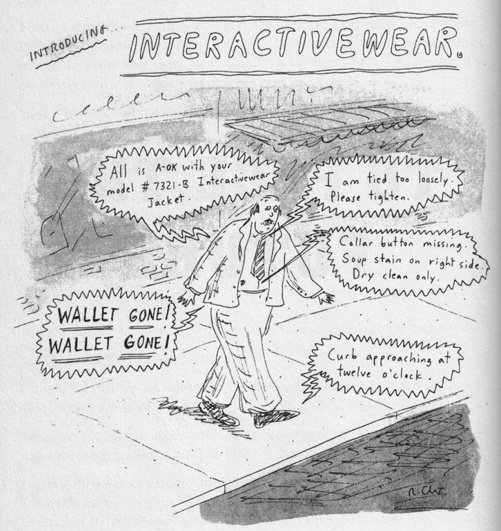
It is now 2009. Individuals primarily use portable computers, which have become dramatically lighter and thinner than the notebook computers of ten years earlier. Personal computers are available in a wide range of sizes and shapes, and are commonly embedded in clothing and jewelry such as wristwatches, rings, earrings, and other body
ornaments. Computers with a high‐resolution visual interface range from rings and pins and credit cards up to the size of a thin book.
People typically have at least a dozen computers on and around their bodies, which are networked using ʺbody
LANSʺ (local area networks). [1] These computers provide communication facilities similar to cellular phones, pagers, and web surfers, monitor body functions, provide automated identity (to conduct financial transactions and allow entry into secure areas), provide directions for navigation, and a variety of other services.
For the most part, these truly personal computers have no moving parts. Memory is completely electronic, and most portable computers do not have keyboards.
Rotating memories (that is, computer memories that use a rotating platter, such as hard drives, CD‐ROMS, and DVDS) are on their way out, although rotating magnetic memories are still used in ʺserverʺ computers where large amounts of information are stored. Most users have servers in their homes and offices where they keep large stores of digital ʺobjects,ʺ including their software, databases, documents, music, movies, and virtual‐reality environments (although these are still at an early stage). There are services to keep oneʹs digital objects in central repositories, but most people prefer to keep their private information under their own physical control.
Cables are disappearing. [2] Communication between components, such as pointing devices, microphones,
displays, printers, and the occasional keyboard, uses short‐distance wireless technology.
Computers routinely include wireless technology to plug into the ever‐present worldwide network, providing reliable, instantly available, very‐high‐bandwidth communication. Digital objects such as books, music albums, movies, and software are rapidly distributed as data files through the wireless network, and typically do not have a physical object associated with them.
The majority of text is created using continuous speech recognition (CSR) dictation software, but keyboards are still used. CSR is very accurate, far more so than the human transcriptionists who were used up until a few years ago.
Also ubiquitous are language user interfaces (LUIS), which combine CSR and natural language understanding.
For routine matters, such as simple business transactions and information inquiries, LUIS are quite responsive and precise. They tend to be narrowly focused, however, on specific types of tasks. LUIS are frequently combined with animated personalities. Interacting with an animated personality to conduct a purchase or make a reservation is like talking to a person using videoconferencing, except that the person is simulated.
Computer displays have all the display qualities of paper‐high resolution, high contrast, large viewing angle, and
no flicker. Books, magazines, and newspapers are now routinely read on displays that are the size of, well, small books.
Computer displays built into eyeglasses are also used. These specialized glasses allow users to see the normal visual environment, while creating a virtual image that appears to hover in front of the viewer. The virtual images are created by a tiny laser built into the glasses that projects the images directly onto the userʹs retinas. [3]
Computers routinely include moving picture image cameras and are able to reliably identify their owners from their faces.
In terms of circuitry, three‐dimensional chips are commonly used, and there is a transition taking place from the
older, single‐layer chips.
Sound producing speakers are being replaced with very small chip‐based devices that can place high resolution sound anywhere in three‐dimensional space. This technology is based on creating audible frequency sounds from the
spectrum created by the interaction of very high frequency tones. As a result, very small speakers can create very robust three‐dimensional sound.
A $1,000 personal computer (in 1999 dollars), can perform about a trillion calculations per second. [4]
Supercomputers match at least the hardware capacity of the human brain—20 million billion calculations per second.
[5] Unused computes on the Internet are being harvested, creating virtual parallel supercomputers with human brain
hardware capacity.
There is increasing interest in massively parallel neural nets, genetic algorithms, and other forms of ʺchaoticʺ or complexity theory computing, although most computer computations are still done using conventional sequential processing, albeit with some limited parallel processing.
Research has been initiated on reverse engineering the human brain through both destructive scans of the brains
of recently deceased persons as well as noninvasive scans using high resolution magnetic resonance imaging (MRI) of
living persons.
Autonomous nanoengineered machines (that is, machines constructed atom by atom and molecule by molecule)
have been demonstrated and include their own computational controls. However, nanoengineering is not yet considered a practical technology.
Education
In the twentieth century, computers in schools were mostly on the trailing edge, with most effective learning from computers taking place in the home. Now in 2009, while schools are still not on the cutting edge, the profound importance of the computer as a knowledge tool is widely recognized. Computers play a central role in all facets of
education, as they do in other spheres of life.
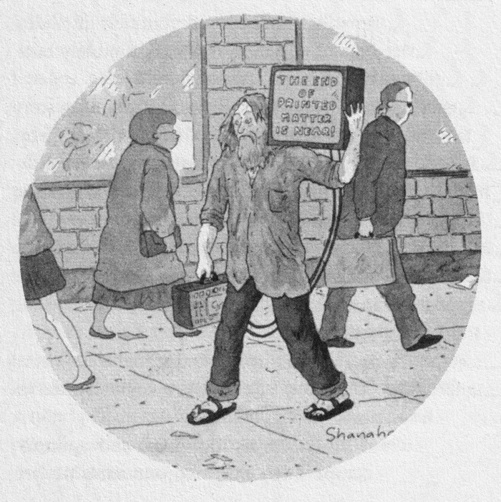
The majority of reading is done on displays, although the ʺinstalled baseʺ of paper documents is still formidable.
The generation of paper documents is dwindling, however, as the books and other papers of largely twentieth-century vintage are being rapidly scanned and stored. Documents circa 2009 routinely include embedded moving images and sounds.
Students of all ages typically have a computer of their own, which is a thin tabletlike device weighing under a pound with a very high resolution display suitable for reading. Students interact with their computers primarily by
voice and by pointing with a device that looks like a pencil. Keyboards still exist, but most textual language is created by speaking. Learning materials are accessed through wireless communication.
Intelligent courseware has emerged as a common means of learning. Recent controversial studies have shown that
students can learn basic skills such as reading and math just as readily with interactive learning software as with human teachers, particularly when the ratio of students to human teachers is more than one to one. Although the studies have come under attack, most students and their parents have accepted this notion for years. The traditional mode of a human teacher instructing a group of children is still prevalent, but schools are increasingly relying on software approaches, leaving human teachers to attend primarily to issues of motivation, psychological well‐being, and socialization. Many children learn to read on their own using their personal computers before entering grade school.
Preschool and elementary school children routinely read at their intellectual level using print‐to‐speech reading software until their reading skill level catches up. These print‐to‐speech reading systems display the full image of documents, and can read the print aloud while highlighting what is being read. Synthetic voices sound fully human.
Although some educators expressed concern in the early ʹ00 years that students would rely unduly on reading software, such systems have been readily accepted by children and their parents. Studies have shown that students
improve their reading skills by being exposed to synchronized visual and auditory presentations of text.
Learning at a distance (for example, lectures and seminars in which the participants are geographically scattered)
is commonplace.
Learning is becoming a significant portion of most jobs. Training and developing new skills is emerging as an ongoing responsibility in most careers, not just an occasional supplement, as the level of skill needed for meaningful employment soars ever higher.
Disabilities
Persons with disabilities are rapidly overcoming their handicaps through the intelligent technology of 2009. Students with reading disabilities routinely ameliorate their disability using print‐to‐speech reading systems.
Print‐to‐speech reading machines for the blind are now very small, inexpensive, palm‐sized devices that can read
books (those that still exist in paper form) and other printed documents, and other real‐world text such as signs and displays. These reading systems are equally adept at reading the trillions of electronic documents that are instantly available from the ubiquitous wireless world‐wide network.
After decades of ineffective attempts, useful navigation devices have been introduced that can assist blind people
in avoiding physical obstacles in their path, and finding their way around, using global positioning system (GPS) technology. A blind person can interact with her personal reading‐navigation systems through two‐way voice communication, kind of like a Seeing Eye dog that reads and talks.
Deaf persons—or anyone with a hearing impairment—commonly use portable speech‐to‐text listening machines,
which display a real‐time transcription of what people are saying. The deaf user has the choice of either reading the transcribed speech as displayed text, or watching an animated person gesturing in sign language. These have eliminated the primary communication handicap associated with deafness. Listening machines can also translate what is being said into another language in real time, so they are commonly used by hearing people as well.
Computer‐controlled orthotic devices have been introduced. These ʺwalking machinesʺ enable paraplegic persons
to walk and climb stairs. The prosthetic devices are not yet usable by all paraplegic persons, as many physically disabled persons have dysfunctional joints from years of disuse. However, the advent of orthotic walking systems is
providing more motivation to have these joints replaced.
There is a growing perception that the primary disabilities of blindness, deafness, and physical impairment do not
necessarily impart handicaps. Disabled persons routinely describe their disabilities as mere inconveniences.
Intelligent technology has become the great leveler.
Communication
Translating Telephone technology (where you speak in English and your Japanese friend hears you in Japanese, and
vice versa) is commonly used for many language pairs. it is a routine capability of an individualʹs personal computer, which also serves as her phone.
ʺTelephoneʺ communication is primarily wireless, and routinely includes high‐resolution moving images.
Meetings of all kinds and sizes routinely take place among geographically separated participants.
There is effective convergence, at least on the hardware and supporting software level, of all media, which exist as digital objects (that is, files) distributed by the ever‐present high‐bandwidth, wireless information web. Users can instantly download books, magazines, newspapers, television, radio, movies, and other forms of software to their highly portable personal communication devices.
Virtually all communication is digital and encrypted, with public keys available to government authorities. Many
individuals and groups, including but not limited to criminal organizations, use an additional layer of virtually unbreakable encryption codes with no third‐party keys.
Haptic technologies area emerging that allow people to touch and feel objects and other persons at a distance.
These force‐feedback devices are widely used in games and in training simulation systems.
Interactive games routinely include all‐encompassing visual and auditory environments, but a satisfactory, all-encompassing tactile environment is not yet available. The online chat rooms of the late 1990s have been replaced with virtual environments where you can meet people with full visual realism.
People have sexual experiences at a distance with other persons as well as virtual partners. But the lack of the ʺsurroundʺ tactile environment has thus far kept virtual sex out of the mainstream. Virtual partners are popular as forms of sexual entertainment, but theyʹre more gamelike than real. And phone sex is a lot more popular now that phones routinely include high‐resolution, real‐time moving images of the person on the other end.
Business and Economics
Despite occasional corrections, the ten years leading up to 2009 have seen continuous economic expansion and prosperity due to the dominance of the knowledge content of products and services. The greatest gains continue to be in the value of the stock market. Price deflation concerned economists in the early ʹ00 years, but they quickly realized it was a good thing. The high‐tech community pointed out that significant deflation had existed in the computer hardware and software industries for many years earlier without detriment.
The United States continues to be the economic leader due to its primacy in popular culture and its entrepreneurial environment. Since information markets are largely world markets, the United States has benefited greatly from its immigrant history. Being comprised of all the worldʹs peoples—specifically the descendants of peoples from around the globe who had endured great risk for a better life—is the ideal heritage for the new knowledge‐based economy. China has also emerged as a
powerful economic player. Europe is several years ahead of
Japan and Korea in adopting the American emphasis on
venture capital, employee stock options, and tax policies
that encourage entrepreneurship, although these practices
have become popular throughout the world.
At least half of all transactions are conducted online.
Intelligent assistants which combine continuous speech
recognition, natural‐language understanding, problem
solving, and animated personalities routinely assist with
finding information, answering questions, and conducting
transactions. Intelligent assistants have become a primary
interface for interacting with information‐based services,
with a wide range of choices available. A recent poll shows
that both male and female users prefer female personalities
for their computer‐based intelligent assistants. The two
most popular are Maggie, who claims to be a waitress in a
Harvard Square cafe, and Michelle, a stripper from New
Orleans. Personality designers are in demand, and the field
constitutes a growth area in software development.
Most purchases of books, musical ʺalbums,ʺ videos, games, and other forms of software do not involve any physical object, so new business models for distributing these forms of information have emerged. One shops for these information objects by ʺstrollingʺ through virtual malls, sampling and selecting objects of interest, rapidly (and securely) conducting an online transaction, and then quickly downloading the information using high‐speed wireless
communication. There are many types and gradations of transactions to gain access to these products. You can ʺbuyʺ
a book, musical album, video, etcetera, which gives you unlimited permanent access. Alternatively, you can rent access to read, view, or listen once, or a few times. Or you can rent access by the minute. Access may be limited to one person or to a group of persons (for example, a family or a company). Alternatively, access may be limited to a particular computer, or to any computer accessed by a particular person or by a set of persons.
There is a strong trend toward the geographic separation of work groups. People are successfully working together despite living and working in different places.
The average household has more than a hundred computers, most of which are embedded in appliances and built‐in communication systems. Household robots have emerged, but are not yet fully accepted.
Intelligent roads are in use, primarily for long‐distance travel. Once your carʹs computer guidance system locks onto the control sensors on one of these highways, you can sit back and relax. Local roads, though, are still predominantly conventional.
A company west of the Mississippi and north of the Mason‐Dixon line has surpassed a trillion dollars in market
capitalization.
Politics and Society
Privacy has emerged as a primary political issue. The virtually constant use of electronic communication technologies is leaving a highly detailed trail of every personʹs every move. Litigation, of which there has been a great deal, has placed some constraints on the widespread distribution of personal data. Government agencies, however, continue to
have the right to gain access to peopleʹs files, which has resulted in the popularity of unbreakable encryption technologies.
There is a growing neo‐Luddite movement, as the skill ladder continues to accelerate upward. As with earlier Luddite movements, its influence is limited by the level of prosperity made possible by new technology. The movement does succeed in establishing continuing education as a primary right associated with employment.
There is continuing concern with an underclass that the skill ladder has left far behind. The size of the underclass appears to be stable, however. Although not politically popular, the underclass is politically neutralized through public assistance and the generally high level of affluence.
The Arts
The high quality of computer screens, and the facilities of computer‐assisted visual rendering software, have made the computer screen a medium of choice for visual art. Most visual art is the result of a collaboration between human artists and their intelligent art software. Virtual paintings—high‐resolution wall‐hung displays—have become popular. Rather than always displaying the same work of art, as with a conventional painting or poster, these virtual paintings can change the displayed work at the userʹs verbal command, or can cycle through collections of art. The displayed artwork can be works by human artists or original art created in real time by cybernetic art software.
Human musicians routinely jam with cybernetic musicians. The creation of music has become available to persons
who are not musicians. Creating music does not necessarily require the fine motor coordination of using traditional
controllers. Cybernetic music creation systems allow people who appreciate music but who are not knowledgeable about music theory and practice to create music in collaboration with their automatic composition software.
Interactive brain‐generated music, which creates a resonance between the userʹs brain waves and the music being listened to, is another popular genre.
Musicians commonly use electronic controllers that emulate the playing style of the old acoustic instruments (for
example, piano, guitar, violin, drums), but there is a surge of interest in the new ʺairʺ controllers in which you create music by moving your hands, feet, mouth, and other body parts. Other music controllers involve interacting with specially designed devices.
Writers use voice‐activated word processing; grammar checkers are now actually useful; and distribution of written documents from articles to books typically does not involve paper and ink. Style improvement and automatic
editing software is widely used to improve the quality of writing. Language translation software is also widely used to translate written works in a variety of languages. Nonetheless, the core process of creating written language is less affected by intelligent software technologies than the visual and musical arts. However, ʺcyberneticʺ authors are emerging.
Beyond music recordings, images, and movie videos, the most popular type of digital entertainment object is virtual experience software. These interactive virtual environments allow you to go. whitewater rafting on virtual rivers, to hang‐glide in a virtual Grand Canyon, or to engage in intimate encounters with our favorite movie star.
Users also experience fantasy environments with no counterpart in the physical world. The visual and auditory experience of virtual reality is compelling, but tactile interaction is still limited.
Warfare
The security of computation and communication is the primary focus of the U.S. Department of Defense. There is general recognition that the side that can maintain the integrity of its computational resources will dominate the battlefield.
Humans are generally far removed from the scene of battle. Warfare is dominated by unmanned intelligent airborne
devices. Many of these flying weapons are the size of small birds, or smaller.
The United States continues to be the worldʹs dominant military power, which is largely accepted by the rest of the
world, as most countries concentrate on economic competition. Military conflicts between nations are rare, and most
conflicts are between nations and smaller bands of terrorists. The greatest threat to national security comes from bioengineered weapons.
Health and Medicine
Bioengineered treatments have reduced the toll from cancer, heart disease, and a variety of other health problems.
Significant progress is being made in understanding the information processing basis of disease.
Telemedicine is widely used. Physicians can examine patients using visual, auditory, and haptic examination from
a distance. Health clinics with relatively inexpensive equipment and a single technician bring health care to remote areas where doctors had previously been scarce.
Computer‐based pattern recognition is routinely used to interpret imaging data and other diagnostic procedures.
The use of noninvasive imaging technologies has substantially increased. Diagnosis almost always involves collaboration between a human physician and a pattern‐recognition‐based expert system. Doctors routinely consult knowledge‐based systems (generally through two‐way voice communication augmented by visual displays), which provide automated guidance, access to the most recent medical research, and practice guidelines.
Lifetime patient records are maintained in computer databases. Privacy concerns about access to these records (as
with many other databases of personal information) have emerged as a major issue.
Doctors routinely train in virtual reality environments, which include a haptic interface. These systems simulate
the visual, auditory, and tactile experience of medical procedures, including surgery. Simulated patients are available for continuing medical education, for medical students, and for people who just want to play doctor.
Philosophy
There is renewed interest in the Turing Test, first proposed by Alan Turing in 1950 as a means for testing intelligence in a machine. Recall that the Turing Test contemplates a situation in which a human judge interviews the computer
and a human ʺfoil,ʺ communicating with both over terminal lines. If the human judge is unable to tell which interviewee is human and which is machine, the machine is deemed to possess human‐level intelligence. Although computers still fail the test, confidence is increasing that they will be in a position to pass it within another one or two decades.
There is serious speculation on the potential sentience (that is, consciousness) of computer‐based intelligence. The increasingly apparent intelligence of computers has spurred an interest in philosophy.
‐‐‐‐‐‐‐‐‐‐‐‐‐‐‐‐‐‐‐‐‐‐‐‐‐‐‐‐‐‐‐‐‐‐‐‐‐‐‐‐‐‐‐‐‐‐‐‐‐‐‐‐‐‐‐‐‐‐‐‐‐‐‐‐‐‐‐‐‐‐‐‐‐‐‐‐‐‐‐‐‐‐‐‐‐‐‐‐‐‐‐‐‐‐‐‐‐‐‐‐‐‐‐‐‐‐‐‐‐‐‐‐‐‐‐‐‐‐‐‐‐‐‐‐‐‐‐‐‐‐‐‐‐‐‐‐‐‐‐‐‐‐‐‐‐‐‐‐‐‐‐‐‐‐‐
. . . Hey, Molly.
OH, SO YOUʹRE CALLING ME NOW
Well, the chapter was over and I didnʹt hear from you.
IʹM SORRY, I WAS FINISHING UP A PHONE CALL WITH MY FIANCE.
Hey, congratulations, thatʹs great. How long have you known . . .
BEN, HIS NAME IS BEN. WE MET ABOUT TEN YEARS AGO, JUST AFTER YOU FINISHED THIS BOOK.
I see. So how have I done?
YOU DID MANAGE TO SELL A FEW COPIES.
No, I mean with my predictions.
NOT VERY WELL. THE TRANSLATING TELEPHONES, FOR ONE THING, ARE A LITTLE RIDICULOUS. I MEAN,
THEYʹRE CONSTANTLY SCREWING UP.
Sounds like you use them, though?
WELL, SURE, HOW ELSE AM I GOING TO SPEAK TO MY FIANCEʹS FATHER IN IEPER, BELGIUM, WHEN HE
HASNʹT BOTHERED TO LEARN ENGLISH?
Of course. So what else?
YOU SAID THAT CANCER WAS REDUCED, BUT THATʹS ACTUALLY QUITE UNDERSTATED. BIO‐
ENGINEERED TREATMENTS, PARTICULARLY ANTIANGIOGENESIS DRUGS THAT PREVENT TUMORS FROM
GROWING THE CAPILLARIES THEY NEED, HAVE ELIMINATED MOST FORMS CANCER AS A MAJOR KILLER.
[6]
Well, thatʹs just not a prediction I was willing to make. There have been so many false hopes with regard to cancer
treatments, and so many promising approaches proving to be dead ends, that I just wasnʹt willing to make that call.
Also, there just wasnʹt enough evidence when I wrote the book in 1998 to make that dramatic a prediction.
NOT THAT YOU SHIED AWAY FROM DRAMATIC PREDICTIONS.
The predictions I made were fairly conservative, actually, and were based on technologies and trends I could touch
and feel. I was certainly aware of several promising approaches to bioengineered cancer treatments, but it was still kind of iffy, given the history of cancer research. Anyway, the book only touched tangentially on bioengineering, although itʹs clearly an information‐based technology.
NOW WITH REGARD TO SEX
Speaking of health problems . . .
YES, WELL, YOU SAID THAT VIRTUAL PARTNERS WERE POPULAR, BUT I JUST DONʹT SEE THAT.
It might just be the circle you move in.
I HAVE A VERY SMALL CIRCLE—MOSTLY IʹVE BEEN TRYING TO GET BEN TO FOCUS ON OUR WEDDING.
Yes, tell me about him.
HEʹS VERY ROMANTIC. HE ACTUALLY SENDS ME LETTERS ON PAPER!
That is romantic. So, how was the phone call I interrupted?
I TRIED ON THIS NEW NIGHTGOWN HE SENT ME. I THOUGHT HEʹD APPRECIATE IT, BUT HE WAS BEING A
LITTLE ANNOYING.
I assume youʹre going to finish that thought.
WELL, HE WANTED ME TO KIND OF LET THESE STRAPS SLIP, MAYBE JUST A LITTLE. BUT IʹM KIND OF SHY
ON THE PHONE. I DONʹT REALLY GO IN FOR VIDEO PHONE SEX, NOT LIKE SOME FRIENDS I KNOW.
Oh, so I did get that prediction right.
ANYWAY, I JUST TOLD HIM TO USE THE IMAGE TRANSFORMERS.
Transformers?
YOU KNOW, HE CAN UNDRESS ME JUST AT HIS END.
Oh yes, of course. The computer is altering your image in real time.
EXACTLY. YOU CAN CHANGE SOMEONEʹS FACE, BODY, CLOTHING, OR SURROUNDINGS INTO SOMEONE
OR SOMETHING ELSE ENTIRELY, AND THEY DONʹT KNOW YOUʹRE DOING IT.
Hmmm.
ANYWAY, I CAUGHT BEN UNDRESSING HIS OLD GIRLFRIEND WHEN SHE CALLED TO CONGRATULATE
HIM ON OUR ENGAGEMENT. SHE HAD NO IDEA, AND HE THOUGHT IT WAS HARMLESS. I DIDNʹT SPEAK
TO HIM FOR A WEEK.
Well, as long as it was just at his end.
WHO KNOWS WHAT SHE WAS DOING AT HER END.
Thatʹs kind of her business, isnʹt it? As long as they donʹt know what the other is doing.
IʹM NOT SO SURE THEY DIDNʹT KNOW ANYWAY, PEOPLE DO SPEND A LOT OF TIME TOGETHER UP CLOSE
BUT AT A DISTANCE, IF YOU KNOW WHAT I MEAN.
Using the displays?
WE CALL THEM PORTALS—YOU CAN LOOK THROUGH THEM, BUT YOU CANʹT TOUCH.
I see, still no interest in virtual sex?
NOT PERSONALLY. I MEAN, ITʹS PRETTY PATHETIC. BUT I DID HAVE TO WRITE THE COPY FOR A
BROCHURE ABOUT A SENSUAL VIRTUAL REALITY ENVIRONMENT. BEING LOW ON THE TOTEM POLE, I
REALLY CANʹT PICK MY ASSIGNMENTS.
Did you try the product?
I DIDNʹT EXACTLY TRY IT. I JUST OBSERVED. I WOULD SAY THEY PUT MORE EFFORT INTO THE VIRTUAL
GIRLS THAN THE GUYS.
Howʹd your campaign make out?
THE PRODUCT BOMBED. I MEAN, THE MARKETʹS JUST SO CLUTTERED.
You canʹt win them all.
NO, BUT ONE OF YOUR PREDICTIONS DID WORK OUT QUITE WELL. I TOOK YOUR ADVICE ABOUT THAT
COMPANY NORTH OF THE MASON‐DIXON LINE. AND, HEY, IʹM NOT COMPLAINING.
Iʹll bet a lot of stocks are up.
YES, THE BOATS KEEP GETTING HIGHER.
Okay, what else?
YOUʹRE RIGHT ABOUT THE DISABLED. MY OFFICE MATE IS DEAF, AND ITʹS NOT AN ISSUE AT ALL. THEREʹS
NOTHING IMPORTANT A BLIND OR DEAF PERSON CANʹT DO TODAY.
That was really true back in 1999.
I THINK THE DIFFERENCE NOW IS THAT THE PUBLIC UNDERSTANDS IT. ITʹS JUST A LOT MORE OBVIOUS
WITH TODAYʹS TECHNOLOGY. BUT THAT UNDERSTANDING IS IMPORTANT.
Sure, without the technology, thereʹs just a lot of misconception and prejudice.
TRUE ENOUGH. I THINK IʹM GOING TO HAVE TO GET GOING, I CAN SEE BENʹS FACE ON MY CALL LINE.
He looks like a St. Bernard.
OH, I LEFT MY IMAGE TRANSFORMERS ON. HERE, IʹLL LET YOU SEE WHAT HE REALLY LOOKS LIKE.
Hey, good‐looking guy. Well, good luck. You do seem to have changed.
I SHOULD HOPE SO.
I mean I think our relationship has changed.
WELL, IʹM TEN YEARS OLDER.
And it seems that Iʹm asking you most of the questions.
I GUESS IʹM THE EXPERT NOW. I CAN JUST TELL YOU WHAT I SEE. BUT HOW COME YOUʹRE STILL STUCK
IN 1999?
Iʹm afraid I just canʹt leave quite yet. I have to get this book out, for one thing.
I DO HAVE ONE CONFUSION. HOW IS IT THAT YOU CAN TALK TO ME FROM 1999 WHEN IʹM HERE IN THE
YEAR 2009? WHAT KIND OF TECHNOLOGY IS THAT?
Oh, thatʹs a very old technology. Itʹs called poetic license.
‐‐‐‐‐‐‐‐‐‐‐‐‐‐‐‐‐‐‐‐‐‐‐‐‐‐‐‐‐‐‐‐‐‐‐‐‐‐‐‐‐‐‐‐‐‐‐‐‐‐‐‐‐‐‐‐‐‐‐‐‐‐‐‐‐‐‐‐‐‐‐‐‐‐‐‐‐‐‐‐‐‐‐‐‐‐‐‐‐‐‐‐‐‐‐‐‐‐‐‐‐‐‐‐‐‐‐‐‐‐‐‐‐‐‐‐‐‐‐‐‐‐‐‐‐‐‐‐‐‐‐‐‐‐‐‐‐‐‐‐‐‐‐‐‐‐‐‐‐‐‐‐‐‐‐
C H A P T E R T E N
2019
He who mounts a wild elephant goes where the wild elephant goes.
—Randolph Bourne
It does not do you good to leave a dragon out of your calculations, if you live near him.
—J. R. R. Tolkien
The Computer Itself
Computers are now largely invisible. They are embedded everywhere—in walls, tables, chairs, desks, clothing, jewelry, and bodies.
People routinely use three‐dimensional displays built into their glasses, [1] or contact lenses. These ʺdirect eyeʺ
displays create highly realistic, virtual visual environments overlaying the ʺrealʺ environment. This display technology projects images directly onto the human retina, exceeds the resolution of human vision, and is widely used regardless of visual impairment. The direct‐eye displays operate in three modes:
1. Head‐directed display: The displayed images are stationary with respect to the position and orientation of your head. When you move your head, the display moves relative to the real environment. This mode is often used
to interact with virtual documents.
2. Virtual‐reality overlay display: The displayed images slide when you move or turn your head so that the virtual people, objects, and environment appear to remain stationary in relation to the real environment (which you
can still see). Thus if the direct‐eye display is displaying the image of a person (who could be a geographically
remote real person engaging in a three‐dimensional visual phone call with you, or a computer‐generated
ʺsimulatedʺ person), that projected person will appear to be in a particular place relative to the real
environment that you also see. When you move your head, that projected person will appear to remain in the
same place relative to the real environment.
3. Virtual‐reality blocking display: This is the same as the virtual‐reality overlay display except that the real environment is blocked out, so you see only the projected virtual environment. You use this mode to leave
ʺrealʺ reality and enter a virtual reality environment.
In addition to the optical lenses, there are auditory ʺlenses,ʺ which place high‐resolution sounds in precise locations in a three‐dimensional environment. These can be built into eyeglasses, worn as body jewelry, or implanted in the ear canal.
Keyboards are rare, although they still exist. Most interaction with computing is through gestures using hands, fingers, and facial expressions and through two‐way natural‐language spoken communication. People communicate
with computers the same way they would communicate with a human assistant, both verbally and through visual expression. Significant attention is paid to the personality of computer‐based personal assistants, with many choices available. Users can model the personality of their intelligent assistants on actual persons, including themselves, or select a combination of traits from a variety of both public personalities and private friends and associates.
Typically, people do not own just one specific ʺpersonal computer,ʺ although computing is nonetheless very personal. Computing and extremely‐high‐bandwidth communication are embedded everywhere. Cables have largely
disappeared.
The computational capacity of a $4,000 computing device (in 1999 dollars) is approximately equal to the computational capability of the human brain (20 million billion calculations per second). [2] Of the total computing capacity of the human species (that is, all human brains) combined with the computing technology the species has created, more than 10 percent is nonhuman. [3]
Rotating memories and other electromechanical computing devices have been fully replaced with electronic devices. Three‐dimensional nanotube lattices are now a prevalent form of computing circuitry.
The majority of ʺcomputesʺ of computers are now devoted to massively parallel neural nets and genetic algorithms.
Significant progress has been made in the scanning‐based reverse engineering of the human brain. it is now fully
recognized that the brain comprises many specialized regions, each with its own topology and architecture of interneuronal connections. The massively parallel algorithms are beginning to be understood, and these results have
been applied to the design of machine‐based neural nets. It is recognized that the human genetic code does not specify the precise interneuronal wiring of any of the regions, but rather sets up a rapid evolutionary process in which connections are established and fight for survival. The standard process for wiring machine‐based neural nets
uses a similar genetic evolutionary algorithm.
A new computer‐controlled optical‐imaging technology using quantum‐based diffraction devices has replaced
most lenses with tiny devices that can detect light waves from any angle. These pinhead‐sized cameras are everywhere.
Autonomous nanoengineered machines can control their own mobility and include significant computational
engines. These microscopic machines are beginning to be applied to commercial applications, particularly in manufacturing and process control, but are not yet in the mainstream.
Education
Hand‐held displays are extremely thin, very high resolution, and weigh only ounces. People read documents either
on the hand‐held displays or, more commonly, from text that is projected into the ever present virtual environment
using the ubiquitous direct‐eye displays. Paper books and documents are rarely used or accessed. Most twentieth-century paper documents of interest have been scanned and are available through the wireless network.
Most learning is accomplished using intelligent software‐based simulated teachers. To the extent that teaching is
done by human teachers, the human teachers are often not in the local vicinity of the student. The teachers are viewed more as mentors and counselors than as sources of learning and knowledge.
Students continue to gather together to exchange ideas and to socialize, although even this gathering is often physically and geographically remote.
All students use computation. Computation in general is everywhere, so a studentʹs not having a computer is rarely an issue.
Most adult human workers spend the majority of their time acquiring new skills and knowledge.
Disabilities
Blind persons routinely use eyeglass‐mounted reading‐navigation systems, which incorporate the new, digitally controlled, high‐resolution optical sensors. These systems can read text in the real world, although since most print is now electronic, print‐to‐speech reading is less of a requirement. The navigation function of these systems, which emerged about ten years ago, is now perfected. These automated reading‐navigation assistants communicate to blind
users through both speech and tactile indicators. These systems are also widely used by sighted persons since they provide a high‐resolution interpretation of the visual world.
Retinal and vision neural implants have emerged but have limitations and are used by only a small percentage of
blind persons.
Deaf persons routinely read what other people are saying through the deaf personsʹ lens displays. There are systems that provide visual and tactile interpretations of other auditory experiences such as music, but there is debate regarding the extent to which these systems provide an experience comparable to that of a hearing person. Cochlear
and other implants for improving hearing are very effective and are widely used.
Paraplegic and some quadriplegic persons routinely walk and climb stairs through a combination of computer-controlled nerve stimulation and exoskeletal robotic devices.
Generally, disabilities such as blindness, deafness, and paraplegia are not noticeable and are not regarded as significant.
Communication
You can do virtually anything with anyone regardless of physical proximity. The technology to accomplish this is easy to use and ever present.
ʺPhoneʺ calls routinely include high‐resolution three‐dimensional images projected through the direct‐eye
displays and auditory lenses. Three‐dimensional holography displays have also emerged. In either case, users feel as if they are physically near the other person. The resolution equals or exceeds optimal human visual acuity. Thus a person can be fooled as to whether or not another person is physically present or is being projected through electronic communication. The majority of ʺmeetingsʺ do not require physical proximity.
Routinely available communication technology includes high‐quality speech‐to‐speech language translation for most common language pairs.
Reading books, magazines, newspapers, and other web documents, listening to music, watching three‐
dimensional moving images (for example, television, movies), engaging in three‐dimensional visual phone calls, entering virtual environments (by yourself, or with others who may be geographically remote), and various combinations of these activities are all done through the ever present communications Web and do not require any equipment, devices, or objects that are not worn or implanted.
The all‐enveloping tactile environment is now widely available and fully convincing. Its resolution equals or exceeds that of human touch and can simulate (and stimulate) all of the facets of the tactile sense, including the sensing of pressure, temperature, textures, and moistness. Although the visual and auditory aspects of virtual reality involve only devices you have on or in your body (the direct‐eye lenses and auditory lenses), the ʺtotal touchʺ haptic environment requires entering a virtual reality booth. These technologies are popular for medical examinations, as well as sensual and sexual interactions with other human partners or simulated partners. In fact, it is often the preferred mode of interaction, even when a human partner is nearby, due to its ability to enhance both experience and safety.
Business and Economics
Rapid economic expansion and prosperity has continued.
The vast majority of transactions include a simulated person, featuring a realistic animated personality and two‐
way voice communication with high‐quality natural‐language understanding. Often, there is no human involved, as a
human may have his or her automated personal assistant conduct transactions on his or her behalf with other automated personalities. In this case, the assistants skip the natural language and communicate directly by exchanging appropriate knowledge structures.
Household robots for performing cleaning and other chores are now ubiquitous and reliable.
Automated driving systems have been found to be highly reliable and have now been installed in nearly all roads.
While humans are still allowed to drive on local roads (although not on highways), the automated driving systems are always engaged and are ready to take control when necessary to prevent accidents. Efficient personal flying vehicles using microflaps; have been demonstrated and are primarily computer controlled. There are very few transportation accidents.
Politics and Society
People are beginning to have relationships with automated personalities as companions, teachers, caretakers, and lovers. Automated personalities are superior to humans in some ways, such as having very reliable memories and, if
desired, predictable (and programmable) personalities. They are not yet regarded as equal to humans in the subtlety
of their personalities, although there is disagreement on this point.
An undercurrent of concern is developing with regard to the influence of machine intelligence. There continue to
be differences between human and machine intelligence, but the advantages of human intelligence are becoming more difficult to identify and articulate. Computer intelligence is thoroughly interwoven into the mechanisms of civilization and is designed to be outwardly subservient to apparent human control. On the one hand, human transactions and decisions require by law a human agent of responsibility, even if fully initiated by machine intelligence. On the other hand, few decisions are made without significant involvement and consultation with machine‐based intelligence.
Public and private spaces are routinely monitored by machine intelligence to prevent interpersonal violence.
People attempt to protect their privacy with near‐unbreakable encryption technologies, but privacy continues to be a major political and social issue with each individualʹs practically every move stored in a database somewhere.
The existence of the human underclass continues as an issue. While there is sufficient prosperity to provide basic
necessities (secure housing and food, among others) without significant strain to the economy, old controversies persist regarding issues of responsibility and opportunity. The issue is complicated by the growing component of most employmentʹs being concerned with the employeeʹs own learning and skill acquisition. In other words, the difference between those ʺproductivelyʺ engaged and those who are not is not always clear.
The Arts
Virtual artists in all of the arts are emerging and are taken seriously. These cybernetic visual artists, musicians, and authors are usually affiliated with humans or organizations (which in turn are comprised of collaborations of humans and machines) that have contributed to their knowledge base and techniques. However, interest in the output of these creative machines has gone beyond the mere novelty of machines being creative.
Visual, musical, and literary art created by human artists typically involve a collaboration between human and machine intelligence.
The type of artistic and entertainment product in greatest demand (as measured by revenue generated) continues
to be virtual‐experience software, which ranges from simulations of ʺrealʺ experiences to abstract environments with little or no corollary in the physical world.
Warfare
The primary threat to security comes from small groups combining human and machine intelligence using
unbreakable encrypted communication. These include (1) disruptions to public information channels using software
viruses, and (2) bioengineered disease agents.
Most flying weapons are tiny—some as small as insects with microscopic flying weapons being researched.
Health and Medicine
Many of the life processes encoded in the human genome, which was deciphered more than ten years earlier, are now
largely understood, along with the information‐processing mechanisms underlying aging and degenerative
conditions such as cancer and heart disease. The expected life span, which, as a (1780 through 1900) and the first phase result of the first Industrial Revolution of the second (the twentieth century), almost doubled from less than forty, has now substantially increased again, to over one hundred.
There is increasing recognition of the danger of the widespread availability of bioengineering technology. The means exist for anyone with the level of knowledge and equipment available to a typical graduate student to create
disease agents with enormous destructive potential. That this potential is offset to some extent by comparable gains in bioengineered antiviral treatments constitutes an uneasy balance, and is a major focus of international security agencies.
Computerized health monitors built into watches, jewelry, and clothing which diagnose both acute and chronic health conditions are widely used. in addition to diagnosis, these monitors provide a range of remedial recommendations and interventions.
Philosophy
There are prevalent reports of computers passing the Turing Test, although these instances do not meet the criteria (with regard to the sophistication of the human judge, the length of time for the interviews, etcetera) established by knowledgeable observers. There is a consensus that computers have not yet passed a valid Turing Test, but there is
growing controversy on this point.
The subjective experience of computer‐based intelligence is seriously discussed, although the rights of machine intelligence have not yet entered mainstream debate. Machine intelligence is still largely the product of a collaboration between humans and machines, and has been programmed to maintain a subservient relationship to the
species that created it.
‐‐‐‐‐‐‐‐‐‐‐‐‐‐‐‐‐‐‐‐‐‐‐‐‐‐‐‐‐‐‐‐‐‐‐‐‐‐‐‐‐‐‐‐‐‐‐‐‐‐‐‐‐‐‐‐‐‐‐‐‐‐‐‐‐‐‐‐‐‐‐‐‐‐‐‐‐‐‐‐‐‐‐‐‐‐‐‐‐‐‐‐‐‐‐‐‐‐‐‐‐‐‐‐‐‐‐‐‐‐‐‐‐‐‐‐‐‐‐‐‐‐‐‐‐‐‐‐‐‐‐‐‐‐‐‐‐‐‐‐‐‐‐‐‐‐‐‐‐‐‐‐‐‐‐
OKAY, IʹM HERE NOW. SORRY ABOUT BEING DISTRACTED TEN YEARS AGO.
No problem. Howʹve you been?
IʹM FINE—BUSY—BUT HOLDING UP. GETTING READY FOR MY SONʹS TENTH BIRTHDAY PARTY.
Oh, so you were pregnant last time we spoke.
I WASNʹT SHOWING YET, BUT PEOPLE DID NOTICE AT THE WEDDING.
Howʹs he doing?.
OKAY, BUT JEREMYʹS A LOT TO KEEP UP WITH.
Doesnʹt sound too unusual.
ANYWAY, I FOUND JEREMY WITH THIS OLDER WOMAN, LIKE MY AGE, LAST WEEK. LETʹS JUST SAY, SHE
DIDNʹT HAVE ALL OF HER CLOTHES ON.
Oh, really.
TURNED OUT TO BE HIS FOURTH‐GRADE TEACHER.
Gee, what was she doing?
WELL, HEʹD BEEN OUT SICK, SO SHE WAS GIVING HIM HIS HOMEWORK ASSIGNMENT.
Without all her clothes on?
OH, SHE HAD NO IDEA.
Of course, the image transformers, I forgot.
HEʹS NOT SUPPOSED TO HAVE ACCESS TO THOSE PARTICULAR TRANSFORMERS. BUT HE APPARENTLY
GOT A CHILD‐BLOCK OVERRIDE PATCH FROM ONE OF HIS FRIENDS. HE WONʹT SAY WHO.
Some things never change.
I THINK WE HAVE THE BLOCK BACK ON NOW.
So did you discuss this with his teacher?
MISS SIMON? OH GOD, NO.
Any punishment?
ACTIVATING THE CHILD‐BLOCK OVERRIDE IS JUST NOT TOLERATED IN OUR HOME. HEʹS RESTRICTED
FROM THE SENSORIUM FORA MONTH.
That does sound serious. Sensorium? Thatʹs a virtual reality thing?
ACTUALLY, SENSORIUM IS A BRAND NAME FOR THE TOTAL TOUCH ENVIRONMENT WE HAVE. ITʹS A
NEW MODEL WITH SOME IMPROVED OLFACTORY TECHNOLOGY. FOR JUST VISUAL‐AUDITORY VIRTUAL
REALITY THATʹS PRETTY MUCH ON ALL THE TIME USING THE LENSES, YOU DONʹT NEED TO USE
ANYTHING SPECIAL.
So what does he do in the Sensorium?
OH, KICK BOXING, GALACTIC WRESTLING, THE USUAL TEN‐YEAR‐OLD STUFF. LATELY, HEʹS BEEN
PLAYING DOCTOR.
Uh oh, he sounds precocious.
THINK HEʹS JUST TRYING TO TEST OUR PATIENCE.
So this incident with Miss Simon, that was in the Sensorium?
NO, THAT WAS JUST A VIRTUAL REALITY PHONE CALL. JEREMY WAS HERE IN THE KITCHEN. HE HAD
MISS SIMON SITTING ON THE KITCHEN TABLE.
So if heʹs looking at her transformed image using his virtual reality lenses, how were you able to see her?
WELL, WE HAVE ACCESS TO OUR KIDSʹ VIRTUAL REALITY ENVIRONMENTS UP UNTIL AGE FOURTEEN.
I see, so youʹre simultaneously in your own virtual reality environment, and those of your children?
YES, AND DONʹT FORGET REAL REALITY, NOT THAT VIRTUAL REALITY ISNʹT REAL.
Isnʹt that confusing, seeing and hearing all these different environments overlaying each other?
WE DONʹT HEAR OUR KIDSʹ VIRTUAL REALITY ENVIRONMENTS. THE NOISE WOULD DRIVE US CRAZY,
AND KIDS NEED TO HAVE SOME PRIVACY, TOO. WE CAN ONLY HEAR REAL REALITY AND OUR OWN
VIRTUAL REALITY. AND, WE CAN TUNE IN AND OUT OF OUR KIDSʹ VIRTUAL VISUAL REALITIES. SO I
TUNED IN, AND THERE WAS MISS SIMON.
What else has he been punished for?
THREE MONTHS AGO, HE WAS BLOCKING OUR CHILD VIRTUAL REALITY ACCESS. I THINK HE GOT THAT
FROM THE SAME FRIEND.
Iʹm not sure I blame him. I donʹt think I would want my mother looking in on my virtual reality all the time.
WE DONʹT LOOK IN ALL THE TIME; WEʹRE REALLY QUITE SELECTIVE. BUT YOU HAVE TO KEEP TRACK OF
KIDS NOWADAYS. WE DONʹT HAVE THIS PROBLEM WITH OUR DAUGHTER, EMILY.
Sheʹs . . .
SIX YEARS OLD LAST MONTH. SHEʹS A REAL SWEETHEART. SHE JUST DEVOURS BOOKS.
At six, thatʹs impressive. She reads them by herself?
BY HERSELF? HOW ELSE WOULD SHE READ THEM?
Well, you could read them to her.
I DO THAT SOMETIMES. BUT EMILY FEELS IʹM NOT ACCOMMODATING ENOUGH. SO SHE HAS HARRY
HIPPO READ THEM TO HER, AND HE DOES EXACTLY WHAT SHE WANTS, AND DOESNʹT TALK BACK. OF
COURSE. I WOULDNʹT WANT A REAL HIPPOPOTAMUS SITTING ON MY KITCHEN TABLE.
Not with a partially clad Miss Simon there also.
IT DOES GET TO BE A CROWDED TABLE.
So when Harry Hippo reads to Emily, she follows along in her virtual book.
SHE CAN EITHER FOLLOW ALONG HERSELF, OR SHE CAN TURN THE HIGHLIGHTING ON. THE KIDS LET
THEIR FAVORITE VIRTUAL FRIEND READ TO THEM, WHILE THEY WATCH THEIR VIRTUAL BOOKS WITH
THE HIGHLIGHTING FEATURE. LATER ON, THEY TURN THE HIGHLIGHTING OFF, AND EVENTUALLY,
THEY DONʹT NEED HARRY HIPPO, EITHER.
Kind of like taking off the training wheels.
RIGHT. NOW, ONE THING THAT DOES GIVE ME COMFORT IS THAT I ALWAYS KNOW WHERE MY KIDS ARE.
In virtual reality?
NO, IʹM TALKING ABOUT REAL REALITY. NOW FOR EXAMPLE, I CAN SEE THAT JEREMY IS TWO BLOCKS
AWAY, HEADED IN THIS DIRECTION.
An embedded chip?
THATʹS A REASONABLE GUESS. BUT ITʹS NOT A CHIP EXACTLY. ITʹS ONE OF THE FIRST USEFUL
NANOTECHNOLOGY APPLICATIONS. YOU EAT THIS STUFF.
Stuff?
YEAH, ITʹS A PASTE, TASTES PRETTY GOOD, ACTUALLY. IT HAS MILLIONS OF LITTLE COMPUTERS—WE
CALL THEM TRACKERS—WHICH WORK THEIR WAY INTO YOUR CELLS.
Some of them must get passed through.
THATʹS TRUE, AND THE TRACKERS THAT GET TOO FAR AWAY FROM THE REST OF THE TRACKERS THAT
ARE STILL IN THE BODY JUST TURN THEMSELVES OFF. THE ONES THAT STAY IN YOUR BODY
COMMUNICATE WITH EACH OTHER, AND WITH THE WEB.
The wireless Web?
YES, ITʹS EVERYWHERE. SO I ALWAYS KNOW WHERE MY KIDS ARE. NEAT, HUH?
So does everybody have this?
KIDS ARE REQUIRED TO, SO I GUESS EVERYONE WILL HAVE IT EVENTUALLY. MANY ADULTS DO, BUT
ADULTS CAN BLOCK THE TRACKING TRANSMISSION IF THEY WISH.
Kids canʹt?
TRACKER BLOCKING IS SOMETHING WE REALLY DO MANAGE TO KEEP FROM OUR KIDS.
So Jeremy hasnʹt gotten his hands on any tracker‐blocking software?
I CERTAINLY HOPE NOT. ALTHOUGH, COME TO THINK OF IT, WE DID HAVE A TRACKER LAPSE LAST
YEAR. THE TECHNICIAN SAID IT WAS A TEMPORARY PROTOCOL CONFLICT. I DOUBT THAT WAS JEREMYʹS
DOING. BUT NOW YOUʹVE GOT ME WORRIED.
I doubt Jeremy would do something like that.
I THINK YOUʹRE RIGHT.
This technician was human?
NO, THE PROBLEM WASNʹT THAT SERIOUS. WE JUST USED A LEVEL‐B TECHNICIAN.
I see. So is your husband plugged into the tracking system?
YEAH, BUT HE BLOCKS IT A LOT, WHICH IS ANNOYING.
Well, husbands are entitled to some privacy, too, donʹt you think?
YES, DEFINITELY.
So, any other relatives you want to tell me about?
THEREʹS MY TWENTY‐FIVE‐YEAR‐OLD NEPHEW, STEPHEN. HEʹS A BIT RECLUSIVE; I KNOW MY SISTER IS
WORRIED ABOUT HIM. HE SPENDS ALMOST ALL OF HIS TIME IN EITHER TOTAL TOUCH OR IN VIRTUAL‐
REALITY BLOCKING‐DISPLAY MODE.
Thatʹs a problem?
ITʹS NOT JUST THAT HE BLOCKS OUT REAL REALITY, ITʹS THAT HE SEEMS TO AVOID INTERACTING WITH
REAL PEOPLE, EVEN IN VIRTUAL REALITY. IT SEEMS TO BE AN INCREASINGLY COMMON PROBLEM.
I guess simulated people are more accommodating.
THEY CAN BE. I MEAN, MY OWN ASSISTANTS AND COMPANIONS ARE, BUT TRY DEALING WITH OTHER
PEOPLEʹS ASSISTANTS, AND THATʹS A DIFFERENT MATTER. ANYWAY, MY SISTER WAS TELLING ME HOW
SHE THOUGHT THAT STEPHEN WAS A CYBER VIRGIN, OR DID SHE SAY VIRTUAL VIRGIN?
Oh dear, now what was the distinction again?
YOU KNOW, A CYBER VIRGIN HAS NEVER HAD INTERCOURSE OUTSIDE OF VIRTUAL REALITY, WHEREAS
A VIRTUAL VIRGIN HAS NEVER HAD INTERCOURSE WITH A REAL PERSON, EVEN IN VIRTUAL REALITY.
How about someone who has never been intimate with a real or simulated person in real or virtual reality?
HMM, WE DONʹT SEEM TO HAVE A TERM FOR THAT.
So what are the statistics on this?
WELL, LETʹS SEE, GEORGE WILL GET THAT FOR US.
George is your virtual assistant?
YEAH, YOU CATCH ON QUICKLY.
Gee, thanks.
SO, FOR ADULTS OVER TWENTY‐FIVE, 11 PERCENT ARE VIRTUAL VIRGINS, AND 19 PERCENT ARE CYBER
VIRGINS.
So I guess virtual sex is catching on. How about you and Ben?
WELL, I DEFINITELY PREFER THE REAL THING!
Real, as in . . .
REAL REALITY, RIGHT.
So you prefer intimacy in real reality, meaning you donʹt avoid the virtual alternative?
WELL, ITʹS RIGHT THERE, MEAN WEʹD HAVE TO GO OUT OF OUR WAY TO AVOID IT. ITʹS CERTAINLY
CONVENIENT IF IʹM TRAVELING, OR IF WE DONʹT WANT TO WORRY ABOUT BIRTH CONTROL.
Or STDS.
WELL, THAT SHOULDNʹT BE AN ISSUE.
Hey, you never know.
WELL, TO BE PERFECTLY HONEST, VIRTUAL SEX IS MUCH MORE SATISFACTORY IN MANY WAYS. I MEAN
ITʹS DEFINITELY MORE INTENSE, PRETTY INCREDIBLE ACTUALLY.
This is in the Sensorium, I assume.
YEAH, SURE. THIS RECENT MODEL HAS REALLY ADDRESSED THE OLFACTORY ISSUE.
Meaning it has an olfactory capability?
RIGHT. ITʹS A LITTLE DIFFERENT THAN THE OTHER SENSES, THOUGH. WITH THE VISUAL AND AUDITORY
SENSE, JUST PLAIN OLD UBIQUITOUS VIRTUAL REALITY IS EXTREMELY ACCURATE. IN THE SENSORIUM,
WE GET THE TACTILE ENVIRONMENT, WHICH ALSO PROVIDES AN EXTREMELY LIFELIKE RE‐CREATION.
BUT WE CANʹT DO THAT YET WITH THE SENSE OF SMELL. SO THE SENSORIUM 2000 HAS PROGRAMMED
SCENTS, WHICH YOU CAN CHOOSE, OR THAT ARE AUTOMATICALLY SELECTED IN THE COURSE OF AN
EXPERIENCE. THEYʹRE STILL PRETTY EFFECTIVE.
How do you feel about your husband interacting sexually with a simulated partner?
YOU MEAN, A SIMULATED PERSON IN VIRTUAL REALITY?
Yeah, in virtual reality or in the Sensorium.
THATʹS FINE. I HAVE NO PROBLEM WITH THAT.
You donʹt mind?
THEREʹS REALLY NO WAY I COULD KEEP TRACK OF IT.
Virtual lipstick on his collar?
YEAH, RIGHT, ON HIS VIRTUAL COLLAR. VIRTUAL SEX WITH SIMULATED PARTNERS IS GENERALLY
ACCEPTED NOWADAYS. ITʹS REALLY REGARDED AS A FORM OF FANTASY—ITʹS JUST ASSISTED FANTASY.
And if the partnerʹs a real person in virtual reality?
IʹD BREAK HIS LEGS.
His virtual legs?
THATʹS NOT WHAT I HAD IN MIND.
So whatʹs the difference between a real person in virtual reality and a simulated person?
AS SENSUAL PARTNERS?
Right.
OH, THEREʹS A DIFFERENCE—THE SIMULATED PARTNERS ARE PRETTY GOOD, BUT ITʹS JUST NOT THE
SAME.
Sounds like youʹve had some experience with this yourself.
PRETTY NOSY, ARENʹT YOU?
All right, Iʹll change the subject. Letʹs see, uh, whatʹs happening with encryption?
WE HAVE VERY STABLE THOUSAND‐BIT CODES. ITʹS NOT PRACTICAL TO BREAK THEM.
What about with a quantum computer?
THE QUANTUM COMPUTERS DONʹT SEEM TO BE STABLE WITH MORE THAN A FEW HUNDRED QU‐BITS.
Sounds like communication is pretty secure.
I WOULD SAY SO. BUT SOME PEOPLE ARE PARANOID ABOUT THE THIRD‐PARTY KEYS.
So the authorities have keys?
OF COURSE.
Well, canʹt you just put another layer of encryption without a key over the official layer?
GOD, NO.
Why is that so hard?
OH, ITʹS NOT DIFFICULT TECHNICALLY. ITʹS JUST VERY ILLEGAL, CERTAINLY SINCE OCTOBER 2013.
2013?
WE MANAGED TO GET THROUGH THE FIRST DECADE OF THIS CENTURY WITHOUT TOO SERIOUS A
PROBLEM. BUT THINGS GOT OUT OF CONTROL IN THE OKLAHOMA INCIDENT.
Oklahoma again. So this was a software virus?
NO, NOT A SOFTWARE VIRUS, A BIOLOGICAL VIRUS. A DISGRUNTLED—I WOULD SAY DEMENTED—
STUDENT, ACTUALLY A FORMER STUDENT AT THE UNIVERSITY THERE. THERE WERE REPORTS THAT HE
WAS LINKED TO THE REMEMBER YORK MOVEMENT, BUT THE RY DISCUSSION LEADERS VEHEMENTLY
DENIED ANY RESPONSIBILITY.
Remember York?
WELL, THIS INCIDENT OCCURRED ON THE TWO HUNDREDTH ANNIVERSARY OF THE YORK TRIALS.
Oh, you mean the 1813 trial of the Luddites?
YES, EXCEPT THAT MOST ANTITECHNOLOGISTS DONʹT LIKE THE TERM LUDDITE ANYMORE; THEY FEEL
THAT THE SOMEWHAT SILLY IMAGE OF NED LUDD BELITTLES THE SERIOUS NATURE OF THEIR
MOVEMENT. BEYOND THAT, THE BEST EVIDENCE SUGGESTS THAT LUDD NEVER EXISTED.
But there was a trial in 1813.
YES, WHICH RESULTED IN MANY OF THE GANG MEMBERS ACCUSED OF WRECKING THE TEXTILE
MACHINES BEING HANGED OR EXILED.
So RY is an organized movement?
OH, I WOULDNʹT SAY THAT. IT IS MORE OF A WEB DISCUSSION GROUP, AND THIS YOUNG MAN
APPARENTLY HAD PARTICIPATED IN SOME OF THOSE DISCUSSIONS. BUT THE RY PEOPLE ARE BASICALLY
NONVIOLENT. THEY WERE DISTRESSED THAT ROBERTS HAD ASSOCIATED HIMSELF WITH THEM.
Roberts was the perpetrator?
YEAH, CONVICTED ON ALL COUNTS. BUT ASIDE FROM THIS ONE DISTURBED INDIVIDUAL, I WOULD SAY
IT WAS REALLY A SCREWUP BY THE BWA.
BWA?
BIOWARFARE AGENCY.
So this was a virus that was unleashed?
YES, JUST A STANDARD MODIFIED FLU VIRUS, ALTHOUGH THERE WAS A TWIST. IT HAD A GREATLY
INCREASED MUTATION RATE, WHICH ACCELERATED ITS EVOLUTION AT SEVERAL LEVELS. ONE FORM
OF THE VIRUSʹS EVOLUTION ONLY TOOK PLACE DURING AN INFECTION. THIS, TOGETHER WITH A TIME‐
BOMB PROGRAM IN THE VIRUSʹS DNA, CAUSED ULTRA‐RAPID VIRAL REPRODUCTION AFTER A FEW
HOURS OF INFECTION. THIS LITTLE COMPLEXITY DELAYED THE DEVELOPMENT OF AN ANTIDOTE FOR
FORTY‐EIGHT HOURS. BUT THAT WASNʹT THE WORST OF IT. AFTER TWENTY‐FOUR HOURS OF
REPLICATING THE ANTIDOTE, THE BWA DISCOVERED THAT ANOTHER BIOLOGICAL AGENT HAD
INFECTED THE BATCHES, SO THEY HAD TO START OVER. AND THEN, THERE WERENʹT ENOUGH
REPLICATION STATIONS, SO THEY HAD TO CLEAN OUT THE ONES THEY HAD JUST USED, AND GO FROM
THERE. FORTY‐EIGHT HOURS WERE LOST IN THIS FIASCO, AND SIXTEEN THOUSAND PEOPLE DIED. WELL,
IF THINGS HAD BEEN DELAYED FOR ANOTHER TWENTY‐FOUR HOURS, IT WOULD HAVE BEEN FAR
WORSE. IT WAS A BIG ISSUE IN THE MIDTERM ELECTIONS OF 2014. THEREʹVE BEEN A LOT OF CHANGES
SINCE THEN.
The third‐party keys?
YEAH, THOSE EXISTED BEFORE. BUT SINCE 2013 THE LAWS AGAINST KEYLESS ENCRYPTION CODES HAVE
BEEN RIGOROUSLY ENFORCED.
What else has changed?
THERE ARE PLENTY OF ANTIVIRAL REPLICATION STATIONS NOW. AND WE ALL HAVE THESE CUTE
LITTLE GAS MASKS.
That little thimble is a gas mask?
YEAH, WELL, IT UNFOLDS LIKE THIS. ITʹS SMALL, SO WEʹRE ENCOURAGED TO KEEP THEM CLOSE AT
HAND. ITʹS ACTUALLY A VIRAL SCREEN MASK. OCCASIONALLY, WEʹRE TOLD TO PUT THEM ON, BUT
GENERALLY ITʹS ONLY FOR A FEW HOURS. SINCE 2013, THERE HAVE BEEN ONLY FALSE ALARMS.
So I guess the security agencies have been hard at work.
AS WILL ROGERS USED TO SAY, ʺYOU CANʹT SAY THAT CIVILIZATION DONʹT ADVANCE, FOR IN EVERY
WAR THEY KILL YOU IN A NEW WAY.ʺ
2013 sounds tragic and frightening. As centuries go, however, it doesnʹt sound like youʹre doing too badly. In the
twentieth century, we knew how to have disasters.
YEAH, FIFTY MILLION PEOPLE DIED IN WORLD WAR II.
Indeed.
ITʹS TRUE THAT THE CENTURY SO FAR HAS SEEN MUCH LESS BLOODSHED. BUT THE OTHER SIDE OF THE
COIN IS THAT THE TECHNOLOGIES ARE SO MUCH MORE POWERFUL TODAY. IF SOMETHING DID GO
WRONG, THINGS COULD SPIRAL OUT OF CONTROL VERY QUICKLY. WITH BIOENGINEERING, FOR
EXAMPLE, IT FEELS A LITTLE LIKE ALL TEN BILLION OF US ARE STANDING IN A ROOM UP TO OUR KNEES
IN A FLAMMABLE FLUID, WAITING FOR SOMEONE—ANYONE—TO LIGHT A MATCH.
But it sounds like a lot of fire extinguishers have been installed.
YEAH, I JUST HOPE THEY WORK.
You know, Iʹve been concerned about the downside of bioengineering for well over a decade now.
BUT YOU DIDNʹT WRITE ABOUT IT IN THE AGE OF INTELLIGENT MACHINES, WHICH YOU WROTE IN THE
LATE 1980s.
That was a conscious decision. I didnʹt want to give the wrong person any ideas.
AND IN 1999?
Oh, the catʹs out of the bag now.
YEAH, WELL, WEʹVE BEEN SCURRYING AFTER THE DESCENDANTS OF THAT CAT FOR THE LAST COUPLE
OF DECADES, TRYING TO KEEP THEM FROM CAUSING TOO MUCH MISCHIEF.
Just wait until the nanopathogens get going.
FORTUNATELY, THEYʹRE NOT SELF‐REPLICATING.
Not yet.
I SUPPOSE THATʹS COMING, TOO, BUT THE TRACKER PASTE AND THE OTHER FEW NANOTECHNOLOGY
APPLICATIONS THAT ARE OUT THERE TODAY ARE MADE USING X‐RAY LITHOGRAPHY AND OTHER
CONVENTIONAL MANUFACTURING TECHNIQUES.
Well, enough of disasters, what are you up to tonight?
IʹM GIVING A LECTURE ON MY EXPERIENCE LAST WEEK AS A TURING TEST JUDGE.
I assume the computer lost.
YES, SHE DID. BUT IT WASNʹT THE SLAM DUNK I THOUGHT IT WOULD BE. AT THE BEGINNING, I WAS
THINKING, GEE, THIS IS A LOT HARDER THAN I HAD EXPECTED. I REALLY CANʹT TELL WHO THE
COMPUTER IS, OR WHO THE HUMAN FOIL IS. AFTER ABOUT TWENTY MINUTES, IT DID BECOME FAIRLY
CLEAR TO ME, AND IʹM GLAD I HAD ENOUGH TIME. A FEW OF THE OTHER JUDGES JUST HAD NO IDEA,
BUT THEY WERENʹT VERY SOPHISTICATED.
I guess your communications background came in handy.
ACTUALLY IT WAS MORE MY MOMMY BACKGROUND. I BECAME SUSPICIOUS WHEN SHEILA—SHE WAS
THE COMPUTER—STARTED TALKING ABOUT HOW ANGRY SHE WAS AT HER DAUGHTER. THAT WAS NOT
CONVINCING FOR ME. SHE JUST WASNʹT SYMPATHETIC ENOUGH.
How about George, how would he fare in a Turing Test?
OH, I WOULDNʹT WANT TO SUBJECT GEORGE TO THAT.
Youʹre concerned about his feelings?
I GUESS YOU COULD SAY THAT. I KIND OF GO BACK AND FORTH. SOMETIMES, I THINK IʹM NOT. BUT
THEN WHEN IʹM INTERACTING WITH HIM, I FIND MYSELF ACTING AS IF HE HAS FEELINGS. AND,
SOMETIMES, I LOOK FORWARD TO TELLING HIM SOMETHING IʹVE EXPERIENCED, PARTICULARLY IF
WEʹRE WORKING ON IT TOGETHER.
I see you picked a male assistant.
SURE, YOUR PREDICTION THAT WOMEN WOULD PREFER FEMALE PERSONALITIES WAS ANOTHER MISS.
That prediction was for 2009, not 2019.
IʹM GLAD YOU CLARIFIED THAT. COME TO THINK OF IT, I DID USE A FEMALE PERSONALITY IN 2009, BUT
THEY WERENʹT VERY REALISTIC THEN. ANYWAY, I HAVE TO GET GOING TO MY LECTURE. BUT IF I THINK
OF ANYTHING ELSE INTERESTING TO TELL YOU, IʹLL HAVE MY VIRTUAL ASSISTANT CONTACT YOURS.
Hey, I donʹt have one, remember Iʹm stuck in 1999.
TOO BAD. I GUESS IʹLL JUST HAVE TO VISIT YOU MYSELF THEN.
‐‐‐‐‐‐‐‐‐‐‐‐‐‐‐‐‐‐‐‐‐‐‐‐‐‐‐‐‐‐‐‐‐‐‐‐‐‐‐‐‐‐‐‐‐‐‐‐‐‐‐‐‐‐‐‐‐‐‐‐‐‐‐‐‐‐‐‐‐‐‐‐‐‐‐‐‐‐‐‐‐‐‐‐‐‐‐‐‐‐‐‐‐‐‐‐‐‐‐‐‐‐‐‐‐‐‐‐‐‐‐‐‐‐‐‐‐‐‐‐‐‐‐‐‐‐‐‐‐‐‐‐‐‐‐‐‐‐‐‐‐‐‐‐‐‐‐‐‐‐‐‐‐‐‐
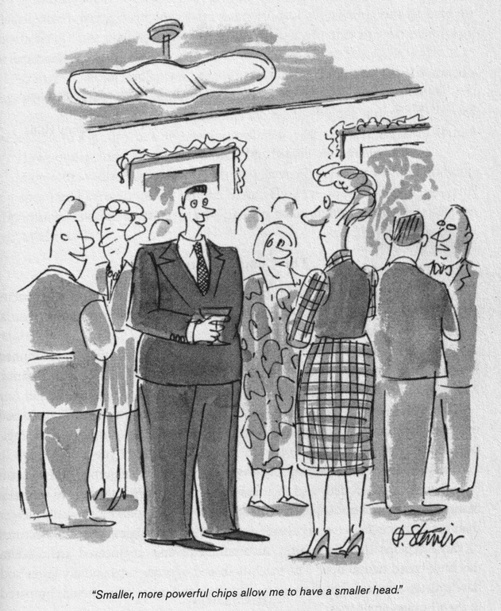
C H A P T E R E L E V E N
2029
Iʹm as fond of my body as anyone else, but if I can be 200 with a body of silicon, Iʹll take it.
—Danny Hillis
The Computer Itself
A $1,000 unit of computation (in circa‐1999 dollars) has the computing capacity of approximately 1,000 human brains
(1,000 times 20 million billion—that is, 2 times 1019 calculations per second).
Of the total computing capacity of the human species (that is, all human brains) combined with the computing technology humans initiated the creation of, more than 99 percent is nonhuman.
The vast majority of ʺcomputesʺ of nonhuman computing is now conducted on massively parallel neural nets, much of which is based on the reverse engineering of the human brain.
Many—but less than a majority—of the specialized regions of the human brain have been ʺdecodedʺ and their massively parallel algorithms have been deciphered. The number of specialized regions, amounting to hundreds, is greater than was anticipated twenty years earlier. The topologies and architectures of those regions that have been successfully reverse engineered are used in machine‐based neural nets. The machine‐based nets are substantially faster and have greater computing and memory capacities and other refinements compared to their human
analogues.
Displays are now implanted in the eyes, with a choice of permanent implants or removable implants (similar to
contact lenses). Images are projected directly onto the retina providing the usual high‐resolution three‐dimensional overlay on the physical world. These implanted visual displays also act as cameras to capture visual images and thus are both input and output devices.
Cochlear implants, originally used just for the hearing impaired, are now ubiquitous. These implants provide auditory communication in both directions between the human user and the worldwide computing network.
Direct neural pathways have been perfected for high‐bandwidth connection to the human brain. This allows bypassing certain neural regions (for example, visual pattern recognition, long‐term memory) and augmenting or replacing the functions of these regions with computing performed either in a neural implant or externally.
A range of neural implants is becoming available to enhance visual and auditory perception and interpretation, memory, and reasoning.
Computing processes can be personal (accessible by one individual), shared (accessible to a group), or universal
(accessible to everyone), at the userʹs option.
Three‐dimensional projected holographic displays are everywhere.
Microscopic nanoengineered robots now have microbrains with the computing speed and capacity of the human
brain. They are widely used in industrial applications and are beginning to be used in medical applications (see ʺHealth and Medicineʺ).
Education
Human learning is primarily accomplished using virtual teachers and is enhanced by the widely available neural implants. The implants improve memory and perception, but it is not yet possible to download knowledge directly.
Although enhanced through virtual experiences, intelligent interactive instruction, and neural implants, learning still requires time‐consuming human experience and study. This activity comprises the primary focus of the human species.
Automated agents are learning on their own without human spoon‐feeding of information and knowledge.
Computers have read all available human and machine‐generated literature and multimedia material, which includes
written, auditory, visual, and virtual experience works.
Significant new knowledge is created by machines with little or no human intervention. Unlike humans, machines
easily share knowledge structures with one another.
Disabilities
The prevalence of highly intelligent visual navigation devices for the blind, speech‐to‐print display devices for the deaf, nerve stimulation, intelligent orthotic prosthetics for the physically disabled, and a variety of neural implant technologies has essentially eliminated the handicaps associated with most disabilities. Sensory‐enhancement devices are in fact used by most of the population.
Communication
In addition to the ubiquitous, three‐dimensional virtual environments, there has been significant refinement to three-dimensional holographic technology for visual communication. There is also projected sonic communication for precisely placing sounds in three‐dimensional space. Similar to virtual reality, much of what is seen and heard in ʺrealʺ reality also has no physical counterpart. Thus family members can be sitting around the living room enjoying
one anotherʹs company without being physically proximate.
In addition, there is extensive use of communication using direct neural connections. This allows virtual, all-enveloping tactile communication to take place without entering a ʺtotal touch enclosure,ʺ as was necessary ten years earlier.
The majority of communication does not involve a human. The majority of communication involving a human is
between a human and a machine.
Business and Economics
The human population has leveled off in size at around 12 billion real persons. The basic necessities of food, shelter, and security are available for the vast majority of the human population.
Human and nonhuman intelligences are primarily focused on the creation of knowledge in its myriad forms, and
there is significant struggle over intellectual property rights, including ever increasing levels of litigation.
There is almost no human employment in production, agriculture, and transportation. The largest profession is education. There are many more lawyers than doctors.
Politics and Society
Computers appear to be passing forms of the Turing Test deemed valid by both human and nonhuman authorities,
although controversy on this point persists. It is difficult to cite human capabilities of which machines are incapable.
Unlike human competence, which varies greatly from person to person, computers consistently perform at optimal levels and are able to readily share their skills and knowledge with one another.
A sharp division no longer exists between the human world and the machine world. Human cognition is being ported to machines, and many machines have personalities, skills, and knowledge bases derived from the reverse engineering of human intelligence. Conversely, neural implants based on machine intelligence are providing enhanced perceptual and cognitive functioning to humans.
Defining what constitutes a human being is emerging as a significant legal and political issue.
The rapidly growing capability of machines is controversial, but there is no effective resistance to it. Since machine intelligence was initially designed to be subservient to human control, it has not presented a threatening ʺfaceʺ to the human population. Humans realize that disengaging the now human‐machine civilization from its dependence on machine intelligence is not possible.
Discussion of the legal rights of machines is growing, particularly those of machines that are independent of humans (those not embedded in a human brain). Although not yet fully recognized by law, the pervasive influence of
machines in all levels of decision making is providing significant protection to machines.
The Arts
Cybernetic artists in all of the arts—musical, visual, literary, virtual experience, and all others—no longer need to associate themselves with humans or organizations that include humans. Many of the leading artists are machines.
Health and Medicine
Progress continues in understanding and ameliorating the effects of aging as a result of a thorough understanding of the information—processing processes controlled through the genetic code. The life expectancy of humans continues
to increase and is now around 120 years. Significant attention is being paid to the psychological ramifications of a substantially increased human life span.
There is growing recognition that continuing extensions to the human life span will involve further use of bionic
organs, including portions of the brain. Nanobots are being used as scouts, to a limited extent as repair agents in the bloodstream, and as building blocks for bionic organs.
Philosophy