
[Transcribers Note: This is a reprint of Caxton's 1474 original. "Englifh" long s's which look very similar to f's have been transposed to s's for readability; yogh (looks like a mutated 3) has been rendered as a 3; thorn, þ, has been left as such and macrons over letters are given as e.g. [=o]. Otherwise the text has been left as is.The original punctutation has been preseved. Virgula suspensiva, shown here as / was in common use from the thirteenth to the seventeenth century. Often used for short pauses (such as the cæsura in the middle of a line of poetry), but sometimes was used as equivalent to the punctus. '9 represents a superscripted 9 and is an ancestor to the modern apostrophe. It usually indicates the omission of a terminal -us.
A small amount of text in this edition is in Blackletter, which was used in the Caxton original, and these sections have been marked up as such.
The book contains many attractive illustrations copied from the Caxton original and an HTML version exists to give a better representation of this.]
 Jonathon Oldbuck on the Game of Chess, 1474
The First Edition: copies in libraries and at sales
Where was it printed?
Caxton's account of the translation
The Second Edition: copies in libraries and at sales
Ferron and De Vignay's "Jeu d'Echecs"
Jacques de Cessoles: "Liber de Moribus hominum"
Sermons on Chess
Ægidius Romanus, his life and his book: "De Regimine Principum"
Occleve's imitation
William Caxton as a translator
Bibliography of the Chess Book:
Colonna
Cessoles
Ferron and De Vignay
Conrad van Ammenhaufen
Mennel
Heinrich von Beringen
Stephan
Caxton
Sloane
The scope and language of the Chess-book
Authors quoted and named
Biblical names and allusions
Xerxes the inventor of Chess!
Sidrac
John the monk
Truphes of the Philosophers
Helinand
Classical allusions
Mediæval allusions and stories
John of Ganazath
St. Bernard
The dishonest trader
The drunken hermit
A violent remedy
Murder of Nero
Theodorus Cyrenaicus
Democritus of Abdera
Socrates disguised
Didymus and raised letters for the blind
Shaksperean etymology
Caxton at Ghent
The history of Chess
The ethical aim of the writer of the Chess-book
This booke conteyneth. iiii. traytees/ The first traytee is of the Invencion of this playe of the chesse/ and conteyneth. iii. chapitres.
The first chapitre is under what kynge this play was founden.
The .ii. chapitre/ who fonde this playe.
The .iii. chapitre/ treteth of. iii. causes why hit was made and founden.
The seconde traytee treteth of the chesse men/ and conteyneth .v. chapitres.
The first chapitre treteth of the forme of a kynge and of suche thinges as apperteyn to a kynge.
The .ii. chapitre treteth of y'e quene & her forme & maners.
The .iii. chapitre of the forme of the alphins and her offices and maners.
The .iiii. chapitre is of the knygth and of his offices.
The .v. is of the rooks and of their maners and offices.
The thirde traytee is of the offices of the comyn peple And hath .viii. chapitres.
The first chapitre is of the labourers & tilinge of the erthe.
The .ii. of smythis and other werkes in yron & metall.
The .iii. is of drapers and makers of cloth & notaries.
The .iiii. is of marchantes and chaungers.
The .v. is of phisicyens and cirugiens and apotecaries.
The .vi. is of tauerners and hostelers.
The .vii. is of y'e gardes of the citees & tollers & customers.
The .viii. is of ribauldes disepleyars and currours.
The .iiii. traytee is of the meuyng and yssue of them And hath .viii. chapitres.
The first is of the eschequer.
The seconde of the yssue and progression of the kynge.
The thirde of the yssue of the quene. [Transcribers note: Original mislabels 3rd chapter as a second 2nd chapter]
The fourth is of the yssue of the alphyns.
The fifth is of the yssue of the knyghtes.
The sixty chapitre of the yssue of the rooks.
The seuenth is of the meuynge & yssue of the comyn peple.
And the eyght and laste chapitre is of the epilegacion and of the recapitulacion of all these forsaid chapitres.


 The readers of the "Antiquary" will remember the anecdote told with so much effusion by Jonathan Oldbuck. '"Davy Wilson," he said, "commonly called Snuffy Davy, from his inveterate addiction to black rappee, was the very prince of scouts for searching blind alleys, cellars, and stalls, for rare volumes. He had the scent of a slow-hound, sir, and the snap of a bull-dog. He would detect you an old black-letter ballad among the leaves of a law-paper, and find an editio princeps under the mask of a school Corderius. Snuffy Davy bought the 'Game of Chess, 1474,' the first book ever printed in England, from a stall in Holland for about two groschen, or two-pence of our money. He sold it to Osborne for twenty pounds, and as many books as came to twenty pounds more. Osborne re-sold this inimitable windfall to Dr. Askew for sixty guineas. At Dr. Askew's sale," continued the old gentleman, kindling as he spoke, "this inestimable treasure blazed forth in its full value and was purchased by Royalty itself for one hundred and seventy pounds! Could a copy now occur, Lord only knows," he ejaculated with a deep sigh and lifted-up hands, "Lord only knows what would be its ransom; and yet it was originally secured, by skill and research, for the easy equivalent of two-pence sterling."'
Sir Walter Scott in a footnote adds:--"This bibliomaniacal anecdote is literally true; and David Wilson, the author need not tell his brethren of the Roxburghe and Bannatyne Clubs, was a real personage." Mr. Blades, whose iconoclastic temper is not moved to mercy even by this good story, says that although it "looks like a true bibliographical anecdote," its appearance is deceptive, and that "not a single statement is founded on fact."[1]
Jonathan Oldbuck did not venture to estimate the sum that would ransom a copy of the "Game of Chesse," and the world of the bibliomania has moved even since his days, so that prices which seemed fabulous, and were recounted with a sort of awe-struck wonder, have been surpassed in these latter days, and the chances of any successor of "Snuffy Davy" buying a Caxton for two groschen have been greatly reduced.
According to Mr. William Blades, our latest and best authority on the subject, there are but ten copies known of the first edition of the "Chesse" book.[2] There is a perfect copy in the King's Library in the British Museum. This is what ought to be Snuffy Davy's copy. A previous owner--R. Boys--has noted that it cost him 3s. The copy in the Grenville Library has the table and last leaf supplied in facsimile. The copy in the Public Library at Cambridge is defective to the extent of five leaves. The Bodleian copy wants the last leaf. The Duke of Devonshire's copy formerly belonged to Roger Wilbraham, and the first and eighth leaves are supplied in facsimile. The exemplar belonging to the Earl of Pembroke is perfect, "but on weak and stained paper." Earl Spencer's copy is perfect, clean, and unusually large. Mr. H. Cunliffe's copy came from the Alchorne and Inglis Libraries, and wants the first two printed leaves, two near the end, and the last two. Mr. J. Holford's copy is perfect and in its original binding. It was once in the library of Sir Henry Mainwaring of Peover Hall, as his bookplate shows. On a fly-leaf is written, "Ex dono Thomæ Delves, Baronett 1682." The copy belonging to the Rev. Edward Bankes is imperfect, and wants the dedicatory leaf and is slightly wormed.
The book, when complete, consists of eight quaternions or eight leaves folded together and one quinternion or section of five sheets folded together, making in all seventy-four leaves, of which the first and last are blank. The only type used throughout is that styled No. 1 by Mr. Blades. The lines are not spaced out; the longest measure five inches; a full page has thirty-one lines. Without title-page, signatures, numerals, or catch-words. The volume, as already mentioned, begins with a blank leaf, and on the second recto is Caxton's prologue, space being left for a two-line initial, without director. The text begins with a dedication:--"(T)o the right noble/ right excellent & vertuous prince George duc of Clarence Erl of Warwyk and of Salisburye/ grete chamberlayn of Englond & leutenant of Ireland oldest broder of kynge Edward by the grace of god kynge of England and of France/ your most humble servant william Caxton amonge other of your servantes sendes unto yow peas. helthe. Joye and victorye upon your Enemyes/ Right highe puyssant and." The text ends on the seventy-third recto, thus:--"And sende yow thaccomplisshement of your hye noble. Joyous and vertuous desirs Amen:/: Fynysshid the lastday of Marche the yer of our lord god. a. thousand foure honderd and LXXIIII. *. *. *. *." The seventy-fourth leaf is blank.
It is unnecessary to say that this book seldom comes into the market. The recorded sales are very few. In 1682 R. Smith sold a perfect copy for 13s. 2d. In 1773 J. West's copy was bought by George III. for.£32 0s. 6d. Alchorne's imperfect copy was bought by Inglis for £54 12s., and at the sale of his books found a purchaser in Lord Audley for £31 10s., and was again transferred, in 1855, to the possession of Mr. J. Cunliffe for £60 l0s. 0d.[3] Mr. J. Holford's copy was bought at the Mainwaring sale for £101.
The last copy offered for sale was described in one of Mr. Bernard Quaritch's catalogues issued in 1872, and the account given by that veteran bibliopole is well worth reproduction.
CAXTON'S GAME AND PLAY OF CHESS MORALIZED, (translated 1474) FIRST EDITION, folio, 65 LEAVES (of the 72), bound in old ruffia gilt, £400.

[Blackletter: Fynyshid the last day of Marche the yer of our Lord God, a thousande, foure hondred and lcciiiii...]
An extremely large, though somewhat imperfect copy of
THE FIRST BOOK PRINTED IN ENGLAND, from Caxton's press.
Mr. Blades quotes 9 copies (4 perfect, 5 imperfect), the present is the 10th known copy, and is TALLER than even the Grenville--hitherto the tallest known copy; my copy measures 11-1/8 inch in height by 8 in width, whilst the Grenville copy (also imperfect) is only 11 inches high.
COLLATION of my copy:
| [Blackletter: This Booke conteyneth iiii traytees] | 1 leaf |
| [Blackletter: This first chapiter of the first tractate] | 1 leaf |
| [Blackletter: The trouthe for to do Justice right wysly,] etc. to the end | 62 leaves |
| The last leaf with the date: [Blackletter: In conquerynge his rightful inheritance,] ending: [Blackletter: fynyshed], etc. 1474 |
1 leaf |
| ------------- 65 leaves. |
My copy wants therefore 7 leaves, the two blank ones being out of question. The imperfections include the first leaf, and two leaves in the second chapitre of the fourth tractate, the end is all right. I should be glad to hear of any IMPERFECT COPY of this work, which would supply me with what I want. In the mean time this precious relic of the Infancy of Printing in England can be feen by BUYERS of Rare books.
See Dibdin's Bibl. Spenc. IV. p. 189.
No copy of this edition has been sold for years; in 1813, Alchorne's copy, wanting first two leaves, the last two leaves and two leaves in the second chapter of the fourth tractate, fetched at Evans', £54. 12s. The value of this class of books has much risen since then, and may now be considered, as ten times greater.
In comparing the first edition of "Caxton's Game of Chess" with the second, one perceives many variations in the spelling. I confider the first edition to be the more interesting, for a variety of reasons:
1. It is the first book printed in England. 2. It is the Editio princeps of the English version. 3. It shows the Art of Printing in its crudest form. 4. It has a Post-script not in the second edition.
Both editions run on together to the passage on the last page of the second edition:

[Blackletter: And a mon that lyvyth in thys world without vertues lyveth not as a man but as a beste.]
The first edition ends thus:
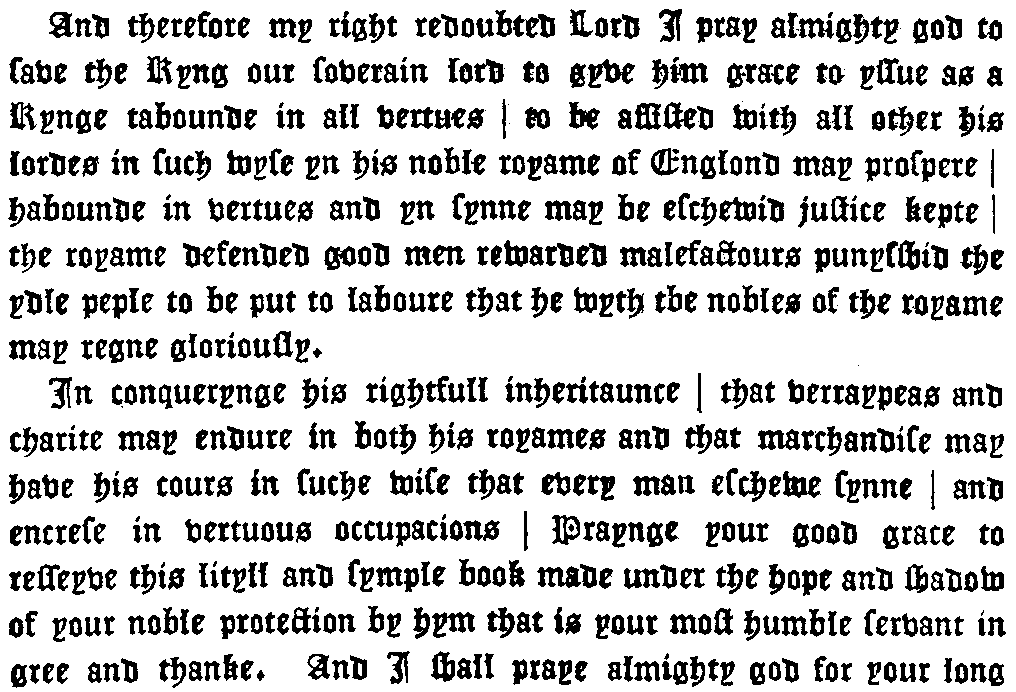

[Blackletter: And therefore my right redoubted Lord I pray almighty god to save the Kyng our soverain lord to gyve him grace to yssue as a Kynge tabounde in all vertues/ to be assisted with all other his lordes in such wyse yn his noble royame of England may prospere/ habounde in vertues and yn synne may be eschewid justice kepte/ the royame defended good men rewarded malefactours punyshid the ydle peple to be put to laboure that he wyth the nobles of the royame may regne gloriously.In conquerynge his rightfull inheritaunce / that verraypeas and charitie may endure in both his royames and that marchandise may have his cours in suche wise that every man eschewe synne/ and encrese in vertuous occupacions / Praynge your good grace to resseyve this lityll and symple book made under the hope and shadow of your noble protection by hym that is your most humble servant in gree and thanke. And I shall praye almighty god for your long lyf & welfare / which he preserve And sende now thaccomplishment of your hye noble joyous and vertuous desirs Amen:|:
Fynysshid the last day of marche the yer of our lord god a. thousand four hondred and lxxiiii. *.:.:.*.]
The second edition ends thus:

[Blackletter: Thenne late every man of what condycion he be that redyth or herith this litel book redde. take therby ensaumple to amend hym. Explicit per Caxton.]
This copy came from the library of Mr. L.M. Petit.[4]
It will be noticed that Mr. Quaritch calls the editio princeps of Caxton's "Game and Play of the Chesse" the first book printed in England. This was the general opinion of bibliographers before the investigations of Mr. Blades. Dibdin, although he seems to have had some doubt, pronounced in favour of that view. Yet it is clearly erroneous. The only materials for judgment are those afforded by the colophon and the prologue to the second edition, with the silent but eloquent testimony of typography. Caxton ends the first edition with the words:--"Fynysshid the last day of Marche the yer of our lord god a thousand four hondred and LXXIIII." The word "fynysshid," as Mr. Blades observes, "has doubtless the same signification here as in the epilogue to the second book of Caxton's translation of the Histories of Troy, 'Begonne in Brugis, contynued in Gaunt and finysshed in Coleyn,' which evidently refers to the translation only. The date, 1475-6, has been affixed, because in the Low Countries at that time the year commenced on Easter-day; this in 1474 fell on April 10th, thus giving, as the day of the conclusion of the translation, 31 March 1475, the same year being the earliest possible period of its appearance as a printed book." Then there is Caxton's own racy account of the circumstances under which the book first appeared:--
"And emong alle other good werkys It is a werke of ryght special recomendacion to enforme and to late vnderstonde wysedom and vertue vnto them that be not lernyd ne can not dyscerne wysedom fro folye Th[=e]ne emonge whom there was an excellent doctour of dyuynyte in the royame of fraunce of the ordre of thospytal of Saynt Johns of Jherusalem which entended the same and hath made a book of the chesse moralysed whiche at suche tyme as I was resident in brudgys in the counte of Flaundres cam into my handes/ whiche whan I had redde and ouerseen/ me semed ful necessarye for to be had in englisshe/ And in eschewyng of ydlenes And to thende that s[=o]me which haue not seen it/ ne [=v]nderstonde frenssh ne latyn J delybered in my self to translate it in to our maternal tonge/ And whan I so had achyeued the sayd translacion/ J dyde doo sette in enprynte a certeyn nombre of theym/ Whiche anone were depesshed and solde wherfore by cause thys sayd book is ful of holsom wysedom and requysyte vnto euery astate and degree/ J haue purposed to enprynte it/ shewyng therin the figures of suche persons as longen to the playe."
It is clear from this that both the translation and printing belong to the period of Caxton's residence in Bruges. From the use of the instrumental form "dyde doo sette en enprynte" it might be thought that Caxton employed the services of some printer, but although commonly so employed, there are instances which will not bear this interpretation of its intention.[5] He either employed a printer or made some partnerfhip with one, and there are various indications that confirm Mr. Blades' theory that the book came from the press of Colard Mansion.
The second edition is undoubtedly the work of our first English printer. "Explicit per Caxton" is the unambiguous statement of the colophon. It is a much more advanced specimen of typography than the first edition. It has signatures, of which a, b, c, d, e, f, g, h, i, are quaternions, k and l are terternions, making in all eighty-four leaves, of which the first is blank. There is no title-page, and the type used is that which Mr. Blades reckons as No. 2*. The lines are spaced out to an even length. There are twenty-nine lines to a full page, and the full line measures 4-7/8 inches. The prologue begins on a ij., and the table of chapters begins on the next page. The text begins on the recto of a iii. The text ends on the recto of l 6, the last page being blank. There are sixteen woodcuts in the volume, which are used twenty-four times. There has been some diversity of opinion as to the year in which this "Game of the Chesse" came from the press of Caxton. The book is not dated. Dibdin thought it one of the printer's earliest efforts. Figgins regarded it as the earliest issue of the Westminster press, and further believed that it was printed from cut metal types. This is not the view of Mr. Blades, who says: "An examination of the work, however, with a typographical eye does not afford a single evidence of very early workmanship. All Caxton's early books were uneven in the length of their lines--this is quite even. Not one of the early works had any signatures--this is signed throughout. These two features alone are quite sufficient to fix its date of impression at least as late as 1480, when Caxton first began the use of signatures; but when we find that every known copy of this edition of the 'Chess-Book' presents a thicker and more worn appearance than any one copy of any other book, there is good reason for supposing that this may have followed the 'Tulli' of 1481, and have been the last book for which Type No. 2* was used."[6]
Mr. Blades describes nine known copies, so that even fewer exemplars remain of the second edition than of its predecessor. The copy in the King's Library in the British Museum is imperfect, wanting several leaves, and is mended in many places. The copy in the Pepysian Collection at Cambridge wants one-half of the last leaf. Trinity College, Cambridge, has a perfect copy, "but a bad impression." The Bodleian copy is defective in not having the last leaf. St. John's College, Oxford, has a copy, from which one-half of d iii. has been torn away. The Imperial Library at Vienna has an imperfect copy. The Duke of Devonshire's copy is perfect, but it is "a poor impression, and slightly stained." The Earl of Pembroke's copy is very imperfect. Earl Spencer's is only slightly imperfect. The prices fetched by the second edition have a sufficiently wide range. In 1698, at Dr. Bernard's sale, a copy fold for 1s. 6d. Farmer's copy in 1798 fetched £4 4s. Ratcliffe's copy was bought at his sale for £16 by Willett; and when his books came to the hammer in 1813, it was purchased by the Duke of Devonshire for £173 5s.[7] It is interesting to know that the copy of the second edition in the Bibliotheca Spenceriana formerly belonged to Laurence Sterne, who bought it for a few shillings at York![8]
In the present reprint, the text followed is that of the first edition, transcribed from the copy in the British Museum; but the variations, alterations, and additions made in the second issue are all recorded in footnotes. The reader has, therefore, before him the work in all its fulness. The same reasons that have led to the adoption of this course have also decided the publisher to include facsimiles of the curious woodcuts which appeared in the second edition. These, although necessarily reductions in size, reproduce the quaint vigour of the originals.
Caxton, we have seen, translated the "Game of the Chesse" from the French. There were in effect two, if not three, from which he may have taken his version. One of these is by Jean Faron, Perron, or Feron (as the name is variously spelled), a monk of the order of St. Dominic, of whom the notices are exceedingly scanty.[9] La Croix du Maine styles him "de l'Ordre des Frères Prescheurs ou Jacobins du Paris." La Monnaye says that the translation was made from the Latin of Cessoles, and was begun in the year 1347. It has not been printed.[10] The translation is considered a literal version of the Latin of Cessoles.
The prologue of Perron's version is as follows:--"Chy ensuit le geu des Eschas moralisé, ouquel a plusiers exemples bien à noter. A noblehomme, Bertrand de Tarascon, frere Jehan Perron, de l'ordre des Freres precheurs de Paris, son petil et humble chappelain soy tout. Le Sainte Escripture dit que Dieux a fait a chascun commandement de pourchassier à tous nos prochains leur sauvement. Or est-il ainsi que nos prochains ne sont pas tout un, ains sont de diverses condicions, estas et manieres, sy comme il appert. Car les uns sont nobles; les aultres non: les aultres sont de cler engin; les aultres, non: les aultres sont enclins a devocion; les aultres, non. Et pour ce, affin que le commandement de Dieu soit mis à execution bien convenablement, il convient avoir plusiers voyes et baillier à chascun ce qui lui est plus convenable; et ainsi pourroit il le commandement de Dieu accomplir; .... Pour tant je, vostre petit chappelain, à vostre requeste, que je tieng pour commendement, vous ai volu translata de latin en français le Gieu des Eschas moralisé, que fist l'un de nos freres, appelé frere Jaques de Cossoles, maistre en divinité, si que vous l'entendés plus legierrement; et à exemple des nobles hystoires qui y sont notteés, veuillés maintenir, quant à vous, honnestement, et quant aux autres justement.... Or prenés done ce petit present, comencié le 4'e jour de May, l'an 1347."[11]
That Caxton made use of Perron's version is clear. Thus Mr. Blades mentions the description of Evilmerodach as "un homme joly sans justice" as peculiar to Ferron, whose version he regards as the basis of the first and third chapters of Caxton's work.
Dr. Van der Linde mentions a number of MSS.; in some the date is given as 1357, and in one as 1317. This version remains unprinted, but there are MSS. of it in the Bibliotheque Nationale, at Aosta, Cambrai, at Brussels, in the British Museum, Chartres, at Bern, and at Stockholm.[12]
Dr. Van der Linde also describes a MS. on parchment of the fifteenth century, forming part of the national library at Paris, which contains the Game of Chess in verse.
"Mès si d'esbat te prent tallant,
Pren ton esbat déuement;
Mès si à jouer vieulx attendre,
Un noble jou te faulte attendre,
C'est des echecs qui est licite
Et à touz bien les gens incite."
The author has concealed his name with an ingenuity that has so far defied penetration.
"Nommez mon nom et mon surnom,
Je ey escript tout environ,
A vingt et dous lettres sans plus,
Sera trouvé cy au dessus
En enscript, et sans plus ne moins."
On this it is only necesiary to quote the remarks of a French critic:--"Ou ne nous dit pas si c'est dans la suite même de la phrase, ou seulement en acrosticke, que se trouvent les vingt-deux lettres de ces nom mystérieux. Nous ne saurions former aucun nom avec les initiales des trente vers qui précèdent ceux que nous venons de citer; et le merite de l'ouvrage ne nous encourage pas à faire des longues recherches pour découvrir un nom que l'auteur a pris plaisir à nous cacher."[13]
The bulk of Caxton's work is undoubtedly from the French translation of Jehan de Vignay, whose dedication to Prince John of France has simply been transformed into a similar address to the Duke of Clarence. He styles De Vignay "an excellent doctor of the order of the Hospital of St. John's of Jerusalem." This is the only authority we have for supposing De Vignay to be connected with that order. He styles himself "hospitaller de l'ordre de haut pas," which was situated in the Faubourg St. Jacques of Paris. It is curious that two members of the same order--for Ferron was also a Jacobin--should independently have occupied themselves with the same work. The version by De Vignay was probably the later of the two, and it was also the most popular, for whilst Ferron's is still unprinted, that of De Vignay has been frequently re-issued from the press. The work is dedicated to Jean de France, Duc de Normandie, who became king in 1350. It will be seen from this that these two French versions were practically contemporaneous.
The prologue to the book is as follows:--"A Tres noble & excellent prince Jehan de france duc de normendie & auisne filz de philipe par le grace de dieu Roy de france. Frere Jehan de vignay vostre petit Religieux entre les autres de vostre seignorie/ paix sante Joie & victoire sur vos ennemis. Treschier & redoubte seign'r/ pour ce que Jay entendu et scay que vous veez & ouez volentiers choses proffitables & honestes et qui tendent alinformacion de bonne meur ay Je mis vn petit liuret de latin en francois le quel mest venuz a la main nouuellement/ ou quel plussieurs auctoritez et dis de docteurs & de philosophes & de poetes & des anciens sages/ sont Racontez & sont appliquiez a la moralite des nobles hommes et des gens de peuple selon le gieu des eschez le quel liure Tres puissant et tres redoubte seigneur jay fait ou nom & soubz vmbre de vous pour laquelle chose treschr seign'r Je vous suppli & requier de bonne voulente de cuer que il vo daigne plaire a receuvoir ce liure en gre aussi bien que de vn greign'r maistre de moy/ car la tres bonne voulente que Jay de mielx faire se je pouoie me doit estre reputee pour le fait/ Et po'r plus clerement proceder en ceste ouure/ Jay ordene que les chappitres du liure soient escrips & mis au commencement afin de veoir plus plainement la matiere de quoy le dit liure pole."[14]
It will be seen that this is the foundation of Caxton's dedication of the Chess-book to the Earl of Warwick. The "Golden Legend," printed by Caxton in 1484, was in effect a translation from "La Legende Dorée," made before the year 1380 by Jehan de Vignay, who in his prologue mentions that he had previously translated into French "Le miroir des hystoires du monde," at the request of "Ma dame Jehanne de Borgoigne, royne de France."[15] This preface Caxton, as usual, adopted with some changes of name and other alterations, amongst which is a reference to "the book of the chesse" as one of his works. The "Legenda Aurea" of Jacobus de Voragine is, of course, the original source of De Vignay's "Legende Dorée," and Caxton's "Golden Legend."
Ferron and de Vignay were avowedly translators. Their original was Jacques de Cessoles. The name of this author has been tortured into so many fantastic forms that one may almost despair of recovering the original. Cæsolis, Cassalis, Castulis, Casulis, Cesolis, Cessole, Cessulis, Cesulis, Cezoli, de Cezolis, de Cossoles, de Courcelles, Sesselis, Tessalis, Tessellis, de Thessolus, de Thessolonia, and de Thessolonica are different manners of spelling his surname, and the two last are certainly masterpieces of transformation. Prosper Marchand has amused himself by collecting some vain speculations of previous writers as to the age, country, and personality of Jacques de Cessoles. Some counted him a Lombard, some an Italian, whilst others again boldly asserted that he was a Greek!
He lived towards the end of the thirteenth or beginning of the fourteenth century, and having joined the Dominican order, was a "Maître en Théologie" of that brotherhood at Reims. Various works are attributed to him, and his learning and piety had many eulogists.
It is more than probable that his name would have been much less widely known but for the happy accident that turned his attention to the game of chess. It was a popular diversion, and in the moralizing spirit of the age he saw in it an allegory of the various components of the commonwealth. The men who were merely killing time were perhaps flattered at the thought that they were at the same time learning the modes of statecraft. Then, as now, the teachers of morality felt that a song might reach him who a sermon flies, and they did not scruple to use in the pulpit whatever aids came handy. The popular stories, wise saws, and modern instances, were common enough on the lips of the preachers, and such collections as the "Gesta Romanorum show what a pitch of ingenuity in unnatural interpretation they had reached. An appropriate instance is furnished by it in the following quaint fashion of moralizing the chess play:--
"Antonius was a wys emperour regnyng in the cite of Rome, the which vsid moche to pley with houndis; and aftir þat pley, all þe day aftir he wolde vse þe chesse. So yn a day, as he pleide at þe chesse, & byheld the kyng fette yn the pley, som tyme hy and som tyme lowe, among aufyns and pownys, he thought þerwith þat hit wold be so with him, for he shuld dey, and be hid vndir erth. And þerfore he devided his Reame in thre parties; and he yaf oo part to þe kyng of Ierusalem; þe secunde part vnto þe lordis of his Reame or his empire; and the thrid partie vnto the pore people; & yede him self vnto the holy londe, and ther he endid his lyf in peas.MORALITE.
Seth now, good sirs; this emperour, þat lovith so wele play, may be called eche worldly man þat occupieth him in vanytes of the world; but he moste take kepe of the pley of the chesse, as did the emperoure. the chekir or þe chesse hath viij. poyntes in eche partie. In euery pley beth viij. kyndes of men, scil. man, woman, wedewer, wedowis, lewid men, clerkes, riche men, and pouere men. at this pley pleieth vj. men. the first man, þat goth afore, hath not but oo poynt, but whenne he goth aside, he takith anoþer; so by a pouere man; he hath not, but when he comyth to þe deth with pacience, þen shall he be a kyng in heuen, with þe kyng of pore men. But if he grucche ayenst his neighbour of his stat, and be a thef, and ravissh þat wher he may, þen he is ytake, and put in to the preson of helle. The secund, fcil. alphyn, renneth iij. poyntes both vpward and douneward; [he] betokenyth wise men, the whiche by deceyuable eloquence & takyng of money deceyueth, & so he is made oonly. The iij. scil. þe kny3t, hath iij. poyntes, & goth þerwith; [he] betokenyth gentilmen þat rennyth aboute, & ravisshith, and ioyeth for her kynrede, & for habundaunce of richesse. The fourth, scil. þe rook, he holdith length & brede, and takith vp what so is in his way; he betokenyth okerers and false merchaunt3, þat rennyth aboute ouer all, for wynnyng & lucre, & rechith not how thei geten, so that thei haue hit. The fifthe is þe quene, that goth fro blak to blak, or fro white to white, and is yset befide þe kyng, and is ytake fro the kyng. This quene bytokenyth virgyns and damesels, þat goth fro chastite to synne, and beth ytake by the devill, for glovis or such maner yiftis. The vj. is to whom all owe to obey and mynystre; and he goth forth, and bakward ayen, & in either side, & takith ouer all; so sone discendith in to þe world, and ascendith to god by praiers; But when he takith [no] kepe of god, and hath no meyne, þan is hit to þe man chekmate. And þerfore let vs not charge of oure estatis, no more þan is with þe men, when þei be put vp in þe poket; then hit is no charge who be above or who be byneth; and so by the Spirit of loulynesse we may come to þe ioy of heven. And þat graunt vs, qui viuit &c."
It is not, therefore, surprising to learn that Jacques de Cessoles found texts for sundry sermons on the game that formed so favourite a diversion of clergy and laity. The favour with which these discourses were received no doubt gratified the worthy Dominican father. At the request of some of those who heard them he began to write down the substance of his sermons. The result was the "Liber de moribus Hominum et officiis Nobilium ac Popularium super ludo scachorum," which immediately attained great popularity. This is shown by the bibliography of Dr. A. Van der Linde in a striking manner, for he has described two hundred codices to be found in the various public libraries of Europe.[16]
The difficulties in the way of forming any clear conception as to the life and personality of Cessoles, Ferron, and De Vignay are well shown in an article by M.C. Leber.[17] Dr. Ernst Köpke, who has reexamined the evidences as to Cessoles, holds that he was a Lombard.[18]
The chief source from which Cessoles took his material was the treatise "De Regimine Principum" of Egidius Romanus.
He was of the great Neapolitan family of the Colonna, and his Christian name appears to have been Guido, but his designations have undergone some curious transformations. Born at Rome, 22nd Sept., 1216, Guido Colonna went at an early age to Paris, where, from the name of his birthplace, he became known as Ægidius Romanus, with the French form of Gilles de Rome. He was an ardent and enthusiastic disciple of St. Thomas Aquinas, and his familiarity with that great doctor of the Church led him to desire admission to the Dominican order, but a difficulty intervened from the circumstance that he had already contracted ties which bound him to the order of St. Augustine. To this untoward accident may probably be attributed no little of the extension of the philosophical doctrine of Aquinas; for Colonna, unable or unwilling to be relieved of the vows that bound him to the Augustinians, preached eagerly amongst them the Thomist speculations of his friend and master. In the controversy with the Franciscans, those whom he had indoctrinated were valuable allies to the Thomists, for their aid, coming from an independent organization, appeared to carry the weight of impartiality, and to be unassailable on the plea of partisan interest. In the year 1287 there was a general convocation of the order of St. Augustine at Florence, and at this assembly it was decreed that the doctors of the order should teach in conformity with the decisions arrived at by Colonna. To him is largely due the success of the Thomist scheme, of which he was an able, persistent, and vigorous exponent. Many tracts by him remain in print and MS. on these subjects. The fame he had thus acquired gained him the name of doctor fundamentarius and doctor fundatissimus. His lectures at Paris attracted to him the attention of Philippe le Hardi, who thought him a fitting person to be entrusted with the education of his son, who was afterwards known to hiftory as Philippe le Bel. It was whilst occupied with this royal youth that the thought of composing or compiling--and the terms were in practice interchangeable in those days--occurred, and the result was the treatise "De regimine Principum libri iii." Philippe le Hardi, if not an educated man himself--and there are doubts as to whether he could write his own name--was laudably anxious that his heir should have the best instruction that could be obtained. It cannot well be claimed that the able, handsome, and unscrupulous Philippe was any great credit to his preceptor. The despotic and perfidious character of the king probably owed more to the influence of Nogaret and other defenders of the "right divine of kings to govern wrong," than to the soberer precepts of Colonna. That Philippe had some tincture of literary feeling may be inferred from his employment of Jehan de Meung to translate the military treatise of Vegetius Flavius Renatus, a compilation of the second century of the present era, which was so popular in the middle ages that it was translated by Caxton into English. Still better evidence is the translation made for the king by the same poet of Boethius, whose stoical philosophy must have had a special appropriateness for those times of political storm and stress, when the fickleness of fortune must have been a matter of only too common repute. Guido Colonna was elected by his admiring brethren the general of the order in 1292, and took up his residence at Bourges, its metropolitan seat.
In this honourable office he continued his literary labours, and to this period are assigned the greater part of his numerous works. He died at Avignon in 1316. His body was translated to Paris, where his effigy in black marble, with his epitaph, remained until the French revolution.[19] It would be superfluous to enumerate his philosophical writings, for they would have no interest in the present day. His commentary on Aristotle "De Anima," it may be observed, was dedicated to Edward I. His name is now chiefly remembered because his work on the rule of princes formed the basis of the treatise in which Jacques de Cessoles moralized the fashionable game of the chess.
One interesting instance of the popularity of Colonna's work is the translation of it made into English verse by Thomas Occleve.[20] He wrote it in 1411 or 1412, and its object was to obtain the payment of an annuity from the exchequer which had been granted to him, but the payment of which was very irregular. The book was dedicated to the Prince of Wales. After mentioning his purpose to translate from the (apocryphal) letter of Aristotle to Alexander and "Gyles of Regement of Prynces," he proceeds:--
"There is a booke, Jacob de Cessoles,
Of the ordre of Prechours, made, a worthy man,
That the Chesse moralisede clepede is,
In whiche I purpose eke to labour ywis
And here and there, as that my litelle witte
Afforthe may, I thynke translate it.
And al be it that in that place square
Of the lystes, I meane the eschekere,
A man may learn to be wise and ware;
I that have avanturede many a yere,
My witte therein is but litelle the nere,
Save that somewhat I know a Kynges draught,
Of other draughts lernede have I naught."--(p. 77.)
"In those days," says Warton, "ecclesiastics and schoolmen presumed to dictate to kings and to give rules for administering states, drawn from the narrow circle of speculation, and conceived amid the pedantries of a cloister. It was probably recommended to Occleve's notice by having been translated into English by John Trevisa, a celebrated translator about the year 1390.[21]
Having thus traced the stream back to its fountain, we return to Caxton. The story of his life has been told by Mr. Blades, and only the most essential facts of his busy and useful career need be recapitulated here. He was born in the Weald of Kent, and it has been conjectured that the manor of Caustons, near Hadlow, was the original home of the family. He was apprenticed to Alderman Robert Large, a mercer, who was afterwards Lord Mayor. The entry in the books of the Mercers' Company leads to the inference that Caxton was born about 1422. Probably on the death of Large, in 1441, Caxton went abroad, for he tells us that in 1471 he had been resident outside England for thirty years. About 1462 or 1463 he was Governor of the English Nation or Merchant Adventurers at Bruges. This was a position of great influence, and it is thought to have enabled the loyal mercer to give good service to Edward IV., who was an exile in 1470. Caxton's marriage was not much later than 1469, and it is conjectured that this led him to enter the service of the Duchess of Burgundy. She had literary tastes, and at her request he translated the "Recuyell des Histoires de Troyes" of Raoul Le Fevre. It was the demand for copies of this that exhausted Caxton's calligraphic patience, and led to his employment of a printer. The incident may have been casual, but it led to great results. It has been said that he learned the printers' art at Cologne, but Mr. Blades supposes that he entered its mystery at Bruges under Colard Mansion, with whom he appears to have had some partnership. Probably towards the end of 1476 Caxton returned to England. He had the favour of Edward IV. and of his sister, Duchess of Burgundy, and the friendship of the King's brother-in-law, Earl Rivers. Ninety-nine distinct productions issued from Caxton's press, he was printer, publisher, translator, and something of author as well. He set in good earnest about the work that is still going on--of making the best accessible literature widely and commonly known. This useful career was only ended by his death. The exact date is not known, but it was probably late in 1491. He left a married daughter. Caxton was a good business man. He was also a sincere lover of literature, and he was at his favourite work of translation only a few hours before the final summons came.
The quality of Caxton as a translator is not a matter of much doubt. It may be that the archaic forms give an additional flavour to his style, since they present few difficulties to the modern reader, and yet sound like echoes from the earlier periods of the language. Generally he is content to follow his author with almost plodding fidelity, but occasionally he makes additions which are eminently characteristic. His author having remarked:--"Il nest an Jour Duy nulle chose qui tant grieue Rome ne ytalie com~e fait le college Des notaires publiques Car ilz ne sont mie en accort ensemble"--Caxton improves the passage thus:--
"For ther is no thynge at this day that so moche greueth rome and Italye as doth the college of notaries and aduocates publicque. For they ben not of oon a corde/ Alas and in Engeland what hurte doon the aduocats. men of law. And attorneyes of court to the comyn peple of y'e royame as well in the spirituell lawe as in the temporall/ how torne they the lawe and statutes at their pleasir/ how ete they the peple/ how enpouere they the comynte/ I suppose that in alle Cristendom ar not so many pletars attorneys and men of the lawe as ben in englond onely/ for yf they were nombrid all that lange to the courtes of the channcery kinges benche. comyn place. cheker. ressayt and helle And the bagge berars of the same/ hit shold amounte to a grete multitude And how alle thyse lyue & of whome. yf hit shold be vttrid & told/ hit shold not be beleuyd. For they entende to theyr synguler wele and prouffyt and not to the comyn/"
Another addition is the brief passage in the first chapter of the fourth tract in which the "good old times" are lamented and contrasted with the decadence of the then present--now the four centuries past.
"Alas what haboundance was some tymes in the royames. And what prosþite/ In whiche was Iustice/ And euery man in his office contente/ how stood the cytees that tyme in worship and renome/ how was renomed the noble royame of Englond Alle the world dredde hit And spack worship of hit/ how hit now standeth and in what haboundance I reporte me to them that knowe hit yf ther ben theeuis wyth in the royame or on the see/ they knowe that laboure in the royame And sayle on the see I wote well the same is grete therof I pray god saue that noble royame And sende good true and politicque counceyllours to the gouernours of the same &c./"
The concluding paragraph of the book is also due to Caxton.
"And therfore my ryght redoubted lord I pray almighty god to saue the kyng our souerain lord & to gyue hym grace to yssue as a kynge & tabounde in all vertues/ & to be assisted with all other his lordes in such wyse y't his noble royame of Englond may prospere & habounde in vertues/ and y't synne may be eschewid iuftice kepte/ the royame defended good men rewarded malefactours punysshid & the ydle peple to be put to laboure that he wyth the nobles of the royame may regne gloriously In conquerynge his rightfull enheritaunce/ that verray peas and charite may endure in bothe his royames/ and that marchandise may haue his cours in suche wise that euery man eschewe synne/ and encrece in vertuous occupacions/ Praynge your good grace to resseyue this lityll and symple book made vnder the hope and shadowe of your noble protection by hym that is your most humble seruant/ in gree and thanke And I shall praye almighty god for your longe lyf & welfare/ whiche he preferue And sende yow thaccomplisshement of your hye noble. Ioyous and vertuous desirs Amen:/: Fynysshid the last day of marche the yer of our lord god. a. thousand foure honderd and lxxiiii"
This was struck out in the second edition, and the following briefer farewell substituted:--
"Thenne late euery man of what condycion he be that redyth or herith this litel book redde take therby ensaumple to amend hym.Explicit per Caxton."
The alteration may perhaps be received as an evidence of our first English printer's fastidiousness as an author.
The bibliography of the editions, translations, and imitations of Cessoles is long and intricate. Details of MSS. have not been thought necessary. They have been amply described by Dr. Van der Linde. The treatise on the rule of princes of Colonna has been taken as furnishing the matter which Jacques de Cessoles afterwards re-arranged under the attractive form of a description of the game of chess. The editions of the Latin text are followed by particulars of the translations into French, English, Spanish, Italian, and other languages. Each title has appended the name of the bibliographer on whose authority it is given.
These are as follows:--
Hain.--Repertorium Bibliographicum ... opera Ludovici Hain. Stuttgart, 1826.
Ebert.--A General Bibliographical Dictionary, from the German of Frederic Adolphus Ebert. Oxford, 1837. 4 vols.
Græsse.--Trésor de Livres rares et précieux: par Jean George Théodore Græsse. Dresde, 1859-67. 6 vols.
Brunet.--Manuel du Libraire par Jacques-Charles Brunei. Paris, 1860.
Linde.--Geschichte und Literatur des Schachspiels von Antonius van der Linde. Berlin, 1874.
Das erste Jartausend der Schachlitteratur (850-1880) zusammengestellt von Dr. A.v.d. Linde. Berlin, 1881.
Dr. van der Linde's work is so complete that, for the most part, it has been thought sufficient to give his name, even when older authorities have been consulted.
(See antè, p. xxviii.)
Ægidius Romanus de regimine principum L. III. s. l. 1473. Folio.
This Ebert and Græsse conjecture to have been printed by G. Zainer. They describe it as the first edition of a work frequently reprinted, and say that the last edition appeared at Lugd. Batav. in 1643, and had on the title-page the name of St. Thomas Aquinas as author. Hain mentions editions at Rome--Stephanum Plannck, 1482, folio; Venetiis, 1498.
(French translation.)
Miroir exemplaire, selon la compilation du Gilles de Rome du regime et gouvernement des rois etc. (by Henri de Gauchy or de Gauchay) et avec est compris le secret de Aristote appellé le secret des secrets, et les noms des rois de France com bien de temps ils out regné. Paris, 1517. Folio.
(Græsse.)
This was printed by Guillaum Eustace: "On les v=et au palais au Tiers pillier Et a la me neufue nostre dame a lenseigne de Lagnus dei" (Brunef). Ebert mentions a French translation as having been printed at Paris, in 1497; but Brunet, in the article on Aristotle, gives a somewhat minute account of the book, to show that it is not that of Colonna.
(Spanish translation.)
Regimi[=e]to de los principes sechs y ordenado par Don fray Gil de Roma de la orden de s[=a]t Augustin. E fizolo trasladar de latín en rom[=a]ce do Bernardo obispo de osma etc. Suilla--a espenses de Mæstre Conrado aleman. & Melchior gurrizo, mercadores de libros, fue impresso per Meynardo Ungut alememo: & Stanislas Polono compañeros. Acabaron se a veynte dias del mes de octubre Año del señor de Mill & quarto cientos & nouenta & quarto [1494] folio.
(Hain, Brunet, Græffe.)
Ebert notes that there was an edition under the name of Th. Aquino at Madrid, 1625, 4to.
(Catalan translation.)
Regiment des Princeps. Barcelona per Mestre Nicolau Spindaler emprentador. 1480. Folio.
(Græffe.)
Regiment del Princeps. Barcelona per Johan Luchner. 1498. Fol.
(Brunei, Græffe.)
(Italian translation.)
Ebert mentions an Italian version by Val. Averoni. Firenze, 1577, 8vo.
(Græffe.)
(English translation.)
De regimine Principum, a poem by Thomas Occleve, written in the reign of Henry IV. Edited for the first time by Thomas Wright, Esq., M.A., F.S.A., &c. Printed for the Roxburghe Club. London, J.B. Nichols. 1860. 4to.
(See antè, p. xxxii., for notice of another Early English version.)
(See antè, p. xxiv.)
Incipit solati[=u] ludi schacor. Scilicz regiminis ac morum nominu= et officium viror' nobili[=u] quor' si quis formas menti impresserit bellum ipsum et ludi virtutem cordi faciliter poterit optinere. (E)Go frater iacobus de thessolonia multor' fratru= &c. Ends: Explicit folaci[=u] ludi schacor'. Folio. 40 leaves.
There is neither date, place, nor printer's name given; but it is considered to have been the work of Nic. Ketelær and Ger. de Leempt, at Utrecht (Ultrajectus), about 1473.
(Linde, Græsse.)
Incipit libellus de ludo Scaccorum, et de dictis factisque nobilium virorum, philosophorum et antiquorum. Explicit tabula super ludum Scacchorum. Deo gratias. 4to. 29 leaves. Sign. A--H.
This is in black letter, and has neither date nor place.
(Linde.)
Incipit libelles de ludo Schaccorum.... Explicit doctrina vel morum informatio, accepta de modo et ordine Ludi Schaccorum. 4to.
(Linde.)
Incipit liber quem composuit frater. Jacobus' de cessolis ordinis fratr[=u] predicatorum qui intitulatur liber de moribus hominum et officiis nobilium super ludo scacorum. Impressum Mediolani ad impensas Paulini de suardis Anno a natali christiano. MCCCCLXXviiij. die xxiij. Mensis augusti. Folio. 24 leaves.
(Linde, Græsse.)
Jacobi de Cessolis Ord. Præd. Informatio morum, excerpta ex modo et ratione ludi Scacchorum; sive de moribus hominum officiisque nobilium et super eo commentarius. Mediolani. 1497. Folio.
(Linde, Græsse.)
Tractatus de Scachis mistice interpretatus de moribus per singulos homin[=u] status. 4to. Anno 1505.
On leaf 31b:--
"Ad lectorum
Qum paucis rigidos possis compescere mons
Accipe: quod offert hiberna ex arce Johannes
Scacherii munus: sapiens Philometer et illud
Tradidit. ut regis babilonis crimina mergat
Hunc tibi si soties capiet te lectio frequens
Noveris et iuste que ius moderamina vite."
No place or date, but supposed to be printed at Vienna, by Joh. Winterburg.
(Linde, Græsse.)
Jacobus de Cessoles. Von Prof. Dr. Ernft Köpke, Mittheilungen, aus den Handschriften der Ritter. Akademie zu Brandenburg. Brandenburg a.d. Havel, 1879, 4to.
(Linde, "Jartausend.")
(French translation.)
Les jeu des Echez moralisé, nouvellement imprimé à Paris (ends). Cy finist le livre des Echez et l'Ordre de Chevalerie, translaté de latin en françois, imprimé nouvellement à Paris; et fut achevé le vendredy, VI'e jour de septembre, l'an MVC et IIII, pour Anthoine Verart, libraire juré en l'université de Paris, demourant à Paris, à l'imaige Sainct Jehan l'evangeliste, devant la rue neufve Nostre Dame, &c. Folio, 102 leaves.
(Linde.)
"On trouve an f. LX un autre traité de Morale et an f. lxxxij celui de Melibee et de Prudence. Il y a à la bibl. imp. un exempl. de cette éd. tiré sur vélin et orné de 4 Miniatures."
(Græsse.)
Le Jeu de Echets moralisé ... Cy finist le liure des eschecz et lordre de cheualerie, translattée de latin en françoys imprimé à Paris: et fut acheué le xiiii iour de nouembre mil cinq cent et cinq. Par Michel le noir libraire ... demourant deuant Saint Denys de la chartre à limaige nostre dame. 90 leaves.
(Linde.)
On trouve à la fin du Livre de l'ordre de chevalerie le même Dialogue entre Melibée et Prudence sous le titre: Ung petit traictie a lenseignement et au prouffit de tous princes barons & aultres que le vouldront entendre & garder lequel fut fonde & extrait d'une fiction trouvee en escript. Ce qui a induit Du Verdier (vol. i. p. 556) en erreur de croire que cette traduction, publiée en 1505, diffère de celle de 1504.
(Græsse.)
{Italian translation.}
Libro di Giuocho di Scacchi intitulato de costumi degli huomin et degli officii de nobili. 4to.
"Ohne Angabe des Druckortes und des Jahres. Ausser dem Titelblattbildchen bringt das Buch dreizehn Abbildungen, welche die von Cessoles auf dem Schachbrett statuirten Würden und Gewerke darstellen."
(Linde)
Libro di givocho di scacchi intitulato de costumi degl huomini & degli offitii de nobili. (Fol. 2a:) In comincia un tractato gentile & utile della uirtu del giuocho degli scachi cioe intitulato de costumi deglhuomini & degli ufitii denobili: composto pel Reu[=e]redo Mæstro Jacopo dacciesole dellordine de fratri predicatori. Fol. 67b: Impresso in Fir[=e]ze per Mæstro Antonio Miscomini Anno M.CCCCLXXXXIII. Adi primo di Marzo 8vo.
(Linde.)
"Cette ed. bien incorrecte quant an texte (comme les reimpressions: f. l. 1534, in 8vo. [56 ff.] I 1. 206, Gallarini) est recherchée pour ses belles gravures en bois, don't une partie a été copiée par Dibdin, Aedes Althorp, vol. ii. p. 5-13. II y a une nouvelle édition: Mil. tipogr. di Giulio Terrario, 1829, gr. in 8°, avec des copies de ces mêmes figures et des corrections du texte d'après des de Florence. On a tiré de cette dernière édition 24 exempl. in carte distinte, 1 sur peau velin d'Augsbourg et 1 in capretti di Roma."
(Græsse.)
Opera nvova nella quale se insigna il vero regimento delli huomini & delle do[=n]e di qualunqu grado, stato, e condition esser si voglia:, Composta per lo Reuerendissimo Padre Frate Giacobo da Cesole del ordine di predicatori sopra il giuoco delli Scacchi, Intitulata Costvme delli hvomini, & vfficii delli nobeli, nuouamente Stampata. M.D. XXXIIII. Stampata in Vineggia per Fransesco di Alessandro Bin doni & Mapheo Pasini compagni: Nelli anni del Signore, 1534. del mese di Zenaro 8vo. 56 leaves.
(Linde.)
Volgarizzamento del libro de' costumi e degli officii de' nobili sopra il giuoco degli scacchi di frate Jacopo da Cessole tratto nuovamente da un codice Magliabechiano. Milano, 1829. Dalla tipografia del dottore Giulio Ferrario Contrado del Bocchetto al No. 2465 8vo. Pp. xx and 162, and 1 leaf.
(Linde.)
Catalan translation.
This does not appear to have been printed. There is a codex in the Vatican and another at Barcelona. They are described by Linde. See ante, p. xxviii.
Spanish translation.
Dechado de la vida humana. moralmento Sacado del juego del Axedrez. tradizado agora de nuevo per el licenciado Reyna Vezino della Villa de Aranda de duero. En este año M.D.XLIX. 4to. 56 leaves.
Printed at Valladolid by Francifque Fernandes de Cordoue.
(Linde.)
German translation.
Ich bruder Jacob von Caffalis prediger ordens, bin überwunder worden von der bruder gebet ... (Ends.) Hie endet sich das buch menschlicher sitten vnd d'ampt der edeln. Folio. 40 leaves.
Without place or year, but printed before the year 1480.
(Linde.)
I (Ch) bruder Jacob von Cassalis prediger ordens bin vberwunden worden vo(n) der brüder gebet wegen vn(d) der weltlichen studenten vn(d) andern edlen leut die mich haben horen predigen das spil das do heysset schachzabel. Das ich davon gemacht hab ditz buch. vn(d) hab das pracht zenutz menschlichs geschlechts. Vn(d) hab es geheissen das buch menschlicher sitten vnnd der ampt der edlen ... (Ends.) Hie endet sich das buch menschlicher sitten vnd der ampt der edeln I.4.7.7. Folio. 40 leaves.
This is believed to have been printed with the type of G. Zainer at Augftmrg.
(Linde)
(I)ch bruder Jacob vo(n) Cassalis prediger ordens bin vberwunden worden von der brüder gebet ... (Ends.) Hie endet sich das Buch menschlicher sitten vnd der ampt der edlen. Gedruckt zu Augsburg in der Kayserliche(n)stat anno dni MCCCC LXXX IIJ. am osterabe(n)t geent. Folio. 36 leaves.
(Linde.)
Dis buchlein weiset die aufzlegung des schachzabel spils, Vnd menschlicher fitten, Auch von den ampten der edeln. (Leaf Aiia)
(I)ch bruder Jacob vo(n) Cassalis prediger orde(n)s ... (Leaf 39b) Getruckt vnd volendet von henrico knoblochzern in der hochgelobten stat Strassburg vff Sant Egidius tag In dem LXXX iij Jor. &c. Folio. 39 leaves.
(Linde.)
Jacobus de Cessolis, de moribus hominum et officiis nobilium ac popularium; oder, Das Schachwerk des Cessolis, von den Sitten der Menschen und den Pflichten der Vornehmen und Niedern. Von Heydebrand v. d. Lafa. (Schachzeitung, 1870.)
(Linde.)
(German rhyming version of Conrad von Ammenhausen.)
Ueber das Schachzabelbuch Konrads von Ammenhausen und die Zofinger Handsschrift desselben, von Wilhelm Wackernagel (Beitrage zur Geschichte und Literatur vorzuglich aus den Archiven und Bibliotheken des Kanton Aargau. Herausgegeben von Dr. Heinrich Kurz ... und Placid Weissenbach. Erster Band. Aarau 1846.)
Dr. van der Linde gives particulars of various MSS. of this rhyming version of Cessolis.
(German rhyming version of Dr. Jacob Mennel.)
Schachzabel. (Ends.) Getruckt vund vollendet in der loblichen statt Costentz vo Hanfen schäffeler. Vf zinftag vor sant Vits tag Anno M. cccc vn vii iar. 4to 13 leaves. Sig. a ii--c ii.
In the prologue Jacob Mennel, doctor, claims the paternity of this rhyming treatise, but he is supposed to have taken much of his material--ready made--from Ammenhausen.
Schachtzabel Spiel. D Esz Ritterlich[=e] kunst lich[=e] Schachtzabel Spiels vnderweygung, erclärung, vn(d) verstant, wo here das kommen, were das am ersten erfunden, vund ausz was vrsach es erdacht sey, Auch wie man das künstlich lernen ziehen vn(d) spielen solle, sampt etlich[=e] kunstlich[=e] geteylten spielen &c. [Illustration: hand] Zu dem Schachtzieher.
"Dein Augen scherpff, nicht uberseh
Dem wyderteyl, sleiszlich nach speh,
Wie fich gebürt, im Feld und Heer,
Dein volck das schich an zu der weer,
Vnd orden das recht an dem streyt,
Ders überlicht, gern vnden leyt."
Getruckt zu Oppenheym. 4to.
This second edition was issued by Jacob Köbel, who printed about 1520.
(Linde.)
Des Altenn Ritterlichenn spils des Schachzabels, grüntlich bedeutung vund klarer bericht, dasselbig künstlich zuziehenn vund spilen. Mit ein newenn zusatz ettlicher besonderen Meisterstück, nach der Current, welfchen art, vn(d) von Hutten, deszgleichen ettlichener besondern Regeln des Schachziehens, vormals nie auszgangen. Franckfurt, 1536. 4to.
(Linde.)
Vnderweifzung, erklärung, vund auszlegung desz Ritterlichenn, kunstlichenn spielfz des Schachzabels, durch den Hochgelartenn Doctor Jacob Mennel... auff dem heiligen Reichsztag zu Kostentz, Anno &c. 1507 in Rheimen gedicht, vund desselbinn spiels Vrsprung vn(d) wesenn, Auch wie man das auff das aller kurtzest zu ziehenn vund spilen begreissen mag, offenbart. Frankfurt, 1536, 4to.
This is given on the authority of Massmann by Dr. van der Linde.
Das Schachzabelspiel. Des alten ritterlichen Spiels des Schachzabels' gründlich Bedeutung... Frankf. 1536. [Reprint.]
Dr. van der Linde does not speak well of this reprint which appeared in:--Schaltjahr, welches ist der teutsch Kalendar, durch J. Scheible. Dritter Band. Stuttgart, 1847.
(German rhyming version of Heinrich von Beringen.)
There is a third rhyming version of the Chessbook by Heinrich von Beringer, of which a MS., dated 1438, is in the Stuttgart library. (Linde.)
(Low German rhyming translation by Stephan.)
Van dogheden vnde van guden zeden fecht dyt boek wol dat valen ouer left de wert ok des schackspeles klock. (Lubeck, about 1489.) Small 4to. or large 8vo.
"Hir gheyt vth ghemaket to dude
Dat schackspil der eddelen lude
Des bokes dichter het stephan."
(Linde.)
(Dutch Translation.)
(D)It is die tafel van desen boeck datmen hiet dat scæcspel (Fol. 2'a) (H)Ier beghint ee suuerlyc boec vanden tytuerdryf edelre heren ende vrouwen. als vande scæc spul. dær nochtant een ygherlyck mensche van wat stæt dat hi si. vele scoenre en(de) saliger leren wt neme(n) mach. næ welcken hi syn leuen sal regieren tot profyt ende salicheyt synre sielen (Fol. 67'b), ghebruyken Amen In iær ons heren dusent vierhondert ende neghentseuentich. opten anderden dach van october, soe is dit ghenoechlycke boeck voleynt en(de) Ghemæct ter goude in hollant. by my gherært leeu. Lof heb god Folio.
(Linde.)
Tractat van den Tydverdryf der Edele Heeren ende Vrouwen, genoemt dat scækspel, verciert met veele schoone historien (Ends:) Int iær ons heren M.CCCC.LXXXIII. opten veertienden dach van februario: so is dat ghenoecklike bock volmæckt te Delff in hollant. 4to.
(Linde.)
Hier beghint een suyuerlijck boeck vande(n) tytuerdrijf edelre heere(n) ende vrouwen, als vanden scæck spel, dær nochtans een ieghelijck me(n)sche va wat stæt dz by sy, vele scoonre en(de) saligher leerighe(n) wt nemen mach, næ welcken hy sijn leuen sal regeren tot profijt ende salicheyt synre sielen. (Ends.) Gheprint tot Louen in de Borchstrate in den Lupært by my Anthonis Maria Bergaigne ghesworen boecprinter. Int iær ons Heren. M.CCCCC. ende LI. den VI. dach van Augustus. 8vo. 120 leaves.
(Linde.)
(Scandinavian rhyming translation.)
De ludo Scacchorum seu de moribus hominum et officiis nobilium ac popularium. Poema suecanum vetustum. e codice manuscripto biblioth. Reg. Universitatis Havn. nunc primum editum. quod consensu ampl. ord. phil. Lund. p.p. Ernestus Rietz et Augustus Ludovicus Sjöberg, scanus in Academia Carolina die vi Decembris MDCCCXLVIII. Lundæ, Typis Berlingianis. MDCCCXLVIII. 8vo.
Fourteen dissertations, of which there is a set in the Jena Library.
There is a MS. of this Scandinavian poetical version of Cessolis dated 1492, and another dated 1492 in the Kopenhagen University Library.
(Linde.)
(English translation.)
The Game and Playe of the Chesse. folio. E. P.
The Game and Playe of the Chesse. Explicit per Caxton. folio.
The Game at Chesse, a metaphorical Discourse shewing the present Estate of this Kingdome. London. 1643, 4to.
This title is given by Lowndes, but examination only would show whether it is in any way an imitation of Caxton.
The Game of the Chesse by William Caxton. [Facsimile reprint of the second edition, with remarks by Vincent Figgins.] London: J. R. Smith, 1855. folio.
The Game of the Chesse by William Caxton. Reproduced in facsimile from a copy in the British Museum. With a few remarks on Caxton's Typographical Productions. By Vincent Figgins. London: John Russell Smith. 1860.
The Game of the Chesse by William Caxton. A facsimile reproduction of the first work printed in England, from the copy in the British Museum. London: Trübner and Co. 1862. fol.
Caxton and the Spelling Reform. [Signed] Isaac Pitman, Bath, 10th March, 1877. 4to. Pp. 4.
This contains an extract from the "Game of the Chess" in four columns:--i. Caxton's spelling. 2. The supposed pronunciation of the same represented by the Phonetic alphabet. 3. Modern spelling. 4. Phonetic spelling.
The Game of the Chesse: a moral treatise on the duties of life. The First Book Printed in England, by William Caxton in the year 1474. Reprinted in Phonetic spelling, with a preface and contents in Caxton's orthography, and a fac-simile page of the original work. Second edition. London, F. Pitman. Bath, Isaac Pitman, James Davies. 1872 [1879].
The printing of this book began in 1872, when the title-page and earlier sheets were worked, but it was not finished until May, 1879. This is the second time that Mr. Pitman has printed the Chess-book in his reformed orthography. The first issue was in 1855. Although the title-page repeats the old belief that "The Game of Chess" was the first book printed in England, and gives the date of 1474, it is really a reprint of the second edition of Caxton.
(Sloane's version.)
The Buke of the Chesse. Auchinleck Press. 1818. 4to.
This is printed from a MS. which is believed to have been written about the beginning of the sixteenth century. The work is in verse, and ends: "Heir endis y'e buke of y'e Chess, Script per manu Jhois Sloane." Only forty copies were reprinted by Sir Alexander Boswell at the Auchinleck Press.
(Linde. Lowndes.)
The "Game and Play of the Chess" is an interesting specimen of mediæval English literature. It is so near our own time that the language prefents few difficulties, in spite of its many Gallicisms, and yet it is so remote as to seem like the echo of an unknown world. The distinctly dogmatic portions of the book are but few, and their paucity is indeed a matter of some surprise, since it is in effect a detailed treatise on practical ethics, and is, in part if not wholly, systematized from the discourses of one distinguished preacher, who had borrowed much of his matter from another eminent ecclesiastic. The author aims not at the enforcement of doctrine, but at the guidance of life, though he no doubt assumes that his hearers are all faithful and orthodox sons of the Church.[22]
The ideal of the commonwealth of the middle ages finds an interesting expression. The sharp lines of demarcation between class and class are stated with the frankness that comes of a belief that the then existing social fabric was the only one possible in the best of worlds. There is no doubt in the author's mind as to the rightful position of king and baron, of bishp and merchant. The "rights of man" had not been invented, apparently, and the maxim that the king reigns but does not govern, would have perplexed the souls of Cessoles and his translators. They had no more doubt as to the divine right of the monarch, than the Thibetan has of the divine right of the grand lama. The Buddhist thinks he has secured the continuous re-appearance of supernatural wisdom in human form, and the regular transmission of political ability in the same family was the ideal for which the devotees of mediæval despotism had to hope. Nothing could be further from the aspirations of our author than a race of mere palace kings seeking enjoyment only in self-indulgence. The king was to be the ruler and leader of his people. The relation and interdependence of the several classes is emphatically proclaimed, and the claims of duty are urged upon each.
The book enables us to gauge the literary culture of the thirteenth, fourteenth, and fifteenth centuries. Poor as it may now seem, it belonged, in those days, to the "literature of power," and had great influence. The form is one which lent itself readily to poetic and historic illustration, and indeed demanded such treatment. The authors and translators were chiefly learned and distinguifhed ecclesiastics. Caxton, the representative of the new time when literature was to be the common heritage, was filled to overflowing with the best literature then accessible. A writer of the present century, probably borrowing his sentiment, has defined originality to be undetected imitation. Such refinements were unknown to Cessoles and his contemporaries. A writer took whatever suited his purpose from any and every source that was open to him. A quotation was always as good as an original sentiment, and sometimes much better. Why should a man take the trouble of laboriously inventing fresh phrases about usury or uncleanness when there were the very words of St. Augustine or St. Basil ready to hand? Why seek modern instances when the great storehouse of anecdotes of Valerius Maximus was ready to be rifled? Very frequently the author is given, mostly it may be imagined from a sense of the value of the authority of the names thus cited. Whatever the intention of the writer, the effect is to show us what were the authors known, studied, and quoted in the middle ages.
The authors named are:--Saint Ambrose (2 references), Anastasius (1), Avicenna (2), Saint Augustine (9), Saint Basil (1), Saint Bernard (2), Boethius (3), Cassiodorus (1), Cato (5), Cicero (6), Claudian (2), "Crete" (1), Diomedes (1), Florus (1), Galen (1), Helinand (4), Hippocrates (4), Homer (1), Saint Jerome (3), John the Monk (1), Josephus (4), Livy (2), Lucan (1), Macrobius (1), Martial (1), Ovid (6), Paulus Diaconus (1), Petrus Alphonsus (2), Plato (4), Quintilian (3), Sallust (1), Seneca (15), Sidrac (1), Solinus (1), Symmachus (1), Theophrastus (1), "Truphes of the Philosophers" (2), Turgeius Pompeius (1), Valerius Maximus (23), Valerian (7), Varro (1), Virgil (2), "Vitas Patrum" (2).
It will be seen that the great classical writers are but poorly represented, and the main dependence has been upon the later essayists, and chiefly upon Valerius Maximus, who has pointed many of the morals enforced in this book. It may, perhaps, be doubted if the writer had more to work from than Valerius, Seneca, and St. Augustine, with occasional quotations such as memory would supply from other sources. The verification of all these quotations would not repay the labour it would involve; but in most cases where the experiment has been tried, the result has been fairly creditable to the old author.
The biblical allusions may be taken as typical. There are references to the "bible," "holy scripture," "Ecclesiastes," and "Canticles." There also occur the names of Adam, Eve, Abel, Cain, Noah, Ham, Lot, David, Abner, Joab, Abishai, Solomon, Isaiah, Evilmerodach, Belshazzar, Darius, Cyrus, Tobias, John the Baptist, and Paul. The citations are not all literally exact. Solomon had not a very good opinion of his fellow-men; but the comprehensive estimate of the number of fools with which he is credited on p. 3 is not to be found in the writings canonically attributed to him. The quotation from the Canticles on p. 25 may be compared with the translation in the Wicliffite verfion made by Nicholas de Hereford, A. D. 1380. This passage is rendered: "His left hond is vndur myn heed; and his ri3t hond shal biclippe me" ("Song of Solomon," ii. 6). Clip is still current in Lancashire, in the sense of embrace.
The extract from St. Paul, with which the prologue to the second edition opens, is no doubt intended for the following passage: "All Scripture is given by inspiration of God, and is profitable for doctrine, for reproof, for correction, for instruction in righteousness" (2 Tim. iii. 16).
In the reference to the Athenians (p. 16), we seem to hear an echo of the words: "For all the Athenians and strangers that were there spent their time in nothing else, but either to tell or to hear some new thing " (Acts xvii. 21).
The most curious reference to a biblical personage is that relating to Evilmerodach (p. 10). Cessoles seems to have been the first to associate the name of the son of Nebuchadnezzar with the invention of the game of chess. The biblical references to Evilmerodach are few; they throw no light on the reason of his selection by the mediæval scribe for a bad pre-eminence of parricide. The epithet of joli applied to the king has an odd effect, followed as it is by the narrative of his most unfilial conduct. Dr. Van der Linde shows how widely the legend spread. Lydgate evidently hesitates between the divided authority of Guido--that is, Colonna, the author of the Troy book--and Cessoles, whom he quotes through Jacobus de Vitriaco.[23]
Amongst the authors not identified are "Crete" (p. 133), and Diomedes (p. 10). The account of the origin of chess attributed to the last is amplified a little further on. The legend that Palamedes invented a game of this kind at the siege of Troy is emphatically rejected by our author, who pins his fame on Xerxes, a Greek philosopher! This became the received opinion, as may be gathered from the unhesitating language of Polydore Vergil in a passage which is thus rendered by John Langley:--"The chesse were invented the year of the world 3635, by a certain Wise man called Xerxes, to declare to a Tyrant, that Majesty or Authority without strength, assistance & help of his subjects, was casual feeble & subject to many calamities of fortune; his intent was to break the fierce cruelty of his heart, by fear of such dangers as might come to passe in the life of man." [24]
The curious treatise which contains the supposed conversations of King Bocchus and the philosopher Sidrac (p. 171) was a favourite science book of the middle ages. It is probably of oriental origin, but there are editions in Latin, French, German, Flemish, Dutch, Italian, and English. By way of question and answer very decided statements are made on a wide variety of topics of which the author was profoundly ignorant. The particular part referred to by Cessoles is chap, cclxxxi: "Pourquoy sacostent les hommes charnellement aux femmes grosses et les bestes ne le font pas?"[25] John the Monk (p. 70) is the noted canonist Giovanni Andrea, who died at the plague of Bologna in 1347. His learning gained him such titles as rabbi doctorum and normaque morum. His commentaries on the decretals were frequently reprinted. He gave the name of "Novellæ" to this work after the name of his mother and daughter. His code of morality contained no prohibition of literary theft, for his additions to the "Speculum Juris" of Durand are said to have been taken bodily from Oddrale. In the same magnificent manner he appropriated the treatise "De Sponsalibus et Matrimonio" of Anguissola. His daughter Novella was a learned woman, and became the wife of Giovanni Calderino, a jurist of Bologna. Their son, Gaspard Calderino, wrote a commentary on the decretals. Father, daughter, son-in-law, and grandson appear to have all been experts in the canon law.[26]
The reference to the "first book of the Truphes of the Philosophers by figure" does not convey a very definite idea as to the particular work intended. It must have been somewhat miscellaneous in character, for one extract describes the fountain of the syrens (p. 122), and the other is an anecdote, which though told here of Julius Cæsar (p. 71), is really the story of the soldier who had fought at Actium with Augustus Cæsar. It occurs also in the "Gesta Romanorum," where the emperor is named Agyos.
"Helmond" (p. 33, &c.) is intended for Helinand, who died some time after 1229. After a brilliant period at the court of Philip Augustus, where he is represented as reciting his heroic verses before the king and his surrounding, he became a monk of the Cistercian Abbey of Froidmont. One of his surviving poems deals with the melancholy subject of death. The "Flores Helinandi" are said to have been popular as well as his "Chronique." He is also the reputed author of some sermons, and of the life of St. Gereon, published by the Bollandists, and of other works still inedited. He is sometimes confounded with another French monk of the same name, who lived in the eleventh century, and was an inmate of the monastery at Persigne in Maine. This second Helinand was the author of commentaries or glosses on the Apocalypse and Exodus.[27] The first-named has been credited with the authorship of "Gesta Romanorum." The grounds for this are very slight. "On a longtemps ignoré le nom de l'auteur de cette compilation, mais un passage du 68^e dialogue du livre intitulé 'Dialogus creaturarum' nous le révele par ces mots: Elimandus in gestis romanorum."[28] But, as Sir F. Madden and Mr. Herrtage have pointed out, the name of "Gesta Romanorum" was given to any book treating of Roman affairs. A French translation of Livy, by Robert Gaguin, has been catalogued as a version of the "Gesta." The reference cited by Brunet is to the Chroniques of Helinand.[29]
Many of the stories and anecdotes are the commonplaces of ancient history, such as the friendship of Damon and Pythias, the sword of Damocles, the chastity of Scipio, the magnanimity of Alexander, the fable of the Dog and the Shadow, &c. Others current in the middle ages had great popularity, and even in our own days occasionally renew their youth. The story of John of Ganazath (p. 48) is to be found in Occleve's translation of Colonna. Mr. Thomas Wright remarks: "This story, under different forms, was a very common one in the middle ages. One version will be found in my 'Latin Stories,' p. 28. It will hardly be necessary to remark that the story of King Lear and his daughters is another version."[30]
The story appears also in some modern compilations. In one instance it is given as the will of Jehan Connaxa, of Antwerp, about 1530.[31] The incident is given in the following form in the popular collection known as the "Percy Anecdotes":[32]--
"An eminent trader at Lyons, who had acquired an easy fortune, had two handsome daughters, between whom, on their marriage, he divided all his property, on condition that he should pass the summer with one and the winter with the other. Before the end of the first year, he found sufficient grounds to conclude that he was not a very acceptable guest to either; of this, however, he took no notice, but hired a handsome lodging, in which he resided a few weeks; he then applied to a friend, and told him the truth of the matter, desiring the gift of two hundred livres, and the loan of fifty thousand, in ready money, for a few hours. His friend very readily complied with his request; and the next day the old gentleman made a very splendid entertainment, to which his daughters and their husbands were invited. Just as dinner was over, his friend came in a great hurry; told him of an unexpected demand upon him, and desired to know whether he could lend him fifty thousand livres. The old man told him, without any emotion, that twice as much was at his service, if he wanted it; and going into the next room, brought him the money. After this, he was not suffered to stay any longer in lodgings; his daughters were jealous if he stayed a day more in one house than the other; and after three or four years spent with them, he died; when, upon examining his cabinet, inftead of livres, there was found a note containing these words: 'He who has suffered by his virtues, has a right to avail himself of the vices of those by whom he has been injured; and a father ought never to be so fond of his children as to forget what is due to himself.'"
Amongst other versions of the story is a novelle by Giovanni Brevio, published as part of his "Rime" in 1545. Piron's comedy of "Les Fils Ingrats," also known as "L'Ecole des Pères," appeared in 1728. "The story," adds Dunlop, "is also told in the 'Pieuses Recreations d'Angelin Gazée,' and is told in the 'Colloquia Mensalia' of Luther, among other examples to deter fathers from dividing their property during life among their children--a practice to which they are in general little addicted."[33]
There is yet another verfion of the story in John of Bromyard's "Summa Predicantium." After describing the discovery of the club it says, "in quo Anglice scriptum erat"--
"Wyht fuyle a betel be he smetyn,
That al the werld hyt mote wyten,
That gyfht his sone al his thing,
And goht hym self a beggyn."
Mr. Wright gives another version, and adds that he is inclined to think that the story and verses had some connection with "a superstition not yet forgotten, which is thus told by Aubrey in his 'Remains of Gentilism'" (Thorn's "Anecdotes and Traditions," p. 84)--"The Holy Mawle, which they fancy was hung behind the church door, which when the father was seaventie, the sonne might fetch to knock his father in the head, as effete and of no more use."[34]
Herodotus has attributed the same unfilial conduct to some Indian tribes.
The incident of St. Bernard playing at dice for a soul (p. 151), is in the "Gesta Romanorum." The anecdote how a son induced his father to become a monk (p. 81) which is quoted from the "Vitas Patrum" is also in the "Gesta Romanorum," and has so much of the Buddhist flavour as to give rise to the suspicion that it comes from an Oriental source.[35] The story of two merchants quoted from Petrus Alphonsus is also in the "Gesta Romanorum." It is the foundation of Lydgate's "Two Friends," and is beyond doubt an Eastern importation. In a MS. of the "Speculum Laicorum," described by Prof. Ingram, the writer has transformed one of the merchants into an Englishman.[36]
The story quoted from "Paul, the historiagraph of the Lombards" (p. 46), is also given in the "Gesta Romanorum." Mr. Herrtage says it is "evidently founded on the classical legend of Tarpeia." The narrative in the chess-book is taken from Paulus Diaconus.[37]
The stratagem by which deposited money was recovered from a dishonest trustee (p. 114) is told by Petrus Alphonsus, and is also in the "Gesta Romanorum."
The story of the danger of drunkenness (p. 129) was a favourite with our forefathers. It is given by John of Bromyard, and is the subject of a fabliau which is given by Meon.[38]
The somewhat violent remedy recorded as having been adopted by Demosthenes (p. 103) will remind some readers of a passage in the life of St. Francis of Assisi. "He had given up," says Mrs. Oliphant, "without hesitation, as would appear, all the indefinite sweetness of youthful hopes. But, nevertheless, he was still young, still a man, with human instincts and wishes, the tenderest nature, and an imagination full of all the warmth and grace of his age and his country. It does not appear that he ever put into words the musings which caught him unawares--the relics of old dreams or soft recollections which now and then would steal into his heart. But one night suddenly he rose from the earthen floor which was his bed, and rushed out into the night in an access of rage and passion and despair. A certain brother who was praying in his cell, peering, wondering, through his little window, saw him heap together seven masses of snow in the clear moonlight. 'Here is thy wife,' he said to himself; 'these four are thy sons and daughters, the other two are thy servant and thy handmaid; and for all these thou art bound to provide. Make haste, then, and provide clothing for them, lest they perish with cold. But if the care of so many trouble thee, be thou careful to serve our Lord alone.' Bonaventura, who tells the story, goes on, with the true spirit of a monkish historian, to state how, 'the tempter being vanquished, departed, and the holy man returned victorious to his cell.' The piteous human yearning that is underneath this wild tale, the sudden access of self-pity and anger, mixed with a strange attempt, not less piteous than the longing, at self-consolation--all the struggle and conflict of emotion which stilled themselves, at least for a moment, by that sudden plunge into the snow, and wild, violent, bodily exertion, are either lost upon the teller of the tale, or perhaps he fears to do his master injustice by revealing any consciousness of the possibility of such thoughts. But it is a very remarkable peculiarity of Francis's history, that whereas every saint in the Calendar, from Antony downwards, is sometimes troubled with visions of voluptuous delight, only Francis, in his pure dreams, is tempted by the modest joys of wife and children--the most legitimate and tenderest love."[39]
The reader must not expect any historical exactitude or critical spirit from our author. For his purpose a narrative was just as useful whether true or false, but it probably never occurred to him to question the exact truth of any statement that he found written in a book. The murder of Seneca (p. 9) is certainly not the least of the many crimes which stain the memory of Nero, but the circumstances of his death are not exactly described by the mediæval scribe. Whether the philosopher and former tutor was implicated in the conspiracy of Piso may be doubted, but some ambiguous phrases he had used were reported to the Emþeror, whose messenger demanded an explanation of their meaning. The reply of Seneca was either unsatisfactory or the tyrant had decided to be rid of his former guide. As in more recent times in Japan the condemned man was expected to be his own executioner, and Seneca opened his veins and allowed the life to ooze from them with a stoicism that was certainly heroic if not untainted by theatrical display. The character of Seneca will ever remain one of the puzzles of history, for the grave moralist was accessory to the murder of Agrippina, and not unsuspected of licentiousness, and of the accumulation of an enormous fortune of three hundred million sestertii by injustice and fraud. The statements of Dion Cassius as to the misdeeds of the philosopher must be weighed against the absence of any condemnation of his proceedings in the pages of Tacitus.
The Theodore Cerem named on p. 12, is Theodorus Cyrenaicus, who was probably a native of Cyrene, and a disciple of Aristippus. He was banished from the (supposed) place of his birth, and was shielded at Athens by Demetrius Phalerus, whose exile he is assumed to have shared. Whilst in the service of Egypt he was sent as an ambassador to Lysimachus, whom he offended by the directness and plainness of his speech. The offended monarch threatened him with crucifixion, and he replied in a phrase which became famous, "Threaten thus your courtiers, for it matters not to me whether I rot on the ground or in the air."[40] The king's threat was not executed, as Theodorus was afterwards at Corinth, and is believed to have died at Cyrene. That he was condemned to drink hemlock is a statement cited from Amphicrates by Diogenes Lærtius (Aristippus, xv.). The anecdote of his colloquy with Lysimachus would easily be perverted into a belief that he had been put to death for the freedom with which he exercised his biting wit.
The Democreon mentioned at pp. 12 and 16 is Democritus of Abdera, of whom the anecdote is told. He was a man whose knowledge and wisdom won even the respect of Timon, the universal scoffer. The tradition that he deprived himself of sight with a view to philosophic abstraction is mentioned by Cicero, Aulus Gellius, and others, but it is hardly necessary to account for a too uncommon calamity by a supposition so remarkable.
The transformations of some of the names are peculiar. At p. 12 we read of Defortes. The philosopher disguised under this strange name appears to be Socrates. The story is told in the Apology of Socrates attributed to Xenophon. The person to whom the saying was addressed was not Xanthippe, but was a disciple named Apollodorus, whose understanding was not equal to his admiration.
The statement that Didymus voluntarily blinded himself is made both by Jerome (Ep. 68) and in the Ecclesiastical History of Socrates (iv. 29). Didymus was born 309 or 314, and became blind at the age of four, as the result of disease. He learned the alphabet by wooden letters, and by application and force of character became learned in all the learning of his time. Is this a real anticipation of the use of raised letters for the blind? What would be the use of a knowledge of the alphabet so acquired in obtaining that skill in geometry, rhetoric, arithmetic, and music for which he was famous? He owed to Athanasius his position as head of the Catechetical School of Alexandria.
The readers of "Cymbeline" will remember the passage in the concluding scene:--
"The piece of tender air, thy virtuous daughter,
Which we call mollis ær; and mollis ær
We term it mulier; which mulier, I divine,
Is this most constant wife: who even now,
Answering the letter of the oracle,
Unknown to you unsought, were clipp'd about
With this most tender air."
This quaint piece of etymology will be found at p. 123 of the present volume.
There is an interesting personal reference in the following passage which has not, it is believed, been pointed out:--
"And also hit is to be supposyd that suche as haue theyr goodes comune & not propre is most acceptable to god/ For ellys wold not thise religious men as monkes freris chanons obseruantes & all other auowe hem & kepe the wilfull pouerte that they ben professid too/ For in trouth I haue my self ben conuersant in a religious hous of white freris at gaunt Which haue all thynge in comyn amonge them/ and not one richer than an other/ in so moche that yf a man gaf to a frere .iii.d or iiii.d to praye for hym in his masse/ as sone as the masse is doon he deliuerith hit to his ouerest or procuratour in whyche hows ben many vertuous and deuoute freris And yf that lyf were not the beste and the most holiest/ holy church wold neuer suffre hit in religion."
This description by the busy merchant of the "best life" might serve to point anew the distinction between the real and the ideal, and perhaps not to the advantage of the latter.
Nothing has yet been said as to the place of this book in the history of chess, and, indeed, it must be confessed that it has very little practical bearing on the game. The learned dreams by which the chess of to-day was connected with the latrunculi and with the amusement said to have been invented by Palamedes, have been dissipated by the cool air of modern criticism. The student of the history of chess may now follow its fortunes under the safe guidance of Dr. van der Linde, who rejects unhesitatingly the claim made for it, and admitted even by Forbes, of an antiquity of 5,000 years.[41] The game of chess, which, whilst remaining an amusement, has acquired the dignity of a science, is one that Europe owes to India, where it was probably invented not earlier than five centuries before Christ; the triumphant progress of Islam aided in the extension of this oriental pastime. It was known at the courts of Nicephorus at Conftantinople and his contemporary Haroun-al-Rashid at Bagdad. One would like to add that Charlemagne also was acquainted with it, but there is no good evidence for that legend. It was known in Spain in the tenth century, since the library of the learned caliph Hakam II. of Cordova contained some Arabic MSS. on the game. By the middle of the eleventh century it was common in the western world. In 1061 a Florentine bishop is said to have been ordered by Cardinal Damiani to expiate the offence of playing chess in public by three recitations of the Psalter, by washing the feet of twelve poor persons, and by giving them liberal alms. The gradual developments of the game in Europe are illustrated in detail by Dr. van der Linde. Chess in its prefent form is comparatively modern, and refults from the enlargement of the powers of the Queen (originally the Vizier or minister) and of the Bishop (formerly the Alfil or Elephant). The greater powers of these pieces came into play between 1450 and 1500, but the period of transition was prolonged to a much later date in some cafes, and the Portuguese Damiano may be regarded as the founder of the modern school. The player of to-day on consulting the elementary directions given in this book (p. 159, et seq.), will see how greatly the present play exceeds in complexity and scientific interest the moves that excited the enthusiasm of Jacobus de Cessoles, and led him to the composition of the book of the chess which has had such long and widespread popularity.
Incidentally his book is a monument in the history of chess, but it was never intended to make its primary object that of teaching the game. The author's aim was almost exclusively ethical. It was to win men to a sober life and to the due performance of individual and social duties, that the preacher exhausted his stores of learning, and invoked alike the reproofs of the fathers of the Church, the history and legend of chroniclers, pagan and Christian, and the words of prophets and poets. As a memorial of the literature and learning of the middle ages, it must always possess a permanent value. From it we may learn, and always with interest, what was the literary taste and social ideal of the thirteenth, fourteenth, and fifteenth centuries. There is, doubtless, ample room for dissatisfaction with that ideal, but it is not without some bright aspects. Possibly there are modern realms that are not any happier now than they would be if governed in strict accordance with the rules laid down by the earnest author of the game and play of the chess.
It only remains for the editor to thank the friends who have interested themselves in his work. Mr. J.E. Bailey, F.S.A., has shown his usual scholarly courtesy and liberality in the communication of books and references. To Mr. R.C. Christie, the Chancellor of the Diocese of Manchester, a similar acknowledgment is due. Mr. C.W. Sutton, and Mr. W.R. Credland, of the Manchester Free Library, on this, as on many other occasions, have not only given the editor many facilities for his work, but some suggestions by which he trusts he has profited. The index is chiefly the work of the editor's eldest daughter.

[42] To the right noble/ right excellent & vertuous prince George duc of Clarence Erle of warwyck and of salifburye/ grete chamberlayn of Englond & leutenant of Irelond oldest broder of kynge Edward by the grace of god kynge of England and of france/ your most humble servant william Caxton amonge other of your seruantes sendes unto yow peas. helthe. Joye and victorye upon your Enemyes/ Right highe puyssant and redoubted prynce/. For as moche as I haue understand and knowe/ that y'e are enclined unto the comyn wele of the kynge our sayd saueryn lord. his nobles lordes and comyn peple of his noble royame of Englond/ and that y'e sawe gladly the Inhabitants of y'e same enformed in good. vertuous. prouffitable and honeste maners. In whiche your noble persone wyth guydyng of your hows haboundeth/ gyuyng light and ensample unto all other/ Therfore I haue put me in deuour to translate a lityll book late comen in to myn handes out of frensh in to englisshe/ In which I fynde thauctorites. dictees. and stories of auncient Doctours philosophes poetes and of other wyse men whiche been recounted & applied unto the moralite of the publique wele as well of the nobles as of the comyn peple after the game and playe of the chesse/ whiche booke right puyssant and redoubtid lord I haue made in the name and under the shadewe of your noble protection/ not presumyng to correcte or enpoigne ony thynge ayenst your noblesse/. For god be thankyd your excellent renome shyneth as well in strange regions as with in the royame of england gloriously unto your honour and lande/ which god multeplye and encrece But to thentent that other of what estate or degre he or they stande in may see in this sayd lityll book/ yf they gouerned themself as they ought to doo/ wherfor my right dere redoubted lord I requyre & supplye your good grace not to desdaygne to resseyue this lityll sayd book in gree and thanke/ as well of me your humble and unknowen seruant as of a better and gretter man than I am/. For the right good wylle that I haue had to make this lityll werk in the best wyse I can/ ought to be reputed for the fayte and dede/ And for more clerely to procede in this sayd book I haue ordeyned that the chapitres ben sette in the begynnynge to thende that y'e may see more playnly the mater wherof the book treteth &c.

 The holy appostle and doctour of the peple saynt Poule sayth in his epystle. Alle that is wryten is wryten unto our doctryne and for our lernyng. Wherfore many noble clerkes haue endeuoyred them to wryte and compyle many notable werkys and historyes to the ende that it myght come to the knowlege and vnderstondyng of suche as ben ygnoraunt. Of which the nombre is infenyte/ And accordyng to the same saith Salamon. that the nombre of foles. is infenyte/ And emong alle other good werkys. It is a werke of ryght special recomendacion to enforme and to late vnderstonde wysedom and vertue vnto them that be not lernyd ne can not dyscerne wysedom fro folye. Th[=e]ne emonge whom there was an excellent doctour of dyuynyte in the royame of fraunce of the ordre of thospytal of Saynt Johns of Jherusalem which entended the fame and hath made a book of the chesse moralysed. which at suche tyme as J was resident in brudgys in the counte of Flaundres cam in to my handes/ which whan J had redde and ouerseen/ ne semed ful necessarye for to be had in englisshe/ And in eschewyng of ydlenes And to thende that s[=o]me which haue not seen it/ ne understonde frenssh ne latyn I delybered in my self to translate it in to our maternal tongue/ And whan I so had achyeued the sayd translacion/ I dyde doo sette in enprynte a certeyn nombre of theym/ Whiche anone were depesshed and folde. wherfore by cause thys sayd book is ful of holsom wysedom and requysyte unto every astate and degree/ J haue purposed to enprynte it/ shewyng therin the figures of suche persons as longen to the playe. Jn whom al astates and degrees ben comprysed/ besechyng al them that this litel werke shal see/ here/ or rede to have me for excused for the rude & symple makyng and reducyn in to our englisshe/ And where as is defaute to correcte and amende/ and in so doyng they shal deserve meryte and thanke/ and I shal pray for them/ that god of his grete mercy shal rewarde them in his everlastyng blisse in heven/ to the whiche he brynge us/ that wyth his precious blood redemed us Amen

 his booke conteyneth .iiii. traytees/
The first traytee is of the Invencion of this playe of the chesse,/ and conteyneth .iii. chapitres
The first chapitre is under what kynge this play was founden
The .ii. chapitre/ who fonde this playe
The .iii. chapitre/ treteth of .iii. causes why hit was made and founden
The second traytee treteth of the chesse men/ and conteyneth .v. chapitres
The first chapitre treteth of the form of a kynge and of suche thinges as apperteyn to a kynge
The .ii. chapitre treteth of y'e quene & her forme & maners
The .iii. chapitre of the forme of the alphins and her offices and maners
The .iiii. chapitre is of the knyght and of his offices
The .v. is of the rooks and of their maners and offices
The thirde traytee is of the offices of the comyn peple And hath .viii. chapitres
The first chapitre is of the labourers & tilinge of the erthe
The .ii. of fmythis and other werkes in yron & metall
[43] The .iii. is of drapers and makers of cloth & notaries
The .iiii. is of marchantes and chaungers
[44] The .v. is of phisicyens and cirugiens and apotecaries
[45] The .vi. is of tauerners and hostelers
[46] The .vii. is of y'e gardes of the citees & tollers & cuftomers
[47] The .viii. is of ribauldes disepleyars and currours The .iiii. traytee is of the meuyng and yssue of them And hath .viii. chapitres
The first is of the eschequer
The seconde of the yssue and progression of the kynge
The thirde of the yssue of the quene
The fourth is of the yssue of the alphyns
The fifth is of the yssue of the knyghtes
The sixty chapitre of the yssue of the rooks
The seuenth is of the meuynge & yssue of the comyn peple
And the eyght and laste chapitre is of the epilegacion.
And of the recapitulacion of all these forsaid chapitres.


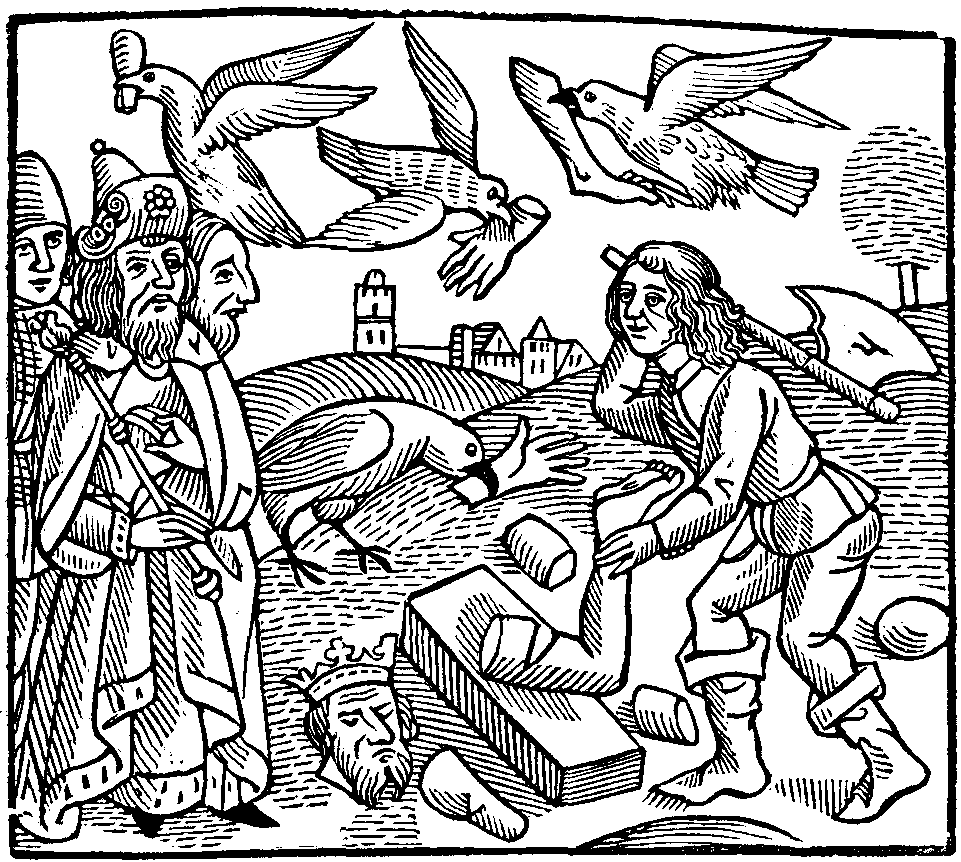
 monge all the euyll condicions and signes that may be in a man the first and y'e grettest is whan he feereth not/ ne dredeth to displese and make wroth god by synne/ and the peple by lyuyng disordynatly/ whan he reccheth not/ ner taketh hede unto them that repreue hym and his vices/ but fleeth them/ In suche wyse as dide the emperour Nero/ whiche dide do slee his maister seneque For as moche as he might not suffre to be repreuid and taught of hym In lyke wyse was somtyme a kynge in babiloine that was named Evilmerodach a Jolye man with oute Justice and so cruell that he dyde do hewe his faders body in thre honderd pieces/ And gaf hit to ete and deuour to thre honderd birdes that men calle wultres And was of suche condicion as was Nero/ And right well resemblid and was lyke unto his fader Nabogodonosor/ whiche on a tyme wold do flee alle the sage and wyse men of babylonye/ For as moche as they coude not telle hym his dreme that he had dremed on a nyght and had forgoten hit lyke as it is wreton in the bible in the book of danyell/ Under this kynge than Evilmerodach was this game and playe of the chesse founden/ Trewe it is that some men wene/ that this playe was founden in the tyme of the bataylles & siege of troye But that is not soo For this playe cam to the playes of the caldees as dyomedes the greek sayth and reherceth That amonge the philosophrs was the most renomed playe amonge all other playes/ And after that/ cam this playe in the tyme of Alixandre the grete in to Egipte And so unto alle the parties toward the south/ And the cause wherfore thys playe was so renomed shall be sayd in the thirde chapitre.

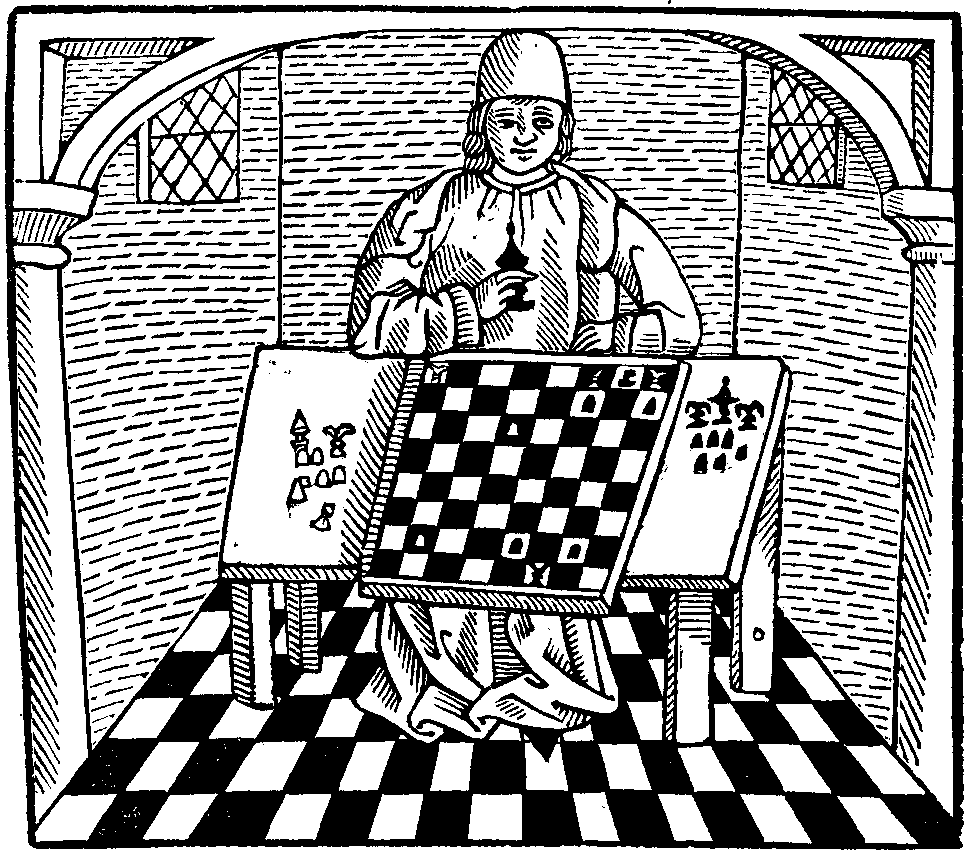
 Thys playe fonde a phylosopher of Thoryent whiche was named in Caldee Exerses or in greke philometor/ which is as moche to saye in english as he that loveth Justice and mesure/ And this philosopher was renomed gretly amonge the grekes and them of Athenes whiche were good clerkys and philosophers also renomed of theyr connynge. This philosopher was so Juste and trewe that he had leuyr dye/ than to lyue longe and be a fals flaterer wyth the sayd kynge. For whan he behelde the foull and synfull lyf of the kynge/ And that no man durst blame hym. For by his grete cruelte he putte them alle to deth that displesid hym/ he put hym self in paryll of deth/ And louyd and chees rather to dye than lenger to lyue: The euyll lyf and diffamed of a kynge is the lyf of a cruell beste/ And ought not longe to be susteyned/ For he destroyeth hym that displesith hym/ And therfore reherceth valerius/ that ther was a wise man named theodore cerem whom his kynge dyde do hange on the crosse for as moche as he repreuyd hym of his euyll & fowll lyf And all way as he was in the torment he said to y'e kynge/ upon thy counceyllours & them that ben cladd in thy clothynge & robes were more reson that this torment shold come/ For as moche as they dar not saye to the The trouthe for to do Justice right wysly/ of my self I make no force whether I dye on the lande or on the water or otherwyse &c as who sayth he recched not to dye for Justice/ In lyke wyse as democreon the philosophre put out his owen eyen be cause he wold not see that no good myght come to the euyll and vicyous peple wyth out right And also defortes the philosophre as he went toward his deth/ his wyf that folowed after hym saide that he was dampned to deth wrongfully/ than he answerd and sayd to her/ holde thy peas and be styll/ hit is better and more merytorye to dye by a wronge and unrightfull Jugement/ than that I had deseruyd to dye.
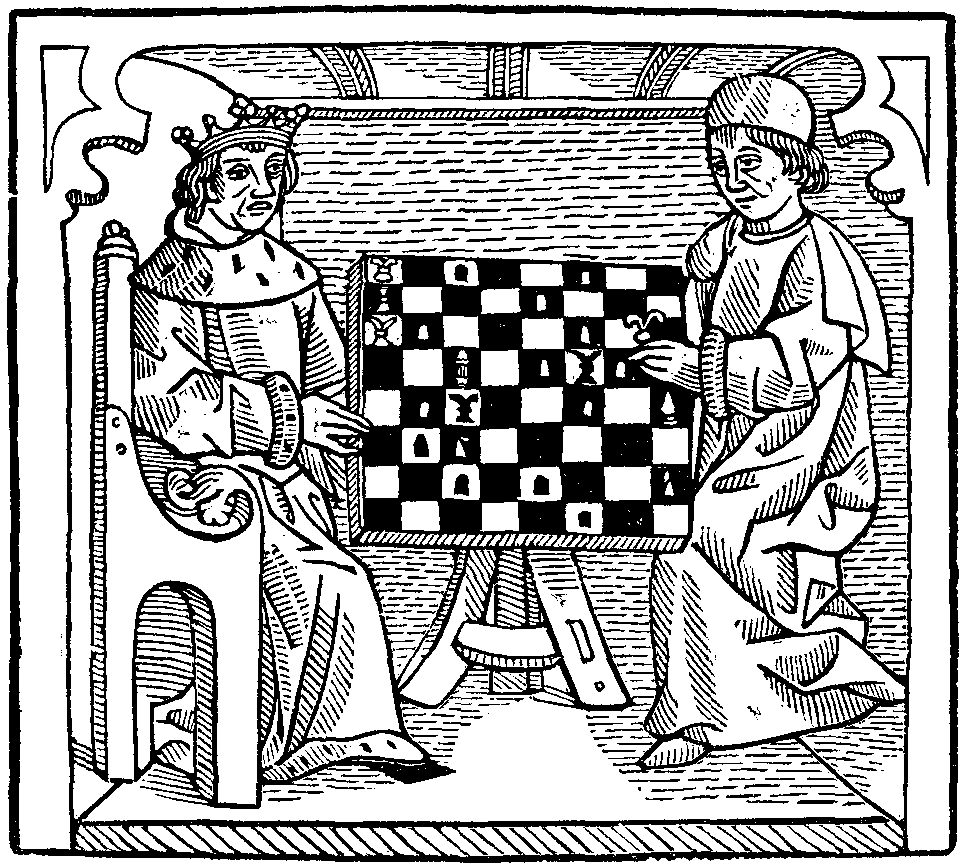
 he causes wherfore this playe was founden ben thre/ the first was for to correcte and repreue the kynge .For whan this kynge Evilmerodach sawe this playe And the barons knyghtes and gentillmen of his court playe wyth the philosopher/ he meruaylled gretly of the beaulte and nouelte of the playe/ And desired to playe agaynst y'e philosopher/ The philosopher answerd and sayd to hym that hit myght not be doon. But yf he first lerned the playe/ The kynge said hit was reson and that he wold put him to the payne to lerne hit Than the philosopher began to teche hym and to shewe hym the maner of the table of the chesse borde and the chesse meyne/ And also the maners and condicions of a kynge of the nobles and of the comun peple and of theyr offices and how they shold be touchid and drawen. And how he shold amende hymself & become vertuous And whan this kynge herde that he repreuyd hym/ He demanded hym upon payne of deth to tell hym wherfore he had founden and made this playe/ And he answerd my ryght dere lord and kynge/ the grettest and most thinge that I desire is that thou haue in thy self a gloryous and vertuous lyf And that may I not see/ but yf thou be endoctrined and well manerd and that had/ so mayst thou be belouyd of thy peple Thus than I desire y't thou haue other gouernement than thou hast had/ And that thou haue upon thy self first seygnorye and maistrye suche as thou hast upon other by force and not by right Certaynly hit is not ryght that a man be mayster ouer other and comandour/ whan he can not rewle ner may rewle himself and that his vertues domyne aboue his vices/. For seygnourye by force and wylle may not longe endure/ Than thus may thou see oon of the causes why and wherfore I haue founden and maad thys playe/ whyche is for to correcte and repent the of thy tyrannye and vicyous lyuynge/ .For alle kynges specyally ought to here her corrygeours or correctours and her corrections to hold and kepe in mynde/ In lyke wyse as Valerius reherceth that the kynge Alixandre had a noble and renomed knyght that sayd in repreuynge of Alixandre that he was to moche couetous and in especyall of the honours of the world/ And sayd to hym yf the goddes had maad thy body as greet as is thy herte Alle the world coude not holde the/. For thou holdest in thy right hand alle the Oryent/ And in thy lyfte hande the occident/ syn than hit is so/ or thou art a god or a man or nought/ yf thou be god doo than well and good to the peple as god doth/ And take not from them that they ought to haue and is theyres. yf thou be a man/ thinke that thou shalt dye/ And than thou shalt doo noon euyll/ yf thou be nought forgete thy self/ ther is no thynge so stronge and ferme/ but that somtyme a feble thinge casteth doun and ouerthrowe hit How well that the lyon be the strengest beste/ yet somtyme a lityll birde eteth hym/ The seconde cause wherfore this playe was founden and maad/ was for to kepe hym from ydlenesse/ whereof senecque saith unto lucylle ydlenes wyth oute ony ocupacion is sepulture of a man lyuyng/ and varro saith in his sentences that in lyke wise as men goo not for to goo/ the same wyse the lyf is not gyuen for to lyue but for to doo well and good/ And therfore secondly the philosopher fonde this playe for to kepe the peple from ydlenes/. For there is moche peple. Whan so is that they be fortunat in worldly goodes that they drawe them to ease and ydlenes wherof cometh ofte tymes many euyllys and grete synnes And by this ydlenes the herte is quenchid wherof cometh desperacion/ The thirde cause is that euery man naturelly desireth to knowe and to here noueltees and tydynges. For this cause they of atthenes studyed as we rede/ and for as the corporall or bodyly fight enpessheth and letteth otherwhyle the knowleche of subtyll thinges/ therfore we rede that [48] democrion the phylosopher put oute his owen eyen/ for as moche as he myght haue the better entendement and understondynge/ Many haue ben made blynde that were grete clerkis in lyke wyse as was dydymus bisshop of Alixandrye/ that how well that he sawe not yet he was so grete a clerk/ that gregore nazan & saynt Ierome that were clerkes and maystres to other/ came for to be his scolers & lerned of hym And saynt Anthonie The grete heremyte cam for to see hym on a tyme/ and amonge all other thynges/ he demanded hym yf he were not gretly displesid that he was blynde and sawe not. And he answerd that he was gretly abasshid for that he supposid not that he was not displesid in that he had lost his sight/ And saynt Anthonye answerd to hym I meruayle moche that hit displesith the that thou hast lost that thynge whiche is comyn betwene the and bestes. And thou knowest well that thou hast not loste that thynge that is comyn bitwene the and the angellis And for thise causes forsayd the philosopher entended to put away alle pensisnes and thoughtes/ and to thinke only on this playe as shall be said & appere in this book after.


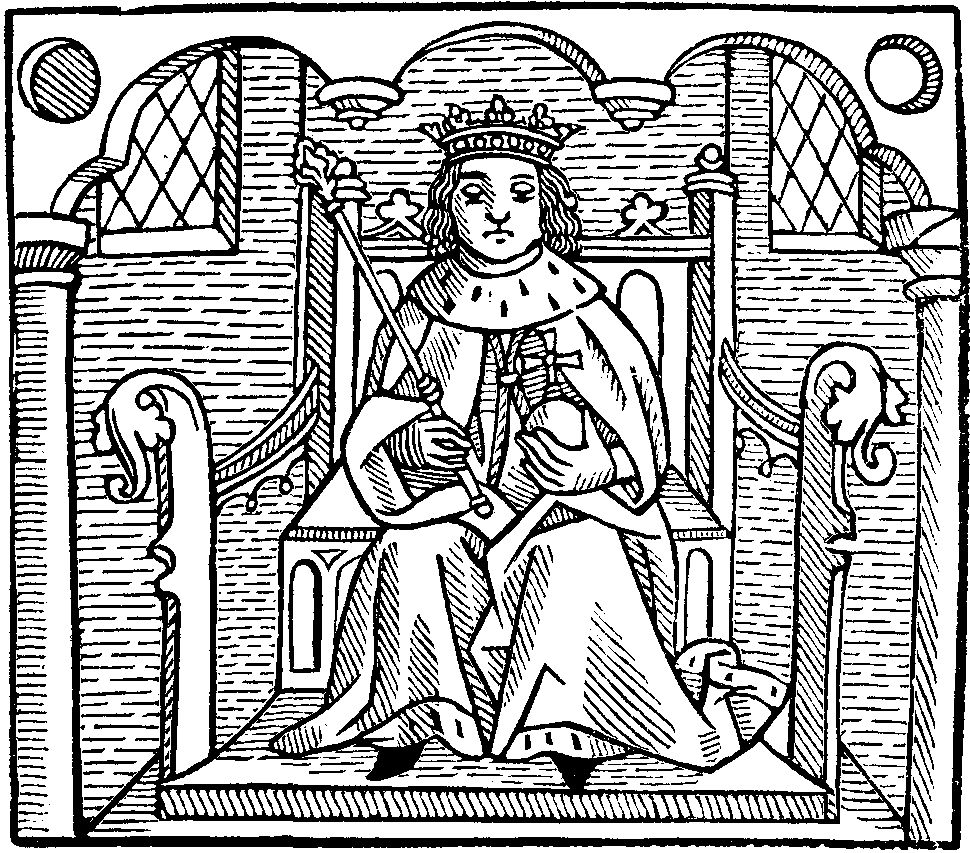
 The kynge must be thus maad. For he must sitte in a chayer clothed in purpure/ crowned on his heed in his ryght hand a ceptre and in the lyfte hande an apple of gold/. For he is the most grettest and hyest in dignyte aboue alle other and most worthy. And that is signefyed by the corone/. For the glorye of the peple is the dignite of the kynge/ And aboue all other the kynge ought to be replenysshid with vertues and of grace/ and thys signefieth the purpure. For in lyke wyse as the robes of purpure maketh fayr & enbelysshith the body/ the same wise vertues maketh the sowle/ he ought alleway thenke on the gouernement of the Royame and who hath thadmynystracion of Justice/ And thys shuld be by hym self pryncipally. This signefieth the appell of gold that he holdeth in his lyfte honde/ And for as moche as hit apperteyneth unto hym to punysshe the rebelles hath he y'e sceptre in his right hand And for as moche as mysericorde and trouthe conserue and kepe the kynge in his trone/ Therfore ought a kynge to be mercyfull and debonayr For whan a kynge or prynce desired or will be belouyd of his peple late hym be gouerned by debonarite And valerius saith that debonairte percyth the hertes of straungers and amolisshith and maketh softe the hertes of his enemyes/ wherof he reherceth that philostratus that was due of athenes had a doughter/ whom a man louyd so ardantly/ that on a tyme as he sawe her wyth her moder/ sodaynly he cam and kyssed her/ wherof the moder was so angry and soroufull that she wente and requyred of her lord the duc/ that his heed myght be smyten of/ The prynce answerd to her and sayde/ yf we shold slee them that loue us/ what shall we doo to our enemyes that hate us/ Certaynly this was thanswer of a noble & debonair prynce That suffred that villonye don to his doughter and to hymself yet more This prince had also a frende that was named Arispe that sayd on a tyme as moche villonye unto the prynce as ony man miht saye And that might not suffise hym/ but he scracchid hym in the visage/ The prynce suffryd hym paciently in suche wyse as thowh he had doon to hym no vilonye but curtoysye And whan his sones wold haue auengid this vilonye/ he comanded them that they shold not be so hardy so to do The next day folowyng arispe remembrid of the right grete vilonye that he had don to his frende and lord wythoute cause. He fyll in dispayr and wold haue slayn hym self/ whan the duc knewe and understode that/ he cam to hym and sayd ne doubte the nothynge And swore to hym by his fayth/ that also well he was and shold be his frende fro than forthon as euery he had ben to fore yf he wold And thus he respited hym of his deth by his debonairte. And in lyke wyse rede we of the kynge pirre to whom was reported that they of tarente had said grete vilonye of hym. For whiche cause he maad alle them to come to fore hym And demanded of them yf they had so sayd. Than oon of them answerd and sayd/ yf the wyn and the candellys had not fayllyd/ thys langage had ben but a Iape/ In regarde of that we had thought to haue doon/ Than the kynge began to lawhe/ for they had confessid that suche langage as was sayd and spoken was by dronkenship/ And for this cause of debonairte the peple of tarante toke for a custome that the dronken men shold be puuysshyd/ And the sobre men preyfed. The kynge than thus ought to loue humylyte and hate falsite after the holy scripture that speketh of euery man generally/ For the kynge in his royame representeth god/ And god is verite/ And therfore hym ought to saye no thynge but yf hit were veritable and stable. Valerius reherceth that Alixandre wyth alle his ooste rood for to destroye a cyte whyche was named lapsare/ whan than a phylosophre whiche had to name Anaximenes which had ben to fore maistre & gouernour of Alixandre herd and understood of his comyng Cam agayn Alixandre for to desire and requyre of hym. And whan he sawe Alixandre he supposid to haue axid his requefte/ Alixandre brake his demande to fore and swore to hym to fore he axid ony thynge by his goddes. That suche thynge as he axid or requyryd of hym/ he wold in no wyse doon/ Than the philosopher requyred hym to destroye the cyte/ whan Alixandre understood his desire/ and the oth that he had maad/ he suffrid the cyte to stande and not to be destroyed For he had leuer doo his wyll than to be periured and forsworn and doo agaynst his oth/ Quyntilian saith that no grete man ne lord shold not swere/ but where as is grete nede/ And that the symple parole or worde of a prynce ought to be more stable than the oth of a marcha[=u]t/ Alas how kepe the prynces their promisses in thise dayes/ not only her promises but their othes her fealis and wrytynges & signes of their propre handes/ alle faylleth god amende hit &c. A kynge also ought to hate alle cruelte/ For we rede that neuer yet dyed ony pietous persone of euyll deth ne cruell persone of good deth Therfore recounteth valerius that ther was a man named theryle a werke-man in metall/ that made a boole of coppre and a lityll wyket on the side/ wherby men myght put in them that shuld be brent therin/ And hit was maad in suche manere/ that they that shold be put and enclosid therin shold crye nothinge lyke to the wys of a man but of an oxe. And this made he be cause men shold haue the lasse pite of them. Whan he had made this hole of copper/ he presented hit unto a kynge which was callyd philarde that was so cruell a tyrant that he delited in no thinge but in cruelte And he told hym the condicion of the bole/ Whan philarde herde and understode this/ he alowed and preysed moche the werke/ And after sayde to hym/ thou that art more cruell than I am/ thou shalt assaye & prove first thy þsente and yeft/ And so made hym to goo in to the boole and dye an euyll deth/ Therfore faith Ouide ther is no thinge more raisonable than that a man dye of suche deth as he purchaseth unto other Also the kynge ought souerainly kepe Iustice/ who maketh or kepeth a royame with oute Iustice/ of verray force ther muste be grete robberye and thefte Therfor reherceth saint Augustyn in a book which is intituled the cyte of god/ that there was a theef of the see named diomedes that was a grete rouar and dide so moche harme that the complaintes cam to fore Alixander whiche dide hym to be taken & brought to fore hym/ and he demanded hym wherfore he was so noyous & cruell in the see And he answerd to hym agayn/ for as moche as thou art oon a lande in the world/ so am I another in y'e see/ but for as moche as the euyll y't I doo is in oon galeye or tweyne therfore I am callyd a theef/ but for as moche as thou dost in many shippis and with grete puyssance and power/ therfore art thou callyd an emperour/ but yf fortune were for me in suche wyse/ I wold be come a good man and better than I now am/ but thou/ the more richer and fortunat that thou art/ the more worse art thou/ Alixander sayd to hym I shall change thy fortune in suche wyse as thou ne saye/ that thou shalt doo hit by pouerte/ but for euyll and mauaiste/ And so he made hym ryche/ And thys was he that afterward was a good prynce and a good Iusticyer/ The kynge ought to be soueraynly chaste/ And this signefyeth a quene that is only on his ryght syde For hit is to be beleuyd and credible that whan the kynge is a good man Iuste. trewe & of good maners and condicions/ that his children shall folowe gladly the same/ for a good sone & a trewe ought not to forsake & goo fro y'e good condicions of his fader. For certes hit is agaynst god and nature in partie whan a man taketh other than his propre wyf/ And that see we by birdes/ of whom the male and female haue to gyder the charge in kepynge and norisshinge of their yonge fowlis and birdis/. For some maner of fowlis kepen them to theyr femeles only/ As hit appereth by storkes dowues and turtils/ But tho fowles that norisshith not their birdes haue many wyues and femelles/ As the cock that no thynge norisshith his chekens/ And therfore amonge alle the bestes that been/ Man and woman putteth most theyr entente and haue moste cure & charge in norisshyng of their children/ And therfore doon they agaynst nature in partye whan they leue theyr wyues for other women/ Of this chastete reherceth valerius an example and faith that ther was a man of rome which was named scipio affrican. For as moche as he had conquerd affricque how well that he was of rome born. Whan he was of .xxxiiii. yer of age he conquerd cartage And toke moche peple in Ostage/ Amonge whom he was presented wyth a right fair mayde for his solas and playsir whiche was assurid and handfast unto a noble yong gentillman of cartage whiche was named Indiuicible/ And anon as this gentill scipio knewe that Notwythstandyng that he was a prynce noble & lusty Dyde do calle anon the parents and kynnesmen of them And deliuerid to them their doughter wyth oute doyng of ony vilonye to her/ and y'e rænsom or gold that they had ordeyned for their doughter/ gaf hit euery dele In dowaire to her And the yong man that was her husbonde sawe the fraunchise and gentilnes of hym/ torned hymself and the hertes of the noble peple unto the loue & alliance of the romayns/ And this suffiseth as towchynge the kynge &c.